Evaluating exponents of negative numbers, or raising a negative number to a power, can get weird. And it has to do with the order of operations.
Exponents come way before subtraction (PEMDAS). So something like
\(-3^2\)
has to take this into consideration.
Even though from left to right it seems the negative is on the 3, it’s really the tiny 2 that’s supposed to come first.
All that’s fine and dandy. But how about a nicer way to think about it?
Exponents are copying instructions. Parenthesis are paperclips.
Imagine you’re heading to the copy center with two pieces of paper — one paper has only a “-” and the other a number (like 3).
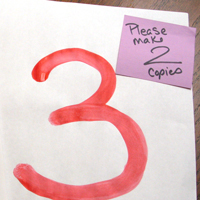
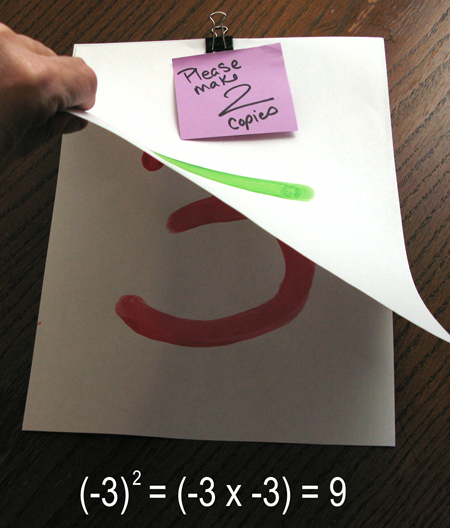
If you have the pages clipped together with the stickie note reading “Please make 2 copies,” it looks like this:
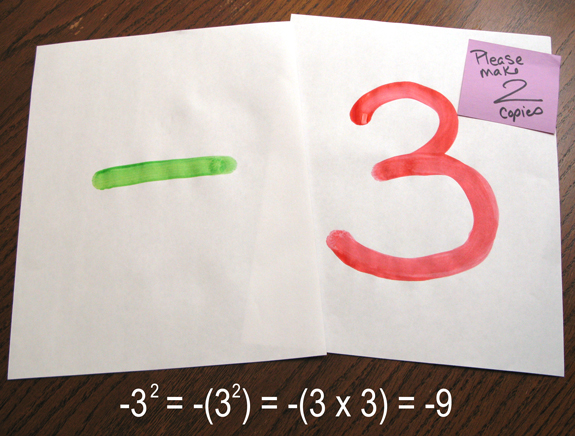
If you have the pages separate and the stickie is only on the page with the 3, it looks like this:
What will you get from the copy center?
Now think of what the copier-dude will do with your first set. He’s going to make two copies of the whole thing. He’ll likely give you two stapled sets.
On the second set, he’ll make two copies of the “3” page and put the “-” page to the side. He’ll think, “Hmm… I wonder what I’m supposed to do with this? Oh, well. I’ll just put it back on the stack after I’m done.”
But there’s an even better way.
If we would put parenthesis where we mean things to happen first, we could avoid all this.
In Chapter 1 of What’s Your Math Problem?, Linda Gojak gives some initial thoughts on learning and teaching problem solving.
She introduces the concepts of routine problems and non-routine problems.
Routine problems are what you typically see at the end of a problem set in a traditional textbook. “In solving routine problems, the learner reproduces and applies a new procedure,” Gojak writes.
Non-routine problems, or rich problems, are the way of the world. They are the things grown-ups solve everyday effortlessly, and often don’t think of them as math problems.
Is solving non-routine problems teachable?
There is a divergence between the way traditional word problems are taught to kids and how grown-ups handle the rich problems in their lives. What’s Your Math Problem? attempts to distill and label each strategy of what grown-ups naturally do, so that we can teach these strategies to our children.
To make this work, knowledge of the various strategies is important. So Gojak labels, defines and gives examples of each strategy throughout the book.
This method of teaching problem solving to children will work if an instructor is careful not to force the use of a particular strategy.
Offer a strategy, but don’t force it.
The idea is to label and clarify each problem solving strategy so it can be one of the options in the toolbox of problem-solving for each child.
As students learn a strategy, teachers shouldn’t require it be used “so they can practice it.” Instead it should be offered and encouraged, but allowed to be tossed aside if the student prefers another method.
And caution should be used to ensure problem solving using these various strategies NOT turn into another algorithm.
Read more about it…
Don’t forget to check out Math Coach’s Corner for some other thoughts on Chapter 1 of What’s Your Math Problem? Make sure to scroll to the bottom, because others are linking up their thoughts and opinions!
Our world is struggling with education of all sorts. We know that STEM fields are in trouble. Not enough people are excited about taking the science and math classes needed to jump into them.
But there’s another piece of the education puzzle that’s missing — writing.
I talked to a primary school teacher at a social function today. She was telling me how students these days were often taught the algorithms of writing. One of which is the classic intro-supporting paragraphs-conclusion that I remember.
I said, “Oh, so they don’t get taught to write in their own voice, and stuff like that?”
“That’s just it,” she said. “They naturally write in their voice. But with the systematic methods we push on them it destroys it!”
That sounds familiar!
It pulled on my heartstrings — there was another basic subject that was competing with the almighty and all-powerful queen of subjects — reading.
Seems writing has the same challenges as math — people think there’s a formula to it when really it’s about voice, personal preference, beauty and art.
And writing, like math, is something people always do when they have to but rarely do just for fun.
What do we learn — really?
It made me really think about learning and teaching. All learning can be boiled down into one of three categories:
Learning information (historical facts, spelling, times tables)
Learning how to get information (reading, researching, googling)
Learning how to give information (writing, speaking)
Reading clearly has its place in #2, as does writing in #3.
But where is math?
When you teach math, are you only teaching facts (like in #1)? Or are you teaching children how to get or discover information (#2)? Or are you teaching them how to give or share information (#3)?
I’ll leave my answers for next time. Until then — what do you teach?
I get sent all sorts of things that claim to show the beauty of numbers. For the most part they show various number theory concepts that make a math mom think, “I wonder why that works.”
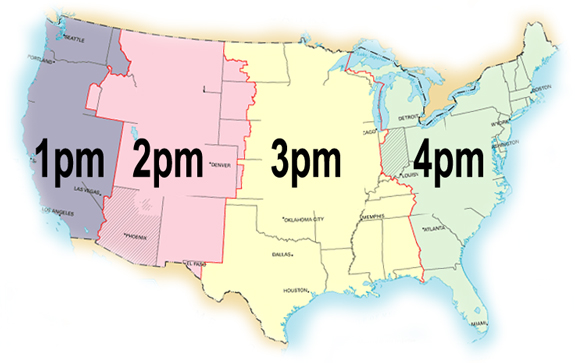
It took me a long time to learn how to figure out what time it was in Los Angeles when it was at 7 AM in Houston.
Notice on this time zone map that the numbers count in a very intuitive way across the US:
This works just fine if you’re managing locally.
Global time zones are more of a challenge.
I used to send out a weekly newsletter. Generally it was set to arrive in people’s inboxes between 3 PM and 6 PM Thursdays — in their local time zone.
Which means any changes that I had to do would have to happen before they got the e-mail at 3pm on Thursday.
But not everybody lives in Texas. So my deadline was not 3 PM on Thursday, really. It was the first time anyone in the world encountered 3 PM Thursday.
In order for me to make the deadline for a global audience, it was essential to figure out what time in Houston that is.
Greenwich Mean Time (GMT) was established in 1884 at the International Meridian Conference, when it was decided to place the Prime Meridian at Greenwich, England.
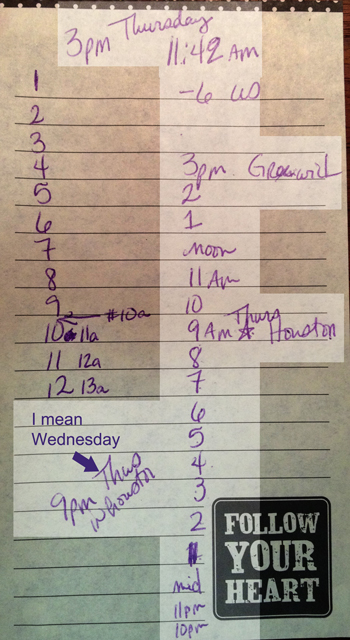
All time zones range from GMT -12 hours GMT +12 hours. Houston is Greenwich Mean Time -6 hours. Which means it should be a rather easy exercise.
All I have to do is add my six hours on the left side of the Meridian to the 12 hours on the right side to see that I’m 18 hours difference.
I subtract 18 hours from 3 PM Thursday to arrive at 9 PM Wednesday as my true deadline.
Often when grownups present math problems to kids, they’ve prepared. They demonstrate working a problem like I worked it above:
Add my six hours on the negative side of Greenwich Mean Time to the 12 hours on the positive side. I’m 18 hours difference. Subtract 18 hours from 3 PM Thursday to arrive at 9 PM Wednesday as my true deadline.
But that’s not the real way we do math. We often use the Fret & Grind method. Fret about what’s going on, grind out some rough sketches. Then fret some more…
So why do we show kids the nice way?
If they see the “all you have to do is” way, then they won’t gain the confidence to use the Fret & Grind method.
And the Fret & Grind method is the best way — sometime the only way.
How do you teach time zone math? Do you encourage Fret & Grind?
I love how Linda Gojak calls juicy, meaty problems “rich problems.” A good, fun thinkable is indeed a math word problem rich with problem solving challenges.
But getting started on a rich problem can leave you feeling rather poor. So Chapter 3 gives, and is called, “Getting Started Strategies.”
What’s that problem about anyway?
The first question you (or your child) should ask when given a problem is, “What’s it all about, anyway?” This is the strategy of “Restate the Problem in Your Own Words.”
Ask
What’s happening — what does it look like?
What bits of this problem are useless to me?
If a normal person were to ask the question, how would it be written?
Now what the heck does it really say?
Restating the question in your own words means understanding what’s being asked and what’s happening.
Is this a trick question?
Sometimes textbooks (and even life) give you problems without giving you all the required information. This is grownup-talk for what kids call a trick question.
If there’s missing information, call that bluff! What info do you need to calculate the final answer?
Is that information contained in the problem?
Can you find that information online or in a library?
Can you figure out that information using other stuff in the problem?
Is it just a flat-out trick question — there can’t be an answer because there’s no way to get the information needed?
Calculate the information, if you can.
Now it’s time to do a little pre-work. Gojak calls it “identifying a subgoal.”
If you’re missing some numbers in the problem but you can get these from others, then start calculating.
I walked 30 feet and then walked another 24 inches. How many feet did I walk?
The subgoal here — figure out how many feet I walked the second time.
Figure out how to show your work — or not?
One of the strategies in chapter 3 is “Select Appropriate Notation” — which means determine how you’ll show your work.
But first ask the question, “Do you want to show your work?”
Here’s the big place where classroom schoolers and homeschoolers will diverge. It isn’t really necessary to show your work. Ever. And in homeschool, children don’t have to.
If you want to show your work that’s great. If you want to share your work, you have to show your work. If you want to be a famous mathematician or even a run-of-the-mill engineer, you have to show your work.
It doesn’t hurt to learn to show your work. But it’s not required to be a great problem solver.
In fact, if your child struggles with notation, and you push this too hard, their developing problem-solving strategies could be stunted.
But should you show your work for other reasons?
Gojak writes:
“…you use notation to help you reach a solution.”
This is not necessarily true. Some people do. I don’t. The problem-solving strategy that works for me is doodling pictures and trial and error, strategies covered later in the book.
I rarely solve a problem using x and y — or even crude representations of x and y like question marks or blanks.
If you feel the need to verify that your child is thinking properly, ask them to explain it out loud. Or give them another rich problem. Don’t force them to show their work because you want to see it.
Read more about it…
Don’t forget to check out Math Coach’s Corner for some other thoughts on Chapter 3 of What’s Your Math Problem? Make sure to scroll to the bottom, because others are linking up their thoughts and opinions!
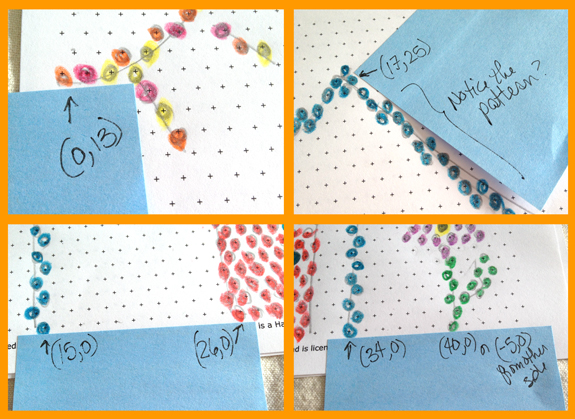
Or… click to get the online Lite-Brite simulator(the technology these days!). And get ready — because that old classic is about to become your child’s favorite graphing lesson!
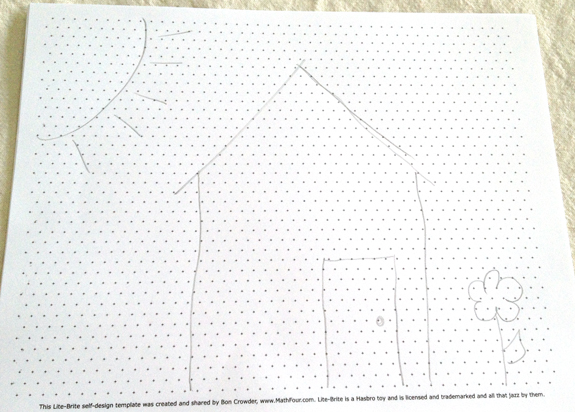
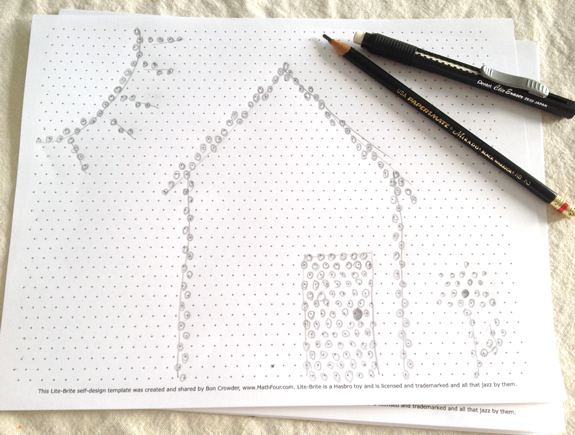
Rough sketches don’t quite work with the peg placement. So draw the peg holes on the template as close to your lines as possible. Start noticing patterns.
3. Use colors!
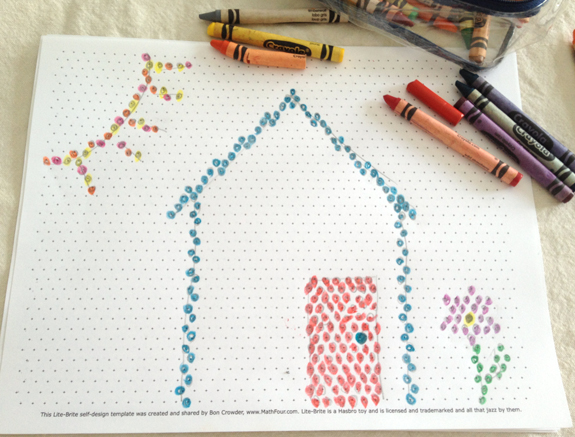
Pick some good colors you’ll want to use when you’re graphing your picture. Unless you and your kids know the exact number of Lite-Brite pegs you have, in which colors, you’ll probably have to tweak this in the next few steps.
4. Figure out where to start
Here’s where things get very interesting. The peg holes are NOT lined up in what you would call a Cartesian coordinate plane. They’re not really in any kind of coordinate plane system. At least not that I know of.
The crazy structure in the grid doesn’t really matter. The fact that you can still count over and up to get where you want to go is what matters.
You and your children get to devise the way you count over and up.
5. Count and push!
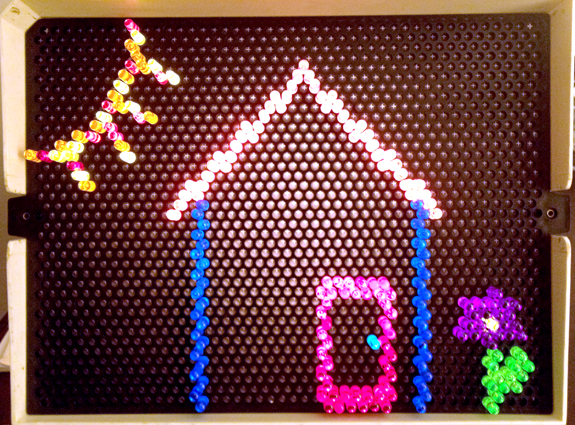
Your child can follow the pattern on the template and push the pegs in the Lite-Brite. This offers practice for the skills they’ll use when graphing and working with the slope of a line. This is the precursor of calculus!
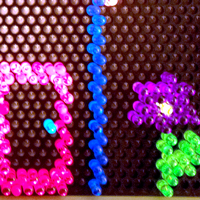
Notice that when I was graphing my drawing, I had to change the door from solid to hollow. I ran out of pegs. #ARG
Try it!
Find your Lite-Brite and download the template: classic or square. Post a link to your finished work in the comments and tell me how it went!
A strange mixture of birthday party planning, birthday present searching and math magic landed the new #MathShack mascots in my house. Seems the “Furry Fibonaccis” are here to stay.
They are Fibonacci numbers in action!
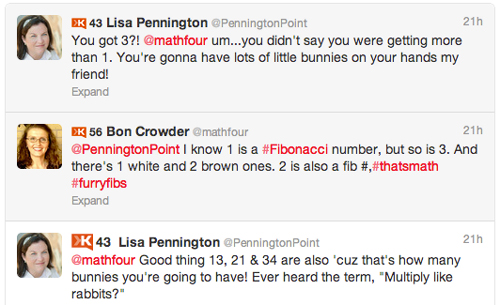
Notice there is one white bunny (already named Abek). And one is a Fibonacci number.
There are two brown bunnies (yet to be officially named). And two is a Fibonacci number.
And there are three total bunnies, another Fibonacci number.
My friend Lisa Pennington assured me that a fluffy addition would not break the bank. Apparently, she didn’t realize that I would end up with three of these furry cuties.
We’ll see…
It’s not so easy to determine the sex of these three little guys.
Assuming there’s an equal probability of a rabbit giving birth to a male as a female, I have a one in four chance that they won’t be able to reproduce.
Keep your fingers crossed that I get lucky, and we don’t end up with 987 bunnies a year from now!
But they ARE cute!
K8 totally loves them. And they’re a great way to teach caring, responsibility and, well… maybe the facts of life.
And if we do end up with 987 bunnies next year, we’ll have an economics lesson too. After all, I paid $10 for each of these — that could be a significant profit!
Have you ever had bunnies? What do you think’s going to happen with Kate’s Furry Fibonaccis? Share your thoughts in the comments, and on twitter.
The 2012 STEMie Award competition is open to all schools and homeschools in the United States and is sponsored by McGraw-Hill. The deadline to enter has passed.
I work hard to convince you to see math around you — in even the most obscure things like lipstick, tattoos and cheese.
You may not have noticed that none of these, or any other articles I’ve written about the math you can find around us, contain science. At least not in the textbook sense.
But one of the fastest and easiest ways to see math around you is through science. So it’s kinda ridiculous that I haven’t really talked about it.
My Nephew is Learning Science
I received an e-mail from my dad today encouraging me to vote for my nephew’s school’s science program, SMORE. Turns out, they’re in competition to win a grant from McGraw-Hill, and 30% of their score comes from online voting for their video. (BTW, that’s math too!)
Knowing that he’ll be learning a lot of math when he’s learning the science, I’m supporting his school.
Make sure to support your kids and schools in science — they’re doing math!