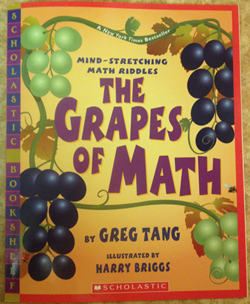
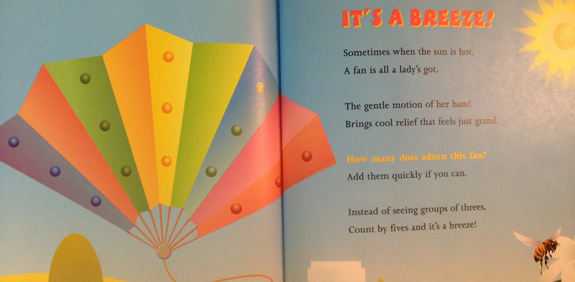
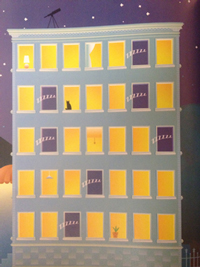
The first thing you see in this math picture book are the bright but simple images. Looking at them you feel like you’ve stepped into the surreal world of those old View-Master reels.
The rhymes are catchy and cute!
I’m all about iambic pentameter. Well, I really don’t know exactly what that is, but it sounds like it means bouncy poetry.
And that’s what this math picture book has!
While scallops on the beach look great, I’d rather see them on my plate.
Unfortunately it’s their loss, They swim their best in butter sauce.
Oh, but the counting’s even better!
Each page has objects (fruit, bugs, dice, etc.) spread out so that children can experiment with different ways to “see” how many there are. You can subitize, group, multiply, subtract – or do them all!
The answer key in the back helps you understand the intent of the authors.
But I recommend you try various ways yourself before turning to the back. Some of their methods were very different than what I came up with.
And you can try it at home!
There are 16 different pictures and riddles to practice on. But it doesn’t have to stop there.
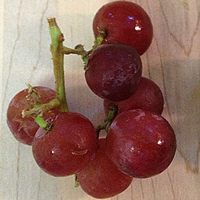
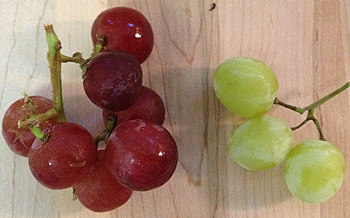
You can do your own playing at home. Check out the grapes I did here:
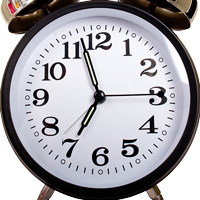
it is now 7:00am + 30 minutes drive time + 1 hour get dressed time + 9 minutes for the snooze button I really want to hit – x (approximately 9 or 10 minutes of something like washing hair, eating yogurt instead of eggs or shaving legs) = be there at 8:30am
Notice this is also substitution!
Use this to positively influence your children.
The next time someone says, “I haven’t done math in years,” point out to them they do math all the time. In fact, they likely did math to get there on time!
Especially point this out if you’re in earshot of a child.
When kids hear how math is used effortlessly and frequently, it helps to demystify it. And when it’s demystified – they become more familiar and comfortable with it.
And you know what that means? They’re more engaged!
Forget it. If they don’t want to pay attention and learn, so be it.
Perhaps you’ve heard others say this, or felt it yourself. It can be extremely frustrating trying to teach a child something who just doesn’t get it, doesn’t pay attention, doesn’t seem to care or who doesn’t seem to want to learn.
There is an alternative.
However, if we consider the bigger picture, we see another possibility. Much of a student’s behavior can be a protective front to keep them from feeling like a failure – after all, who likes that?
Perhaps they act this way because the material is unfamiliar and therefore they don’t know if they can understand it. The uncertainty is a bit scary.
“Well they don’t have to be scared,” we say.
But they are. So… if they pretend they don’t care, and if they don’t try or if they hold back on really applying themselves, they can’t fail. Problem solved.
What does this have to do with me?
Those students who experience these negative feelings can exhibit behavior that can make it seem as if they don’t care. And then we take it personally. “They’re just really ungrateful of everything I do.”
It’s our job to meet them where they are — in their distraction, interest, frustration, intimidated state, excitement, fear, wonderment, avoidance, etc. But if we are burned-out, frustrated, or feel unappreciated, it’s hard to do that.
So how do I get there?
Adjusting just a few assumptions can put us in a more relaxed, sustainable place to offer reassurance and hope to kids who feel this uncertainty. Doing this is just as much for our self-care as it is for their education.
Use these statements to reset your assumptions.
These guidelines are designed to help us “reset” our assumptions in the service of positively impacting our approach to students.
1. It’s about them, not us.
When kids avoid or check-out, most of the time they aren’t doing it to “get back” at us. They do it to avoid the concern they feel about whether they’ll be able to meet a challenge. Or because they’re worried about looking incompetent in front of their peers.
They may even act out to divert attention away from their academic ability. This is another protective feature — again, not about us.
Adjusting this assumption can free up the compulsion to defend ourselves. It can also allow for more time and energy for them.
2. Kids have different levels of abilities. Period.
If we assume this, all of a sudden we aren’t expecting Joe to perform as well as Roger, or vice versa. This allows us to determine, without judgment, where Joe and Roger are with their abilities and to ask independent, non-comparative questions.
“What does Joe need to further his learning and education.”
And completely separately…
“What does Roger need to further his learning and education.”
3. They ARE trying.
There’s an assumption that all students CAN understand “if they just try” hard enough.
When we take this into the classroom, it’s easy to become frustrated (All they have to do is…), become resentful (I am so tired of busting my tail and they’re not caring) or even retaliate (If they don’t want to work in class, I’m just gonna load them up with a ton of homework. That’ll teach ’em!).
Assume that they ARE trying and ARE understanding as much as they possibly can. Doing this rids us of the temptation of doing things such as shaming and scolding — which has been shown to be counterproductive to learning.
It also puts us in a “glass half full” position of recognizing what they DO learn, rather than focusing on what they don’t. (Half cup of motivational praise, anyone?)
Keep these statements handy.
Write the above sentences down and keep them nearby. Read them at the beginning of every day, or every lesson or class even. It helps to have brief, yet constant reminders.
After a couple of weeks, see if you can tell a difference in how you feel, your stress level, and the reaction of your students.
Try them out and share know how it goes in the comments or on twitter/x. Did you come up with some of your own assumption adjustments?
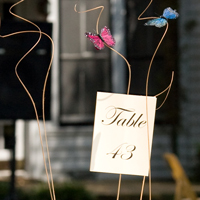
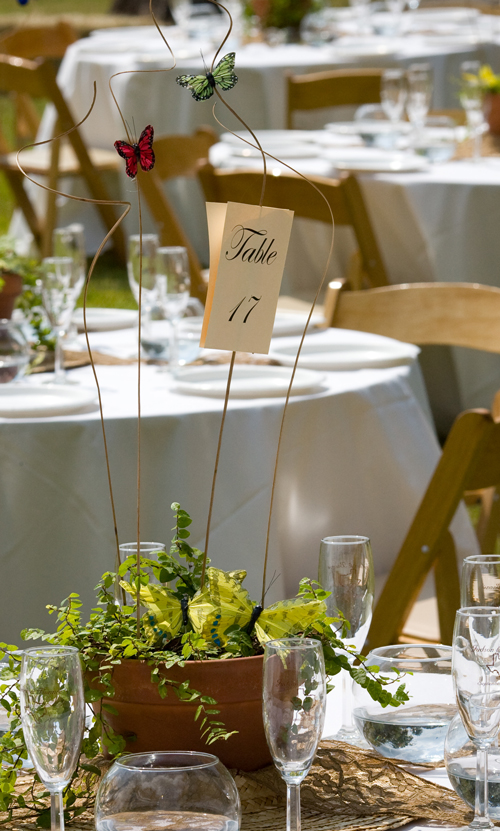
The bride wanted to have all the tables labeled with prime numbers. She used all the primes through 43. Each table was set for 10 people. How many guests could come to the wedding?
I’ve noted before how math shows up in course study lists like the Toddler Reading Readiness List. But in looking at other courses of study, I’m seeing math everywhere. So here’s another one!
This list is from the WorldBook site and is their Typical Course of Study for Grade Level 4, Language Arts section.
Silent and oral reading
Reading and comprehending information is essential in math, too. And later in math classes you’ll find reading something out loud happens a lot more that you think.
Listening skills
Wowsers! If you don’t listen carefully to a theorem or explanation of a proof, you could be super lost!
Telephone skills
Can you say “study group calling tree”?
Summarizing simple information
This is the basis of all word problem solving.
Listening to literature
Which is another skill when listening to a word problem. Better yet – listening to a “real world” word problem that is being told to you by someone who needs help.
Critical reading
Using definitions of math things along with theorems and “math rules” is critical reading. Critical reading means following all the logic. And logic is math.
Increasing dictionary skills
This is called “lexicographic ordering” and is huge in math. Especially when you try to order the points on the plane (or complex numbers).
Cursive handwriting
You write faster with cursive. When you’re doing math and needing to write out details, getting them out on paper fast helps keep your brain caught up with what’s going on.
Simple outlining
This is one of the important skills in constructing a proof.
Writing letters and informal notes
It’s all about formulas here. If you can plug and chug with the salutation, date, closing, etc., you’re golden on math formulas and functions!
Popular math books are great to read. And when you give a quick summary of them in a social setting, you look really cool. (Not to mention if you end up being a mom blogger you’re likely to review some math books at some time in your life.)
Creative writing
There’s nothing more creative than writing a word problem!
Developing skills in locating information
You don’t really need to know the right formula – if you can find it!
Increasing indexing skills
Finding something in a math book index is huge when you’re trying to figure stuff out.
Developing encyclopedia skills
Again – great to have when looking up a math word or formula.
What you can do
There’s math everywhere – even 4th grade Language Arts! When helping your children with their LA – in homeschool or classroom school – remind them how these skills will also help them in math.
The more they hear that they’re doing math, the better they’ll be in their “official” math class.
This year K8 is turning 3, a Fibonacci number. So we’re having a Fibonacci Birthday Party!
Her birthday parties the previous two years have been non-math. And I’m fairly certain at some point she’ll want to choose her own birthday party theme. So this might be my last chance to do a Fibonacci birthday party.
Fibonacci Birthday Party Decorations
Spiral streamers, pinecones, whole pineapples and sunflowers will adorn the house.
We’ll have blue painter’s tape outlining the spiral on the tiles of the floor. And we’ll each wear a fun Fibonacci t-shirt!
Birthday Party Foods
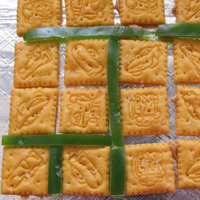
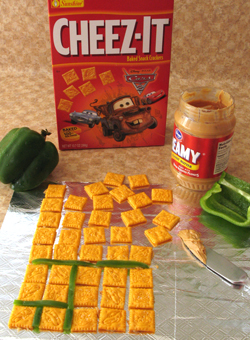
We’ll have bananas, apples and pineapples as healthy snacks for the kids. And I’ll likely do an arrangement of Cheez-its glued down with peanut butter. Of course there’ll be plenty of free floating Cheez-its too!
For the grownups, we’ll have broccoli and cauliflower along with cucumbers.
If we serve a meal, we’ll do lasagna with Fibonacci rectangles outlined in spinach fettuccine noodles!
Party Favors
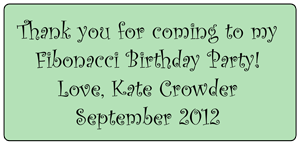
I’ll buy a bunch of Fibonacci paperback children’s books, including Rabbits Rabbits Everywhere and Wild Fibonacci. I’ll print some fun stickers to put on them that read
And those will be the party favors!
Fibonacci Birthday Party Gimmicks
We’ll play some games, including Fibonacci Hopscotch (as suggested by @mathhombre). The adults can play, “What is My Fibonacci Number?” based on the popular party game, Who Am I?
And the best part – we’ll have live rabbits for the kids to pet!
What do you think?
Have you ever given a Fibonacci Birthday Party? or a math party? Do you have any other ideas to make this awesome?
Update: The That’s Math! membership site is no longer available. However, this post still has useful and entertaining information.
While developing the That’s Math! membership site, that launches today, we’ve had some interesting discussions about wording. Because of our different backgrounds, we’ve had to have some lengthy clarifications. Bon, with her technical math info, and myself, with ethical/credible research wording.
Below is a rough “transcript” sample compiled from a couple of discussions.
Bon: Math anxiety makes it so that kids lock up – they’re paralyzed with fear and then can’t do math.
Wil: Well, actually, the anxiety they experience doesn’t prevent them from doing math. It just makes it much more difficult.
Bon: And That’s Math! will fix that.
Wil: No. We aren’t trying to “fix” anything. Just help parents with positive math exposure.
Bon: And the research proves that the parents talking about math in front of kids will take care of that. Got it.
Wil: You have to be careful with that word “prove”. We have to say the research suggests that kids who have a supportive environment are more likely to engage in math exercises and homework. Part of that support is talking about math in a positive way.
Bon: Great! So we support the parents by helping them discover math that happens in their environment.
Wil: Right. And the exercises we’ve designed help parents to practice saying that math in front of their kids. When the kids hear Mom and Dad talk about math, the kids learn to be not so scared of it.
Bon: We act just like we see our role models act. Mom says “hey, there’s math” instead of “I was never good at math, it’s so hard!”
Wil: Right. It’s called social modeling. We pick up on what other people do, whatever it is. There’s all kinds of research to support that social modeling is how we learn how to act.
Bon: So “social modeling” is doing stuff where kids see it. And if parents use that for math specifically…
Wil: Exactly and…
Bon: …and BAM! Their kids will love math and be geniuses!!!
Wil: It doesn’t mean they’ll love math or be geniuses!
Bon: But it will get them closer to being geniuses.
Wil: Well, there’s research that supports that they are likely to engage more, so I guess you could say they’re getting closer to being geniuses.
Bon: Virtually proving that using positive math talk like we teach in That’s Math! will improve your kids’ grades.
Wil: Dude. You’re killin’ me. But I like the enthusiasm.
Are you ready to positively influence your kids in math? Learn more about the That’s Math! membership website now!
If you aren’t a “lifelong learner,” well, bummer for you. Because you’re dead.
But what exactly does it mean to learn?
What does real learning look like?
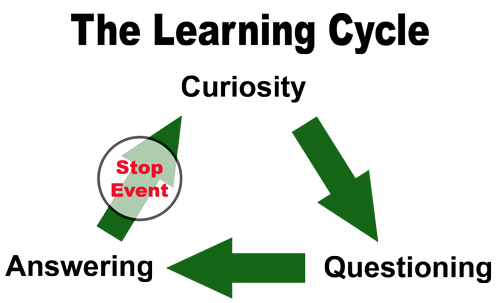
I’ve been watching people learn for over 20 years. Everyone goes through this learning cycle:
Curiosity
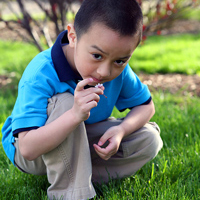
It all starts when you get curious.
“Hmm… I wonder…”
Questioning
And then you form curiosity into words.
“What is that?”
“How does it work?”
“Why?”
Answering
After the question is out there, someone answers it.
“What is that?”
“It’s a flower.”
You might answer it yourself. Or someone else chimes in to offer an answer.
And the answer could be all sorts of things.
The “right” answer (something that’s true)
The “wrong” answer #1 (something that’s false, but sounds good)
The “wrong” answer #2 (something that’s false, and obviously so)
The “I don’t know” answer (an open ended un-answer)
The learning cycle can continue.
After obtaining some sort of answer, you decide if you should go on or stop. Continued curiosity causes you to go through the learning cycle again. You start searching for deeper meaning.
“Hmm… What is that?”
“It’s a flower.”
“Oh. It’s funny looking for a flower. Hmm… I wonder…”
…
And the learning cycle can hit a stop event.
If you have enough information to satisfy your curiosity, you’ll likely stop the learning cycle. (Even if the answerer is ready to give more information.)
“Hmm… What’s that?”
“It’s a flower.”
“Oh. It’s pretty.”
But sometimes the stop event is damaging.
If you obtain an answer in a way that oppresses your natural curiosity, you’ll also stop.
And here’s where trouble starts.
“Hmm… What is that?”
“Really? Are you blind? It’s a flower.”
Or
“Hmm… What’s that?”
“We already went over this. It’s a flower.”
And if you encounter a damaging stop event, you’re likely to internalize it. You’re also likely to avoid that curiosity again.
What is your experience with your learning cycle? Share it in the comments or on twitter/x.