
Author: Bon Crowder

  • Understanding Math — Let Kids Fake It

    Understanding Math — Let Kids Fake It

    There’s a lot of talk about making sure kids understand what they are learning — instead of just practicing some arbitrary set of steps. I’m a proponent of this myself.
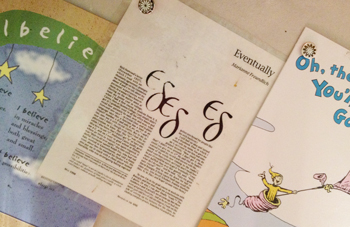
    I copied and laminated this back in 1998!

    But how well a child grasps a concept is based on how well he or she connects with it.

    The learning style and interests a child has has an impact on if (or how well) he or she will understand a concept. And, as far as I know, there’s no rule on figuring that out.

    You keep explaining it in different ways until you see the “aha moment.”

    Except there are some times when understanding is too far out of reach. Or the child’s way of learning requires a deeper understanding than what’s available or possible at that point.

    So what do you do in those cases?

    Do you delay teaching that piece for understanding? Do you go on to something else and skip it altogether? Can you go on to something else?

    Before making that decision, consider three points.

    1. Nobody understands everything.

    The way all the pieces of math work together is amazing. Nobody knows how they all fit — even the most famous of mathematicians. Everyone has something missing. Some of us have much missing.

    So if your child is lacking in understanding for a few things — or even many things — that’s okay.

    2. There’s more than one way to “understand” something.

    Take any math concept and you’ll find that the applications of it are vast. It’s likely that you can use it in business, in fashion, in your yard and kitchen and in the toy box. So you can explain the concept — and inspire understanding — with any of the applications.

    You can also explain a concept with metaphors to other math concepts and even metaphors to non-math concepts.

    3. But they’ll get it, eventually.

    Back in 1998 I photocopied an article from an AMS Notices journal called “Eventually” by Marianne Freundlich. I laminated it and hung it on my office wall.

    It’s moved offices a dozen times at least, but has remained an important reminder: “When learning something new, you may not get it now, but eventually you will. Just stick with it.”

    The “fake it ’til you make it” principle works in math too. It’s okay for them to practice something that they don’t understand.

    But kids need you to know they’re faking it.

    Often kids fake their learning. But they’re also trying to fake out the instructor. It turns into a big dirty secret that they keep inside. Like this:

    “Mr. Smith, I don’t understand this. I think I can do the problems, though.”

    “Well, Joan, let me explain it this way…”

    Mr. Smith explains another way. Joan feels uncomfortable because he’s spent so much time on her and she still doesn’t get it.

    “Okay, I think I understand now.”

    “I’m glad. It’s important for you to understand before we move on.”

    Joan thinks she’ll just keep practicing and hope that something clicks before the test. She doesn’t want to ask for more explanation.

    Fake it like Fermat!

    (That’s supposed to be a play on “Bend It Like Beckham” — I’m not sure it works.)
    A well known phrase in math graduate school is, “Okay, I don’t understand that, but I’ll go with it for now.”

    Mathematicians fake it all the time. They come back later to see if they can work out the details (and don’t publish or approve of something until they do). But they announce out loud that they’re faking it.

    And kids should be allowed this too.

    “Mr. Smith, I don’t understand this. I think I can do the problems, though.”

    “Okay, Joan, that’s fine. Perhaps after you do it a while, you’ll get it. “

    “It’s possible.”

    “No problem, if you don’t get it now, you’ll get it eventually. As we move forward, when you come to something like this, just keep doing the steps. That might help you understand, too.”

    “That works for me. Thanks, Mr. Smith.”

    “Feel free to ask me any questions about it and we’ll continue the conversation until you do get it.”

    Not understanding is totally okay — but the child must know it. And, more importantly, they must know that you know it!

    So let them fake it!

    When understanding is too far out of reach, encourage some rote practicing of the steps. And let them admit, out loud, that understanding isn’t there — even be happy for it.

    Anticipate the understanding and be excited that someday it will come.

    And if your child wants to move on, do it. They’ll get that other stuff eventually.

    Share your thoughts in the comments or on twitter/x.

    You might also like:
  • Concrete Math — Like in Your Driveway

    Concrete Math — Like in Your Driveway

    They poured my new driveway yesterday. We ate breakfast and watched as they worked.

    And we witnessed an amazing feat of engineering.

    A tiny twist is all it takes!

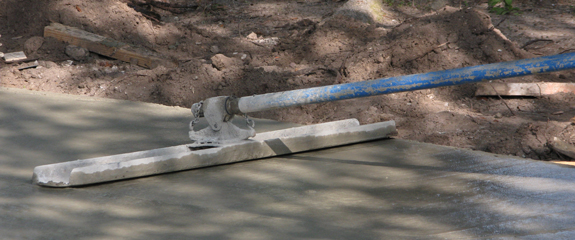
    I was watching one of the workers smooth the concrete. He was using a bull float:

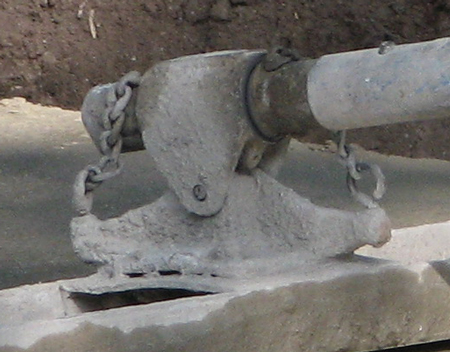
    I noticed he was twisting the handle as he worked. On closer inspection, I saw the engineering of the device:

    And here’s the other side:

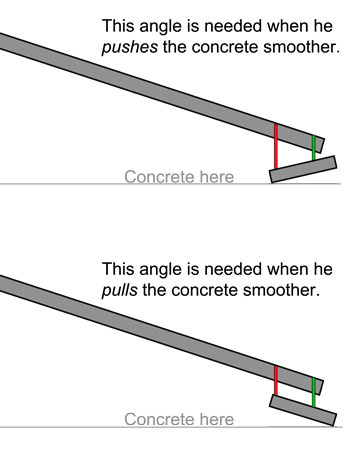
    As the worker twisted the handle, it would change the angle of the surface of the bull float. This prevented him from having to change the angle of the handle. Like this:

    Watch it in action:

    Oh, yeah — those angles and changing the of length of the chain… That’s Math!

    Share your thoughts in the comments or on twitter/x.

    You might also like:
  • Dumb Questions? Aren't They All?

    Dumb Questions? Aren't They All?

    I was labeled an “airhead” in high school. Until today, I’ve avoided telling people that. The moniker had a real negative effect on me.

    I was known as the kid who asks dumb questions. If my peers wanted to waste the last five minutes of class and not have to start another topic, they’d whisper at me, “Ask one of your dumb questions.”

    “There are no dumb questions.”

    If you’ve never said these words, email me now and I’ll send you $10.

    You’ve said them, haven’t you?

    Yup — we all have.

    The fact is that every question is a dumb question. Because someone else knows the answer.

    And the more people who know the answer, the dumber the question is. And the more valuable it is to ask it.

    Just because everyone knows the answer to a question, doesn’t mean it’s the right answer. It’s just the safe answer.

    I asked a question with an obvious answer.

    The story of how I earned my “airhead” nickname is a rather curious one. It happened like this:

    We had a guest speaker, a grownup, in our debate class. He was explaining details of the debate topic, which involved transporting water across some distance.

    He drew a series of pumps and downward sloping pipes on the chalk board. He explained that water had to be pumped up every so many feet so it could continue traveling the decline.

    I watched and listened. I wondered why they didn’t just pump the water straight through a horizontal pipe.

    I asked, “So why do the pipes have to be tilted?”

    The grownup responded with a snicker, “Because water runs downhill.”

    In retrospect, it is clear to me that I was dealing with an idiot. He lacked the novel thought, as well as nurturing behavior, to wonder what a 14 year old might be thinking when she asked the question.

    My classmates joined in on the grownup’s joke. “Wow, you don’t know that water runs downhill,” they jeered, “What an airhead!”

    Who knows what would have happened…

    Suppose that grownup would have encouraged my line of questioning.

    “The pipes have to be tilted because we let gravity do most of the work.”

    “But why can’t we just pump it straight through horizontal pipes?”

    “It’s not efficient to do it that way.”

    “What does it mean to be efficient? Do we have numbers on that?”

    “I’m not sure. Maybe that bears some investigation.”

    Perhaps I would have proposed that we create a pumping system so powerful, and efficient, that we didn’t need thousands of pumping stations? That might have led to other innovations.

    There’s no telling.

    And yet his snide remark, which gave the other students encouragement to be mean, shut down all routes of novel thinking for me.

    At least in that class.

    The airhead learns best.

    Novel thought — creative thought — is the foundation of innovation. It’s the foundation of learning.

    In math, thinking outside the proverbial box is an efficient way for a student to learn. Asking crazy, airheaded, dumb questions gets a student thinking about all sorts of things.

    The effort put into this novel thinking to solve a math problem will seem high. But the depth and breadth of a student’s understanding when they do this is incredible.

    And that understanding will carry to other things — decreasing the effort to learn even more!

    So why not be an airhead?

    Kids start out being airheads — thinking novelly and creatively. And grownups (like the guest speaker in the debate class) have an uncanny knack for destroying it.

    When your kids ask a dumb question, refrain from being a grownup. Ignore the fact that everyone knows the answer to that. See what happens.

    Encourage your kids to ask dumb questions. Give prizes for the most dumb question of the day — the one that sparks the most novel and innovative thinking.

    Epi-blog

    By the way, my peers continued this nonsense for years. It might be easy for me to say that I stopped wasting my dumb questions on those idiots. But in fact, they were just as squashed as I was.

    They were covertly given permission to do it by our teachers (except for Mr. Berkebile), therefore they continued.

    Share your thoughts in the comments or on twitter/x.
    You might also like:
  • Marble Math iPhone Apps

    Marble Math iPhone Apps

    Artgig studio recently released two iPhone apps for math learning support: Marble Math & Marble Math Junior.

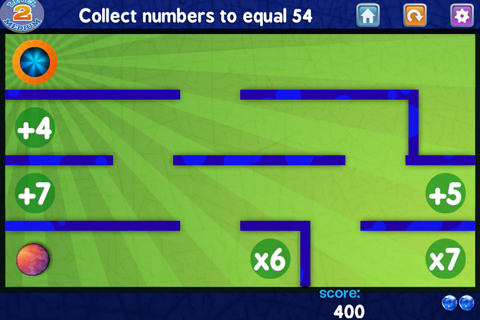
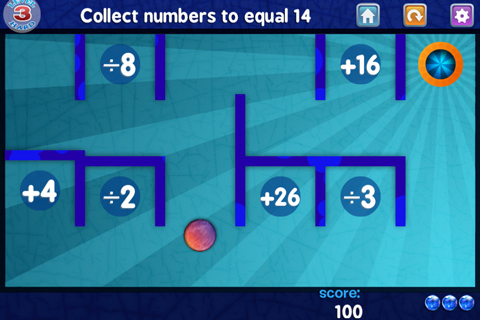
    In the games, you roll or drag a marble around a maze collecting right answers (or the pieces of a right answer) to a math question.

    Husband likes to roll the marble. He says that’s more fun because dragging the marble isn’t a challenge.

    But I like to drag it.

    Marble Math is fun and educational!

    Both of the Marble Math games have the same features: it’s a maze with obstacles, vortexes, bonus items and point decreasers.

    The difference between the two apps is the level of math. So before you see the cool screenshots, check out some of the things covered in each version of the iPhone app:

    In Marble Math, I encountered

    • Addition (three digits)
    • Subtraction
    • Ordering Roman numerals (yipes!)
    • Addition of fractions
    • Algebra with addition, subtraction, multiplication, division
    • Ordering decimal numbers
    • Combining things to get a number using order of operations
    • Factors of a given number

    In Marble Math Junior, I encountered

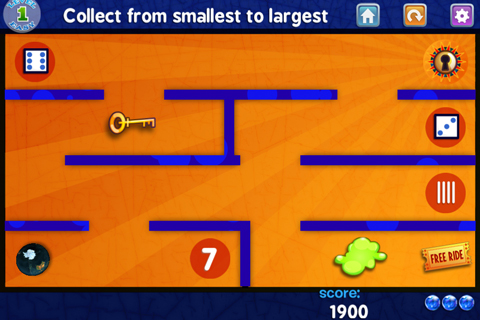
    • Ordering things (including a mixture of dice, tallies, arabic numerals, etc.)
    • Finding items that are the same as a given number
    • Identifying shapes
    • Adding up to a number
    • Telling time
    • Finding numbers less than a number
    • Multiples of 2 and multiples of 10
    • Basic multiplication (by 10)
    • Some basic fractions
    • Basic algebra with addition (10+?=17)

    The pictures are worth 103 words!

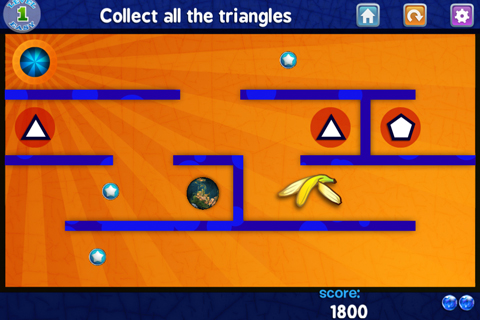
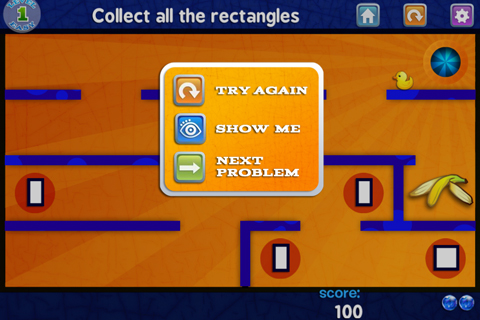
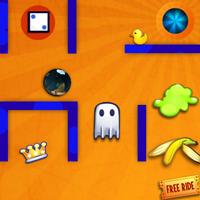
    The “pick the shapes” puzzles are fun. The banana will make your marble slip, but collect all the stars and you’ll get an extra life.

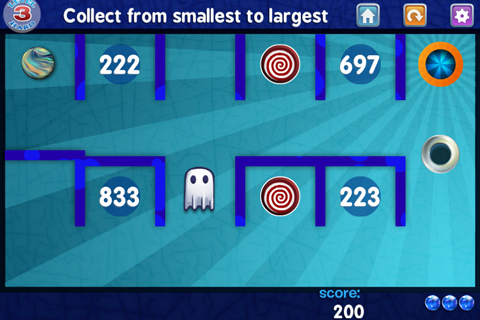
    The ghosts look like badguys — but they’re actually your friends. They let you go through the walls. (Come to think of it, it might be bad if you’re rolling the marble and not dragging it!)

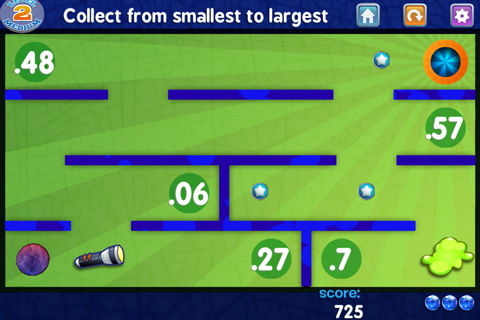
    Collect all three tiny stars and you earn another “life.” Roll over the flashlight and… well, I’ll let you see what happens then!

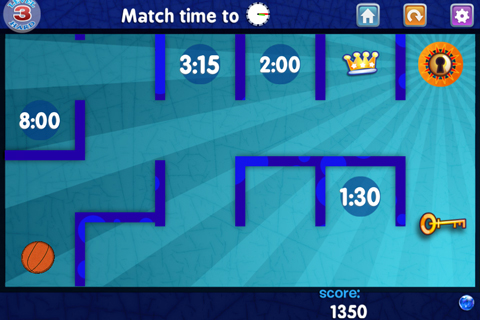
    I like that they use time, but that tiny little clock is hard to see. (But my eyes are a good 30 years older than the target audience!)

    The key opens the “I’m done” portal.The green slick sends you spinning. The Free Ride ticket give you extra points:

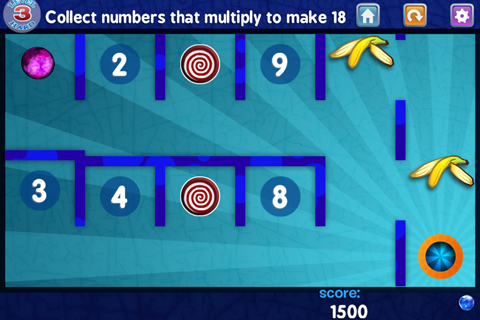
    Here’s a sample of a multiply one. The bananas here will make your marble slip and the swirlies will transport you between them!

    Having problems? Skip it, get the solution or give it another shot:

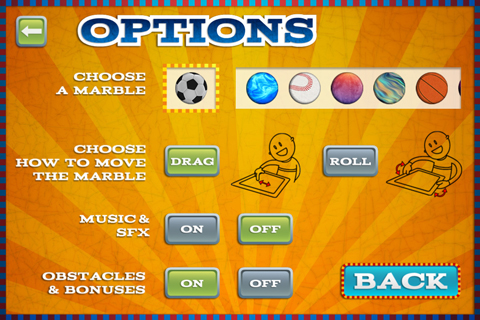
    But at some point the math will be hard enough to turn off the obstacles and bonuses. You can also choose your marble — but you have to earn them first!

    Here’s a nice order of operations one:

    This one almost killed me. I kept plugging at it, though. It’s from Level 3 of Marble Math.

    Give it a shot!

    Get the Marble Math & Marble Math Junior apps — one or both. Try your hand at them and share them with your kids!

    P.S. The cool folks at Artgig Apps were kind enough to share the app with me free of charge.

    Share your thoughts in the comments or on twitter/x.
    You might also like:
  • Fibonacci Birthday Party Preparation — Fun Facts

    Fibonacci Birthday Party Preparation — Fun Facts

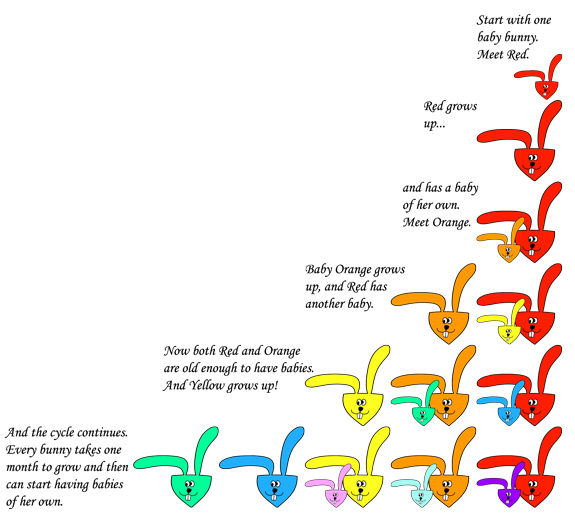
    I’m planning K8’s Fibonacci Birthday Party. And I have some decisions to make.

    • Evite or mailed invitations?
    • Design my own invitation or use a template?
    • Give information about Fibonacci Numbers on the invitation or just let guests figure it out?

    In trying to make these decisions, I’ve found a number of resources full of Fibonacci finds and glorious Golden Rectangle goodies. I thought I’d share:

    And here’s what I just created myself:

    Oh — and I also learned how we get the golden ratio. It’s the number that the ratio of consecutive numbers in the Fibonacci sequence approaches. We call it phi and it’s sort of 1.62.

    Cool!

    Share your thoughts in the comments or on twitter/x.

    You might also like:
  • Numeracy Practice with the Number of the Day

    Numeracy Practice with the Number of the Day

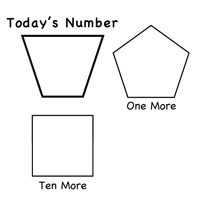
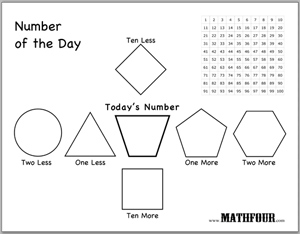
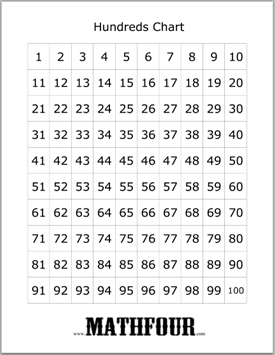
    Inspired by numeracy presentations by Conroe ISD teachers and Flip Flop Math at the recent CAMT conference, I have created my own Number of the Day Worksheet and mini Hundreds Chart.

    I started using a verbal version of this with K8 this week. She has a hundreds chart on her wall (she calls it her “present” because I gave it to her as a random gift one day) but I wanted one to write on too.

    Why a Number of the Day?

    Numeracy, or quantitative literacy, includes having a sense of how numbers work. Specifically in our base 10 system.

    Every number can be related to a multiple of 5 or 10 by counting 1 or 2 up or down. Getting a good handle on how that works is essential in building your child’s numeracy.

    The Number of the Day Worksheet helps children practice how the system works. And the hundreds chart helps them see it graphically — by tens.

    Pick a Number of the Day everyday.

    Create a hundreds chart for your wall, or download this printable one. Each day, let your child pick a number.

    Talk about the number — what does it look like, what does it mean? And what other numbers around it “match”?

    That last question was inspired by K8. She noticed that 84 on the hundreds chart matched the numbers to the right and left of it — the “8” was the same. Numeracy… here we come!

    Fill out the Worksheet

    Even if your child is too young to write, fill out the Number of the Day Worksheet and put it on the fridge. Practice filling in the spots, or talking about them. Let him or her color it or write on it.

    Got stickers? Decorate the sheet!

    I made the spaces in various shapes (notice the pattern?). I’m not sure if different shapes was a great idea, but it seemed fun. It might be a way to engage your older kids in the activity.

    Now… Play!

    Print out the worksheet and the hundreds chart and get your family going. At breakfast each day, choose a number — have each kid pick their own if you want.

    Enjoy it and let me know how it goes in the comments or on twitter/x.
    You might also like:
  • Lipstick Math

    Lipstick Math

    My best friend used to buy $1 lipstick when we were in high school. I think she still does.

    Her logic: “If I only pay a dollar for it, I can have lots of different ones. And I don’t have to fret about losing it or having it melt in the car.”

    Like a good friend, I went along with this logic.

    For years.

    Is expensive lipstick really expensive?

    I’m not here to convince you of the quality of expensive lipstick. There are blogs out there dedicated to lipstick. I’m merely a serious lipstick user.

    I will, however, attempt to convince you of the math (economics?) in lipstick.

    There’s some psychology in this.

    Suppose you buy your own lipstick (which you probably do). If you pay $1 for it, the perceived value is quite low – regardless of the actual quality. And you treat it like that — leaving it in the car to melt, forgetting it in a public restroom, etc.

    Just like my friend does.

    Now let’s assume that you pay $10 for a tube of lipstick. That’s ten times what you’ve been paying.

    All of a sudden the perceived value is huge!

    The loss factor is indirectly proportional to the price of the lipstick!

    If you pay ten times as much for a tube of lipstick, you’re 1/10 as likely to lose it. Okay, I have no empirical evidence to confirm this, merely empirical experience.

    But it’s true!

    As soon as I started buying expensive lipsticks, I quit losing them. And I quit leaving them in the car to be melted by the Houston heat!

    Note for my mathematician friends — the constant of proportionality is affected by the lipstick wearer and that crazy butterfly down in South America. There’s not strict math here. Yet. 😀

    The finish-factor is directly proportional to the price of the lipstick.

    Not only do I keep an expensive tube much longer, but I tend to finish it. In fact, the more expensive it is, the more likely I’ll use a lip brush to dig out the stuff crammed deep in the tube!

    My current favorite, Chanel Allure Rouge, is a shocking $30 per tube. I keep the old broken tube in the Math Shack so I can dig lip color out of the bottom of it when it’s time to video or do a daily mug shot.

    Lipstick Math applies to everything!

    If your child uses his own allowance to buy a new toy, he really knows the value. Furthermore, if he spends more, he’s more likely to care for it.

    When you notice this, point it out. Make sure to note how it’s math – and that your kiddo is doing it effortlessly!

    Share your thoughts in the comments or on twitter/x.

    You might also like:
  • Math Quote Cryptogram: What's Hard?

    Math Quote Cryptogram: What's Hard?

    This is the first in the Math Quote Cryptogram series.

    I learned a great deal of logic and thinking skills by playing the Dszquphsbnt! cryptogram puzzles in GAMES Magazine with my dad.

    There are many places to get online cryptograms, but I thought I would offer a series of “pencil and paper” ones for the old fashioned folks (like me).

    If you need help solving it, check out the amazing Cryptograms.org site for instructions.

    Click here for a printable version of Math Quote Cryptogram #001.
    Print it, work it, tweet it and let me know what you think!


    The Puzzle: “What’s Hard?”

    L R   J V O J B V   Z O   G O H   I V B L V K V   H W U H   T U H W V T U H L S Y

    L Y   Y L T J B V ,   L H   L Y   O G B P   I V S U N Y V   H W V P   Z O   G O H

    D V U B L M V   W O Q   S O T J B L S U H V Z   B L R V   L Y .

    — X O W G   K O G   G V N T U G G


    Share your thoughts in the comments or on twitter/x.
    You might also like:
  • Great Finds at CAMT12

    Great Finds at CAMT12

    Last week, Wil and I were at the Conference for the Advancement of Mathematics Teaching. We learned so much and had a great time – and found tons of neat stuff!

    I walked away with so much knowledge and quite a few great products – and Wil ended up with some too. Here are our fun finds and great product choices – look for more information on each soon!

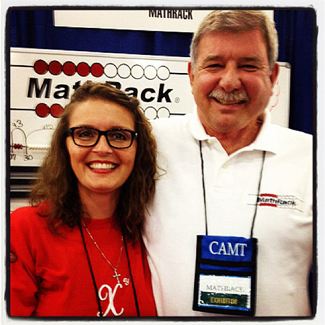
    The MathRack

    The MathRack is an amazing product built by even more amazing folks. They started in their own home, and they still assemble the MathRack by hand in their garage.

    I know I should share a photo of the product, but Scott Rule, owner, founder, chief cook and bottle washer of MathRack, is such a sweetheart – and has worked so hard on the product – I couldn’t resist including this fun photo of us!

    The Ultimate Puzzle

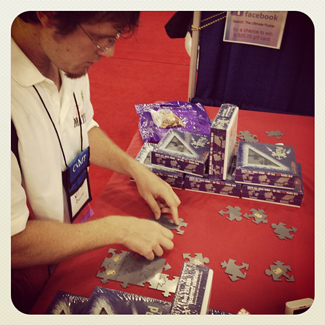
    Anette offered a free Ultimate Puzzle to anyone who could solve it in less than 5 minutes. Both Wil and I tried our hand at this puzzle developed in Estonia.

    There are over a bazillion million hundred billion ways this thing can go together – and only 200 of them will work!

    Alas, I ended up buying one of them.

    Dinah Zike’s Alphabet Tabbed WrapAround

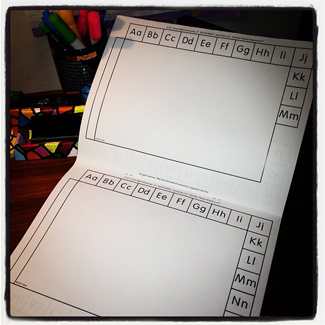
    Last week I put alphabet tabs on a Moleskine book to help me teach K8 to read. Then I found Dinah Zike’s Alphabet Tabbed WrapAround. It’s amazing and I can’t wait to use it!

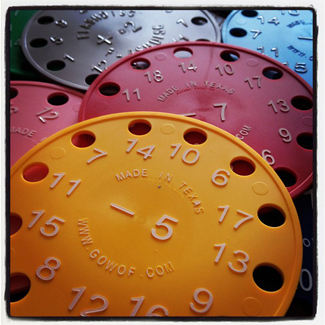
    Flashdisc – Wheel of Facts

    The Flashdiscs are a nifty little self-checking set of fact helpers. They come in both addition/subtraction and multiplication/division.

    Luckily Wil could actually use a set of these with his tutoring clients — I got him to pay for it!

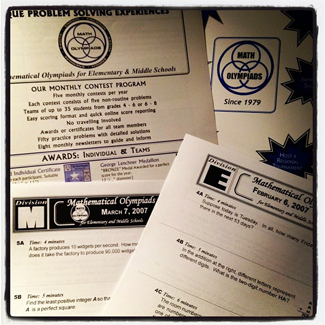
    Math Olympiads

    Math Olympiads is a monthly competitive math fun for classroom schoolers and homeschoolers. Seems very cost effective and lots of fun for kids of all ages.

    Tons of ideas!

    We learned about numeracy and using “Number of the Day” exercises from two fabulous teachers from Conroe ISD. We learned great ways to use the MathRack from the beautiful and awesome Christina Tondevold.

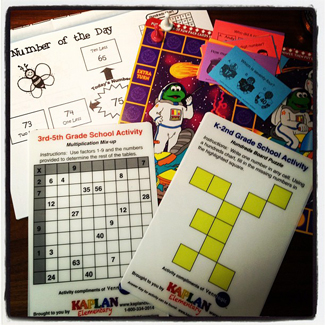
    We even got some great giveaways from Kaplan Elementary and Frog Publications that we’ll be dissecting so you can use them at home (they’re currently only priced for full classrooms).

    So look for detailed articles on these and other great math learning ideas coming soon. I’m kinda bubbly inside from all I have to write on.

    … and next week is the Homeschool Convention!

    Share your thoughts in the comments or on twitter/x.
    You might also like:
  • Math Standards and Competencies: Converting the TEKS into Plain English

    Math Standards and Competencies: Converting the TEKS into Plain English

    Many states and countries have standards or competencies that outline what children at various ages should have. Classroom schoolers and homeschoolers alike can use these (and sometimes must use them).

    The state of Texas, where I live, makes its own educational rules. Our public schools follow the competencies and standards outlined in the TEKS – Texas Essential Knowledge & Skills.

    Reading through these can cause all kinds of reactions – mostly “what the heck does that mean?”

    So I’ve taken a little time to translate a few of them into plain English.

    Some TEKS in Plain English

    These start out very “legal” sounding and are written from a grownup’s point of view. The Plain English version is a list of “objectives” from a kid’s point of view.

    I’ve kept the TEKS words in bold and the Plain English bullets are in, well… plain text.

    These are from Chapter 111. TEKS, Subchapter B., Middle School §111.22., Math, Grade 6., (b) Knowledge and skills.

    (1) Number, operation, and quantitative reasoning. The student represents and uses rational numbers in a variety of equivalent forms. The student is expected to:
    (A) compare and order non-negative rational numbers;

    • When I see numbers, I can put them in order.
    • If the numbers are things like fractions or decimals, I can put those in order too.
    • Even if you give me a mix of fractions, decimals and regular numbers, I can put those in order too.

    (B) generate equivalent forms of rational numbers including whole numbers, fractions, and decimals;

    • I know that numbers mean a value of something. Like dollars, inches, or years.
    • I know that there are different ways to write numbers – like 1/2 is the same as .5.
    • When I see a number that has a value, I can write it in various ways.
    • I can even write a number that looks normal in a way that looks freaky – just for fun if I want. Like .5 is the same as 100/200.

    (C) use integers to represent real-life situations;

    • I know that numbers come in positives and negatives.
    • I know that negative numbers mean something being taken away, owed or somehow located elsewhere.
    • I know that positive numbers mean something being given, borrowed or somehow located here.
    • I can tell you if a value should be positive or negative and explain why I think it is.

    (D) write prime factorizations using exponents;

    • I know that numbers can be written as multiplication problems using other numbers.
    • I know that there are crazy numbers (called primes) that can only be written as a multiplication of 1 and itself.
    • I know that all numbers can be written as a multiplication of prime numbers.
    • I can figure out what a number’s multiplication problem in terms of prime numbers is.
    • If there are a bunch of the same number in a multiplication problem, I can stick them together an put an exponent (a flying number) on it.

    (E) identify factors of a positive integer, common factors, and the greatest common factor of a set of positive integers; and

    • I can play with numbers and the various multiplication problems that make them.
    • I can figure out all the multiplication problems that make a number.
    • If you give me two numbers, I can figure out all the similarities in the multiplication problems that make each of them.
    • If you give me two numbers, I can figure out the biggest number that their multiplication problems have in common.
    • I can do all of these things with more than two numbers, too!

    (F) identify multiples of a positive integer and common multiples and the least common multiple of a set of positive integers.

    • I know that all numbers can be multiplied by other numbers.
    • I know that a number can “go into” other numbers too – sometimes with remainders and sometimes without.
    • I can figure out if a number “goes into” another number without a remainder.
    • If you give me two numbers I can figure out a bigger number that they both go into.
    • If you give me more than two numbers I can figure out a bigger number they all go into, also!
    • I can even find a number that all the numbers go into that’s smaller than any number you can find!

    You can make your own Plain English Standards!

    Tomorrow I’ll publish guidelines to create these. And on Friday, at the Conference for the Advancement of Mathematics Teaching, I’ll be giving a session on it (as well as what to do with them when you’re done).

    If you’re there, come!

    Share your thoughts in the comments or on twitter/x.

    You might also like: