For a while, a long while, I let this math blog just sit. I didn’t want to delete it. I spent too much time on it and I knew it was full of great stuff that was still being used. But I wasn’t in love with writing on it.
In my lethargy, the hackers and jerks managed to infiltrate and completely take it down. That was on October 23, 2025.
Today is December 30, 2025. I rescued all the posts and will gradually get all the good ones reposted. But I have to start over, creating the whole website from scratch.
Luckily the wayback machine (internet archive) has a nice snapshot of the images and layout. It’ll take me a while, but I’ll get it all back up. Maybe even with some improvements!
If you are looking for a specific post – something you remember from long ago or something you want to know about – leave it in the comments. I’ll hunt it down and get it posted.
I’m looking forward to having all those great math stories, thoughts and tips live again – I hope you are too.
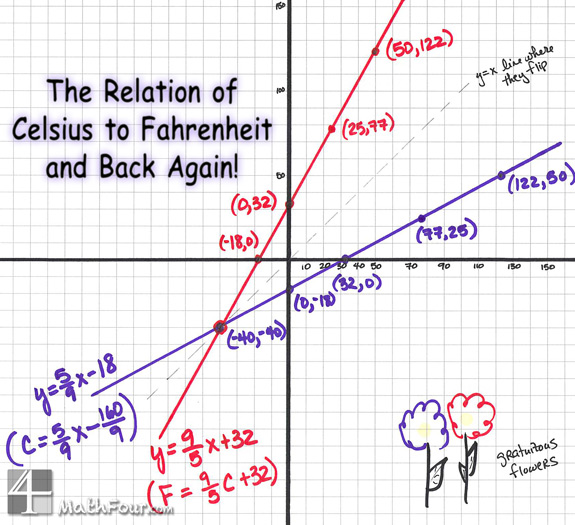
It inspired me to draw the graphs of Celsius in terms of Fahrenheit and Fahrenheit in terms of Celsius.
The conversion from Celsius to Fahrenheit and back again can be strange. One way to understand it is on a graph. And you can use this to teach some linear algebra too!
Notice these two intersect at (-40, -40). Which means that -40°F is -40°C!
Use it to convert temperatures.
The x values on the red line are Celsius – so find the °C you have and then look at the y-value to convert to °F.
It’s just the opposite on the purple line.
Okay, fine. This isn’t the greatest way to convert – but it’s exciting to see it graphically. And it might be easier to convert this way for someone who’s more visual.
Use it to teach math!
These two lines are inverses of each other. So the coordinates of one are switched to make the other.
Also, they mirror image across that 45° line. I marked the line with dashes and wrote on it.
And if you’re into this, their functional composition (both ways) is… x! (not factorial)
Compare and Contrast…
Take a look at the way J.D.Roth did it and then look at the graphs I have. Let your students find the way they like the best. And encourage them to create new ways!
Oh, yeah – and share what happens in the comments!
I first saw this video over at MathFail. It’s cute, and I have to admit, kind of cool.
But anything this simplistic always sends me into skeptical mode.
Before we go any further, check it out:
Do you believe it?
This might be the question to start a discussion with a student. It’s certainly the first question that comes to my mind.
If it were really this simple, wouldn’t we have used it to “prove” the formula for the area of a circle much earlier?
What’s wrong with it?
For the “proof” in the video to work, you have to assume (or believe) that the circumference is 2πr. This seems a bit cheesy to me, since that formula is as complex as the one we’re trying to prove. Not to mention quite closely related. But I’ll let this one go.
The thing that really bothers me is that they use only a few chains — each of which has thickness.
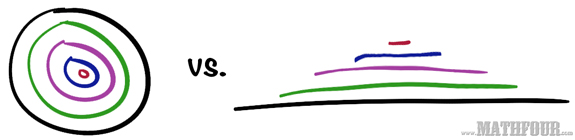
If you filled the inside of a circle (a disk) with concentric circles, none of those circles would have a thickness. In fact there’s an infinite number of those circles.
Is it realistic to take each of those circles and fold them out and get a triangle?
Can you use it to teach?
I believe the makers of the video intended this to be a fun way to remember the area formula of a circle.
But the video would be better used to allow students to ponder the relationship of a circle to an isosceles triangle.
What do you think?
Are you okay with this video? Are you as skeptical as I am, or am I a little too sensitive?
Every year people try to prove or disprove the existence of Santa. There are sites like iCaughtSanta.com for grownups to create “proof” and write-ups like Keith Devlin’s The Mathematics of Christmas that counter any proof that photos might provide.
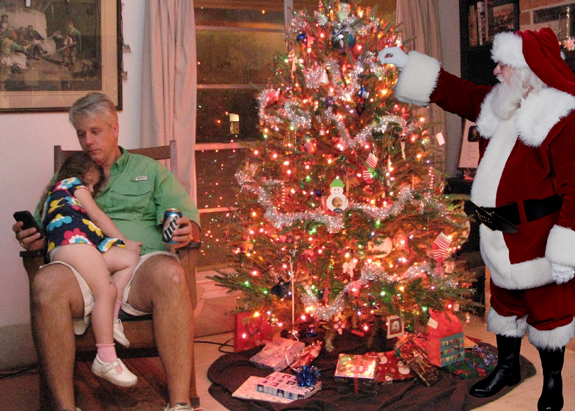
I used the super cute service at www.iCaughtSanta.com to create this. You gotta love how Husband doesn’t even see Santa because he’s too busy on the iPhone!
But to really prove anything about Mr. Jolly-Red-Boy, we must think about what it really means to prove something — mathematically.
Say what you want to prove.
The first thing you need for a nice mathematical proof is a “conjecture.”
A conjecture is a statement that you think can be proven. Or that you want to prove. According to the google dictionary a conjecture is
an opinion or conclusion formed on the basis of incomplete information
Our working conjecture here is: Santa exists.
It’s pretty straight up. But this isn’t quite enough. We need to know what “Santa” means.
Then define and refine.
Before we can work with the conjecture, it’s important to know the details. The details are usually definitions and assumptions.
So this is where it gets fun. I often tell people that mathematicians “make all this crap up.” This is because we start with definitions and assumptions — not reality.
So define Santa to be a human male who can enter the living room of every house with Christian children within a span of 24 hours.
We can refine our conjecture to be:
In the set of all human males, there exists x such that x can enter the living room of every house with Christian children within a span of 24 hours.
Direct proof — proving it without using any fancy logical methods. This is more difficult that you would think.
Proof by contradiction — proving it by saying if the conclusion weren’t true, then it would be really stupid. Or the earth would implode. Or 1 would be the same as 0. Etc.
Proof by blatant assertion — proving it by saying it is true. Usually in a really loud voice and with a shaking of the fist. It’s helpful in this method to use swear words, but not required. (Note: all mathematicians attempt this type of proof at least once in their lives. But they never accept this method from others.)
A myth is that mathematicians (and math teachers) know how to do something before they tackle it. In fact, they typically never know how to do something or what will happen when they try something.
So as good Christmas mathematicians, we’ll give these our best shots…
Play with the proofs and see what shakes out!
A direct proof would be to show that everything in our known world supports the existence of Santa. Without doing any calculations, we can easily see that no standard human would be able to visit every living room in a small country, much less the whole world.
So a direct proof won’t work for us.
A proof by contradiction would be “if Santa doesn’t exist, then the world doesn’t really exist either. Well, at least in the way we know it.”
This one doesn’t quite work either.
Of course if we adjust our conjecture to say the opposite of what it does, a proof by contradiction would work.
New Conjecture: In the set of all human males, there does not exist x such that x can enter the living room of every house with Christian children within a span of 24 hours.
Proof: Suppose Santa does exist. Using some calculations regarding physics (found in this article on the Math in Christmas), we can see that Santa must be able to time travel or break the general laws of physics.
Since breaking the laws of physics cannot be done, we have just shown (by contradiction) that Santa doesn’t exist.
Well that’s certainly not good for our original, and preferred, conjecture. But we have one more proof method left.
Say “Santa exists!” regardless of what the logic says.
Now we get to turn to proof by blatant assertion.
I believe in Santa in a way that can’t be shaken. But to be honest, my belief uses a different definition.
It doesn’t matter — if you want to believe you can. People all over believe in God, the spirit of the trees and some people even believe that the real line doesn’t exist. There are tons of ways to “prove” the opposite of all of these.
But these are things from the heart. Not from any logical or mathematical standpoint.
So go ahead, believe in Santa. Ignore the physics and go print out proof of Santa for your kids!
And don’t forget to talk about logic and proofs. At least on the surface.
I’m working on a $0 budget for Christmas this year. And now that I’m in the wrapping phase, I’m noticing some missing checkboxes on my list.
So my big question this morning was, “How do I stay at $0 — but still give something they’ll love?”
Make something cool!
My abilities redefine crafty. Well, they defy crafty anyway.
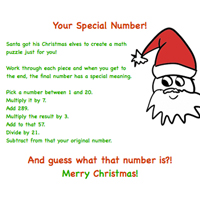
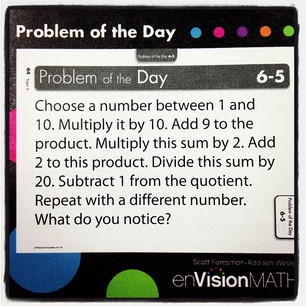
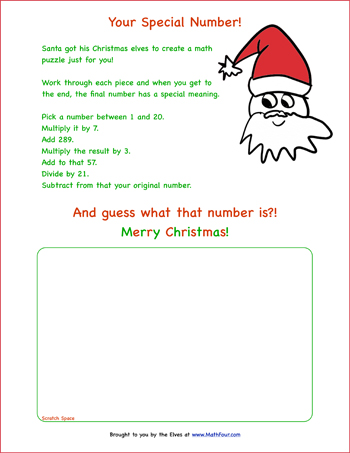
I remembered seeing this number puzzle in a textbook a few weeks ago:
I dissected it and came up with a formula for recreating the number puzzle using any numbers I wanted.
And I figured out how to make it so the end result would be anything — not just the number you picked at the beginning.
Personalized number puzzles as gifts!
So I’m taking each person’s “special number” and creating a number puzzle out of it. For some, that’s their birth year. For others it will be their favorite number or last four digits of their phone number.
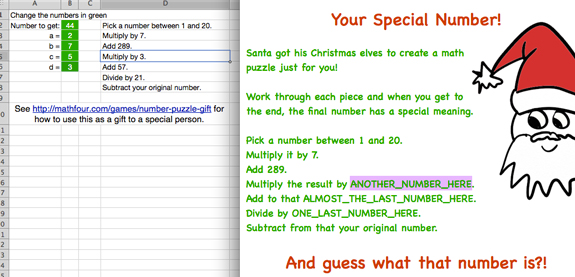
And I’m making them into a pretty little gift sheet:
You can do it too.
I’ve put all this neatly in a spreadsheet so you can put in your own numbers — and make a number puzzle gift for your cherished math people!
This post originally appeared on The HSBA Post on December 17, 2012.
This year, money’s tight. But we’ve had tight Christmases before. And what I know from tight budget Christmases is that they’re a drag.
I know – giving isn’t the reason for Christmas. But it’s really fun to choose things for the ones you love that make their faces light up.
Nothing makes you feel like you’re celebrating Jesus’s birthday like having a family member say, “Oh, wow! This is the coolest thing ever!”
So when I first thought about how we were going to manage Christmas giving this year, I had a small idea: give things I already have.
I had no idea that small idea would grow to be huge.
“If you don’t use it, pitch it.”
I’m married to a professional organizer. So I constantly hear stories of his clients and the things he coaches them. The big one is, “Yes you could use it, but do you use it?”
I own a lot of things that I don’t use. But they are beautiful or special — so much so that I ignore the advice. I just can’t pitch them — or even donate them — because… well, because I just can’t.
But if I shared it, now that’s a different story.
Excitement welled!
As I looked around at the things in my home that are fabulous and unused, I got excited. I went from shelf to shelf, drawer to drawer, discovering all the cool things that I could give.
Then I thought about all the things in my mother’s attic. I gave her a call.
“How about a special Christmas gift for you, Ma?” I asked. “Can I come over and get all my boxes out of your attic?”
Now she got excited.
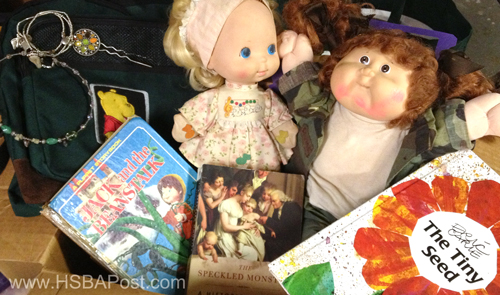
So last week I went “shopping” in Ma’s attic. All my old toys, books, crafts, clothes, and jewelry are going to find their way into hands that will love them like I do. And use them!
I’m recycling, reusing, cleaning out my home and Ma’s attic – all on a $0 budget.
And I’m celebrating the way Jesus would – by sharing!
How about you – are you on a shoestring budget or a $0 budget, too? Tell us about it in the comments!
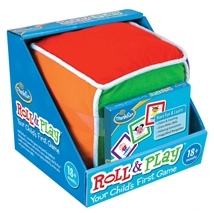
Billed as “Your Child’s First Game,” this helps the little ones understand game play. Non-competitive, but fun. All activities are marked on the cards with pictures as well as words, so they are easily deciphered by the non-readers of the family.
Moving pawns or putting up fences. Deceptively simple. Ridiculously challenging after you and a friend have played 5 times. Which will your strategy be?
Ages: Ages 8 and up Players: 2 to 4 Review: Coming soon! Cost: $29.95 on Amazon
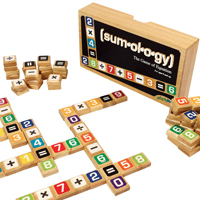
Helps children build equations and do advanced math using the basic operators. Players place their tiles in crossword fashion either horizontally or vertically to create valid equations.
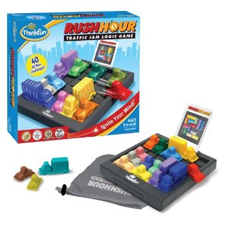
Playing Rush Hour helps build sequential thinking, reasoning and planning skills. Challenges range from beginner to expert, so everyone in the family will enjoy it! Rush Hour can be played at home or on-the-go — perfect for on road trips, airplane rides or physician waiting rooms.
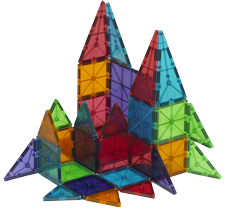
These tactile, colorful translucent Magna-Tiles stick to each other for fun 3D exploration or practicing basic shapes and colors. Magna-Tiles develops patterning, shape recognition, building and motor skills. They store nicely on the refrigerator too!
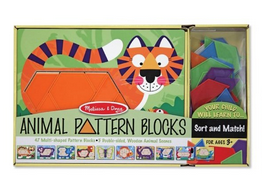
Complete the colorful animal pictures with geometric shapes. The 47 geometric shapes come in a rainbow of bright colors, and can also be used outside of the boards for counting, sorting and original designs. Great for developing shape and color recognition, fine motor skills and language skills!
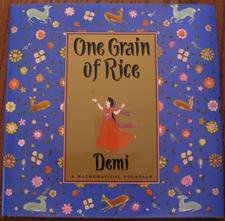
Exotic, beautiful, and instructive, this “mathematical folktale” by author-illustrator Demi emerged from her love of India. This retelling of the classing “doubling” story is about Rani, a clever girl who outsmarts a very selfish raja and saves her village. When offered a reward for a good deed, she asks only for one grain of rice, doubled each day for 30 days.
This special counting book visually explores the concepts of factoring and the role of prime and composite numbers. The playful and colorful monsters are designed to give children (and even older audiences) an intuitive understanding of the building blocks of numbers and the basics of multiplication.
But of course, donating also has math in it. So if you donate to those in need, you can integrate math learning into it.
And if you haven’t had a chance to donate in a while, check out the math below to see how easy it is!
Donate your time.
Volunteering with Qpon Junkie at The Salvation Army Angel Tree Secret Warehouse
Head to a local shelter, Salvation Army, or church to volunteer. Talk to your kids about how much time they spend each week playing, doing sports and gaming.
1. Suppose your family donates a half day — how much of their free time will they be giving up?
Say they have 18 hours a week to play: 1-2 hours/day during the week and 3-5 hours/day on the weekend.
A half day, or four hours, is \(\frac{4 \text{ hours}}{18 \text{ hours}}\) or 22%. So less than a quarter of their free time is taken as a volunteer.
If that’s the only time all year you volunteer, the math is a little different. The play time for the year is 52 weeks x 18 hours/week = 936 hours.
Volunteering 4 of those hours means they’ve given \(\frac{4 \text{ hours}}{936 \text{ hours}}\) or 0.5% (less than 1%) of their free time away!
Donate some money.
How much money are you budgeting for gifts this holiday season? $250? $500?
2a. If you donate $5 to The Salvation Army online, what percentage of your budget of $250 would be donated to them?
Five dollars out of $250 is \(\frac{\$5}{\$250}\) or 2% of your budget.
2b. What percentage of your budget of $500 would be donated to The Salvation Army online if you gave $50?
Fifty dollars out of $500 is \(\frac{\$50}{\$500}\) or 10%.
3. If the average present cost for you is $25 and you donated 10% of that to The Salvation Army online, what would the new average present cost be?
Ten percent of $25 is the same as 10% x $25 (remember “of” means multiply). This is 0.10 x $25 or $2.50.
So your new average present cost is $25 – $2.50 or $22.50. That’s still pretty good!
Share the experience.
Suppose you just don’t have a half day, and you’re working on a budget of $0 this Christmas. You can still help your children see the beauty of giving and share some math with them.
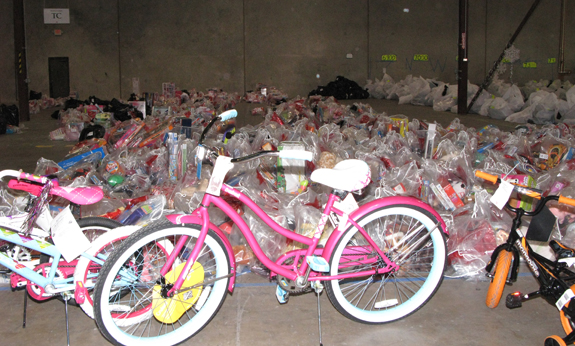
4. The Houston Salvation Army Secret Warehouse (where they keep all the toys) is 24,000 square feet. It serves about 6,000 families. About how much space is that for the toys for each family?
So \(\frac{24,000 \text{ square feet}}{6,000 \text{ families}} = 4 \text{ square feet/family}\) in that warehouse! That’s the size of a square with each side roughly the length of your arm.
Check out the bags of donated gifts behind the bike in the picture and you can see that it’s totally true!
Share a smile.
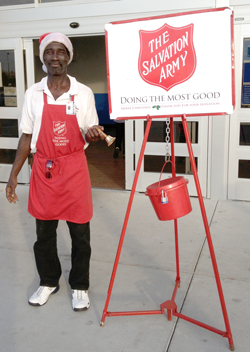
Michael J. Ivery, one of the famous Salvation Army Bell Ringers
The Salvation Army Bell Ringers have a tough job encouraging people to drop their loose change into the famous Red Kettle. They spend hours on their feet. And many times people don’t even look their way.
So give them a big smile when you pass by. Have your children stop and shake their hand and tell them thanks for helping others.
When you leave, talk about how big the bell ringer’s smile was at having someone interact with them. Remember, the size of a smile could be measured in inches (another math thing) — but often it’s measured in happiness!
Create a math model.
A math model is an equation that represents reality. Or something close to reality.
You can model how good you would feel based on how you share.
5. Can you create a formula for how good you feel when you donate your time, money or do other nice things for others?
For me, I used a scale from 1 to 10. I assigned numbers to each of the activities:
Giving one toy makes me feel as good as 6.
Giving one book makes me feel as good as an 8.
Giving one hour of my time makes me feel a 4.
Giving a smile and handshake to a bell ringer makes me feel like a 10.
Giving one dollar makes me feel like a 5.
So my formula for how good I feel this season looks like this:
So how about it? What will you do this holiday season to help you feel good and teach your children math? Share your thoughts in the comments and don’t forget to tweet about it.