Author: Bon Crowder

  • Fractions Aren't Exact!

    Fractions Aren't Exact!

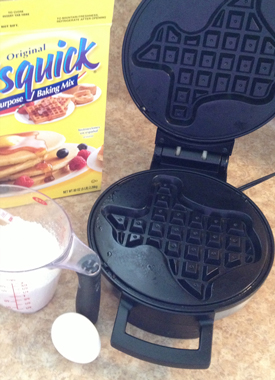
    I make Texas shaped waffles every Saturday morning. But this weekend I ran into a snag. The recipe called for 2 cups of Bisquick and I only had 1 1/4 cups left!

    Break out the fractions!

    “This shouldn’t be a problem,” I thought. “I’m good with fractions. I’ll just scale down the whole recipe.”

    2 cups is the same as 8 quarter cups. I have 1 1/4 cups of Bisquick — or five quarter cups.

    So I need to break the other ingredients down into eight pieces and only use five of them.

    This is the thinking that most math people would translate into, “I need 5/8 of the whole recipe.”

    Sounds good!

    Until I saw the other ingredients…

    • 1 1/3 cups milk
    • 1 egg
    • 2 tablespoons oil

    For real?!

    Here’s how I thought about the fractions in the 1 1/3 cups milk:
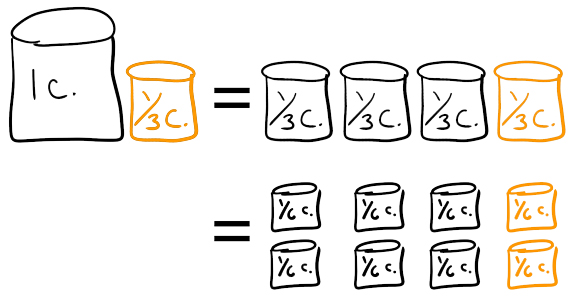
    Since I need 5 of the eight pieces, I need 5 of the 1/6 cups. Grief!

    “Don’t panic,” I thought, “4 of the 1/6 cups give me 2/3. And 5/6 is pretty close to 1. So let’s just estimate the milk as almost a cup.”

    Now what about the egg?

    I was not about to find 5/8 of an egg. So I thought:

    The recipe doesn’t say a large egg or a medium egg. And the variations of eggs are huge. So what would it matter if I used one egg or 5/8 of an egg? It’s still pretty close.

    I dumped the whole egg in.

    And I threw caution to the wind.

    At this point, my fractions were so far gone I just tipped the bottle of oil up and let it go.

    And wouldn’t you know — we had some pretty awesome waffles!

    Share your thoughts in the comments or on twitter/x.

    You might also like:
  • Math Quote Cryptogram: Bragging Rights

    Math Quote Cryptogram: Bragging Rights

    This is the fourth in the Math Quote Cryptogram series.

    This series is inspired by the Dszquphsbnt! cryptogram puzzles in GAMES Magazine that I used to play with my dad.

    If you need help solving it, check out Cryptograms.org for instructions.

    Click here for a printable version of Math Quote Cryptogram #004
    Print it, work it, tweet it and let me know what you think!


    The Puzzle: “Bragging Rights”

    Y Z   A W O   F Q M C G Q   W R G C O Z   W   M R Y M A Q   Z C   L Q G W L X

    Z A W Z   D C F C P S   F C W O Z O   C I   Y K D C L W D M Q   C I

    R Y Z Q L W Z B L Q ,   F B Z   Y Z   Y O   O C M Y W R R S

    W M M Q H Z W F R Q   Z C   F C W O Z   Y K D C L W D M Q   C I

    O M Y Q D M Q   W D P   H L C B P R S   M R W Y G

    Y D M C G H Q Z Q D M Q   Y D   G W Z A Q G W Z Y M O .

    — L Y M A W L P   P W V X Y D O


    Share your thoughts in the comments or on twitter/x.

    You might also like:
  • Doing Math Quietly

    Doing Math Quietly

    This is part of the Five Minute Friday series.

    This week’s prompt is “Quiet.”

    And how pleasant is quietness when you’re totally focused, and in “flow,” working through a challenging but not too hard math problem?

    That’s how we’d like our students to be — just like Goldilocks in the house of the Bears. Not too much and not too little. But just right.

    Keeping it Quiet

    What does quiet mean, when doing school work? For some it is the literal meaning — no sound.

    But for some, it means keeping the brain from making other internal racket that others couldn’t possibly hear.

    That’s why you see some people listening to music while they study or work. That part of their brain must be kept busy while the other part focuses.

    What does your child need?

    Think about how you like to work on different things. What puts you in a state of real focus for that task?

    Then watch your kids. Talk to them about what it means for them to be focused. How they focus for a particular subject or task is their quiet.

    Do what you can to help them reach it.

    And share your thoughts in the comments or on twitter/x.
    You might also like:
  • Painting Math

    Painting Math

    Part of Wordless Wednesday
    My sister’s birthday brunch was at Painting with a Twist this weekend. Here’s the original:

    And here’s and my math interpretation of it:

    Share your thoughts in the comments or on twitter/x.
    You might also like:
  • The Distributive Property — What Is It, Anyway?

    The Distributive Property — What Is It, Anyway?

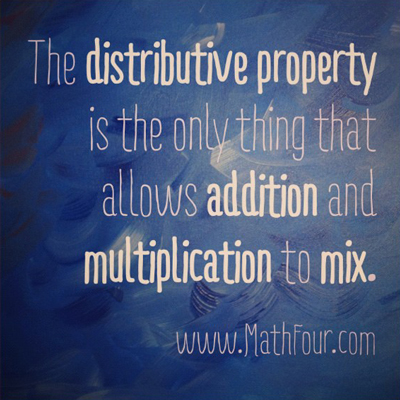
    The two most commonly used operations in math are addition and multiplication.

    And although we intermingle addition with multiplication (along with division and subtraction), these two can only mix using the distributive property.

    How the distributive property works

    Multiplication, in a crude sense, is a shortcut of addition. Like 3 x 8 is the number 8 added to itself three times. Or 8 + 8 + 8.

    Look at 3 x (6 + 2). This is the number (6 + 2) added to itself three times. (Refrain from adding those two together, no matter how tempting. Leave them separate as 6 + 2.)

    So we have (6 + 2) + (6 + 2) + (6 + 2).

    And we know that when it comes to only adding, we don’t need any parenthesis. Which gives us

    6 + 2 + 6 + 2 + 6 + 2

    Also, addition is commutative. So we can scramble these numbers around.

    6 + 6 + 6 + 2 + 2 + 2

    And if we want, we can squish them together in parenthesis (seems lame, but stay with me…)

    (6 + 6 + 6) + (2 + 2 + 2)

    And, hey! We know that 6 + 6 + 6 means 3 x 6 (and the same with 2’s) so we have:

    (3 x 6) + (3 x 2)

    Remember what we started with. Put it together with what we ended with. And we’ve just demonstrated (the long way) that

    3 x (6 + 2) = (3 x 6) + (3 x 2)

    or, more visually…

    3 x (6 + 2) = (3 x 6) + (3 x 2)

    This is the Distributive Property of Multiplication Over Addition. (That’s the fancy name for the distributive property.)

    It works with something else, too…

    Since exponents are a shortcut of multiplication, we can play the same game.

    Consider (6 x 2)3

    This is (6 x 2) x (6 x 2) x (6 x 2)

    And we can get rid of parenthesis and scramble:

    6 x 6 x 6 x 2 x 2 x 2

    And re-group:

    63 x 23

    Showing that:

    (6 x 2)3 = 63 x 23

    This, by the way, is the Distributive Property of Exponentiation Over Multiplication!

    Yes — this IS useful.

    Seems ridiculous, right?

    But when learning algebra, students often get lost when faced with 3(y + 2). “What do I do now?” they think, going into panic mode.

    If they know that y is just a number with lipstick on (as a disguise), they can think about the above example.

    Remembering what it means is the key to knowing what to do with the algebra stuff!

    What do you think? Share your thoughts in the comments or on twitter/x.

    You might also like:
  • Math Words — Start Using Them Early

    Math Words — Start Using Them Early

    Every parent is concerned that their children will not get what they need to be successful. Especially in math.

    Instead of worrying, you can take action. And it’s not hard.

    Use “big” math words.

    Don’t refrain from teaching your child math words just because they’re big or seem complicated to you.

    This sentence, “May I have milk, please,” has five simple words. To a grown-up.

    But to a child, a five word sentence is no different than a five syllable word. Like, “parallelogram.”

    In fact, if you teach your child to count to 10, it’s the same as teaching your child an eleven syllable word. (Seven has two syllables.)

    To put this in perspective, the word overintellectualization has only ten syllables!

    O – ver – in – tel – lec – tu – a – li – za – tion

    One – two – three – four – five – six – seven – eight – nine – ten

    In fact, overintellectualization is easier to say when you look at it like this.

    Try some words!

    Give these math words a shot with your little ones:

    Parallelogram (pear-uh-lell-uh-gram)

    A parallelogram is a shape. It has four sides. The sides that are across from each other are parallel to each other. Which means a square is a type of parallelogram. And so is a rectangle.

    So the next time you see a square or a rectangle, say to your child, “Hey, there’s a rectangle. It’s also a parallelogram. Can you say parallelogram?”

    Hypotenuse (hi-pot-uh-news)

    The hypotenuse is any diagonal that you take instead of walking first to the left and then to the right (or vice versa). So the next time you walk across the street at a diagonal, say to your child, “Were walking the hypotenuse. Can you say hypotenuse?”

    Coplanar (co-plane-er)

    Any two things that are on the same flat surface are coplanar. Like two people standing on the floor together.

    When you’re around stairs, stand on a different step than your child. Say, “Look, we are not coplanar.

    Then move to the same step as your child and say, “Now we are coplanar. We are on the same flat surface. Can you say coplanar?”

    Go do it. Have fun!

    You don’t have to know the formal definitions of your math words. Just know a place or two where you can demonstrate them in your own world.

    Remember, getting your child familiar with math words will make a big difference.

    So pull out some big words, and try them on for size. Your little ones can handle it!

    You might also like:
  • Permutations in Braiding Hair

    Permutations in Braiding Hair

    As a mom of a girl child, I’m supposed know all about braiding hair. But I don’t. <cue dramatic bad mom music>

    I know how to braid three basic strands of hair… mostly. But when I try the French braiding thing, K8’s hair looks like a feral goose nested in it overnight.

    “There must be some way of knowing how much extra hair to pull in — and when!” I thought.

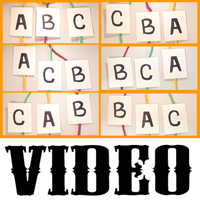
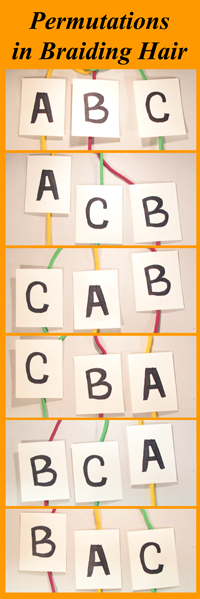
    When trying to figure it out (mathematically, of course), I noticed that the strands of the braid weave to give all possible permutations of three things!

    Check it out:

    So we have all of these:

    Are there more?

    This makes me wonder what happens with four strands. Of course that kind of thinking will send any incompetent braiding mom into fits!

    What do you think? Share your thoughts in the comments or on twitter/x.

    You might also like:
  • Lands' End f(x) Collection — What's the Message?

    Lands' End f(x) Collection — What's the Message?

    I was told about the Lands’ End f(x)™ Collection by a reader a few days ago. She was excited to see that Lands’ End had used the traditional function notation for a line of clothing that was very functional.

    And indeed it is. If we didn’t live in Houston, this coat, and all it’s functional bits, would be a perfect coat for K8.

    I wanted to know more.

    I was excited to be able to write about this line of clothing — and be able to quote Lands’ End on how “functional” it was. I wanted to share how “up on math” this very popular clothing store was.

    So I started searching.

    During the search, Husband peeked over my shoulder. I told him about it and showed him the ad.

    “They probably mean effects,” he said calmly.

    I was horrified. “What do you mean?”

    “You know,” he explained, “When you put F and X together, it is effects. That’s probably what they mean by it.”

    So I dug deeper!

    I found nothing written to support the naming of the Lands’ End f(x)™ Collection after anything math or even claiming functionality. But I wasn’t deterred.

    After all, they are using the standard notation, right down to the italics.

    So off to twitter I went.

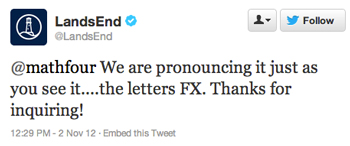
    According to a tweet from @LandsEnd, the official pronunciation is FX (like effects) not “f of x” as the math world knows it. Husband was right!

    What’s the message?

    Does the presence of the italicized f(x) in popular print help us to be more familiar with the notation? Absolutely.

    And since familiarity leads to comfort and then engagement, this advertisement is a definite cultural boost for math.

    But what effect does the mispronunciation have? And since the branding has minimal (or no) association to math functions — what message does that send?

    I look forward to hearing your thoughts. Please share them in the comments or on twitter/x.

    P.S. I also find it strange that they trademarked it. Can you really trademark functional notation?

    You might also like:
  • Roots — Exponents and Culture

    Roots — Exponents and Culture

    This is part of the Five Minute Friday series.

    Really? Today’s prompt is “Roots.”

    You can’t get a better writing prompt for a math blog if you pushed really hard!

    So what is a root? And what does it mean to have many roots?

    A root is the opposite (the inverse) of a power or exponent. When you raise something to the power of 2 (or square it), you’re using the exponent 2. If you want to undo this, you take the square root.

    When we do this for roots of larger numbers, it gets much more entertaining. Like the 4th root.

    Raise 3 to the 4th power… you get 81 (which is 3*3*3*3). So when you take the 4th root of 81, you get back 3.

    That’s not the intent of the prompt, though…

    Indeed the FiveMintueFriday prompt wasn’t meant for math. So let’s consider the other “roots” in math. What are your math roots? What kind of math roots are you establishing for your children?

    Do you have positive math roots? Do you say happy and positive things about math when it’s mentioned. Do you make a point to point out where you do math daily (like setting your alarm clock)?

    If you do, you’re establishing some very good math roots for your children.

    Share your thoughts in the comments or on twitter/x.
    You might also like: