
Author: Bon Crowder

  • Anxiety or Excitement?

    Anxiety or Excitement?

    I’ve been doing 50 Word Friday for a while. But I’ve just stumbled across a thing called Five Minute Friday that has me excited.
    My heart is racing!

    Yup. Racing.

    And it’s not from the coffee overload this morning.

    I have what’s called “test excitement” — which is the opposite of test anxiety. If you tell me to do something (for which I some level of mastery) and then say that it’s timed or a test, I just go nuts.

    I’m all about getting the best grade, beating everyone else or creating the best whatever in the allotted time.

    So this new challenge is right up my alley!

    Starting tomorrow (or late, late tonight) I’ll be using this online timer and Lisa-Jo Baker’s Five Minute Friday prompt to write something about math.

    Things might get a little crazy.

    In this challenge, you don’t proofread what you do. How exciting!

    And you only write for 5 minutes. So I’ll pick a photo before she gives the prompt.

    Which means that what you, sweet reader, will get out of this, is anyone’s guess.

    The one thing I’ll guarantee… it will be about math or math learning.

    Anxiety or Excitement?

    So what does this article have to do with math?

    In order to excel you have to be out of the state of anxiety and into excitement. This goes for excelling in learning as well.

    So try this little test with your children. Print this Anxiety or Excitement? sheet (or use a blank page) and have each of your children (and you) fill it out.

    In one column write out everything that makes you anxious. Include all the things you avoid because of this.

    In the other column, write down everything you love to do — anything you’re excited about doing and you want to do more.

    Then take a peek at what you and your children have written.

    What do you notice?

    Use those filled out sheets as a guide to turning anxiety into excitement — like if your child is anxious about math but loves fairies, convert all word problems into fairy problems. Like this:

    The fairy playground is about 50 twinkletoes wide by 120 twinkletoes long. There’s a border of pixie dust around the entire playground that’s 1800 square twinkletoes. How wide is that pixie dust border around their playground?

    Does it turn anxiety into excitement? Maybe not immediately.

    But perhaps if you let her draw it out — with glitter paint — it will start her down the right path!

    Stay tuned…

    If one of the things on your excitement list is writing or doing anything at midnight for five minutes, join me for the #FiveMinuteFriday party (aka #FMFParty)!

    I’d love to see what you write. And if you’d like to share your anxiety/excitement list with me, please do! Put it in the comments or post it on twitter/x.

    You might also like:
  • A Halloween Puzzle: Rubik's Cube

    A Halloween Puzzle: Rubik's Cube

    Part of Wordless Wednesday

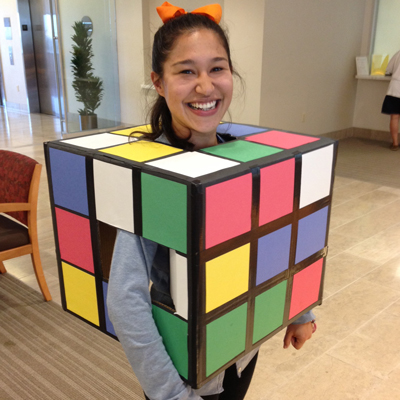
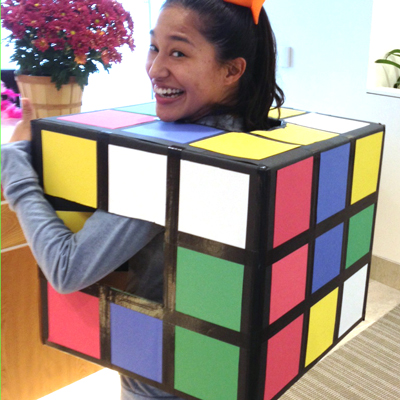
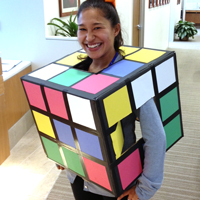
    This is alli (lower case “a”) at my doc’s office, wearing her fun Rubik’s Cube costume. From the photos below, can you deduce what 10 color squares aren’t shown — 9 on the bottom and one where her neck is?

    As a bonus — is it actually possible to twist the Rubik’s Cube to show the patterns of the five sides as she has them?

    Share your thoughts in the comments or on twitter/x.
    You might also like:
  • Our Number World

    Our Number World

    This is a math story, but the names have been changed to protect the innocent.

    UPDATE June 2026: When going back through content on MathFour.com, I read through this and it took me a while to figure out what the heck I was writing. If you start reading this and feel like you’re confused, try using this word unscrambler tool for the proper names in this story.

    There once was a strange little world called Lears. It was quite small, relatively speaking, and had only one continent. The residents called the continent Tailorsan and they named the single ocean (with all its very strange fish) Ralitanisor.

    In Tailorsan, there was a single city called Egrestin. Anyone living outside of the city was called a “mice lad.” (People weren’t very nice to those country folk!)

    All the Egrestins lived happily in Egrestin, it seemed. At least until one day…

    Crime set in!

    There was a group of Egrestins who didn’t seem to like anyone. They would meet regularly and fight. Everything they did was hateful and mean.

    So the more optimistic and positive of the Egrestins began to migrate to one side of the city. Soon they decided to form an official, and gated, neighborhood.

    They held a contest for the name of their new community and Mr. Reoz, a very liberal man, won. He had chosen “The Lehow Urbsmen.” (A rather fancy name, but they were the snobs of the city.)

    “That outta keep out the rubbish,” Mrs. Neetiff said to some of her neighbors as they finished the gate around their shiny new community.

    Mr. Reoz overheard her and was horrified.

    “Mrs. Neetiff. I understand that we don’t want crime in our neighborhood,” said Mr. Reoz, “and we don’t like all the negativity. But the people outside of The Lehow Urbsmen aren’t ‘rubbish’ — they’re people too!”

    She responded, “Well, how about this, then… why don’t you move outside our nice little community!?”

    Mr. Reoz looked at her and thought about it. He never liked her much — and she was so odd.

    He said, “Since I picked the name for the community, I don’t really think that’s right. But I’m not sure I want to live inside the gate with the likes of you!”

    So they rebuilt the gate to exclude Mr. Reoz’s house. He remained a part of the The Lehow Urbsmen, but just not inside the gate.

    He named the gate “The Alasturn” — a word that means “The Optimists” in the Learsian language. He hoped that giving them that name would have a positive effect on them.

    He became the middle man.

    Mr. Reoz eventually became friends with everyone in Egrestin. In his networking, he was able to introduce people from inside the Alasturn to other Egrestins.

    It seemed that through him, each member of the gated community perfectly matched someone outside of the community.

    And they lived happily ever after!

    Can you draw the map of Lears? What does this have to do with math? Did I miss anything?

    Share your thoughts in the comments or on twitter/x.

    You might also like:
  • Math Picture Book: One Grain of Rice

    Math Picture Book: One Grain of Rice

    This is part of the Math Picture Book series.

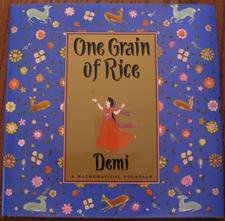
    My musical friend Christi Gell sent K8 and me a delightful math picture book recently. One Grain of Rice, by Demi, is both visually and mathematically beautiful.

    It’s exponentially better as you read it.

    And that’s not a figure of speech! One Grain of Rice is the story of a girl that asks for a simple reward for a good deed. She asks for a single grain of rice on the first day and for 30 days, double the amount of rice given on the previous day.

    I’ve heard this story told in a variety of ways, but the illustrations and scenario of this book make it appealing in ways that outshine all the rest.

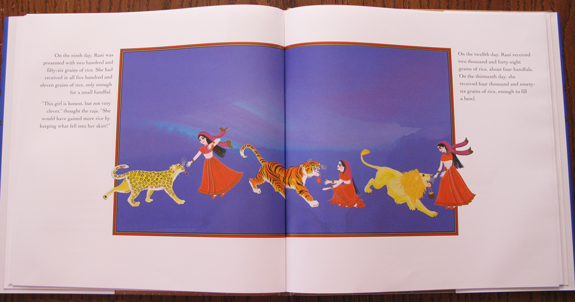
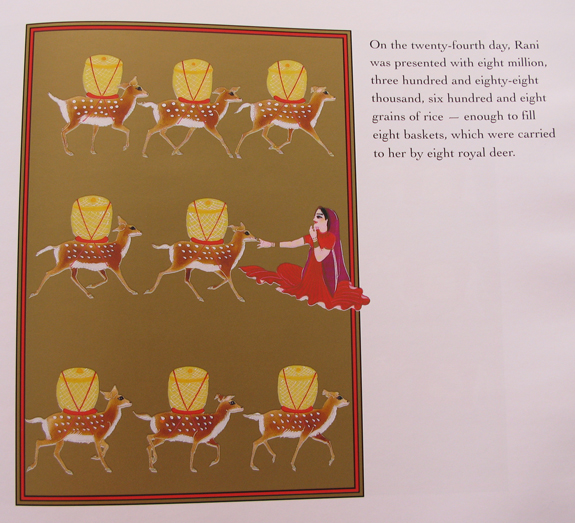
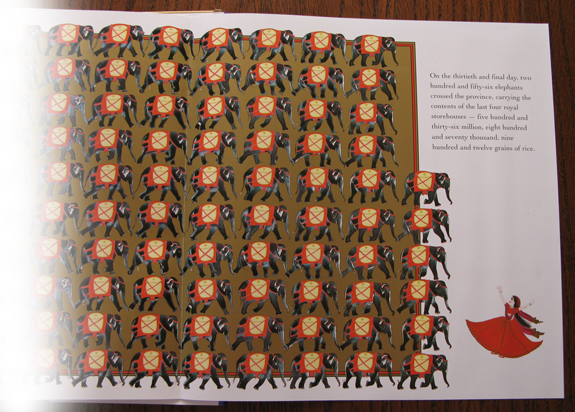
    The illustrations have a gold-leaf feel about them. And Demi shows the quantity of rice very literally, down to multi-page foldouts showing exactly how many animals it takes to carry that day’s amount of rice!

    It starts small.

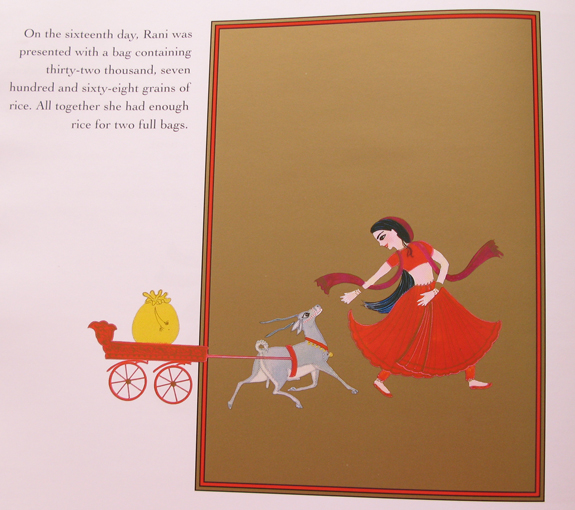
    Here you see her getting “help” carrying the rice from various animals on the 9th, 12th and 13th days.

    And on the 16th day, she really needs this help!

    Soon the raja’s getting worried.

    By the 24th day, she’s needing to borrow deer from the raja to carry it!

    By the 30th day, she needs 256 elephants to carry it all. And all 256 of them are shown in a gorgeous 4-page foldout!

    Don’t miss this math picture book!

    One Grain of Rice is also the tale of a greedy raja that learns a lesson through the cleverness of a girl. The magnificient illustrations help kids (and grownups) see the magnitude of exponential growth, without even putting that label on it.

    Head out now to get your own copy of the math picture book One Grain of Rice, by Demi. And send a copy to an artistic or mathematical friend too!

    Share your thoughts in the comments or on twitter/x.

    You might also like:
  • 10 Questions to Ask About a Math Problem

    10 Questions to Ask About a Math Problem

    I’m substitute teaching 5th grade Language Arts today. I just found a handout with a set of questions titled “Peck’s Questions.” I quickly figured out (with my amazing powers of deduction) that they were questions you could ask about a novel.

    After reading them, though, I thought, “Why don’t they have something like that for math?!”

    So I did some research.

    Before creating the super math list, I thought I would find out a little more about the original list.

    Apparently this Richard Peck guy is pretty famous in young adult literature. The list is officially titled, “Ten Questions To Ask About a Novel” and was published in the The ALAN Review in the Spring, 1978 edition. Here it is:

    1. What would this story be like if the main character were of the opposite sex?
    2. Why is this story set where it is (not what is the setting)?
    3. If you were to film this story, what characters would you eliminate if you couldn’t use them all?
    4. Would you film this story in black and white or in color?
    5. How is the main character different from you?
    6. Why would or wouldn’t this story make a good TV series?
    7. What’s one thing in this story that’s happened to you?
    8. Reread the first paragraph of Chapter 1. What’s in it that makes you read on?
    9. If you had to design a new cover for this book, what would it look like?
    10. What does the title tell you about the book? Does it tell the truth?

    The list allows students to dig in a little deeper to the novel. It helps them get creative and think about the story in ways they wouldn’t normally.

    And it trains them to do this with novels throughout their lives.

    Why a list of questions about math problems?

    Before creating them, I decided the questions should do the following:

    • Allow the student to dig in deeper to the math problem, and the math behind the problem.
    • Help the student to think about the problem in ways they wouldn’t normally.
    • Let the student get creative in thinking about the problem.

    And of course doing these things regularly will train them to continue to do this with all math problems through their lives.

    Ten Questions to Ask About a Math Problem

    1. Who do you think created this math problem? Was it a man or woman? How old were they?
    2. Who do you think first figured out how to do a problem like this? How long ago?
    3. Imagine this is a real problem asked by a real person. What is that person’s job? Why are they asking this question?
    4. Why does this problem use the scenario that it does?
    5. If you could rewrite the problem using the same numbers and getting the same numeric answer, what scenario would you use?
    6. What numbers would you use in the problem to make it easier? What numbers would you use to make it funny?
    7. Is there a story that can be created before or after this math problem that makes sense?
    8. Has the situation in the problem ever happened to you or someone you know?
    9. What about this math problem appeals to you? If nothing, why did you continue to work on it?
    10. If you had to illustrate this math problem, what would it look like?
    11. (UPDATE Nov 5 from suggestion in comments) Can you develop some sort of theory as a result of solving this problem?
    12. (UPDATE Nov 5 from suggestion in comments) How does this problem relate to problems you have encountered before?

    Will it work?

    Try using it yourself first. Get a feel for what each question means and how it might be answered.

    Then try it on your children. Which questions work? What questions should be changed — and to what?

    Share what you find in the comments or on twitter/x so we can have a super solid list of Ten Questions to Ask About a Math Problem!

    You might also like:
  • Extreme Sports with Extreme Math — Kitesurfing

    Extreme Sports with Extreme Math — Kitesurfing

    While at the beach, we got to see an amazing sport in action: kitesurfing!

    I couldn’t help but marvel at all the math this guy was doing automatically and at great speed.

    And he did it effortlessly!

    He probably didn’t even recognize he was doing math the whole time.

    He was managing the angles of his board on the waves and calculating the angle of the kite with the wind.

    And every so often he had to recalculate to turn and surf in the other direction!

    Everyone does this with normal activities.

    Do you know anyone who thinks they don’t do math? Watch their activities carefully, you’ll soon see that even in walking, they’re doing fast and furious calculations!

    Share your thoughts in the comments or on twitter/x.

    You might also like:
  • Logic and Reasoning Skills are Missing in ‘Drop Everything And Read’

    Logic and Reasoning Skills are Missing in ‘Drop Everything And Read’

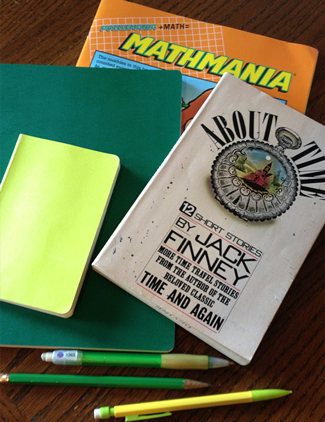
    Here are some of the options I had for including in my RWAM Kit.

    I had the privilege of substitute teaching fifth graders last week. In that experience I was introduced to the D.E.A.R. program — Drop Everything And Read.

    Imagine my horror!

    Okay, I’m a little sensitive to how obsessed with reading to children grownups are (and how much they ignore building logic and reasoning skills like math). But this D.E.A.R. thing makes it clear to me that I’m right.

    Do you see a “drop everything and do a puzzle” program? Nope.

    Reading is passive.

    We’ve been brainwashed that reading is the most important thing in learning. But it has some serious downfalls.

    Reading is a passive activity. Granted, you can learn a great deal of grammar and vocabulary through reading. So it’s not without its merit.

    But stressing reading to the exclusion of other, more active, activities is doing your children a disservice.

    Math and writing are active.

    Math and writing are the active ones in the three categories of learning. You can’t passively do math — one of the reasons we often say math is not a spectator sport.

    And writing, well, that would be interesting to see someone do that passively, I’ll tell you!

    Math and writing both require logic and reasoning skills — thinking skills.

    So how about a Reading, Writing And Math Kit?

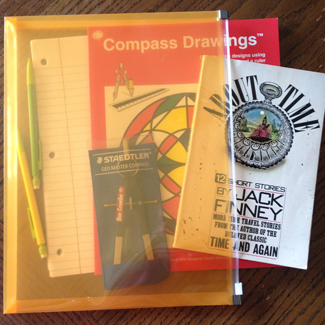
    This is my RWAM Kit — complete with my new compass!

    Teach your children to carry a “RWAM kit” everywhere they go (pronounced “ram”).

    Pick up a cheap zipper pouch (mine was $2.59 at Office Max) and let them decorate it.

    It should always have a pencil or pen and a blank book or loose paper. They can also carry a book for reading and a drawing or puzzle book (like sudoku, Mathmania or GAMES Book for Kids).

    Reading — they can practice this necessary and helpful skill with the book or some of the instructions in the puzzle book.

    Writing — they can write journal entries or stories in the blank book. They can also play, “what will happen next” after each chapter or segment in the reading book.

    Writing this out is a fun and active exercise that provides children with a reading break, as well as a different way to practice logic and reasoning skills.

    Math — the puzzles provide the math skills here. If they’re doing a puzzle, they’re practicing the same logic and reasoning skills required for math. In fact, if a child does puzzles, he or she will get much better in textbook math than by using the textbook alone.

    What if they draw instead?

    Drawing can encompass any or all of the above three.

    Students can illustrate a part of the reading book. Or they can illustrate their own writing.

    And they can create tessellations or other geometric drawings. In fact, even if they draw racecars, they’re still practicing shapes, ratios and perspective — all math things!

    So don’t drop everything.

    Don’t fall prey to the brainwashing Drop Everything And Read campaign. Because you just might be depriving your children of actively growing their logic and reasoning skills!

    Help your child build his or her RWAM Kit today — and don’t let them leave home without it!

    P.S. You should do it too. Not only is it a great habit, but you’ll also be a good example.

    Share your thoughts in the comments or on twitter/x.

    You might also like:
  • Parent Influence is Powerful

    Parent Influence is Powerful

    It’s hard to understand how parent influence really works. But your words and actions have a serious impact on your children.

    Even saying, “I haven’t done math in 15 years,” sends a decisive message to your kids: “I don’t need math as a grownup, and neither will you.”

    Kids want to do what you do.

    Here’s how powerful parent influence can be…

    K8 and I were getting ready for bed yesterday. I started taking off my eye makeup. She wanted to do it too.

    So I got out a cotton round for her and put a little makeup remover on it. She wiped her eye and was immediately annoyed.

    “I want brown!” she whined.

    My cotton round was full of removed makeup. Hers was white. She wanted to be like me.

    So I put a dab of liquid eyeliner on each of her lids. When she wiped it off, she had some “brown” on her cotton round too.

    Parent Influence is crazy powerful.

    How nuts that she wanted to have dirty eyes so she could clean them. It makes no logical sense.

    And that’s why your positive math talk is so important. Parent influence is the first and most impactful influence in your child’s life.

    As early as three years old (as K8 showed), they want to do everything exactly like you are doing. Exactly!

    So if you say you’re not good at math, they want to be not good at math too.

    So turn it around — be positive.

    Since parent influence has that kind of impact, make sure to keep it positive. Learn how to quit saying negative things about math.

    Have questions or suggestions on doing it? Leave them in the comments. And share this on twitter too!

    You might also like:
  • Adding Decimals — All Wrong!

    Adding Decimals — All Wrong!

    Part of Wordless Wednesday

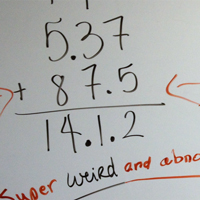
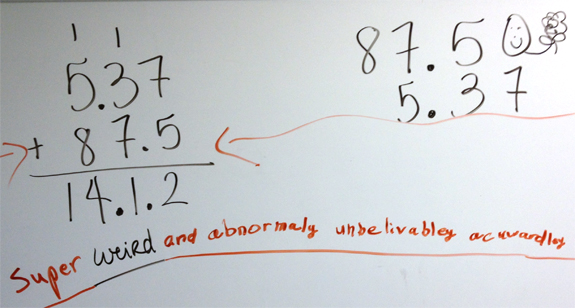
    When substitute teaching 5th grade math today, I had the opportunity to incite a riot.

    The students were calmed when I finally listened to their screams of, “line up the decimals.” And some of the girls stayed after class to add some adverbs to my comment of “two decimals in a number is weird.”

    Share your thoughts in the comments or on twitter/x.

    You might also like:
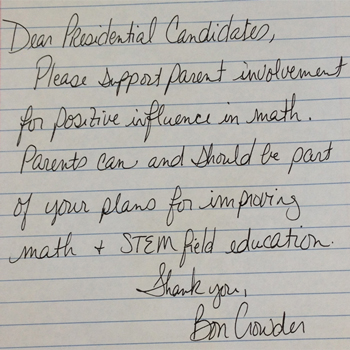
  • An Open Letter to Obama and Romney about Math Education

    An Open Letter to Obama and Romney about Math Education

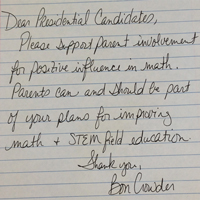
    This is an open letter, please feel free to share onTwitter, via a printed copy or on your favorite social media site.

    Dear Mr. President and Mr. Romney,

    Thank you for supporting education and for being dedicated to improving the math learning in the United States. Americans all know that we may be in trouble when it comes to competing with the world in STEM fields — now and in the foreseeable future.

    I am not writing to give my method of how to fix the schools. We have plenty of those — both in theory and in action.

    Instead, I am writing to ask that you direct some of your considerable support towards a mission that is in great need of it: parent involvement for positive influence in math.

    WHAT’S MISSING

    Consider the influence that math-anxious grownups, such as parents, grandparents, aunts and uncles, have on young children. Research has shown that social modeling — parents saying, “I was bad at math too, honey” — has a significant impact on the attitudes and level of engagement kids have when going into a math classroom.

    All the money invested in and all the programs that we currently use are ineffective if our children see their role models openly announcing that they don’t like or do math.

    What if we could get parents to notice the math that they do effortlessly all day, every day, and announce THAT to their children? Children would then see that math is something done daily — not just in a classroom with pencil and paper. Children would enter their math lessons excited to engage in the next math-related discussion. And research bears out that this engagement is what facilitates true learning.

    WILL IT WORK?

    We have seen this work in the literacy movement of the past decades. Reading is Fundamental, and its competitive and companion programs, have created a society where parents not only read to their children on a daily basis, but also read to their children in utero!

    How ridiculous to consider that reading to a child at such a young age will help them learn to read! But what it does do — and why the practice is effective and encouraged — is turn parents into positive reading role models. We have turned a society that was once comfortable with illiteracy into a society of readers. All from positive social modeling!

    And what is lacking in our STEM education, nationwide, is this positive influence from adults towards children regarding math. But it CAN be done!

    WE NEED YOUR HELP

    Please integrate a parent involvement element in your education programs to help parents learn to to be a positive influence in math. We’re working at a grass roots level but we can enact this change much more quickly if we have your help. We can stop leaving the children behind if we get the parents to start exerting educational influence early.

    With kindest regards,
    Bon Crowder, Writer & Publisher, Math Mom & Education Advocate

    This is an open letter, please feel free to share onTwitter/X, via a printed copy or on your favorite social media site.