Author: Bon Crowder

  • Ellipse vs. Ellipsis — And Other Similar Math & English Words

    Ellipse vs. Ellipsis — And Other Similar Math & English Words

    I have long wondered about the similarity between some math words and some English grammar words. In particular ellipse vs. ellipsis and hyperbola vs. hyperbole.

    I finally decided to look up their etymologies, and amazingly there is good rhyme to the reason!

    Ellipse and Ellipsis

    Both of these words come from a Latin root meaning, “a falling short or deficit.”

    The grammar term, ellipsis, means the three dots used to designate missing words, or a deficit of words. Like … well…, you get the picture!

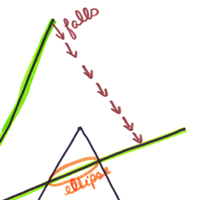
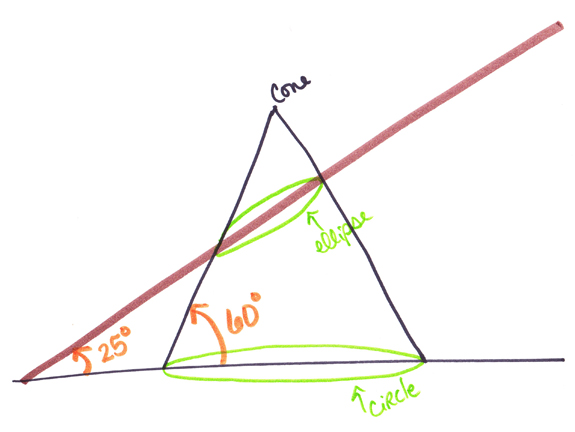
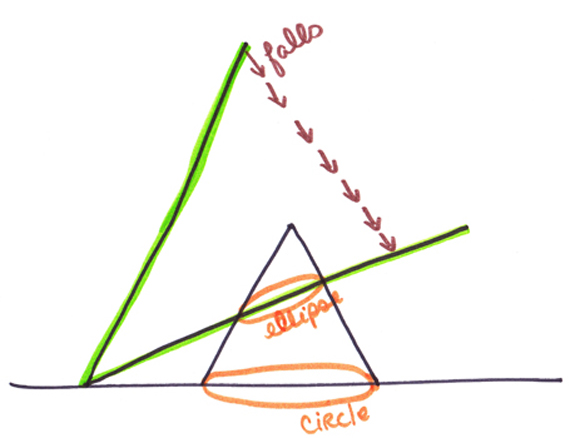
    For the mathematical shape, or graph, an ellipse is created when a cone is cut by a line whose angle is less than (or falls short of) the angle of the side of the cone to the bottom of it. (#ARG, I know. Check out the pix.)

    The brown line that creates the ellipse has a 25° angle which is much smaller than the 60° angle between the bottom and side of the cone:
    You can see it “in action” here with the line falling:
    Hyperbola and Hyperbole

    A hyperbole is the fancy English grammar term for exaggeration. Everyone use hyperbole all the time! (See what I did there…?)

    And a hyperbola in math is the graph/shape that looks like the light beams from a two-sided flashlight.

    Both of these words come from a Latin word that means extravagance or “throwing beyond.” You can see how an exaggeration (a hyperbole) is throwing beyond. But what’s up with the math word, hyperbola?

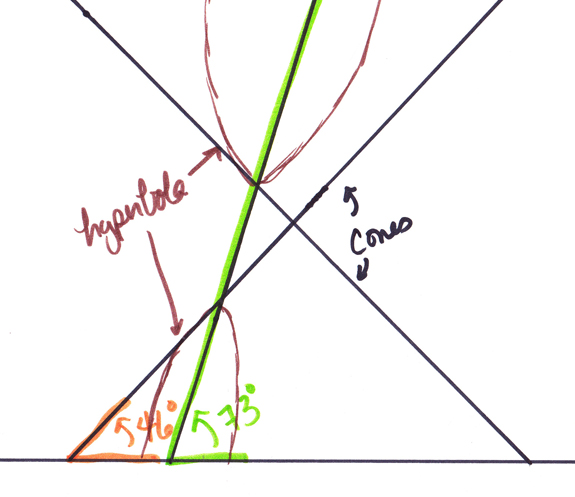
    We look to the angle of the cutting line again. A hyperbola is cut from a cone (actually stacked cones — see the picture) with a line who’s angle is “beyond” or more than the angle of the side of the cone to the bottom. It’s just the opposite of the ellipse!

    Check it out: (This one is somewhat drawn to scale so you can really see what’s going on.)
    Are there more?

    These are the only two that have bugged me through the years. But now I’m wondering if there are other math words that have cousins over in the English department.

    Any ideas? Let me know in the comments or via twitter/x, would you?

    You might also like:
  • The Man in the Arena

    The Man in the Arena

    This quote, by Theodore Roosevelt, is from his speech “Citizenship In A Republic,” delivered at the Sorbonne, in Paris, France on 23 April, 1910:

    It is not the critic who counts; not the man who points out how the strong man stumbles, or where the doer of deeds could have done them better. The credit belongs to the man who is actually in the arena, whose face is marred by dust and sweat and blood; who strives valiantly; who errs, who comes short again and again, because there is no effort without error and shortcoming; but who does actually strive to do the deeds; who knows great enthusiasms, the great devotions; who spends himself in a worthy cause; who at the best knows in the end the triumph of high achievement, and who at the worst, if he fails, at least fails while daring greatly, so that his place shall never be with those cold and timid souls who neither know victory nor defeat.

    If you’re in tears and your heart is on fire, you’re probably a soldier in the Math Revolution.

    Share your thoughts in the comments or on twitter/x.

    You might also like:
  • Math Basics — The Real Ones!

    Math Basics — The Real Ones!

    I hear often that the “basics of math” are important. What people mean is that kids should memorize their math facts.

    The basics of mathematics that are required for a student to learn and do mathematics aren’t math facts. They are these: Logic, Joy of Failure and Familiarity with Math.

    1. Logic

    Children start learning what an if/then statement is at an early age:

    If you clean your room then you can go to the park and play.

    The more parents have normal conversations with their children, the more children will understand the other subtleties of logic — like negation, contradiction and contrapositive. We all understand these, even if we don’t know the proper math words for them:

    • Negation: “I am not going to listen to you whine!”
    • Contradiction: “That dog is green.” (and K8 says, “Nu-uh! That dog is brown!”)
    • Contrapositive: “Oh, I see you’re not at the park. I guess you didn’t get your room cleaned!”

    Once the basics of logic are understood, a child is able to pick up a calculus book and work through it. At any age!

    2. Joy of Failure

    Teachers often well rehearse their lectures before they present them to the students. The struggle and failure that he or she goes through figuring out how to smoothly demonstrate the problem is kept from the children. Teachers know the job of failure, but they keep it hidden.

    Thus children believe that failure is not an element of mathematical thinking. And nothing could be farther from the truth.

    Parents can support their children in finding the joy of failure by allowing them every opportunity to attempt, reattempt, and fail at everything.

    Promoting failure is tough, but important.

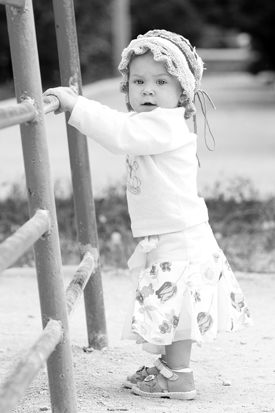
    If your toddler is trying to climb a ladder, resist the urge to jump in and help. The more the child fails a climbing the ladder, the more insight he or she will gain into what else might work. (Like different hand positions, different footing, etc.)

    You helping them climb the ladder might get them to the top faster, but resisting helping them (until they ask at least) will help them get used to learning from failure.

    Mastery may seem a pleasant goal, but it merely means there is no more learning to be done and it’s time to move onto something else. Don’t give them a false sense of mastery — let them learn the joy of failure.

    3. Familiarity with Math

    Children are quite confident and very engaged in learning the craziest things. It may be how to skateboard, how to make funny noises or how to repair their bike. One of the reasons they are competent and engaged in these activities is because they are familiar with them. Everyone is doing it!

    It’s difficult to be fearful of something that you see as a normal everyday part of life.

    Parents can help children gain a familiarity with math by pointing out where they themselves use math every day.

    This can be challenging to some parents, because they truly believe they don’t use math. But finding where the math is — and saying it out loud — will help your children a great deal.

    How are you doing?

    Do you talk to your children and let them read users’ manuals? (This promotes logic.)

    Do you let your kids mess up? (Helping them find a joy of failure.)

    Do you talk math to your kids? (Showing them how math is everywhere.)

    Will you start?

    Share your thoughts in the comments or on twitter/x.

    You might also like:
  • Ruler and Compass Construction: Perpendicular Bisector

    Ruler and Compass Construction: Perpendicular Bisector

    I started the ruler and compass series a while ago and am just now getting back to it. Here is my construction of a perpendicular bisector of a given line segment.

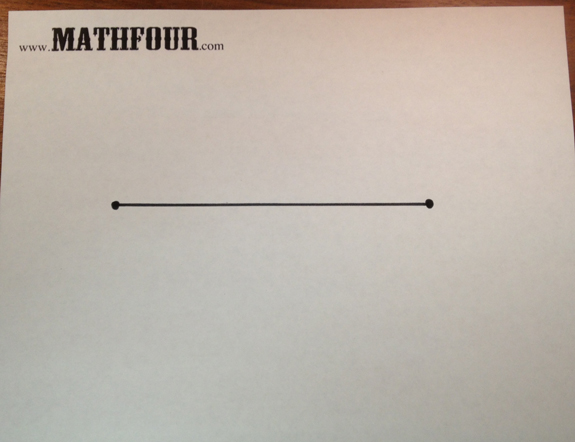
    First, I drew a line segment:

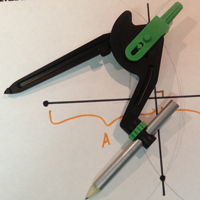
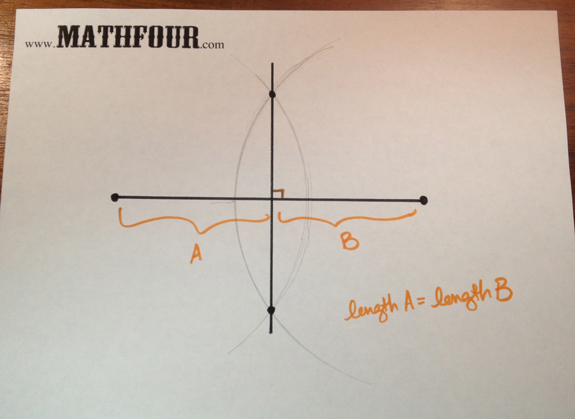
    Using my compass (which quickly gave out on me), I made two big fat arcs. They have the same radius — this is important.

    Where those two cross, I drew a line. That line is the perpendicular bisector of the original segment (which means it makes a 90° angle and splits it into two equal parts):

    Why does it work?

    Well, that’s a great question. I’m sure there’s some proof of why this actually results in splitting the original line segment in half with a perpendicular line. I’ll have to think on it more.

    But intuitively it totally feels right.

    Now that’s a bad way to proceed with math, but it’s a great first start!

    How about you?

    Do you like to play with ruler and compass constructions? Do you know why this works?

    Oh — and if you don’t have one, buy a compass here (that’s the one I just bought to replace my junky one).

    And I also ordered this cool book about Compass Drawings — I’m so excited!

    Share your thoughts in the comments or on twitter/x.

    You might also like:
  • Riddle: What are the ages of the kids?

    Riddle: What are the ages of the kids?

    I met the dad of a homeschool family on the plane yesterday who told me a riddle. Now that I’ve enjoyed solving it, I thought I would share it with you:

    Two math moms, Lisa and Gwen, are carpooling to a play date with Heather. Lisa is telling Gwen about Heather and her family. The conversation turns to the ages of Heather’s three children.

    Lisa says, “If you multiply their ages together, you get 36.”

    Gwen says, “How nice, but that doesn’t give me enough information to determine their ages.”

    “Good point. If you add up all of their ages, you get that house number,” Lisa says pointing to a house.

    “Interesting,” Gwen says, “but that’s still not quite enough information.”

    Lisa says, “Well, you’ll meet two of them soon. But the oldest is with her grandma.”

    “Oh, great,” Gwen says, “They’re perfect ages to play with our kids!”

    What are the ages of Heather’s kids?

    The end of the riddle is “what are their ages?” But the real value in the riddle is the logic and work it takes to arrive at the final answer.

    The “answer” is easy, but getting there (or explaining how you got there) is much more challenging.

    There’re not that many possibilities. So the trick is to imagine what each mom is thinking as they talk. What makes Gwen think, “that’s not enough information”?

    Share this with your children.

    Tell this riddle to your children. Let them play with it. If they get discouraged and want a hint, ask them these questions — one at a time — and see how far they can get:

    • What are all the possible answers? In other words, what sets of three numbers can multiply to give you 36?
    • Lisa points to a house number. What are the possible numbers that are the house number?
    • Go through each possible answer and imagine what Gwen was thinking when she said, “that’s not enough information?”

    And there’s more…

    When your child solves the riddle, see if he or she can try to replicate it with other numbers. What kinds of things do you need to make another riddle just like this one, but with other numbers?

    And don’t forget to share what happens in the comments below or on twitter/x!

    (P.S. I’m specifically not giving the solution here because I believe it’s valuable to find the solution independently. If this angers you, tweet me and I’ll give you the answer.)

    You might also like:
  • The Butler Stick  — A New Use for an Old Tool

    The Butler Stick — A New Use for an Old Tool

    I’m at the Domestic Estate Manager’s Association Convention this weekend with Husband and I’ve discovered a marvelous math tool. It’s called “The Butler Stick” and it’s used by butlers and other domestic service personel — mostly.

    But there’s a lot of math in it — enough to integrate The Butler Stick into your world as another learning tool.

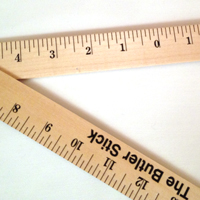
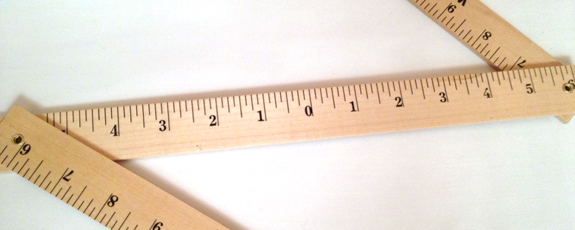
    On one side it’s a yardstick.

    The Butler Stick has thirty six fun inches to measure just about anything. It’s foldable, though, so you can store it like a standard ruler.

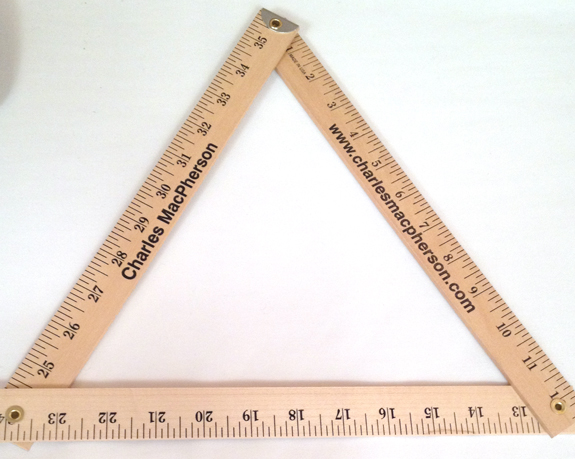
    You can show an equilateral triangle with it, as well play with various angles.

    On the other side it’s a number line!

    Okay, so it’s missing the negative signs on the left, but those are easily added with a sharpie.

    The Butler Stick is typically used to set a table. The plate is centered at zero, and from there you can symmetrically lay out the flatware and other bits.

    You can use it to teach proper place setting (something every child should know) and inject some math into dinnertime!

    You can also use it to create other things of symmetry. Use it to have fun with math during art lessons.

    Treat your family to one!

    They sell The Butler Stick at Charles MacPhearson’s site, but you have to call to order it (416-369-1146). It’s not cheap, at $24.95, but it’s well made and looks like it would take a beating from a few children. (But not give a beating!)

    Or you could try it out for a while by making your own. Use some some cardboard and rivets and you’ll be able to see the value of it. It’s a crude version, but the math’s the same.

    Once you see how cool it is, you’ll be calling them up — just like me!

    Share your thoughts in the comments or on twitter/x.

    You might also like:
  • Math Quote Cryptogram: Trapped

    Math Quote Cryptogram: Trapped

    This is the third in the Math Quote Cryptogram series.

    This series is inspired by the Dszquphsbnt! cryptogram puzzles in GAMES Magazine that I used to play with my dad.

    If you need help solving it, check out Cryptograms.org for instructions.

    Click here for a printable version of Math Quote Cryptogram #003
    Print it, work it, tweet it and let me know what you think!

    And since it’s based on a famous book, you might consider buying and watching the movie version. (And look out soon for a review on it!)


    The Puzzle: “Trapped”

    Q R R   L X   Y E   Q I V   E R Q Z V E   K L   K S V

    D I V O Y G C P V E   L X   L Y I   L U T   G C J V T E C L T .

    — K S L J Q E   N Q T P S L X X

    (C T   K S V   C T K I L G Y P K C L T   K L   X R Q K R Q T G)


    Share your thoughts in the comments or on twitter/x.

    You might also like:
  • Chutes and Ladders  — It’s a Math Game!

    Chutes and Ladders — It’s a Math Game!

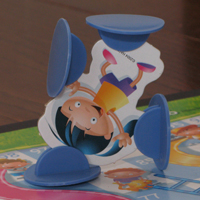
    I was playing Chutes and Ladders with K8 the other day when I noticed something. It might seem a little obvious, but I just saw it.

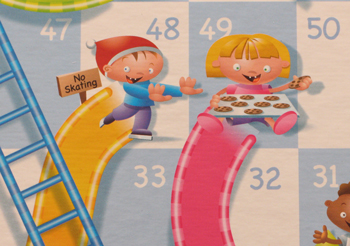
    Chutes and Ladders is played on a Hundreds Chart!

    It is! And as you look at it, and play it, you can see it’s totally a math game.

    You can practice numeracy with your children by counting up from a number. In Chutes and Ladders, if you’re on space #46 and you spin a three, you count up three: 47, 48, 49.

    The whole game is numeracy practice like this.

    It’s even good for the bigger kids.

    Sometimes big kids don’t want to play the little kid games. In Chutes and Ladders, the big kids have the opportunity to calculate how big the loss is on a chute. And how big the gain is on a ladder.

    Get freaky with your rules!

    You can also team a big kid with a little one and create some house rules. After spinning the wheel, the team gets 5 seconds to calculate the number square to which they’ll advance. If they get it right, they get a bonus of a free spin or to skip over any chutes.

    And if you really want to get advanced, choose a new function at the beginning of each game. Like SPIN + 2 or 3 x SPIN + 1. After spinning the wheel, the team gets 5 seconds to calculate the number square to which they’ll advance using that formula! If they can’t do it, they only get to advance the number of spaces on the original spin.

    You can make your own!

    And don’t forget you can make your own game using an $.88 Hundreds Chart that you can find at your local teachers’ supply store. Break out the construction paper, scissors and glue and start creating some Chutes and Ladders on it.

    And please share your photos and house rules in the comments or on twitter!

    You might also like:
  • Math Picture Book: Perfect Square

    Math Picture Book: Perfect Square

    This is part of the Math Picture Book series.

    I rounded the corner at Barns & Noble one day and and this beautiful math picture book looked me in the eyes.

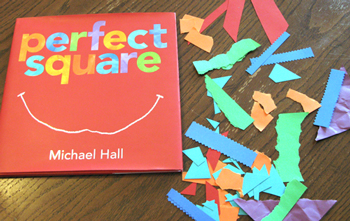
    I just couldn’t resist buying Perfect Square by Michael Hall!

    And what a treat it was!

    It’s inspiration for math crafts, playing with color and patterns and talking about shapes — all in one neat little package!

    A happy little perfect square gets cut, torn and shredded over the course of a week. But this optimistic shape uses the “abuse” to make itself into new and fun things each time.

    Construction paper and scissors…

    I made a bunch of squares from construction paper to start. With each page, I replicated the images.

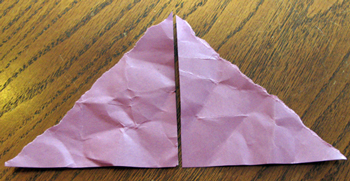
    One day the square gets cut into two triangles and crumpled up. So it makes itself into a mountain. This one was fairly easy.

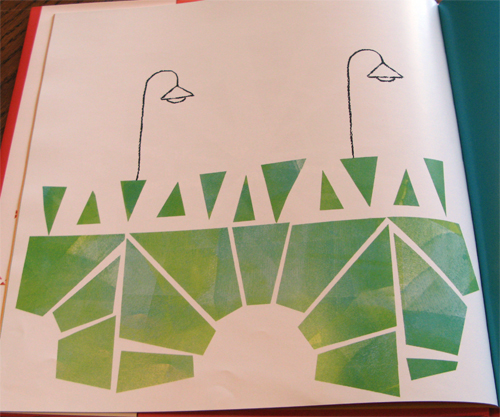
    Another day it was shattered, so it made itself into a bridge. The shattering resulted in 24 pieces — each a triangle or trapezoid. It was especially hard to do, so I’m sharing a picture of the bridge in this math picture book.

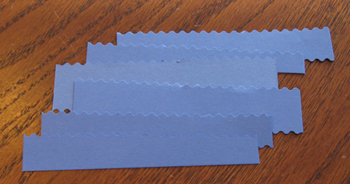
    Another day, Perfect Square was cut into ribbons with crinkle shears and makes itself into a river. Long thin “mostly” rectangles were fun to do when I found my old scrapbooking scissors.

    Are you ready to play?

    I had a great time cutting each shape and seeing how I could replicate the images in the math picture book, Perfect Square. Some were easy, some were hard.

    What can you do? What can your kids do? I’ll bet their creative minds go all over the place!

    Share in the comments or on twitter/x.

    You might also like: