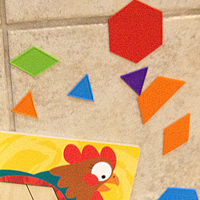
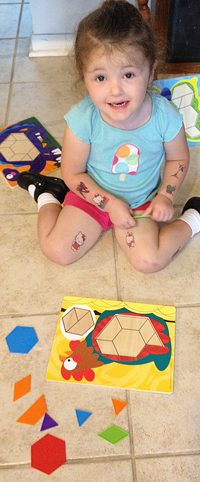
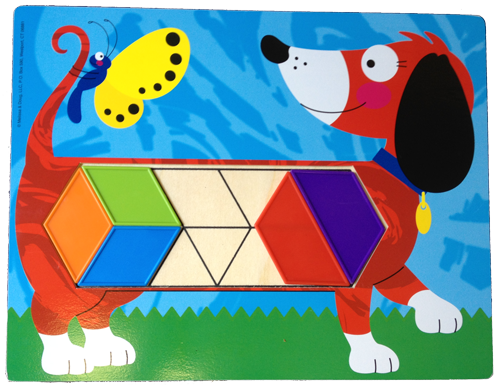
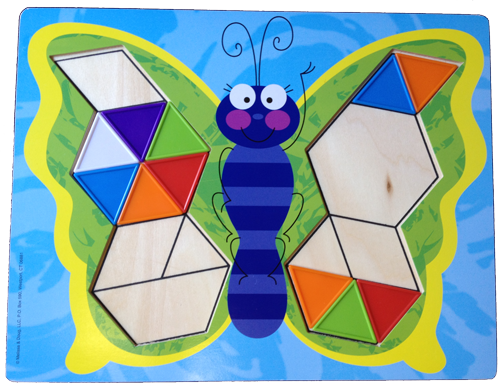
It has ten different animals (on five two-sided boards) and over 50 plastic shapes in tons of colors to complete the pictures.
Use it to teach more than just shapes.
Of course you can talk to your toddler about hexagons, triangles, parallelograms (which are also rhombuses in this math toy) and trapezoids. But you can do even more!
All the shapes can make the bigger ones. So it’s not just a bunch of shapes that may or may not work – this toy is designed with some serious thought.
Here are some questions you can ask while playing:
How many of each shape can squeeze into a hexagon?
Pick a shape and cram them into the hexagons!
How many triangles fit in each shape?
This is huge in math. Since all shapes can be made of triangles, answering this questions preps your little one for some big geometry stuff.
And after you play with those a while, you might notice how the number of sides of a shape compare to the number of smaller shapes that can fit in it.
Who said it first? Maybe Jerry Mortensen. Maybe George Phillips.
But hundreds, maybe thousands, of math teachers have said it and put it on their syllabus.
Because it’s true.
But does this mean that students have to “practice, practice, practice”?
And what exactly does that mean?
Say to me “practice, practice, practice,” and I’ll growl at you.
You’d might as well say to me, “I don’t know squat about your learning style and aren’t interested in finding out. But I know that you’d better do all 50 problems or you’ll lose points on your homework grade.”
So I prefer to think of this triad mantra in three phases: Practice Phase 1, Practice Phase 2 and Practice Phase 3…
Practice Phase 1 is isolated practice.
When a student learns a new math concept, he or she should apply it a few times, by itself. This is what’s offered in the problem sets of textbooks: isolated practice of the new math skill.
This practice is also an assessment phase. At many points here, the student can ask, “Can I do this? Do I understand this?”
Regardless of the answer, the student can proceed to Practice 2.
Why “regardless of the answer”?
Practice phase 1 is what’s commonly referred to when grownups say “practice, practice, practice.” But over practicing can be detrimental.
Some kids need to nail the isolated practice before moving on.
Some kids.
And some kids will become annoyed with it and need to move on to see the value of the skill.
Refrain from giving 50 problems just because “practice makes perfect.” It doesn’t. Practice sometimes makes frustration.
Let your child move on to practice phase 2. You can even let them skip assigned problems. She or he may return to the isolated practice in phase 1 later or mentally isolate the skill within the “bigger picture” in phase 2 or 3.
Practice Phase 2 is “big picture” practice.
This practice phase helps solidify the math skill. It should teach the integration of the skill into the full toolbox of math skills.
The math skills ancillary to the main skill being practiced, are themselves being practiced (hopefully in phase 2 or 3). How fluent a student is in these ancillary skills has an impact on his or her perception of achievement of the main skill.
Textbooks offer a problem set for this phase, but it’s often disguised. It just looks like harder problems.
It’s helpful to point out the ancillary skills being practiced. This helps affirm how much a child is learning and aids in building confidence.
Practice Phase 3 is ongoing.
Real skill is realized when it’s integrated without thought. For me this was always at least six months after first learning a skill. Sometimes it happened years later.
And there are some things I didn’t “get” until decades later.
Which means that practicing a skill must be continuous – even if a student doesn’t fully understand the logic underlying the process.
Of course this phase is subtle if not completely invisible. But instructors can point out when the “old skills” come into play long after they are learned.
Example: Factoring
Skill: Use the distributive property to remove a common factor from an expression.
Practice Phase 1 – Isolated
\(3x + 3y = 3(x + y)\)
Or with letters:
\(xy + xz = x(y + z)\)
Practice Phase 2 – Big Picture
Here the skill is integrated with factoring numbers:
At some point a student might notice that combining like terms is equivalent to factoring the common term then combining the numbers, like this:
\(3x + 5x = (3 + 5)x = (8)x = 8x\)
So, really – how much practice and when?
A student should practice in phase 1 until he or she is comfortable. Remember, over practice can be annoying and seem punitive.
And punitive math is never effective.
A student should practice in phase 2 based on his or her comfort level. This is a great time for parents/instructors to notice weaknesses in other skills, too.
Practice phase 3 is, well, ongoing.
It’s really helpful to note, out loud, where old math skills come into play. Instructors should always be on the lookout for ways to do this.
Even things like long division show up in the more advanced skill of polynomial division.
Pay attention to your student.
Some kids may respond to the “practice, practice, practice” mantra. Some may get annoyed at it (like me). If your child needs and wants more top-down learning, allow it.
Don’t force phase 1 practice – offer it.
And if you see a deficiency in an ancillary skill in phase 2, bring them back to phase 1 on that one.
Math really isn’t a spectator sport. But that doesn’t mean you have to drill like crazy on it. Adjust the teaching and practicing according to the child.
We don’t teach each new math skill just to have something to do during the next math lesson. And yet textbooks make it look like we do.
Math skills are presented in bubbles called sections. The section doesn’t show how the math rule being taught connects to past or future lessons. Nor does it point out what previously learned skills or rules are currently being employed.
Okay, it might note that this section is similar to the others in the chapter. But how often do you see a section point out how you’re going to use the skills you learned in a previous course?
Kids rarely understand that each level of math is taught so that the tool that’s being practiced can be used later – in another math lesson or math situation.
They don’t see the long term growth of math skills and math maturity – their math toolbox.
Math skills are tools.
Take a look in any man’s garage and you’ll see a plethora of tools.
Point one out and ask the owner these things:
What is this?
Under which situations will it function (and under which won’t it)?
In what situations would it be helpful to use?
Do you have the confidence and ability to use it when you need to?
Have you ever used it when there was something else that would’ve worked better?
Chance are, he’ll have thorough answers for 1, 2 and 3. And for number 4 – he’ll look at you like you’re nuts and say, “Well, yeah!”
For number 5, he’ll say, “Well, of course. Sometimes I’m not sure what will work best, so I just pick a tool that I know can work. If it turns out to not be the best tool for the job, it’s no big deal. It might have taken a little longer, but it still got the job done.”
Tools accumulate – and add to each other.
Mr. Garage Owner didn’t collect a whole bunch of tools that he’s clueless about. He likely wanted to build one thing and realized a tool could help. So he bought it.
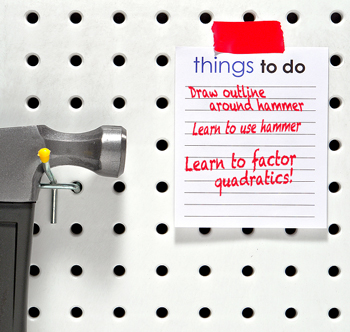
He learned how to use it, then hung it on the wall. Probably on a pegboard with the shape of the tool outlined.
Then he wanted to fix something else. He could have used his tool, but if he had another tool as well, it would make it even easier.
So he bought another tool.
Together with the first tool, he fixed his gadget then hung the new tool on the wall.
He continued this way until his pegboard was full and he was building more tool storage space in the back yard.
Now he knows each tool, when and how to use them, and confidently pulls them out each time it’s necessary.
And if he chooses the wrong tool for the job, he gets over it quickly.
Teach math like the kids are accumulating tools.
When you start a new section in your math lesson, review the math rules that they previously learned. Show how the newest problems may (or may not) be solved with the old math skills alone.
Present the new skill or math rule thoroughly. Be clear on what it is, how it can be used and under what circumstances. Also point out where it can’t ever be used. Like “adding to both sides” can’t work when there’s no equal sign.
Point out some areas where the new math rule might be helpful. Point out some areas where the new rule might not be the best for the job, but it would still work.
Show how to use the new math rule along with the old rules (pointing them out everywhere) to achieve results.
Have them make a list of all the math skills they’ve learned – a pegboard outline – so they can be kept handy.
Let them play.
Math is typically thought of as the subject where “there’s only one way to do it.”
BAH!
Just like Mr. Garage Owner, using the non-optimal tool for the job still gets the job done. As long as it works (can’t run an electric drill in the rain, after all).
So let them play. Turn your math lesson into a time where they can use any math rule they want. Let them discover their own confidence in choosing tools.
And let them try out tools that might not be the best for the job.
As they grow their math toolbox, they’ll grow in math maturity and confidence!
I’m on a counting roll. I’m not sure, but it could be because this song is stuck in my head. It plays all the time on Sprout TV, the channel where my other addiction is – Lazy Town.
Don’t press play unless you want it in your head. It’s very catchy.
Which means that the probability of randomly guessing and winning is 0.0000000000582076609.
That’s, well… pretty small.
And if I gave it a shot (to randomly guess) it would take 544 years to go through all the options (if I could submit a new answer set every second).
By that time Ree would have given someone else the iPad and everyone involved would be dead.
But… can I win anyway?
No sense in guessing from the start. I’ve already decided that it would take too long. So I need another tactic.
Thus, I need to know other things about this quiz.
FACT: I get immediate feedback on what grade I make.
That might be helpful.
Doing some testing I can determine that…
FACT: I get no points for entering my name and email address.
Seems dumb, I know, but if I get points for name and email, then I have to keep putting them in while I do my experiments.
There are some things I know!
I know that the 10th letter in the Greek alphabet is kappa (it’s a math thing), so I go for answering only question #5 and find…
FACT: I earn 6% for a correct answer on #5, with no other questions answered.
I remember that Juliet gets mad that Romeo drank all the poison, so I go for #7 as “a dagger.”
FACT: I earn 6% for a correct answer on #7.
So it looks like each question (other than name and email) get 6 percentage points. But 18 * 6 = 108. Way more than 100.
Curious.
Now I do what all good mathematicians (and cheaters) do. I wonder…
CONJECTURE: I’ll bet the two yes/no questions are only worth 2 percentage points.
I recall Katherine Hepburn being married to just about everyone. So I answer “true” to #14. I get ZERO percentage points. So I try again with the opposite.
FACT: Strangely, my conjecture was wrong. I got all 6% for answer “false” on #14.
So I do more experiments!
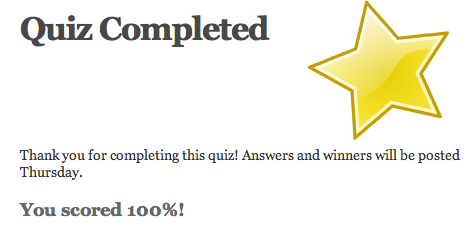
It takes me less than two hours to experiment and get a 100% on the quiz. Significantly less than 544 years.
I gave myself the gold star!
“How can I use this with my kids?” you ask?
Ah… there’s the kicker!
Math isn’t just about numbers and books and getting the right answer. Math is about figuring stuff out.
It’s about wondering, guessing, playing. It’s about conjecturing and getting stuff wrong.
And it’s sometimes about brute force – getting your hands dirty and finding out what the heck is gonna get you to success.
Play a game or take a quiz.
The next time you and the kids have an opportunity to play a game or take a test or quiz, see how you can do it without really doing it. Point out that the logic behind things is really just math.
I’ve never been a believer in the real number line. It just always felt wrong that between any two numbers, there’s another number. Sure, you can go between two things – but is there a number there?
And then I think, “Well, add up the numbers you’re standing between and divide it by 2 – that’s the number between them.”
But it still doesn’t feel right.
I could be onto something, though.
I listened to Episode #110 of Stuff To Blow Your Mind called “Is math a human invention or a human discovery?” They pointed out that tiny babies can perceive quantities.
“Curious,” I thought.
Then I peeked at their math series, in particular the article on What are Numbers? Which led me to Stanislas Dehaene and his appearance on RadioLab’s episode on Innate Numbers.
Here’s the discussion.
I was particularly interested when they noted (around minute 11) that we don’t naturally switch from logarithmic thinking to this 1-2-3-4-counting we do now!
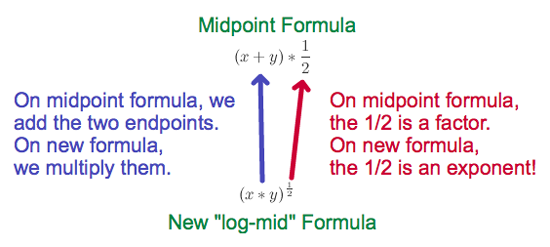
Around minute 12 in the audio, they consider the idea of midpoint. Dehaene notes that in logarithmic thinking, the midpoint between 1 and 9 isn’t 5, but 3.
The midpoint between 1 and 9 is… 3?
Here’s how we think of the middle: “What do I add to 1 twice to get 9?”
We can add 4 to 1, twice, to get 9. So then we add it only once to get halfway there – and halfway there is 5.
(Of course this leads to a whole ‘nother discussion about how the square root is really just “half” with respect to multiplication. But that’s going a bit to far for this article)
And the bigger the numbers, the more “ish” things become. And apparently, that’s okay!
So maybe we do have it wrong.
I’ve told thousands of students over the years that mathematicians just make this crap up. There’s no truth to that “mathematics is the universal language” hoo-ha that they feed you in the movies.
Leopold Kronecker noted:
God made the integers; all else is the work of man.
And just maybe man has messed it up.
So is there really a number between any two numbers? Or is there just something “sort of” between any two numbers?
What does this mean to math learners?
Okay – now the bottom line. What does this mean to grownups teaching math – and the kids learning math?
These little super heros have amazing powers – right when they’re born!
Well – one thing is that we grownups can lay off. Let the kids learn their own ways. Let them inquire, discover and develop their own methods for doing things.
If they’re logarithmic thinkers (which they are from the start), let them ride that wave a while.
Also, remember that we, the grownups, have been conditioned out of logarithmic thinking. Which means that their way (the natural way) seems wrong.
But we are the ones who are wrong.
So if your kids don’t believe what you’re feeding them. Let them doubt. They’ll learn enough eventually to pay their rent, balance their checkbook and meet their friends halfway.
This is the 7th in the draft purge series where I’m throwing stuff out over a three week period.
Rules often leave out the details.
Don’t drink alcohol and drive a vehicle in public, simultaneously. Find a common denominator, when adding fractions. Do it to both sides of the equal sign. Multiplication comes before addition in arithmetic. Find a point using slope from another point on the line.
This is the 6th in the draft purge series. It was first drafted in May 2011. If you have examples of this type of math puzzle, please include them in the comments.
Since the first time I used email back in 1991, people have sent me various versions of the puzzle “I can guess your birth year.” The results end up as something like:
This year (and this won’t work for any other year)
Your phone number
Your birth date
Your favorite number and the year you were born
Your blood type
Okay, that’s exaggerating a little. But it seems like these puzzles get wilder and wilder.
When I receive these emails, it’s usually from a family member with the preface: “Can you tell me how this works?”
So I’ve dissected tons of these over the years. And I’ve always thought, “You know – I could totally make my own math puzzle like this!”
You can invent your own math puzzle!
The trick to this math puzzle is to add zero and multiply by one in clever ways.
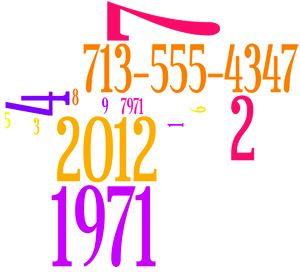
First you pick the result you want. Like the last four digits from my childhood phone number: 4347.
Factor it into primes, if you can. Let your kids do this by hand if you want them to have practice on factoring. If they struggle, you or they can calculate the prime factors using an online service like this one.
Mine is: (3)(3)(3)(7)(23)
If you can’t factor into primes, subtract a single digit number and try it.
Like 4349 – it’s prime, so subtract 2 and then use that to do the rest of this.
At the end of the whole math game you’ll just need to put one more step that includes subtracting this number.
Start constructing the math game.
The starter line for your game will be “Choose a single digit number from 1 to 9.”
We’re going to construct our game using this, with x as the chosen digit.
I’ll keep going until I have a nice set of instructions. Then I can do this on my Ma, Paps, my siblings and all my childhood friends that remember that phone number.
And it’s a great learning tool!
Kids will learn and practice order of operations and algebra. At the same time, they create something they can email or perpetrate on another person – preferably a grown up – and impress them!
GeoGebra bills itself as “Free mathematics software for learning and teaching.” Indeed the intent is learning – but the market for the software is teachers.
Which means grownups are using it and then making kids use it. And we are using it as if we know what a student needs to learn math.
And I worry that a powerful tool like this can easily turn into another way we can tell students:
Here, do this. It will help you learn math because it’s hands on. Make sure you follow the instructions so you can discover what you’re supposed to.
But we don’t have to let it!
The objectives are the current focus.
In the classic backwards way we teach, the “lesson plan” might go something like this:
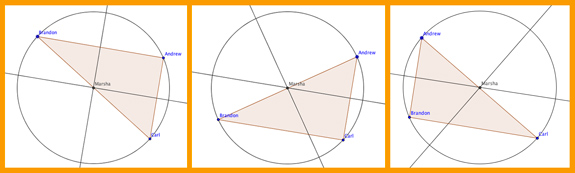
We need to learn that the center of the circumcircle around a right triangle is the midpoint of the hypotenuse. So I’ll give them the steps to draw a circumcircle. Then I’ll teach them how to move the vertices.
I’ll construct specific questions to lead them to discover that the center of the circle will be the midpoint of the hypotenuse. They’ll certainly get it then.
And what if they don’t “discover” it on their own? It becomes another performance based failure. And then the teacher discovers it for them.
We can refocus on discovery!
I discovered math when I used GeoGebra. Math I never knew.
I loved watching the circles and triangles dance. From that I saw that when my point “Marsha” is on each of the sides, it appears she’s on the midpoint.
But I wasn’t answering any questions about it. I followed the instructions to draw the triangle and the circle. And then I played.
There were no leading questions. Nothing I had to “get right.” I just had fun.
Try it in class.
Suppose you gave your kids exactly what I had – instructions to draw the circumcircle and how to use the Move Tool.
And left it at that.
Would some students discover the hypotenuse/center thing?
Sure!
Would other students not?
Yepper!
And that’s okay.
I’d never heard of a circumcircle. I know “circumscribed” – but not circumcircle or circumcenter. And I’m doing pretty well mathematically.
If a child discovers something, that’s a win. If they don’t – well that’s NOT a loss! Let it go.
It’s not your job to discover it for them. No matter what the Common Core Standards or TEKS say.
See what happens…
Restructure your lesson plans. See if you can give lots of different “how-to” sheets on drawing stuff on GeoGebra. And see where their curiosity takes all of you. You just might be surprised!