This is the 5th in the draft purge series where I’m throwing stuff out over a three week period. One month after starting MathFour.com, I came across an article about GeoGebra. I was quite taken by the software, but a little overwhelmed.
I’m not much into technology — at least when it comes to math. So the power of the tool was much more inhibiting for me than it was empowering.
So the review of it stalled.
Indeed this article was first “drafted” back in March of 2011 — more than a year ago. It only had the link to that article in it. Not much of a draft.
Lucky for us, math is math. It doesn’t change much over a year (or even a few hundred years).
So GeoGebra is pretty much as useful (and as scary) as it was a year ago.
But like all good heros, leaders and people stupid enough to think they might be either, I’m diving in. Regardless of my fear.
First: Get out the users’ manual.
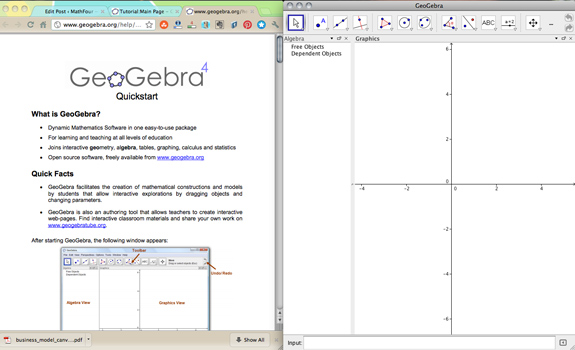
So I found the GeoGebra Quickstart guide and started reading. I downloaded GeoGebra and cranked it up.
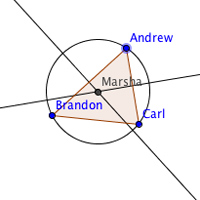
The Quickstart has three examples to try. The first one is un-intimidating — merely involving a triangle and a circle.
So I did it.
And I can share it, too!
Turns out you can “share” your work on GeoGebra — those guys are pretty clever, I must say!
Following the directions, I learned about the Move Tool. Which means you can move just about anything — the whole triangle, the circle or any of the vertices!
Check out the “dance” I did with my circle and triangle:
I’m looking forward to playing some more. But I still have my concerns.
I’ll share those tomorrow. For now, I’m just going to enjoy the tool!
How about you?
Have you played with GeoGebra? Will you? How do you use it? Tell us in the comments.
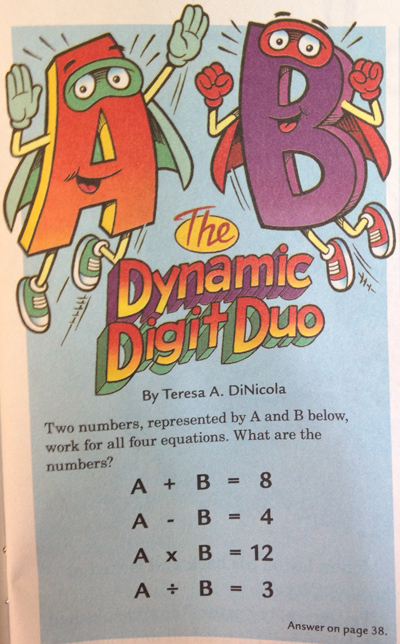
The March 2012 edition of Highlights magazine for kids fell in my lap this morning. Thumbing through it, I found a fun little algebra puzzle.
After looking at the equations and discovering my solution, I began to wonder some things. Then I realized that these ponderances of mine were good for kids to consider as well.
Let the curiosity flow!
Here are the extra questions you can offer your children in case they’re curious:
Did you use all four equations to decide your answer?
Could you have used three, two or only one of the equations to decide your answer?
Try to use only one equation to decide an answer. Did you discover anything?
Try to use only two equations. What did you discover now?
How about three – what happens when you choose three equations?
Can you make a puzzle like this of your own?
How about you?
As a grown up, what do you discover about math in this Highlights puzzle? What do you see your children doing with these extra questions?
This is the 4th in the draft purge series where I’m throwing stuff out over a three week period.
Discalculia (pronounced dis-kal-COOL-yu) is the official word meaning a learning disability in math. Some think that math anxiety is just another way of saying discalculia. Maybe because people with this learning disability often have math anxiety.
But you can certainly have math anxiety without having discalculia. I did once. So it’s not exactly the same thing.
Here are some resources and descriptions you might find helpful. If you have 8 extra minutes, watch the video at the bottom – it’s a super great intro!
This is the 3rd in the draft purge series where I’m throwing stuff out. I’m down to 56 drafts – down from 70! (not factorial)
I’ve taught in the classroom for over 17 years. I never hesitated to give my phone number out. In all those years, with all those kiddos, I got one drunk call. And that was an accident – he meant to call Ben and not Bon.
It was a good idea. And I’ve had good results.
So why should you do it?
To show you’re human.
If you teach math, you just might be viewed as supernatural. Or inhuman, depending on the student. Famous, important or supernatural people don’t just give out their phone numbers willy-nilly.
If you give yours, you’re showing your human side. You have to keep the authority, but you can give a little. Let them in.
To offer a ray of hope.
They will probably be nervous about calling, but they’ll text. And they’ll understand if it takes you a while to get back to them. If they have this lifeline, they won’t lose the confidence
they have gained in your presence.
I’ve heard hundreds of students say, “I was doing okay in class, but when I got home, I just couldn’t understand what I’d been doing.”
There’s a magic of the teacher standing there. It’s a safety net. And it gives many students the confidence they need to keep going.
It’s a fake net, but it works.
If they know they can text you, they maintain this safety net at home.
To show trust.
For some reason, classrooms have gotten into the “us vs. them” mentality. Teachers are the bad guys to the students. Teachers may label kids unfairly, too.
Show your students you’re not a label maker. Let them know that you have trust and faith in them. Give them your number!
Will you do it?
How do you show you’re human? How do you give hope and show trust? Will you try the phone number sharing?
Let me know in the comments and don’t forget to share this on twitter!
I put this list together on Amazon when I was teaching at the Art Institute of Houston back in October 2002. I wanted the library to purchase a few – but they bought them all!
It was fun to go through the list and see what I’ve read and haven’t read. And what’s still around!
My latest accomplishment – getting rid of 50 things from this (now neat) bookshelf!
Of course, I haven’t read it – inspirational books like this only need me to purchase them to apply their basic principles.
But I have thrown out multiples of 50 things in the past few weeks. All because of this book!
“What’s that got to do with math?”
Great question; I’m glad you asked.
Well, for starters, “fifty” is a number. In particular a positive integer.
And if you buy this book (adding one more thing to your pile of stuff, as Husband points out), then you probably have at least 50 things you can throw out.
Which means you have way more than 50 things.
How many things do you have?
Take a quick inventory. No – not of everything. But just of what you see right in front of you at this very moment.
Chances are you stopped counting and started estimating at around 50. Then you stopped altogether at around a few hundred.
Even if you divide this by two (if you’re married or partnered) that’s still a ton of stuff.
“Things” are more than what you see.
Now take a quick peek at your email. How many things are clogging your inbox?
If you’re online, I’ll bet you have a plethora of people you’re friends with and following.
And if you write a blog… look at how many drafts you have.
So throw out fifty things.
Well, make sure to recycle them or donate them. But get them out of your world.
If it helps, think of how many thousands of things you have. If you have 500 things in each room and you have ten rooms, that’s 5000 things.
Throwing out 50 of those is 1% of your stuff. That’s practically nothing. And you’ll feel great!
I’m throwing out 70 things in the next three weeks!
I’ve pitched books, sold cloth diapers and donated socks – at least 50 pair of the cutest 1980’s socks you’ve ever seen!
Shirts, pants and shoes… if I didn’t love them, I gave them to someone who would.
And now it’s time for the e-throw-out.
I have 70 articles on this site – in draft mode! So for the next three weeks, every one of them is getting published or pitched.
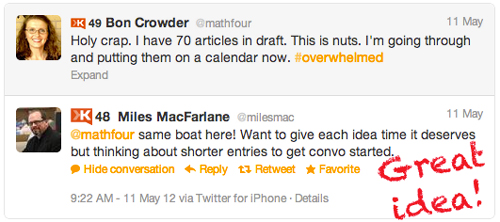
Many will be conversation starters, as my twitter friend Miles MacFarlane suggested. Some might turn into full articles.
And some drafts will meet their fate with the “File 13” button of death.
And I’ll be free!
Okay, there’ll certainly still be things that haunt me. Things I need to do, want to do and have to do.
But I won’t have a mountain of “should-haves” sitting on my shoulders.
So how about you? Share in the comments what kinds of things you’ll throw out for your first 50 things. And let others join the fun – tweet this out!
There are a number of ways to be an education advocate. Facilitating or encouraging change is definitely one of them.
Communicating, getting support for change, and making that change happen can be a bit of an art. Especially because we’re asking others to be part of it.
Here are some ways to make this easier.
Get their ear.
Communicating is perhaps the most important tool in advocacy. It’s more than just having a voice and speaking up.
As parents and education advocates, we must let others know what’s important to us and why – AND be ready to listen to the their concerns.
It’s a conversation.
Use “We” instead of “You.”
If we’re wanting change, we can’t just criticize. We need to offer ideas of what that change could look like.
The difference between being an advocate for change and being a complainer is this:
Complainer – “I don’t like this. YOU need to do something about it.”
Change advocate – “I have concerns about this. This is why. I think these changes may help. I think this is a way we might be able to make that happen. What do you think?”
Being an advocate comes with having ideas of what TO DO and HOW to change, rather than just criticizing what IS.
Be an advocate (and not a complainer).
It’s important to know what we want before talking to others about it. Being unhappy with what is currently happening in education is the first step.
From there, ask yourself what specifically you don’t like. What could replace this that would be more effective, appropriate, or helpful? How could that transition occur? Who’s involved and what will that change look like for them? How will they handle the transition to this change?
You don’t need to completely answer all these before starting a conversation about educational change. But keep those questions in mind. Be willing to offer ideas on them.
It can go a long way in getting others to listen.
Be patient with the process of change.
Many parents and teachers know the benefit of shifting the focus in the schools. They want to get away from memorization and performance on standardized tests. They want to move toward learning ideas and understanding concepts.
But that’s a tall order.
For a broad change like this to occur, there must be (near) unanimous support. There must be a sense that this change is not only helpful, but is needed and required.
Convincing people who are married to the “traditional” way of the teaching/learning method can take time.
Make the change easier for others.
Advocating for change isn’t just pushing for it or convincing others that it needs to happen. It is important to support those who will be a part of that change.
Help teachers and administrators understand you’ll be around to support those changes. Let them know you don’t expect them to do all the work. Then they’ll be more willing to support and make those changes happen.
Talk to everyone.
You never know where you’re going to find the ally – or someone ready to consider something new.
And start here. What do you think? How will you start the conversation?
Leave your thoughts in the comments. And share this post on twitter!
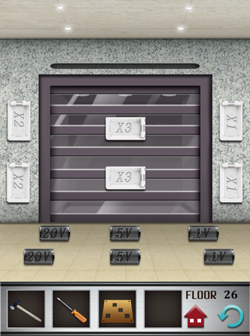
I’ve become slightly addicted to this free iPhone game called 100 Floors. It has strange and interesting parallels to leraning math.
It has no instructions and no hints. And upon first entry to the app, you feel lost, confused and annoyed. (Already starting to sound like a math problem, right?)
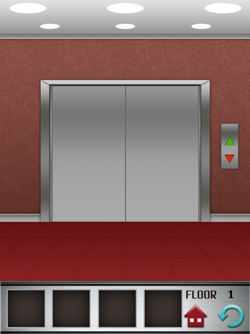
Based on the name of the game and the view of “Floor 1,” it’s clear that the idea is to open each set of elevator doors.
But with just a bit of patience and curiosity, you find yourself challenged just enough on each subsequent floor to keep going.
And you have no idea what to do next.
With each floor you’re not sure what to do.
So you start doing seemingly random things. You notice yourself bumping the phone. Tilting the phone. Shaking it. Blowing on it (I know, that isn’t a feature yet, but I tried anyway).
You tap and drag everything on the screen – including the ads.
(I even yelled into it – just in case that was the key to getting the doors open.)
And sometimes you just stare at it. Curious.
Remember – there’s no punishment for failure.
This one is my favorite!
If you can’t get the doors open immediately, no big deal. If you look, shake, yell, bump, tap and tilt with no results… okay.
So what? Who gives a fuzzy red rat’s tail?
You might turn off the phone and go mow the yard.
But those closed elevator doors stay in your mind. So you’ll come back at some point. You’ll open the app and check it out.
Just one more time.
Just to see…
And when the doors open – yippee!
There’s no prize. There’s no grade. There’s no money.
But the excitement you have from getting those crazy doors open and seeing the green arrow is unimaginable!
“Cheating” is allowed.
Sharing a tip is something you do only if you want. Giving or getting a solution isn’t prohibited, but it’s fun to try to get the solution yourself.
So you choose what to share and what to ask for. Based on your own desires and curiosity.
And it’s the same as learning math.
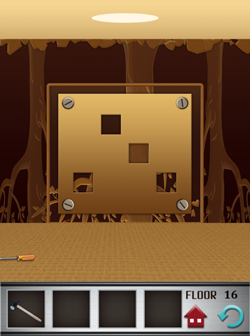
This one almost killed me. Had to go do something else for a while and come back later.
So far I haven’t found an official math problem in the game. But the tactics, patience and curiosity that you use are exactly what learning math is all about.
In each new math problem, students may wonder, “What the heck do I do with this one?” Just like you do with those elevator doors.
And if there’s no punishment for trying nutty things, their curiosity will take them places.
Tapping, dragging, shaking and yelling into the phone might have made me look goofy. But Husband was nestled in his chair doing equally insane things to get his elevators to open.
But there IS punishment in learning math.
That’s where things diverge.
Performance based teaching is the basis of the typical math lesson. Math problems are given to the student. And the student is expected to give back the right answer.
If the right answer isn’t given, there are repercussions. Points are deducted or the failure is publicly noted. Or both.
And if you don’t have the right answer, you’re just not learning math.
Period.
(BTW – that’s a horrible myth!)
And “cheating” is all or none.
This one sort of turns out to be a math problem.
Either the teacher coaches step-by-step, or there is no tutor or teacher at all.
Think about the last time you did a math problem from a textbook with a teacher watching.
If you took the wrong path, you were quickly guided back on track. This was either with words, “Are you sure that’s what you need to do?” or with facial expressions.
Math students aren’t allowed to take or leave tips at will. And they sure aren’t allowed to give them when they want.
That’s cheating.
But isn’t that what grownups do when they “guide” students?
How do we change this?
How can we make learning math more like playing 100 Floors? How can we get students into the adventurous mode – tapping, shaking and doing anything they can to a math problem?
How do we get them to cheat on their own terms? And how do we get grownups to stop over cheating?
Share your thoughts in the comments. And share this article on twitter!
Previously in an article about math anxiety parents may feel, I mentioned how grown-ups inadvertently teach kids to be scared of certain things.
It’s not our fault. We learned it from adults when we were younger.
But we still do it.
“I hate rats.”
“Math? I’ve always had math anxiety.”
“Ew, roaches, yikes!”
“Math is hard. I don’t do math.”
What’s psychology got to do with it?
From the principles of psychology, we know that hearing other people talk about things, we adopt some of those same attitudes – especially being young and impressionable as kids.
And your kids are like that, too.
An example: Think about butterflies. They’re insects and they have erratic movement patterns. So why don’t we hate butterflies like we do roaches?
Ok, to be fair, roaches invade our living spaces given the slightest chance. And they carry diseases. But are these things the reason why we feel a shiver?
Not really – it’s seeing others freak out when they see a roach.
And seeing others say, “Ooo, how pretty!” when they see a butterfly!
And the research shows…
In the previous article, I mentioned that the reason why this is important lies in the immediate and long-term effect on children. I presented on how this impacts math anxiety recently at the Western Social Sciences Association Conference.
Research and experience show that when we display math anxiety or a negative attitude toward math, kids do to. And this causes them to have lower confidence in their math ability, higher math anxiety, and more avoidance toward doing math.
And when we (or our children) don’t engage in something, we don’t have an opportunity to learn.
But noticing everyday math gives them more confidence – and more opportunity!
Is it up to parents?
You might have heard (or even said), “That’s the teachers job.” Well, they can only do so much. The best prescription for helping kids to learn is to make it enjoyable. Or at very least, neutral so they don’t avoid it.
The less avoidant (and more engaging) they are on their own, the more they take it upon themselves to do math things. They’ll see the everyday math. And they’ll do it without having someone over their shoulder all the time.
Learning then happens even outside the math class.
They’ll do math on their own?
Yes.
Learning doesn’t just happen in the classroom. It occurs when we explore, follow our curiosity, ask questions, and think about why something is the way it is.
Math is no different.
Ever wonder how many packs of taco shells you need for everyone to have two?
Math.
Or how long it will take to wash and dry all the laundry?
Yup – everyday math again.
Confidence in doing math make these things more palatable, and more likely to be thought of as math.
We don’t need an “answer” for there to be math.
We’re a bit trained (brainwashed may be a little harsh, but accurate) to think that doing math is sitting with a pencil and paper, and with numbers, letters, lines and answers.
If you think about it, it’s like saying reading only happens in the library or bookstore. The idea of doing math has a fairly limited scope.
Because of this, we don’t realize how much we really do it.
So what can WE do.
Say it when it happens. Say it when you recognize it. Say it when you see someone else doing it.
Tacos in the grocery store? Yep, there it is again. Say it out loud to your kid.
How about how long it takes to get somewhere walking vs. driving in a car.
“Hey, little Billy, it takes us longer to walk to the store than to drive. That’s math.”
Any time we compare two things and decide one is larger than the other, we’re doing math.
If we count items to determine how many we have, we’re doing math there, too.
When you recognize everyday math, just say whatever you’re thinking out loud. And watch as the “Ew, roach!” avoidance turns into the “Ooo, butterfly!” interest.