My mom is a big fan of flash cards. So when she figured out how to use my School Zone Numbers 0-25 Flash Cards with MATH, she was so excited.
We’ve been doing MATH a lot – but she says we can only do it once a day. I love doing it because I get to eat the MATH after we’re done.
No fair that we can only do it once each day.
So here’s what it is…
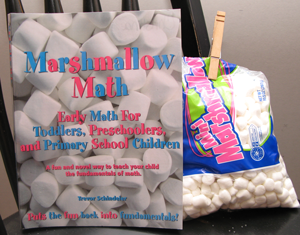
There’s a bag full of them in the cupboard. The individual MATHs are tiny white things that taste SO good! They’re chewy and squishy and fun in my mouth.
They’re about the size of Cheerios. (Oh – and comparing sizes is something called “math” – but Cheerios don’t taste like this, so it must be different).
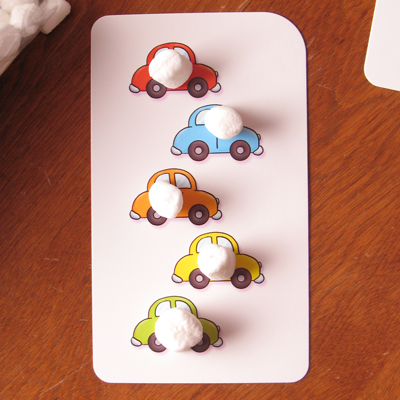
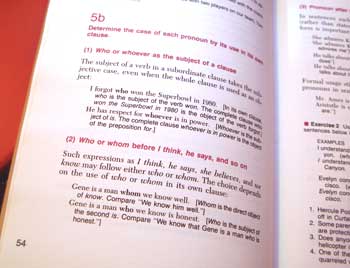
Taica took the picture at the top of this article so I could show you what I’m talking about. Look to the right of the book in the photo – that’s MATH. YUM!
You can do it with flash cards.
She pulled out my number flashcards (made by School Zone and given to me by Granfuffy) and let me pick a card. I chose the one with cars. I like cars.
I put one MATH on each car. Taica counted as I did this. After a while I got really good at putting them on and taking them off. It’s called “one-to-one correspondence,” apparently. Or at least she kept saying that.
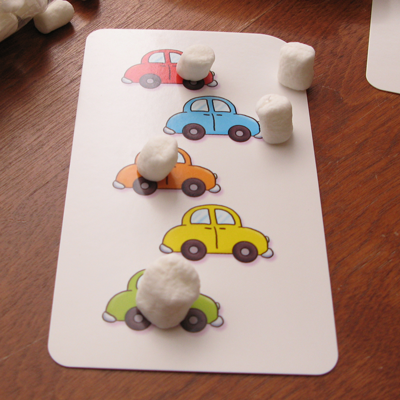
Then she turned the card sideways!
This was a little harder. But I managed.
Then upside down – I was really wanting to eat the MATH at this point, but I continued to play along.
At one point the marshmallow rolled off the car. So I left it there. I knew where it was supposed to be so it wasn’t a big deal.
When I finished, I was out of MATHs and still had the yellow car left! Like this:
Taica told me that if I didn’t make sure that the MATH was directly on the car, I would lose the “one-to-one correspondence” and end up with a leftover car.
We figured it out and then it was time to eat.
Do you want to try?
I’m looking forward to the next time – there are some flash cards that have lots and lots of things to match!
If you want to do it, you can get everything you need at a store. You have to “pay for them” before you take them home, but that’s easy for grownups.
It’s rare that you get a chance to really see life from the other side. Today I did.
I presented at the Western Social Science Association conference at 8am. I stayed to watch the other talks – and got a serious taste of what many people feel when in a math class.
I was comfortable with the concepts.
Strangely, I was totally comfortable with the hypotheses of this group of social scientists.
I saw talks where people speculated on what was up with juvenile detention workers that liked their jobs. And I was cool with it.
I was fascinated, engaged and understood the hypothesis that people who identified with their gender, and lived that way, were more healthy than those who claimed one thing and behaved the opposite.
It made perfect sense to me that someone would want to do research to see if indeed boys who are close to their moms pray more as grownups.
I got uncomfortable when they started talking… stats!
Yup!
It was the math that got me.
At first I watched in relative peace as these folks paraded the slides loaded with positive and negative decimal numbers. I ignored my ignorance of something they deemed important called “R2.”
I told myself that if I knew what these things were, I would totally get this.
I’m an algebraist. We don’t even use numbers, much less negative decimals.
But I assured myself that I was perfectly capable, I just hadn’t learned this branch of math.
But the talks and slides kept coming.
And my defenses didn’t hold up.
Wil was kind enough to give me a cheater hint. I tried to memorize it. The rule ended up looking like this:
Positive number means “as one thing goes up, the other does too.”
Negative number means “as one thing goes up, the other goes down.”
“Big” number means it really is true.
“Small” number means it probably is just B.S.
I developed math-anxiety.
When a stat slide came up, I looked away. The speaker’s voice became Charlie Brown’s teacher. I checked my iPhone to see what was happening on Twitter.
As Wil would say, I was participating in avoidance behavior.
But occasionally I’d try…
Calgon – take me away!
If one of those slides came up and I didn’t turn away fast enough, I’d give it a shot.
After all, I’m a mathematician by trade! This shouldn’t intimidate me.
I would fish around desperately in my brain for that memorized rule.
And to think that just two days ago I told my students, “You can’t just follow the rules – you should understand what they mean.”
Easy for me to say.
I’m going to crawl into the tub with a glass of wine.
I’m doing research for a paper that I’ll be presenting in two days at the Western Social Science Association
conference. Here’s the outline:
What is literacy?
What is numeracy?
The Similarities between Numeracy and Literacy
The Differences between Numeracy and Literacy
Some Models for Literacy Improvement
How These Literacy Improvement Models Might be Modified for Numeracy Improvement
In attacking the first two questions, I’ve come across a paper titled What is Literacy? by James Paul Gee. Amazingly, the definitions he gives to primary discourse (or use of language), secondary discourse and meta-discourse are all applicable to math literacy/numeracy.
Primary use of language is “casual” discourse.
Primary use of language is the acquired communication tools we use among our “intimates.” This means it’s the way we talk, write or otherwise communicate with family members, close friends or others who are part of our personally identified social group.
Secondary use of language is more formal and used with anyone.
Secondary discourse is the acquired communication tools we use with anyone. This includes our close friends or family – sometimes.
But mostly this is the way we talk in (or write for) “polite company,” as my mother would say.
Meta-discourse is the study of the discourses.
Freaky, I know. But meta-anything is freaky once you think about it.
In particular, meta-discourse is the study of grammar and syntax as well as literary analysis and other English-class-goodies like that.
Where you put the commas and if you use “I” or “me,” are both bits that you’d find in meta-discourse.
How does this compare to numeracy?
Consider what primary, secondary and meta uses of mathematics might look like.
Primary use of math is the stuff you do everyday. The subtraction that you do without thought in order to know what time to set your alarm clock.
A secondary, or more formal used of math might be borrowing money from a bank. It could also look like the calculation of gas mileage.
Secondary use of math involves a more conscious effort to do “math things” – like annual percentage rate for a loan or division of miles driven by gallons used.
And meta-math is the formal stuff.
So then math that is taught (like in school) is the equivalent of meta-discourse. It is the study of the formalizations of arithmetic and logic that we use.
Often people term primary and secondary uses of math as “mathematics” while labeling meta-discourse in math as “Mathematics” – with the capital M.
You say tomato and I say, well… you know.
Literacy is acquired, not taught.
Yup – here’s the quote (and I love this):
Literacy is mastered through acquisition, not learning… it requires exposure to models in natural meaningful, and functional settings…
So we “teach” reading, but it’s really a matter of hurrying along the process of acquisition.
It’s likely that children are already well on their way to acquisition of language (or literacy) by the time they’re in school. Many parents read to their children very early – and continue to do so well into school aged years.
This is a display of discourse or use of the language. And it supports the child’s acquisition of the language.
Isn’t numeracy also acquired?
I certainly didn’t teach K8 perpendicular distance at 2 years old, and yet she knows enough about it to apply it at an Easter egg hunt!
Through experience, she’s acquired that primary use of math.
And just watch when a toddler does “division” using a box of three dolls when she sees four kids. You don’t want to be in that room!
This is also a “skill” acquired through experience and observation.
So why isn’t the acquisition of numeracy encouraged?
Math learning – at least in the primary and secondary uses – is happening automatically. But why don’t we notice and celebrate it?
Sure, we teach our kids to count and make sure they know their shapes. But then we stop.
We wait to start math-talk until children are sitting in their chairs, hair combed, hands washed, ready for class. We send the message that math isn’t done unless you’re in math class or at the kitchen table with pencil, paper and book.
We shove meta-math at them after making them think that they’ve never experienced the primary or secondary use of math.
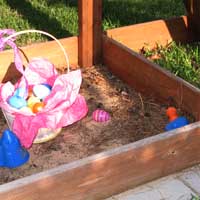
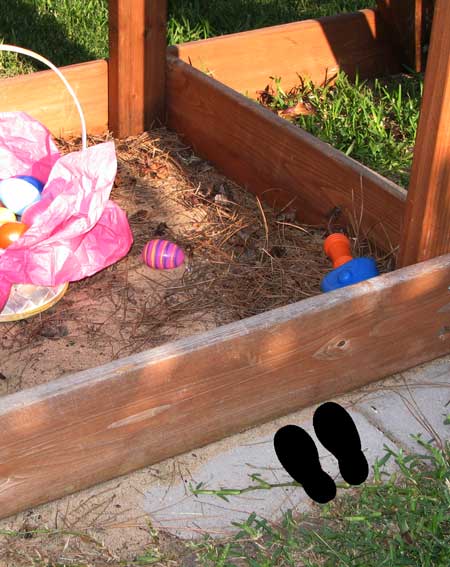
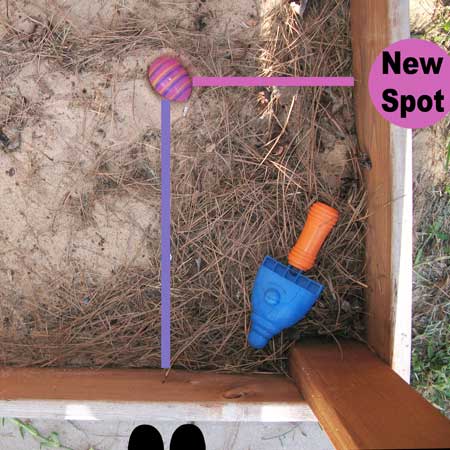
K8 was hunting Easter eggs at Mawmaw & Pawpaw’s house. She saw an egg inside the sandbox. As she reached into the box she realized the egg was too far away.
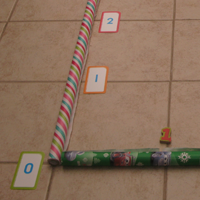
She was standing where the footprints are. The egg was where the striped egg is:
She needed to step inside the sandbox.
The “easy” answer was to step inside the sandbox. But she wanted no part of the gritty sand.
With no hesitation, she moved from her location, around the sandbox to the new spot:
This took some effort because she had to squat to get under the ladder. But she had seen that avoiding the sand was possible if she accessed the egg from the other side.
She recognized and compared distances!
With no vocabulary or formal training (indeed she’s 2 1/2 years old) she identified perpendicular distance! She assessed which side of the square sandbox would minimize this distance. And she acted on that assessment.
It’s normal for parents to believe their children are especially smart, gifted or brilliant. I believe that all children are these things.
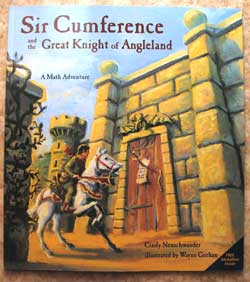
This fun little gem of a book is only one in a series of Sir Cumference books by Cindy Neuschwander.
Enjoying the puns with the math…
Radius is the son of Sir Cumference and Lady Di of Ameter. (See what I mean – the puns start on page one of this picture book!)
He decides he’s old enough to take a quest and learns from his mentor, Sir D’grees (it’s side splitting, I tell ya!) about the missing King Lell.
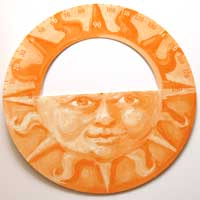
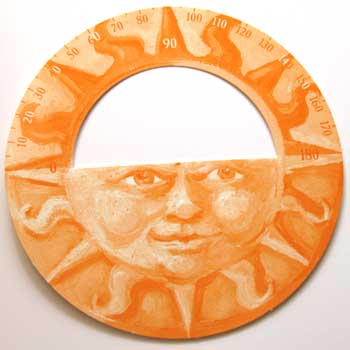
Radius is given a “medallion” by his parents to help him on his quest. No one really knows what the medallion is for, but it seems it might be helpful.
Or at least cool to have while on a quest.
As a treat to the reader, a laminated version of this medallion is included in the back of the picture book. It looks like this:
More punny math fills the pages!
Angles, degrees and all things geometry show up. And Neuschwander doesn’t write them out loud until the end, when Radius starts naming them.
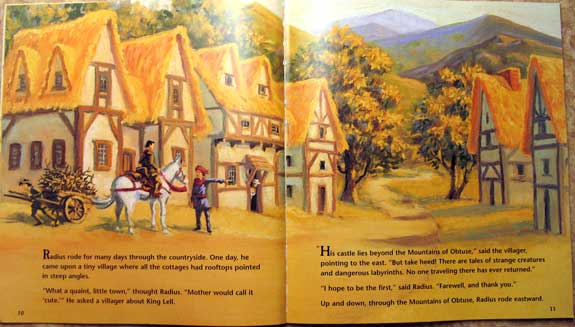
Here you see the steep “cute” roofs of the village in the valley near the Mountains of Obtuse.
Husband enjoyed paying attention, looking at the pictures, and trying to guess which person or thing would end up as a namesake for a geometry term. I think he enjoyed it more than K8!
It’s worth a read – for fun or as a lesson!
Read this picture book to enjoy (as we did) or use it to introduce or enhance your geometry lessons.
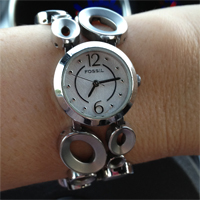
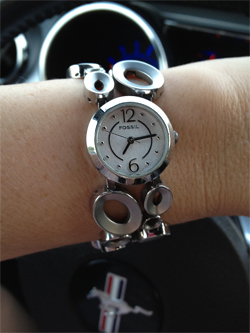
I found my super fun circle watch from Fossil and put it on. I haven’t worn a watch in quite a while. So it’s fun wear it again.
We don’t need to wear watches anymore.
Well, except for fashion. Our mobile phones (even the “dumb” ones) keep time rather well.
If you need the time, you dig out your phone. And if it’s too deep in your purse, you ask someone.
And they tell you with words like, “It’s 8:23.”
You never have to wonder.
Do you recall this type of conversation:
Kate: What time do you have?
Wil: I show 10:15, but I’m usually about 5 minutes fast. So it’s really about ten after.
Kate: Thanks!
That phrase, do you have, is now obsolete. Everyone has the same time. It’s from Verizon, AT&T or TMobile. And they get it from the same place – the place that has the exact time.
This means a lot for math.
Nobody runs fast or slow. Also, we don’t have to add or subtract to get the real time.
The time just is.
20 years ago when your watch was six minutes fast, you had to do this to get the real time:
Look at your watch.
Figure out the time (the big hand’s on the …”).
Subtract 6.
You got to practice addition and subtraction – often!
In the middle of doing some research, I found an article by Marilyn Burns about math and reading. I kept digging and found a list of great picture books for teaching math. Wow!
Math Picture Books
You might have noticed I’ve started discussing picture books here on MathFour.com. With the list by Marilyn Burns, I’m looking forward to doing a lot more.
Here’s the list of math in picture books that I have discussed so far: