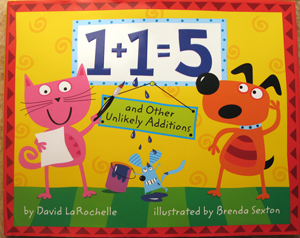
It’s colorful, fun and – the best part – unexpected!
Each page introduces a new way to look at 1 + 1.
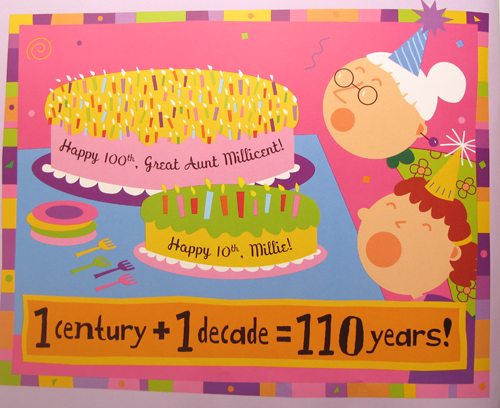
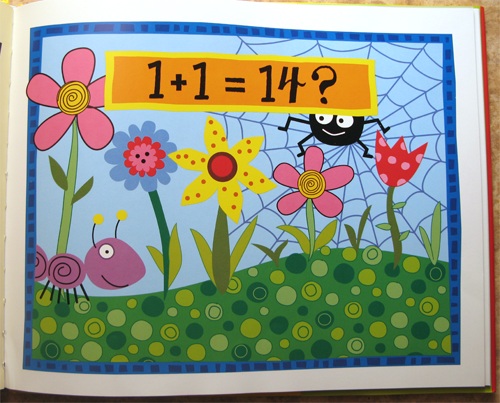
This book enforces the concept of units and place value. Like this page where 1+1=110.
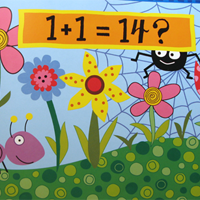
It also gives parents and teachers the opportunity to talk about things like creepy crawlies – and their differences. Here’s a page where we see some differences in ants and spiders:
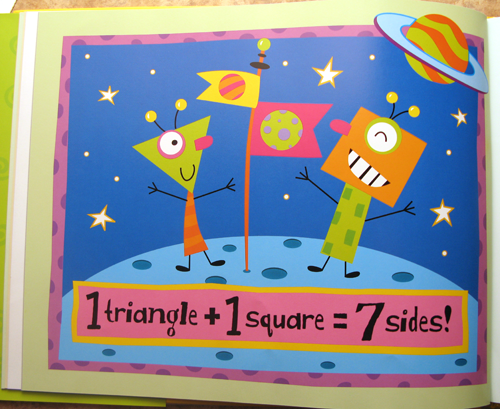
And who could resist a discussion about shapes when you get to this one:
When I read it to K8, Husband was enthralled. Clearly there’s fun stuff for all ages in this one!
I have been working with eHow.com to get some common math questions answered. One of the questions was, “How are the areas of a rectangle and triangle with the same base and height related?”
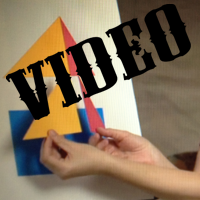
Curiously, all rectangles can be cut into triangles. And all triangles can be doubled to make a rectangle. Watch this video – and then get out the construction paper, scissors and glue.
Grab a kid and have some fun watching them discover!
Wil, the research guy, notices how technology has advanced, but education is being left behind.
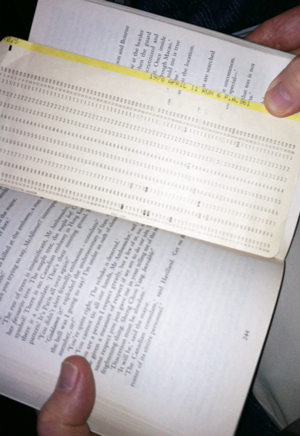
While on vacation recently, I met an English professor who was using a 70s era computer programming punched card as a book mark.
During a brief exchange, he said “Forty years ago we never imagined we’d have things like this,” pointing to my iPhone.
What struck me was the manner in which he offered anecdotes of the days in which they were still in use. He didn’t imply loss or anger. He didn’t express any resentment for discontinuing the now antiquated and obsolete programming medium.
On the contrary, he jovially stated, “Now, I use them as bookmarks and my wife uses them for her grocery lists.” Talk about recycling!
Embracing change.
I began to wonder why advances in technology have been embraced so well and completely, and why we are still in the “punched card” age of education.
Many “upgrades” to effective learning are not universally applied… yet.
For a considerable number of our public schools, we still approach the teaching-learning interaction in a way that is decidedly contrary to what research has not only indicated, but has, in many cases, shown to be true.
It’s not just data transfer.
Some still believe that education means opening the knowledge portal of students (whatever age) and simply depositing information. This is unrealistic and grossly simplified. Education – learning – must be received more than it can be given.
Let them lead.
Autonomous students not only having a say in what they engage but to a large degree feel their education is self-directed. This has a huge impact on their motivation, level of focus and ultimately how much they learn.
Support with information, and don’t forget the “Way to go!”
Research has provided us with concepts such as scaffolding to help children with mastery.
Less acknowledged and utilized (perhaps due to less educator proficiency) has been emotional support and encouragement. But this is just as important in a child’s education.
You may have the best information in the world for how to do something. But if the student is disengaged, it’s just not going to happen.
Start with a conducive learning environment.
This could be a post all by itself. The jist: it’s less about giving something, and more about ensuring the student is engaged. So the educational paradigm must focus on how we can facilitate the student’s learning, whatever that looks like.
This means focusing on the student and HOW they learn right now. Instead of “he just needs to pay attention” or “she needs to work harder”.
Back to the punched cards.
We’ve been given these specifics that have been presented to us over and over in the research. They are being applied with successful and definitive results. So why are we resistant? And who are the “we” we are talking about?
Look at the inevitable and constant changes in technological advances. Now consider the stagnant, upgrade-resistant public educational system. What’s the difference?
What you can do.
Be informed. Ask questions. Request and support educational “upgrades” in your schools.
You and your children are the customers. Only you can create the demand for improvements in your child’s education.
Have a voice. Be the squeaky wheel. And support schools when they move in that direction.
They may already be doing so. If they are, let them know this is what you want.
For more on how to support your schools in embracing conducive learning environments, contact us or leave a comment.
Seems that I’m learning something called “addition” these days. My parents say things like “two bottles of vitamins plus one bottle of vitamins equals four bottles of vitamins. That’s addition!”
I’ve figured out that “addition” means you use the words “plus” and “equals” in the same sentence.
You can do addition with counting too!
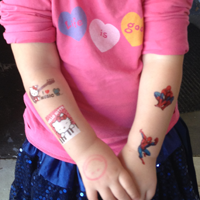
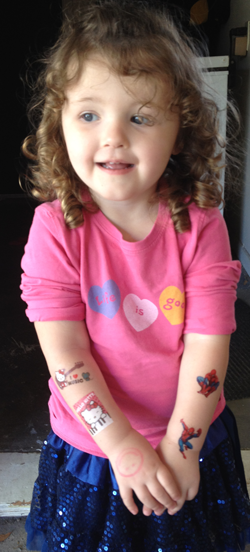
I’m into tattoos. I have kitten tattoos and Spider Man ones. To put them on, we have to use a wet rag and count – first to 20 and then to 10. My mom says that “twenty plus ten equals thirty.”
That sentence has both of the important words: “plus” and “equals.”
So doing tattoos is not just counting, but addition too!
So tattoos are math!
My dad doesn’t like me to have so many tattoos. He prefers I use the fun band-aids. Band-aids are okay, but you don’t have to count or add to put them on.
The more tattoos I put on, the more counting and addition practice I can get. So he should be happy I’m getting lots of tattoos!
Tattoos and counting teach other stuff also.
I’m learning “patience.” That means waiting without whining or screaming.
I don’t mind “patience” when I’m counting. Because I’m doing something fun.
Do you have a 2 year old like me, that can count? Are you teaching him or her addition too? And what kinds of tattoos do y’all have?
A palindrome is a word or phrase (or string of numbers) that reads the same front-to-back and back-to-front.
Wil, the research guy, in mirror image
There’re the little ones, like Wow, Mom, Dad and Hannah.
Then there are big ones, like this one from Jon Agee:
Go hang a salami, I’m a lasagna hog.
But there are also words, phrases and names that are almost palindromes.
But how “almost” is an almost palindrome?
You can measure the “almost” of a palindrome with a palindrome number (or PALN for short). Here are the rules:
Adjust the word or name using any of these:
Switch any two adjacent letters.
Insert a letter anywhere in the word.
Remove any letter from the word.
For each of these increase the PALN by one. The smallest numer of these adjustments that can be made and still have an intelligible sounding “word,” is the palindrome number or PALN.
Watch how it works…
Start with something that is an “almost palindrome” – something that has a palindrome in it or lots of the same letters. The go crazy, like this:
William – the bold part is a palindrome
We can remove three letters to be left with “illi.” Or we can add A, M and W to the word to get “Mawilliwam.” Either is pronounceable and yields the PALN=3.
mathchat – the bold part is a palindrome and the parts in italics are the same letters
Remove the M and then switch the first A and T. So the resulting palindrome is “tahchat.” PALN=2.
Susannah – bold part is a palindrome and so is the italics part
As nice as this looks, its PALN is much larger than the other two. Removing the H is helpful, and then adding an extra SUS at the end gives a PALN=4. The result is “Susannasus.”
Hanna – SO close!
PALN=1. Simply remove the H or add an H for Hannah or Anna.
You can use this to teach math!
Math is about patterns as much as it is about numbers. Recognizing those almost palindromes and playing with them improves cognitive thinking.
Keep your eyes peeled everyday for almost-palindromes. Use the opportunities to teach math in a way that doesn’t even seem like math.
There were several thoughtful and intense comments to the Sylvan commercial. As promised, here is a follow-up article based on the comments. A special thanks to those commenting on the video, as this is what keeps the math-revolution conversation going!
There is definitely a disconnect from a service or product and those advertising or making the sales. I’m sure a lot of tutors/teachers at Sylvan wouldn’t endorse the commercial or would go about it a different way.
Our intent wasn’t to beat up on Sylvan for trying to make a buck. We wanted to bring the commercial’s message to the attention of readers more as a way of asking:
What does it say that a (probably) well paid ad dept. thinks that this would be effective (which it is)? And what does that say about us as a society (‘math stinks, it’s something to fear, I don’t even want to try’)?
How about the fear?
What you don’t know or understand is often scary.
You may have memorized some math at some point, then brain dumped it on some test. If so, do you really understand this math you “learned”?
What’s more frightening: wondering what the monster looks like, or seeing him?
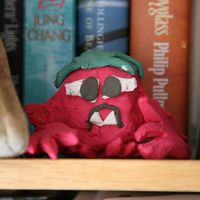
So they will never show you what your “math monster” looks like.
But what if they did? Is the math monster that bad?
What would it look like to help make math less scary for parents? Could parents model this “okay-ness” to their kids? Or better yet, would they have the confidence to help little Billy with homework?
It’s not going to happen if parents really believe they are helpless and shouldn’t even try. The kids see this and do the same thing 25 years later to their kids. (Perpetual pattern?)
It’s ok, maybe even cool to say “I’m bad at math”.
This makes the commercial palatable, or even comical, to some who may relate.
But if this commercial featured a mom running away from little Billy when he asked, “Mom, can you help me with my reading?” folks would be offended!
Let’s make math okay for parents too.
I’m not saying places like Sylvan shouldn’t exist. To the contrary, actually. They provide a wonderful service.
But if parents are running – and encouraged to run – from helping their kids, they are sending a message. Kids see this and learn, “Mom doesn’t do or like math, so it’s really not that important.”
Little Billy might end up passing, even making an A, but he’ll continue the pattern with his kids.
Fridays sometimes have a 50 Word Friday article with a special feature – exactly 50 words. I’m doing a variation of this – every sentence in this post has 15 words exactly.
The requirement will be hard to meet, but I can do it with some effort!
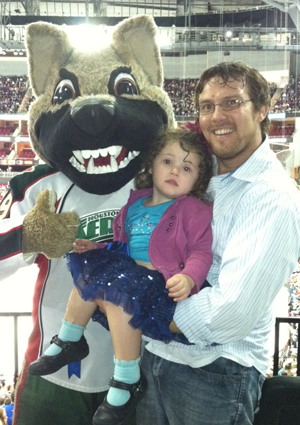
That was a pretty expensive trip to a hockey game. Especially since the tickets were free!
In the spirit of Dan Meyer‘s Any Questions? style of learning, my question arose:
Was it worth it for the Aeros to give me tickets to the hockey game?
Here are some things I need to know before I can arrive at the answer:
What’s the value of the tickets?
How much did I spend?
Answer 1. The tickets we got were $26 each. So my ticket, along with Daughter’s ticket, was $52.
Answer 2. Here’s the total of what she and I “consumed” on non-ticket items:
Two beers ($13.50) (that was me, not us together)
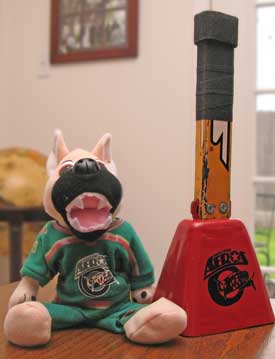
One stuffed animal (the mascot Chilly) $12.50
A cowbell (I’m from the country, I couldn’t resist) $25
One hotdog $6.50
Parking $10
So we spent $67.50 at the hockey game. That’s $15.50 more than the cost of the tickets. Seems like it was worth it for them to give me the tickets.
But did they make money off me?
Just because they got their money back, plus some, doesn’t mean they made money.
Would these tickets have been sold to someone else at full price? And would those people have also spent $67.50?
What was the cost of us being there? And what was the cost of the stuffed animal, the cowbell, the hotdog and the beer?
Answer 1. There were lots of empty seats, so I’m thinking they were leftover seats. Nobody was going to buy them.
Answer 2. Supposing we took up $.05 of air conditioning and maybe $.05 in water (we also washed our hands), it cost them ten cents to have us around. For the things we bought:
Stuffed animal – $1
Cowbell – $1
Hotdog – $.25
Beer – $4 (there’s serious tax in this, I think)
So they spent about $6.35 having us there and paying for the products we bought. So yes, they definitely made money.