
Author: Bon Crowder

  • Differentiated Instruction

    Differentiated Instruction

    I just learned what the phrase “differentiated instruction” means. Jeanette Stein told me on #MathChat that for her, differentiated instruction is

    Meeting kids where they are at to take them where they can go.

    I love it!

    So I read the article Jeanette shared from Teach-ology. Seems differentiated instruction is a fancy term for focusing on the individual students rather than the teacher.

    I’ve been doing it for years!

    The first few semesters I taught math (back in 1996), I would lecture. I mean straight up, lecture. But soon I learned that it wasn’t about me.

    Over the next 16 years I watched the students. I quit spending so much time and energy on preparing lectures and much more time and energy thinking about the comments and questions I got from the students.

    I learned how students get quickly confused by the simplest of things – like solving an equation in one variable with four terms.

    I learned that the way something is said is much more important than what the words are.

    I learned that many of the “math rules” were merely tricks some clever person thought of as a mnemonic device. And that if these tricks are forced on certain students, they’ll likely never understand what’s really happening.

    The biggest trick/hoax is PEMDAS or the Order of Operations. Other math rules that get highly confusing are the Zero Product Rule and cross-multiplying (a term I personally despise).

    And most importantly, I’ve learned that creating a safe and inquiry based learning environment is the key to differentiated learning.

    And there’s more!

    In considering my classroom experiences, I’m finding many other instances and examples of differentiated instruction. So this is the first in a series on tactics to improve your own differentiated classroom. Here are the proposed topics/titles:

    • Eliminating the Fear – How to Engage Students without Calling on Them
    • Show Your Work! – What’s up with that?
    • Grading in a Differentiated Classroom – Why Teaching Math Is Harder than Giving Birth
    • “It’s Your Education!” – How to Empower Your Students
    • If Shakespeare Taught Math – How to Use Metaphors to Teach Math
    • If Picasso Taught Math – How to Use Drawings to Teach Math
    • How to Teach Your Students to Think Like a Mathematician

    Wow – that’s rather ambitious of me, isn’t it?

    I’ll shoot for these once a week and you can find a link to the series (this article) in the sidebar under “Quick References.”

    If you have any requests or ideas, let me know in the comments. And don’t forget to share this series with your PLN on twitter!

    Related Articles:
  • Creativity Destroyed

    Creativity Destroyed

    I am attending the Offshore Technology Conference this week, meeting old friends and looking for great math to talk about. Yesterday, while relaxing at the Oil States booth, I explained my goal of finding math at a trade show.

    Amber, a subsea and pipeline engineer (i.e. super math girl) started throwing out ideas.

    She saw the ratio of bolts in a flange connection to the size. She mentioned gear ratios and the number of turns it takes to open and close valves.

    And then things took a strange turn.

    Amber jumped outside the box with both feet: “How many CEOs does it take to change a light bulb?” I wrote down the joke.

    Feeling comfortable with getting a little math-crazy, she unleashed her creativity.

    She suggested that thread size, shape and spacing on bolts was like the binding on spiral notebooks – both good places where math is used. She pondered the statistics of letter frequency in the names of different nationalities of people.

    And she noticed that the distance between the signs hanging from the rafters, and the tops of the booths must have been calculated or they would be smacking into each other.

    “I love thinking outside the box,” she gleefully exclaimed.

    And then she told a story of creativity destroyed.

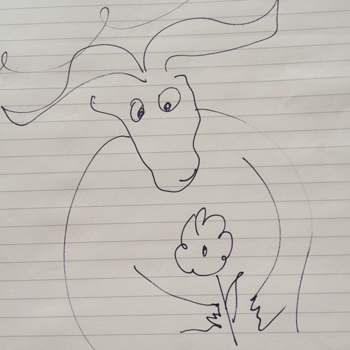
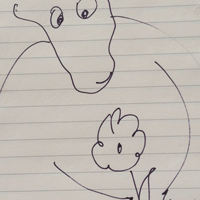
    As a child, she had drawn the famous Ferdinand the Bull under his favorite tree, smelling the flowers.

    And her teacher told her it sucked.

    “I never did art again,” she confessed to me.

    Heartbreaking – especially since I’ve heard a version of this story hundreds of times. I never thought that I would ever hear it told with drawing, though.

    A few words can destroy creativity.

    It’s normal and healthy to know our strengths and weaknesses. But we each have a right to discover our own weaknesses. Having someone declare our weaknesses is a violation.

    Amber does very well as an engineer. But how different would her life look like now if she had continued to draw?

    Maybe none. Maybe she would have drawn for years, enjoying it. Perhaps she would have eventually discovered that she was much better suited to engineering.

    But maybe she would have become a Picasso.

    Be careful what you say.

    If a child is giving it their best shot and you meet them with criticism, you might shut down their creativity for life. And it’s easy to do this with math – there are so many ways for a kid to do things “wrong.”

    But try to treat math learning like learning to create art. Regardless of how much the drawing sucks, be encouraging.

    If a child is adding denominators instead of finding a common one, discuss what the answer looks like. Give them the right, and the power, to see where they went wrong.

    Foster each child like they’re a budding Picasso and Pythagoras, regardless of how little talent you may see in them. Let them do things their way.

    You just might be surprised at what they end up doing.

    Do you have a story of creativity destroyed? Share it in the comments. And don’t forget to share Amber’s story on twitter.

    Related Articles:
  • Math Picture Book: One, Two, Three!

    Math Picture Book: One, Two, Three!

    This is part of the Teaching Math with Picture Books series.

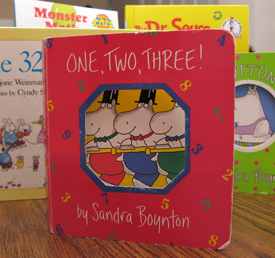
    I’m a big fan of Sandra Boynton. So when I found her One, Two Three! book at a resale shop I was ecstatic.

    It blends personal relationships with counting.

    Each of the numbers from one to ten connects to an event that might require that many people.

    For social situations like having a private conversation, you need two people. So “two is right for a quiet talk.”

    Major math concepts are used too.

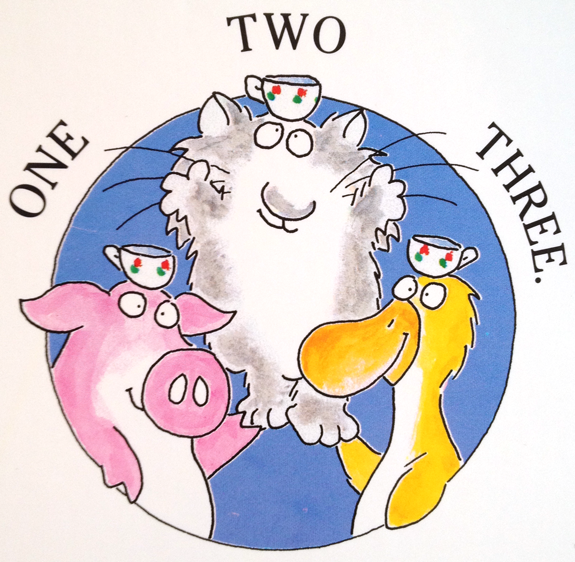
    You can discuss one-to-one correspondence of teacups and friends:

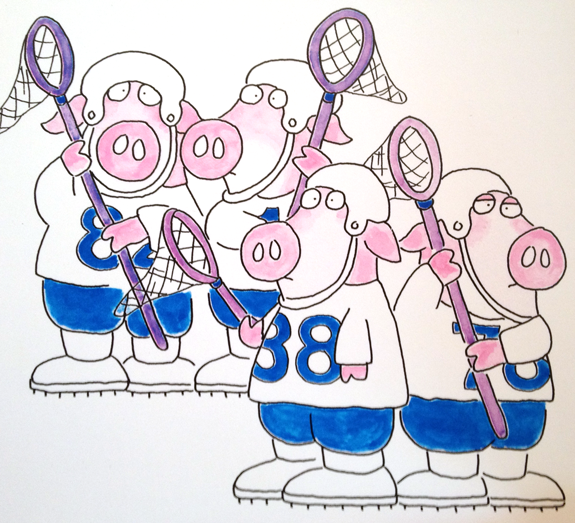
    And kids can speculate on the jersey numbers on the Pigglystick players:

    Seven gives a fun way to see subitizing in action. And there’s even a hint of multiplication in the two rows of four hippos taking a ballet class!

    And the best part…

    Sandra Boynton’s One, Two Three! is a board book! So you can introduce all these great math concepts to your toddler!

    Head out and get a copy and tell me what you think in the comments. And don’t forget to share it on twitter!

    Other Articles in the Math Picture Books Series:
  • Misery in Email – The Math Behind Your Clogged Inbox

    Misery in Email – The Math Behind Your Clogged Inbox

    When your email becomes unbearable, what then? Unsubscribe to everything? Delete what you’ve already responded to?

    But what if you have 10,000 emails? How long will that take? And can you batch them?

    One every second takes almost three hours.

    Looking at each for 5 seconds takes fifteen hours.

    Yipes!

    This article is a part of the 50 Word Friday series. Learn more about this strange, limited writing style here…

    Related Articles
  • Rush Hour Traffic Jam Game

    Rush Hour Traffic Jam Game

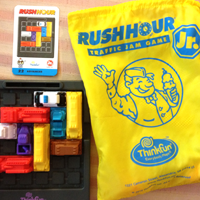
    Some amazing math found in the @ThinkFun game of Rush Hour! MathFour.com

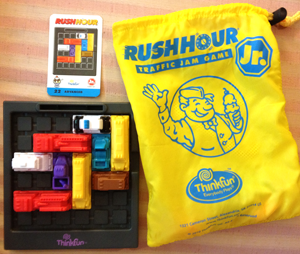
    My sister-in-law showed me the Rush Hour Traffic Jam Game by Think Fun this weekend. She “assigned” one of the harder cards in the deck to me (sometimes it sucks to be known as the math mom) and assured me that I could do it.

    The Set-up

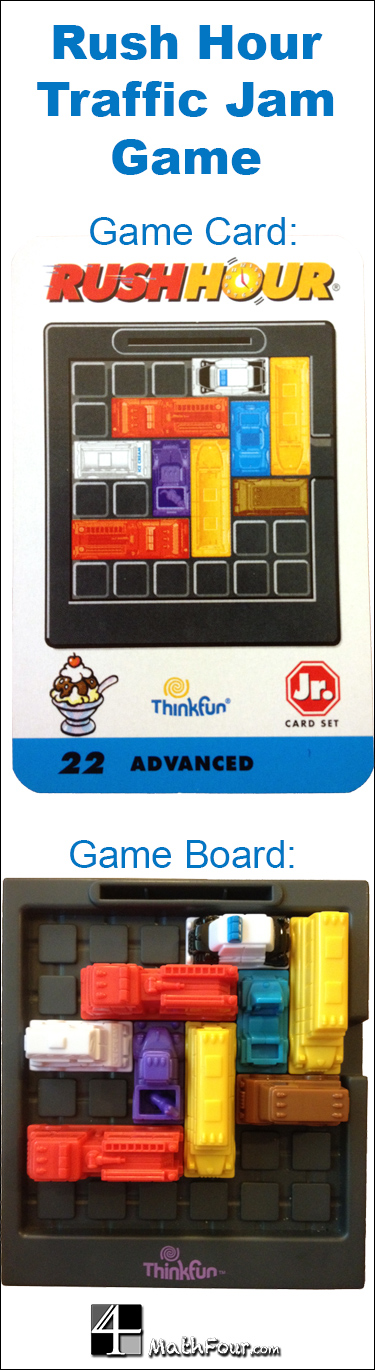
    You set up the 6×6 game board with the plastic vehicles just like the game card shows. Here’s where the math starts.

    The skills children develop doing this support graphing on the Cartesian coordinate plane later on.

    Even if your child isn’t ready for the actual game play, this step supports them in math!

    The Goal

    Allow the ice cream truck to “escape” the maze.

    In order to do this, you are allowed to slide any of the cars forward or back. They can’t crash into other cars to push them out of the way. And you can’t lift any of them off the game board.

    A more challenging goal is to also do this in the minimum amount of moves possible.

    The Strategy

    Everyone has their own plan. My nephew likes to scooch the cars around until he stumbles upon an answer. I decided to pick up the cars and move them to the most unique solution to see what the end result should look like.

    The Math

    You’ve the coordinate plane. You have logic. And you have strategy. But you have someone much more amazing here.

    The beauty of the game is the way it simulates mathematical research and discovery.

    • Everyone has their own style.
    • Everyone has their own solution.
    • If you follow the rules and “win” then you’ve done it right, regardless of how someone else did it.
    • There are many levels of success – and the player determines which level he or she is shooting for.
    • Given the board and the colorful cars, you can create your own game.

    Wanna play?

    The next time you’re tutoring or teaching math, consider treating it like the Rush Hour game. Give it to your child then back off. Refrain from telling or showing. Let him or her play.

    You’ll be amazed at what you see.

    Let us know in the comments and don’t forget to tweet this out.

    Related Articles
  • Blog Carnival: Mathematics and Multimedia #22

    Blog Carnival: Mathematics and Multimedia #22

    As mentioned a couple of weeks ago, we are hosting the Mathematics & Multimedia Blog Carnival this month.

    To make it more interesting (and slightly weird), the MathFour.com team has associated some arbitrary information (for various media) with each article.

    In other words, these questions are answered for each:

    1. Who is the ideal person (alive or dead, real or fiction) to record the reading of this post?
    2. If this post were being made into the lyrics of a song, what should the genre of music be?
    3. What type of costume would be worn during an interpretive dance during the performance/reading of this post?
    4. What type of video game might be created based on this post?

    Let’s Roll!

    A Little Problem for the Holidays… by Colleen Young

    • Read by: Patrick Stewart
    • Music genre: Jack Black style like the math song
    • Interpretive dance costume: Chameleon
    • Video game: Space Invaders

    How to Grow Algebra Eyes and Ears by Mathematics for Teaching

    • Read by: Morgan Freeman
    • Music genre: 2001 Space Odyssey style
    • Interpretive dance costume: Colorful stripes
    • Video game: Role playing game

    10 Hot Pieces of Research to Help Boost Your Child’s Math by Maths Insider

    • Read by: Alex Trebek
    • Music genre: March
    • Interpretive dance costume: Camouflage
    • Video game: Jeopardy

    Theorems of Triangles by MaxLogik on YouTube

    • Read by: R2D2
    • Music genre: Death Metal
    • Interpretive dance costume: R2D2
    • Video game: Jenga

    And that’s Multi-Media!

    For math and multimedia, we managed to include multiple media forms for each. Some spot on, some a little wiggy.

    So now it’s your turn. Check out the articles. See why we picked the answers we did. There’s logic and fun in them all!

    And don’t forget to comment on each that you visit and tweet this carnival out to your followers!

    Related articles
  • Math Picture Book – Blockhead: The Life of Fibonacci

    Math Picture Book – Blockhead: The Life of Fibonacci

    This is part of the Teaching Math with Picture Books series.

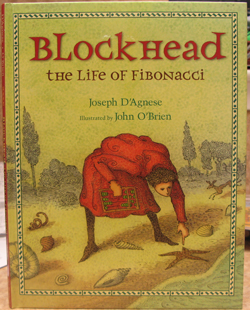
    After publishing my recommendation of You Can Count on Monsters, a reader emailed an equally compelling suggestion: Blockhead: The Life of Fibonacci, by Joseph D’Agnese.

    Armed with my new Barnes & Noble membership card, I scurried down to the bookstore to get it.

    It’s not just math.

    Intertwined in this tale of the great mathematician Fibonacci, are fun historical facts and a coming of age story.

    I learned the approximate time Arabic numerals started making their way to Italy and when the Leaning Tower was built.

    D’Agnese has Fibonacci narrate the story. Through his eyes we see the difficulties of a smart boy with moxie. He struggles, but doesn’t let the ridicule interrupt his dreams.

    And there’s plenty of math, too!

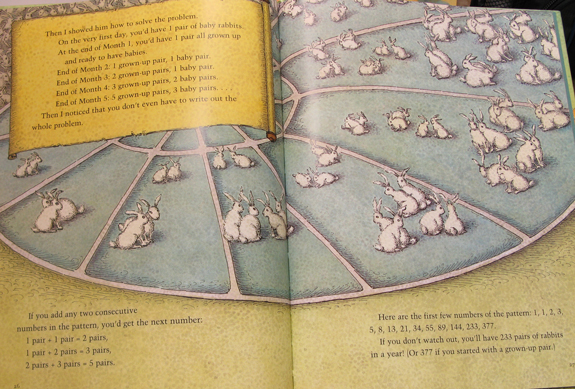
    Of course no picture book on Fibonacci would be complete without the rabbits. Illustrator John O’Brien doesn’t disappoint:

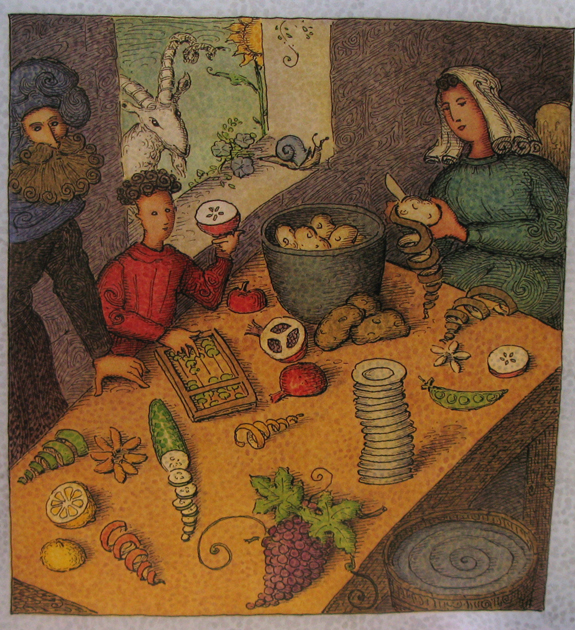
    And there’s math filtered in the images all over the place. Here’s an obvious one:

    Brilliantly, they’ve included a “Can you find…” page at the back to encourage and support children and parents in finding the beautiful countables.

    They even offer ways to find math in your own kitchen and backyard!

    Your turn…

    Go grab Blockhead: The Life of Fibonacci at your library or bookstore. Enjoy it alone or with kids – it’s great either way.

    And do share your thoughts in the comments and on twitter.

    P.S. Writing this inspired me to think of a way to remember how to spell Fibonacci. Acci & Fred were friends until one day bad Fred told a Fib On Acci.

    Related articles
  • The Gruel We Feed Our Children

    The Gruel We Feed Our Children

    We used to discover math.

    Now it’s processed and canned in textbook factories.

    We spoon feed it to our kids.

    And sprinkle it with carcinogenic sweeteners.

    We make the spoons bigger and force feed this gruel to them.

    So much in our world is going organic.

    Maybe math should too.

    This article is a part of the 50 Word Friday series. Learn more about this strange, limited writing style here…

    Related articles
  • Literacy Improvement – Can It Be Modified for Numeracy?

    Literacy Improvement – Can It Be Modified for Numeracy?

    Can we apply the tactics of literacy improvement campaigns to numeracy improvement?

    It sure would be nice!

    Last week at the Western Social Science Association conference, I presented this question along with some possible answers.

    This is the first in a series explaining how that may work. Here is the proposed series:

    • Introduction and Definitions (this one)
    • How Numeracy & Literacy are Similar
    • How Numeracy & Literacy are Different
    • Tactics of Literacy Improvement Models
    • Modification Ideas & Needs for Numeracy Improvement

    The first step to formulating a plan to apply literacy improvement models to numeracy improvement is to define them.

    The Definition of Literacy

    James Paul Gee spent some considerable time, in a paper titled What is Literacy?, discussing and formulating a definition of literacy.

    Many definitions include reading and writing. Some definitions include thinking critically.

    Various definitions extend the definition to include cultural norms, technology and interpreting various multimedia forms of communication.

    Under these extremely expanded definitions of literacy there is a much greater number of “illiterate” people that those normally labeled (either self-labeled or otherwise) as illiterate.

    Because of this, I will keep my definition of literacy tightly defined as:

    Literacy is the ability to decode written text and verbal statements, comprehend the literal meaning of them and speculate on the writer’s or speaker’s meaning.

    Speculating on the writer’s or speaker’s meaning includes the comprehension of various forms of metaphorical devices. I have included this in my definition since metaphorical devices are ubiquitous.

    Note that literacy, in this definition, much be of a certain language.

    The Definition of Numeracy

    Numeracy is a much less familiar word, but has no less variation in definition. Definitions can encompass: number sense, arithmetic, mathematical manipulation techniques, data analysis, measurement, geometry, probability, statistics, the ability to solve spacial and quantitative problems and the ability to interpret and understand graphs, diagrams, charts and tables.

    Because of this seemingly exhaustive list, I will keep my definition to this:

    Numeracy is the ability to collect, organize and interpret information and arrive at numerical or numerically supported conclusions.

    This definition, because of the numerical requirement of conclusions, assumes the information being collected, organized and interpreted is of a numerical nature.

    Thus the definition includes the requirement of a person to be able to “read math.”

    A slight clarification of the definitions.

    Both of my definitions include the assumption that the abilities don’t have to be demonstrated “out loud.” A person can have a “gut feeling” of the content of a written metaphor without the ability to articulate it.

    Likewise, a person can, within moments, collect, organize and interpret the information of a pack of hungry lions rushing toward him and come to the conclusion of “RUN!” – a decision numerically supported by the number of attackers and the probability that he’s not going to win that fight.

    Next…

    Share your thoughts and your definitions in the comments. And shout it out on twitter.

    Oh – and stay tuned for the next in the series, How Numeracy & Literacy are Similar.

    Disclaimer – this was originally drafted as a Paper (capital P) so that’s why some parts might look a whole lot less like my normal writing. Please excuse this.

    Related articles