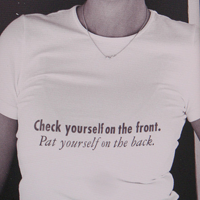
I’ve known enough women, both young and “old,” who have joined the horribly unfortunate club of breast cancer survivors. And I sometimes wonder how it is that I still forget every month to do my breast exam.
Especially when you look at the math!
5 seconds of breast exam per breast/month x 2 breasts = 10 seconds/month
10 seconds/month x 12 months = 120 seconds/year or 2 minutes/year on your breast exam
TWO MINUTES PER YEAR!
2 minutes/year x 90 years = 180 minutes or 3 hours
Can you use 3 hours of your life to do your breast exam?
And what does 3 hours of time gain you?
If you feel that tiny pebble when you do your short breast exam you can get to the doc quick. Which means nabbing that bundle of evil cells before they go any further.
Taking 10 seconds to do your breast exam means having a lumpectomy instead of a mastecomy – and possibly lymphadenectomy along with it.
Spending merely two minutes each year on your breast exams means surgeons can get that nice margin around the lump. It means preventing those damaged, multiplying cells from cruising your system and getting into other parts of you.
It means living longer. For you. For your partner and friends.
For your kids.
Cancer is the only place where muliplication sucks for everyone.
Multiplication is normally the bomb. It rocks. It’s cool.
Even if someone’s not good at it, multiplication give you the ability to triple your income. It lets you be ten times smarter than you were three years ago.
With multiplication you can love someone twice as much tomorrow.
But the multiplication that cancer cells do, destroy all of this.
So do your part.
Donate to the cause or attend a special event that supports breast cancer awareness.
And do your breast exam every month. Let your kids keep their mom.
The math shows that it only takes a little while to gain you a long while.
Do it!
I’m heading to the Houston Aeros Breast Cancer Awareness Hockey Game today. They were sweet enough to send me a bundle of tickets and I’m honored to help them raise money for the Young Survival Coalition. Tomorrow I’ll write about the math in hockey!
My friend Shawn from #mathchat shared a video about teaching times tables with a number stick. It’s been haunting me ever since!
I have to learn to use one!
I just had to learn how to teach with this thing, and get me one! So I looked around to find out how to do it with other numbers. I found this video of how to do it:
Where do you get one?
As far as I can tell, you gotta rob your mop of its handle, get some tennis grip tape and make one. I can’t find a place to just buy one – anywhere!
So I’m off to buy a mop.
What do you think? Have you used a number stick? Do you own one? Wanna sell it to me?
This post originally appeared on The HSBA Post on February 28, 2012.
When I opened Katy & The Big Snow by Virginia Lee Burton to find some math, I was shocked. I didn’t have to look far at all – it was everywhere!
Math is disguised in all sorts of fun places in this beautiful book!
Katy includes graphing!
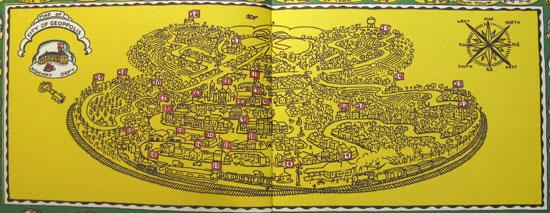
The book starts off with the map of the city. Maps are graphing.
And when the city is shown on other pages, if the orientation is different, a compass is shown to indicate direction. The compass represents the x-axis (N/S) and y-axis (E/W). It also shows the 360º in a circle.
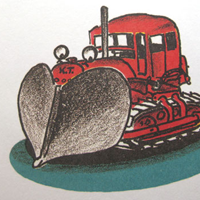
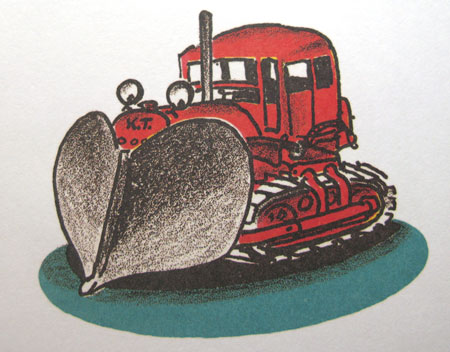
When Katy (the tractor) is introduced, you can see lots of symmetry – especially in her big snow plow. Symmetry is another important concept in graphing.
Factors and multiplication are in the book.
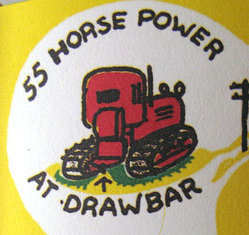
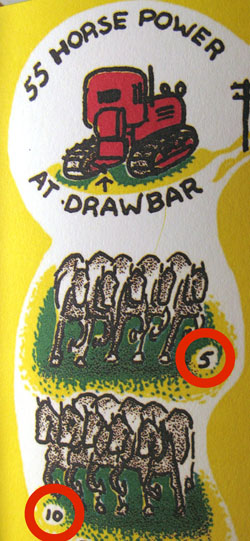
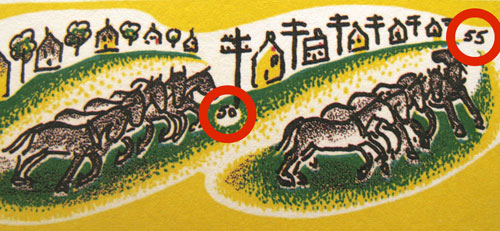
Katy’s features are outlined in the margins and include her horsepower. Instead of merely writing “55 horsepower,” Burton illustrates it with 55 horses, and they are counted in 5s.
Skip counting like this shows factoring as well as multiples (which are used in finding the GCF and LCM – remember those?).
And Burton doesn’t just stop at 5 and 10, she illustrates and counts all 55 horses.
(Note: I put the red circles on the images.)
So when you read Katy & The Big Snow with your children – you can support their math learning by seeing and saying the math in the pictures!
Share your thoughts and experiences in the comments!
It was Monday. My “day off” from my diet. So Daughter and I decided to use the McDonald’s coupon we got in the mail yesterday.
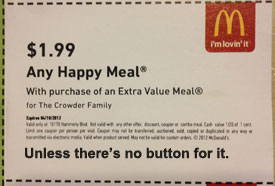
$1.99 for a Happy Meal for her if I buy a grownup value meal.
Easy enough, right?
I informed the speaker: “I have a coupon for a $1.99 Happy Meal with value meal. I’d like a #2 and a Cheeseburger Happy Meal.”
The voice said great and gave me my total: $9.97.
Something didn’t add up.
As I drove around, I couldn’t help thinking my $5.50 value meal, plus her $2 happy meal, plus tax shouldn’t get me all the way to $10.
So I asked about it when I got to the first window.
“Well,” she started, “We don’t have a button for that.”
“I’m sorry…?”
“Those coupons got sent out and they never put a button on our register for it. So I can’t give you the $1.99 Happy Meal. Sorry.”
I was stunned.
“So you’re telling me you sent me this coupon and I can’t use it because there’s no button for it?”
She smiled and shrugged cheerily, “Right. When they sent out the coupons, they didn’t put a button on here for it. If you want to use the coupon later, they might give us a button for it in the next couple of days.”
“Can I talk to a manager?”
The manager was equally unhelpful.
The conversation was similar. With a lot of “there’s no button for it.”
She told me they would be happy to take down my name. Later I could come back for “a small fry or something.” And she tried to keep my coupon.
I was totally confused.
The obvious solution was, well… not obvious.
“There’s no button for it.”
But they have a $.99 menu. And two $.99 menu items is pretty close to $1.99. So why didn’t they merely charge me for two of those?
I have been frustrated many times at the inability of clerks to do simple arithmetic (and to be fair, I’ve also been pleased).
But this was more than arithmetic.
This was thinking.
They were both paralyzed by the fact that there was no button for it. They couldn’t see past that.
Their lack of thinking created a terrible lack of customer service.
I took my coupon back and said that I would be happy to patronize the McDonald’s down the road from now on.
“Oh,” she said, “So you don’t want anything?”
Really, lady?
Can anything be done?
Can we fix the lack of thinking ability in normal people?
I don’t know the answer to that. And I don’t know the cause.
Sometimes I think that early calculator use caused this. But there are lots of parents who allow calculator use early on and raise brilliant, thinking kids.
Sometimes I think it’s the education system.
And sometimes I think it’s society.
What I do know is that my Grams had a 6th grade education and more thinking power than many high school graduates.
Don’t raise blind button pushers.
However you can. Whatever method you find.
We need our kids to learn: If there’s no button for it, you can make it work another way.
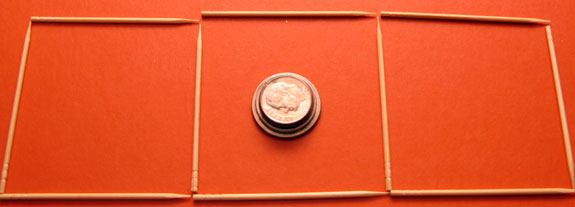
One of my favorite math games as a kid was The Tower of Hanoi. I had no idea what it was called until college, though. To me it was another cheap wooden puzzle. Or a game you could play with four coins and 10 toothpicks.
The object of the game:
Move the stack from where it is, to another square or post.
The rules of the game:
You can only move one disk (or coin) at a time.
You can only put a disk (or coin) on top of one that’s bigger – physically. (I.e. you can’t put a big one on top of a smaller one.)
You can play it online for free or buy a physical version in classic or kid-friendly versions.
How can you use The Tower of Hanoi with your kids?
In the Tower of Hanoi puzzle, the math is vast – especially for such a simple little puzzle. But the math can be discovered gradually.
Present these challenges to your kids, one at a time:
Move the stack according to the rules (just get it to another place.)
Move the stack according to the rules in as few moves as possible. How many moves is that?
Make the stack smaller or larger. Then move the stack according to the rules in as few moves as possible. How many moves is that?
Repeat challenge #3 with many different numbers of coins/disks. Use cut out pieces of paper if necessary.
Determine how many moves it would take to move a stack of 100 disks. Or 1000 disks.
Then figure out a way to say this without numbers. In other words, create some sort of formula that will tell you how many moves you need to move any number of disks.
These challenges might range over many many years. I first learned of The Tower of Hanoi when I was about ten. And I’m still learning about it 30 years later.
Oh, and try to resist giving them any answers – ever. Instead let them work on it in their spare time.
Your turn!
Have you played The Tower of Hanoi math game, or a version of it? Do you remember the first time you came across it? Did you learn or teach math with it?
We’ve trained kids to know that math is a set of specific, discrete rules that, when followed, yield the correct answer.
They memorize math rules like:
Whatever you add to one side, you must add to the other.
FOIL
Distribute
PEMDAS
Plug in 1 for x (then 0, then -1)
The rub is, that they don’t understand why the rules work. Which might not be a big deal – but the rules don’t always work!
We got to see The Math Rules in action.
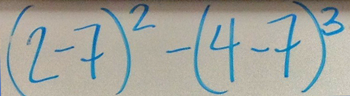
For two days, in my #PowerMath class (officially Developmental Math – the class two levels below College Algebra), we’ve been working on this problem:
The goals were these:
Practice and understand the order of operations.
Compare this to working with variables.
Learn to experiment with the math rules to discover how things work.
What I saw was mind-boggling. I knew the skill level was low. But I had no idea the blind following of math rules was so widespread and detrimental.
Goal #1: Practice and understand the order of operations.
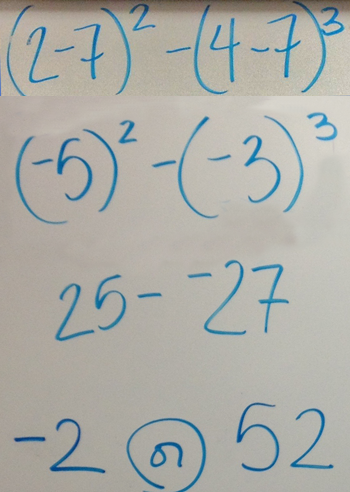
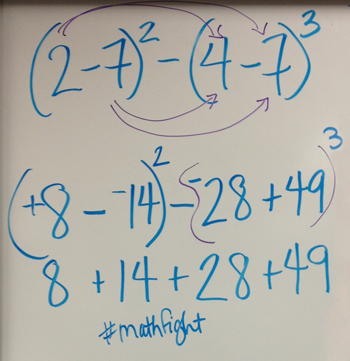
When given the problem, and asked to coach me on various ways to do it, someone requested we use the order of operations and “do inside the parenthesis first.” So we did. They instructed me to write it like this:
All was cool until the end when there was a bit of an argument on the final answer. So we listed them both as possibilities.
Although the act of doing the arithmetic inside the parenthesis is valid, we had much discussion on the positive and negative signs running around.
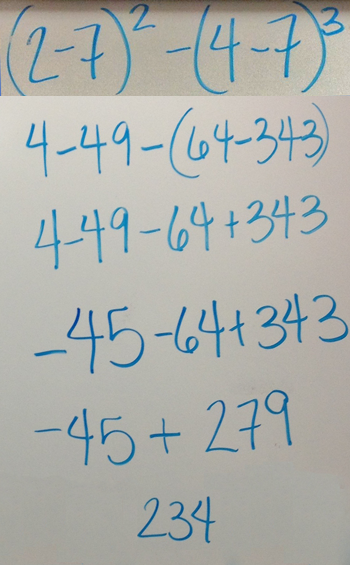
I had encouraged everyone to chime in with their own ways to find the answer, and someone suggested that I do the exponents first. They coached me to write this:
Alas, we had yet a different answer than the first two.
This is a common mistake. But I was hoping that through other experimentation they would see how we could fix this.
Someone else pointed out that we could FOIL. I asked them to explain exactly what they meant by it and they told me how to draw the arrows:
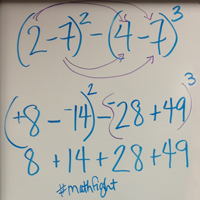
By the time we stopped, the class was in a full out #mathfight. Some students believed we needed to handle the exponents first, then do FOIL and others thought we should keep the exponents on the bits after we used FOIL. We decided to postpone this version until we worked out some of the others.
The use of FOIL here doesn’t work because the two binomials are being raised to a power. Furthermore, they are being subtracted, not added.
Goal #2: Compare this to working with variables.
The comparison of real numbers to variables has three main points:
Variables represent numbers.
Any math rules you can apply to numbers you can also apply to variables.
Any math rules you end up using on your variables, must also work with numbers.
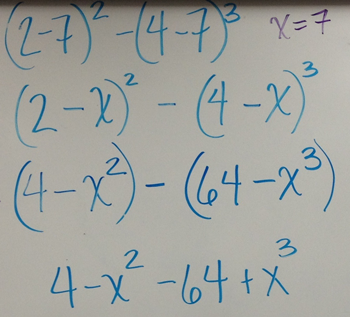
To help illustrate this, I removed the 7’s in the problem and replaced them with x’s. Our initial tries were interesting.
This experiment, as suggested by the students, applied the same “method” of squaring the inside pieces as one of the purely number versions above:
At which point, someone suggested that we subtract 4 from both sides.
Line #3 here is incorrect. Also, there is no “both sides” because there is no equals sign.
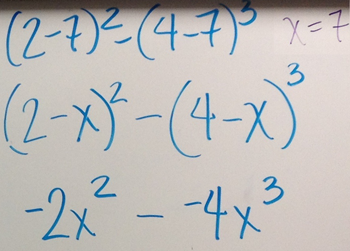
We went to another part of the board to start over and give it a try like this:
Here it was suggested that we set x=1.
Since x=7 (by the design of the problem) it doesn’t follow that x=1. I believe the student was remembering graphing an equation where x is the dependent variable. Also, note that the last line is merely a permutation of the symbols in the expression – it is not equivalent to the previous line.
Goal #3: Learn to experiment with the math rules to discover how things work.
We have a rule in class:
Until you decide differently, everyone is wrong. Even the teacher and textbook.
So I don’t tell them when the answer is right. The skills they are learning are the middle of problems they’ll be solving in the future. They’ll never get confirmation that what they are doing is right or wrong.
There’s no back-of-the-book solutions for the middle of a calculus problem.
Checking themselves, and having confidence in the answers that they have confirmed, are vital.
And yet they get highly frustrated with this.
Why? Because they’ve been trained that they should follow the rules and the teacher or back-of-the-book will tell them if they’re right.
And I’m refusing to play that game.
The full and complete math rules, that go with those above, are:
Whatever you add to one side, you must add to the other, when you have an equation, not just an expression with no equals sign.
FOIL when you are multiplying two sums, not subtracting them.
Distribute exponents over products, not sums.
PEMDAS works only when you know what each term really means and how to use them.
Plug in 1 for x (then 0, then -1) when you are graphing an equation where x is the dependent variable.
But those last bits – the ones in bold-italics – those are ignored. They see an exponent outside of a set of parenthesis, they want to put the exponent on the inside pieces. They see two sets of parenthesis, they want to FOIL.
Handing out rules don’t work. Because students aren’t ever allowed to understand the rules in their entirety.
If you don’t have math anxiety, remembering (or freshly experiencing) performance anxiety is a great way to understand what it’s about.
This happened to me at the beginning of this semester.
I try to memorize the names of all my students. I go through the roll and for each person, I say the name and then look at the student. I study where they are, who they are and their name. I say it a few times and try to get it solid in my memory.
Doing this helps students with math anxiety relax a little. And students who are trying to stay in the shadows (so they can miss class, etc.) learn quickly that I’m going to connect with them, personally.
Of course the act of memorizing names isn’t perfect. The second day of class I usually remember about 30% of the names. So I go through and try to match the names on the roll with different people – giving it my best shot.
I often get it wrong.
A few weeks ago, I mistakenly called one woman, “Sandra.” I was wrong. She said, “Awe, come on, now!”
It was all in jest, I had no doubt. But the strong reaction to my mistake hit me. So when I was looking through the roll to find her correct name, I was nervous.
I was experiencing performance anxiety.
If I gave it a shot and chose the right name, I would look good. But if I picked incorrectly, I would likely get another round of jeers.
Of course, I’m the instructor, so there isn’t that much risk. But there certainly was performance anxiety.
Surprisingly, there was a lot of anxiety.
I pointed this out to the students.
Because the class is less of a content based course and more of a confidence building/math anxiety busting experience, I thought pointing this out might be enlightening.
We talked about how they might have said things like, “That’s a good try, Bon. Unfortunately, Sandra’s not my name. Would you like to give it another try?”
We talked about how that kind of encouragement compares with the “Awe, come on, now!” reaction that they gave before.
And we talked about the parallels of those statements to the statements by math instructors to students – about math. And the parallel of my performance anxiety to the math anxiety many experience.
Consider it yourself.
The next time you try something and get it wrong, notice how you feel. Think about how your child might feel in a similar situation.
And ponder how this feeling would manifest itself as math anxiety if this performance anxiety happens in a math class.
Share your thoughts and experiences in the comments. And tell others about it…
Laura over at Math For Grownups wrote an article on the math behind the points system that Weight Watchers uses.
It was interesting. But since I didn’t do Weight Watchers, I merely found it a fun novelty. Until…
I joined Weight Watchers last week.
I was inspired by a combination of Fitarella’s 12 in 12 super motivational plan, Laura’s “How Many Points Is That?” article and my Ma declaring, “This is the last diet I will ever pay for!”
The points are fun to count and add and play with. After all, it’s math.
But I’m an electronic girl. So I downloaded the Weight Watchers iPhone app and began to plug in my food numbers there.
But the math isn’t quite what the math is supposed to be.
Like Laura said:
Instead of counting just calories, we’re considering four components of our food: protein, fiber, carbohydrates and fat.
Which means that all four of these bits go into a fun (and probably secret) math formula to arrive at the final number of official POINTS for a food.
Which was good with me. Until Ma recommended a great 1-point bread.
1-point for her, that is.
Apparently the iPhone app uses the decimals! Which means…
This 1-point bread is really more than one point!
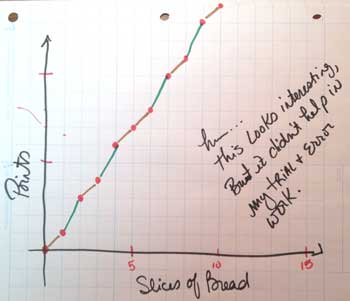
The points, according to the iPhone app, go like this:
1 slice = 1 point
2 slices = 3 points (excuse me?)
3 slices = 4 points
4 slices = 6 points (really?)
5 slices = 7 points
6 slices = 8 points
7 slices = 10 points (now you’re really getting on my nerves)
8 slices = 11 points
9 slices = 13 points
10 slices = 14 points (*sigh*)
So what’s that about?
Shafting me out of points, is what!
Clearly the iPhone app uses the decimals that the paper version rounds to.
So from the information above, can you do the math? Can you figure out exactly how many points the Weight Watchers app assigns to a slice of this so-called 1-point bread?
You could put together a fancy math formula.
But that would be painful (yup, it’s as painful for you and me as it is for the kids – remember that).
Or you could just do some trial and error.
Here’re the assumptions:
Weight Watchers rounds like normal people. If it’s .5 or more, they round up. If it is .4 or less, they round down.
A slice of bread is more than one point. If it wasn’t, I wouldn’t be so mad.
Now to go in for the guesses:
Guess #1: A slice of bread is 1.2 points.
Does this work? If so, you can stop and go have a 2-point beer*, if not, continue.
How do you check it? See if it works in the “chart” above:
1 slice = 1.2 point
2 slices = 2.4 points YIPES!
This doesn’t work. 2 slices have to round up to be 3 points. This would round down to 2 points.
So on to the next guess:
Guess #2: A slice of bread is 1.3 points.
Check it in the “chart”:
1 slice = 1.3 points
2 slices = 2.6 points (good to go! this rounds up to 3 points)
4 slices is supposed to be 6 points. So it needs to be at least 5.5 points.
Again…
Guess #3: A slice of bread is 1.4 points.
Check it in the “chart”:
1 slice = 1.4 points ~ 1 point
2 slices = 2.8 points ~ 3 points
3 slices = 4.2 points ~ 4 points
4 slices = 5.6 points ~ 6 points
5 slices = 7.0 points = 7 points
6 slices = 8.4 points ~ 8 points
7 slices = 9.8 points ~ 10 points
8 slices = 11.2 points ~ 11 points
9 slices = 12.6 points ~ 13 points
10 slices = 14.0 points = 14 points
Woohoo!
You can use this with your kids!
Okay, you might not want to share dieting things with kids. But you can share the “Dirty is better than pain” philosophy:
Why go through the pain of variables and formulas, when you can get your hands dirty with trial and error?
And guess what – if the kids are confident with the trial and error, they might someday see if they can generalize it themselves. Which means they could come up with a formula – on their own!
What do you think? Do you use formulas for your everyday math? Or do you “dirty>pain” it? Can you teach this to your kids?