Part of Wordless Wednesday…
Share your thoughts in the comments or on twitter/x.


Part of Wordless Wednesday…
Share your thoughts in the comments or on twitter/x.

Yesterday I shared my first experience on GeoGebra – and hinted that I had some concerns.
GeoGebra bills itself as “Free mathematics software for learning and teaching.” Indeed the intent is learning – but the market for the software is teachers.
Which means grownups are using it and then making kids use it. And we are using it as if we know what a student needs to learn math.
Yes, we occasionally do. But we have much less discovery learning these days and much more spoonfeeding.
And I worry that a powerful tool like this can easily turn into another way we can tell students:
Here, do this. It will help you learn math because it’s hands on. Make sure you follow the instructions so you can discover what you’re supposed to.
But we don’t have to let it!
In the classic backwards way we teach, the “lesson plan” might go something like this:
We need to learn that the center of the circumcircle around a right triangle is the midpoint of the hypotenuse. So I’ll give them the steps to draw a circumcircle. Then I’ll teach them how to move the vertices.
I’ll construct specific questions to lead them to discover that the center of the circle will be the midpoint of the hypotenuse. They’ll certainly get it then.
And what if they don’t “discover” it on their own? It becomes another performance based failure. And then the teacher discovers it for them.
I discovered math when I used GeoGebra. Math I never knew.
I loved watching the circles and triangles dance. From that I saw that when my point “Marsha” is on each of the sides, it appears she’s on the midpoint.
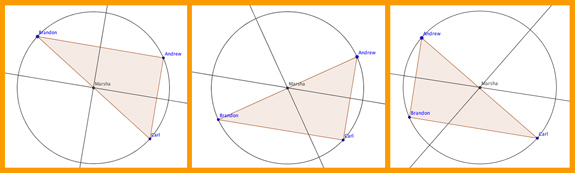
But I wasn’t answering any questions about it. I followed the instructions to draw the triangle and the circle. And then I played.
There were no leading questions. Nothing I had to “get right.” I just had fun.
Suppose you gave your kids exactly what I had – instructions to draw the circumcircle and how to use the Move Tool.
And left it at that.
Would some students discover the hypotenuse/center thing?
Sure!
Would other students not?
Yepper!
I’d never heard of a circumcircle. I know “circumscribed” – but not circumcircle or circumcenter. And I’m doing pretty well mathematically.
If a child discovers something, that’s a win. If they don’t – well that’s NOT a loss! Let it go.
It’s not your job to discover it for them. No matter what the Common Core Standards or TEKS say.
Restructure your lesson plans. See if you can give lots of different “how-to” sheets on drawing stuff on GeoGebra. And see where their curiosity takes all of you. You just might be surprised!
Share your thoughts in the comments or on Twitter/X.
This is the 5th in the draft purge series where I’m throwing stuff out over a three week period.
One month after starting MathFour.com, I came across an article about GeoGebra. I was quite taken by the software, but a little overwhelmed.
I’m not much into technology — at least when it comes to math. So the power of the tool was much more inhibiting for me than it was empowering.
Indeed this article was first “drafted” back in March of 2011 — more than a year ago. It only had the link to that article in it. Not much of a draft.
Lucky for us, math is math. It doesn’t change much over a year (or even a few hundred years).
So GeoGebra is pretty much as useful (and as scary) as it was a year ago.
But like all good heros, leaders and people stupid enough to think they might be either, I’m diving in. Regardless of my fear.
So I found the GeoGebra Quickstart guide and started reading. I downloaded GeoGebra and cranked it up.
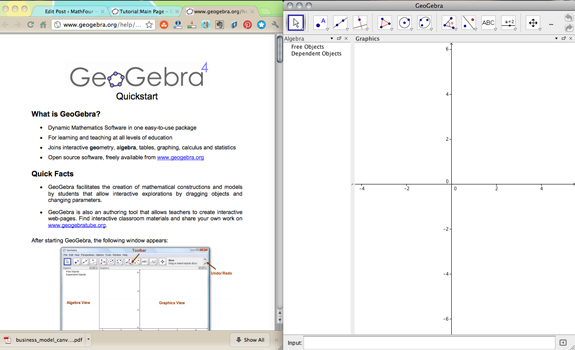
The Quickstart has three examples to try. The first one is un-intimidating — merely involving a triangle and a circle.
So I did it.
Turns out you can “share” your work on GeoGebra — those guys are pretty clever, I must say!
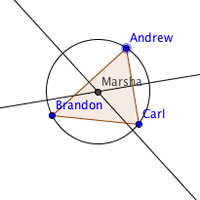
Click here to see my first ever attempt at GeoGebra goodies. Notice I named my triangle vertices and the center of the circle with real names — fun!
Following the directions, I learned about the Move Tool. Which means you can move just about anything — the whole triangle, the circle or any of the vertices!
Check out the “dance” I did with my circle and triangle:
I’m looking forward to playing some more. But I still have my concerns.
I’ll share those tomorrow. For now, I’m just going to enjoy the tool!
Have you played with GeoGebra? Will you? How do you use it? Tell us in the comments.
Don’t forget to tweet it out, too!
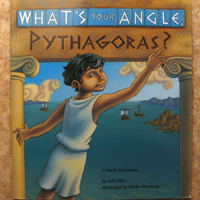
This is part of the Teaching Math with Picture Books series.
Check out this activity you can do with What’s Your Angle Pythagoras?
Will you do it? What else can you do? Tell us in the comments.
And share this on Twitter!
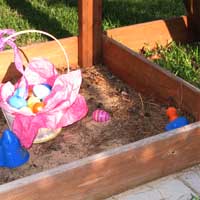
I saw natural math ability yesterday!
K8 was hunting Easter eggs at Mawmaw & Pawpaw’s house. She saw an egg inside the sandbox. As she reached into the box she realized the egg was too far away.
She was standing where the footprints are. The egg was where the striped egg is:
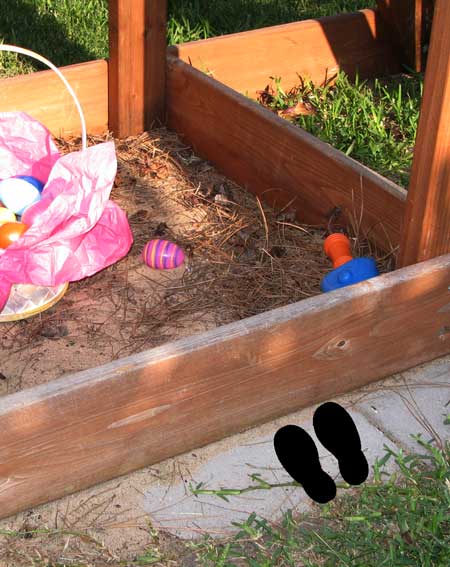
The “easy” answer was to step inside the sandbox. But she wanted no part of the gritty sand.
With no hesitation, she moved from her location, around the sandbox to the new spot:
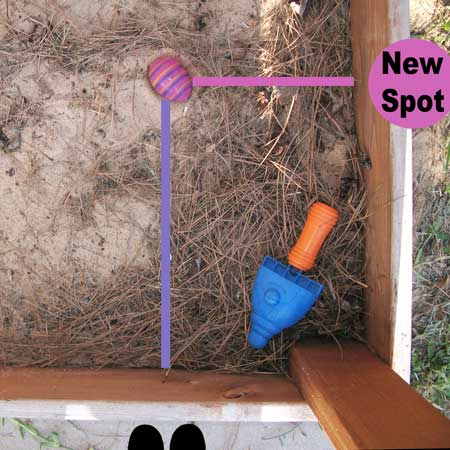
This took some effort because she had to squat to get under the ladder. But she had seen that avoiding the sand was possible if she accessed the egg from the other side.
With no vocabulary or formal training (indeed she’s 2 1/2 years old) she identified perpendicular distance! She assessed which side of the square sandbox would minimize this distance. And she acted on that assessment.
It’s normal for parents to believe their children are especially smart, gifted or brilliant. I believe that all children are these things.
Kids have a natural math ability. And so do you.
What do you think? Share your thoughts in the comments and make sure to share this story with your twitter network!
This is part of the Teaching Math with Picture Books series.
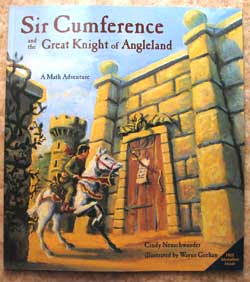
The math picture book Sir Cumference and the Great Knight of Angleland appealed to me because of the punny title – and the promise of wordplay was certainly fulfilled!
This fun little gem of a book is only one in a series of Sir Cumference books by Cindy Neuschwander.
Radius is the son of Sir Cumference and Lady Di of Ameter. (See what I mean – the puns start on page one of this picture book!)
He decides he’s old enough to take a quest and learns from his mentor, Sir D’grees (it’s side splitting, I tell ya!) about the missing King Lell.
Radius is given a “medallion” by his parents to help him on his quest. No one really knows what the medallion is for, but it seems it might be helpful.
Or at least cool to have while on a quest.
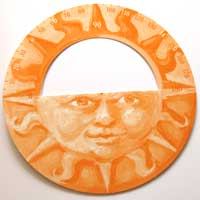
As a treat to the reader, a laminated version of this medallion is included in the back of the picture book. It looks like this:
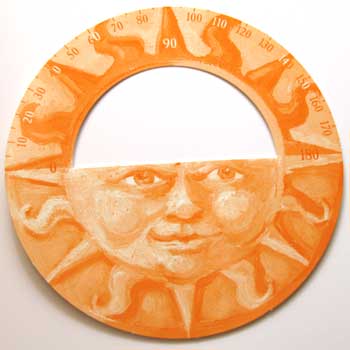
Angles, degrees and all things geometry show up. And Neuschwander doesn’t write them out loud until the end, when Radius starts naming them.
Here you see the steep “cute” roofs of the village in the valley near the Mountains of Obtuse.
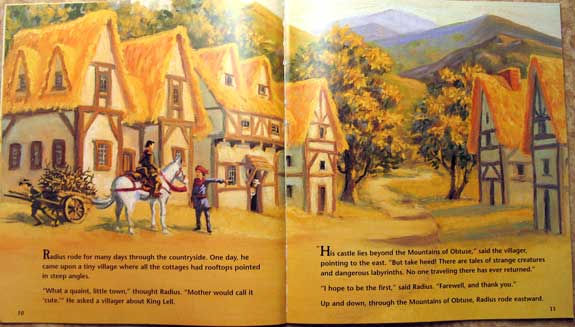
Husband enjoyed paying attention, looking at the pictures, and trying to guess which person or thing would end up as a namesake for a geometry term. I think he enjoyed it more than K8!
Read this picture book to enjoy (as we did) or use it to introduce or enhance your geometry lessons.
I won’t spoil it for you, though. Get it at the library or find Sir Cumference and the Great Knight of Angleland online. Read it. Enjoy it. You’ll see I’m right. (No pun intended!)
Share your thoughts in the comments and make sure to tell your PLN on twitter!
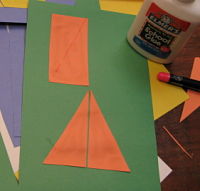
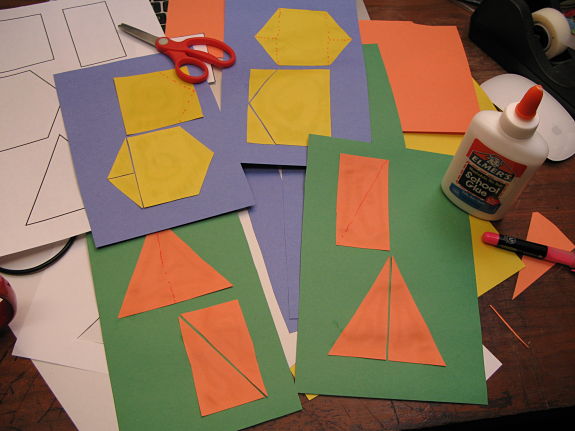
I have been working with eHow.com to get some common math questions answered. One of the questions was, “How are the areas of a rectangle and triangle with the same base and height related?”
Curiously, all rectangles can be cut into triangles. And all triangles can be doubled to make a rectangle. Watch this video – and then get out the construction paper, scissors and glue.
Grab a kid and have some fun watching them discover!
Have thoughts on this? Share them in the comments. And don’t forget to share it on twitter/X.
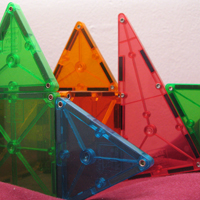
Daughter got a set of Magna-Tiles geometric shapes from her aunt for Christmas. I distracted her long enough to get some great photos so I could write about this amazing toy.
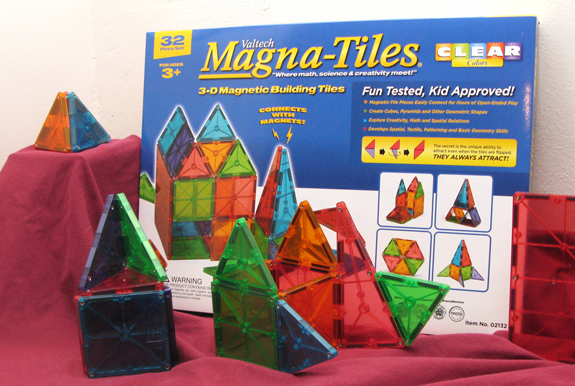
When teaching math, you pull out any shapes you can from anywhere in the house. And sometimes stuff you can buy trumps all the other stuff. Not often – the home holds tons of great geometric manipulatives – but sometimes.
The magna-tiles are clear, so they’re pretty and you can shine light through them.
Also they’re magnetic – so they stick together and stick on the fridge. Great storage for fast usage!
And then – here’s the best part – they’re geometric shapes! Two sizes of squares, three sizes and shapes of triangles.
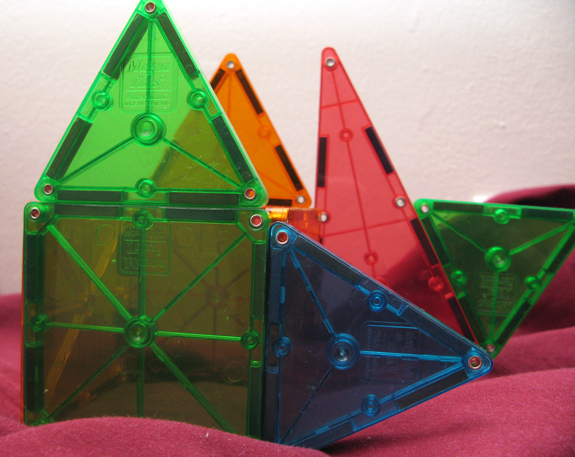
You’d think that being geometrical was the first requirement. But really – clear, pretty and magnetic go a long way!
Get these fabulous shapes at Valtech! Co. on Amazon.com, or at your local teacher/homeschool supply store.
Do you have some? Do you want some? Share your thoughts in the comments.

When looking at Christmas lights with a child, you see things you might never have seen before.
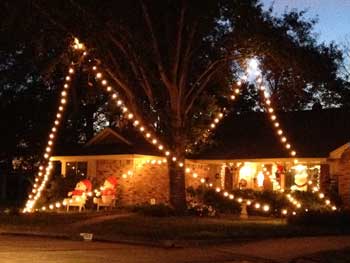
Lights around a window make a rectangle. Lights that droop might be a parabolic or catenary curve.
And some people hang their Christmas lights in triangles!
What shapes are in your Christmas lights?
This article is a part of the 50 Word Friday series. Learn more about this strange, limited writing style here…