Tag: geometry

  • Fahrenheit to Celsius – Graphically!

    Fahrenheit to Celsius – Graphically!

    Part of Wordless Wednesday

    The beautiful and talented Heather at Freebies4Mom.com sent me a post on An Easy Way to Convert Celsius to Fahrenheit.

    It inspired me to draw the graphs of Celsius in terms of Fahrenheit and Fahrenheit in terms of Celsius.
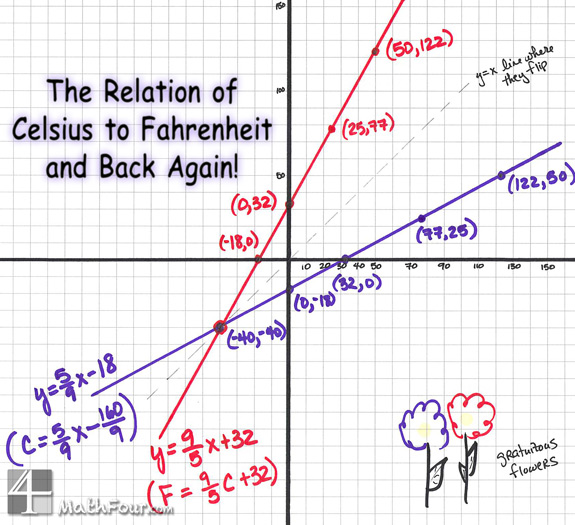
    The conversion from Celsius to Fahrenheit and back again can be strange. One way to understand it is on a graph. And you can use this to teach some linear algebra too!

    Notice these two intersect at (-40, -40). Which means that -40°F is -40°C!

    Use it to convert temperatures.

    The x values on the red line are Celsius – so find the °C you have and then look at the y-value to convert to °F.

    It’s just the opposite on the purple line.

    Okay, fine. This isn’t the greatest way to convert – but it’s exciting to see it graphically. And it might be easier to convert this way for someone who’s more visual.

    Use it to teach math!

    These two lines are inverses of each other. So the coordinates of one are switched to make the other.

    Also, they mirror image across that 45° line. I marked the line with dashes and wrote $latex y=x$ on it.

    And if you’re into this, their functional composition (both ways) is… x! (not factorial)

    Compare and Contrast…

    Take a look at the way J.D.Roth did it and then look at the graphs I have. Let your students find the way they like the best. And encourage them to create new ways!

    Oh, yeah – and share what happens in the comments!

  • Math Teacher Interview Questions

    Math Teacher Interview Questions

    At 8:30 PM CST tonight, October 20, 2011, Natural Math is hosting a presentation about a new book called Modern Math for Elementary Schoolers by Oleg Gleizer. It’s a Creative Commons book on advanced math for elementary school children! (So it’s free! Get it here.)

    Gleizer’s inspiration is from a similar situation in which I currently find myself: To what school should I send my child? Of course my answer is The Bon Crowder School at Home. Alas, Husband believes there’s no reason to fully homeschool if there great schools out there.

    So are there great schools out there?

    I started reading the book and stopped on page 4. Gleizer is explaining his method of finding math teachers. He asked math teachers of potential schools these two questions in the interviews:

    1. Given a straight line and a point away from it, how would you draw another straight line passing through the point and parallel to the original line, using a compass and straightedge as tools?
    2. How would you draw a four-dimensional (4D) cube?

    Of course, I immediately began to wonder if I was good enough to answer these questions myself!

    I got the answer to #1 after some thought, and am pondering #2. I’m refraining from reading on, as I want to come up with my own answer before I read anything else. But I’ll be attending the presentation this evening.

    What about you? Can you join us?

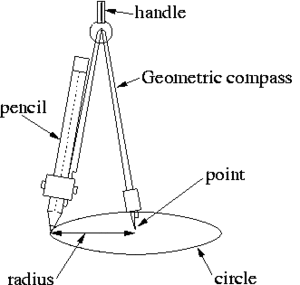
    P.S. I’ll  have to wait to post the answer to #1 tomorrow, as I have discovered that I don’t have a compass. How on earth can you teach math without that?! How embarrassing! So I’m off to Walmart right now to get one.

    Related articles
  • [50 Word Friday] Cars Driving in Circles

    [50 Word Friday] Cars Driving in Circles

    Daughter wanted to play. I wanted her to learn. We did both.

    She learned:

    • You can sit in the center of a circle.
    • Cars drive on the circumference of the circle.
    • Cars driving at the same speed can continue to be diametrically opposed.

    Learn and play – the best way!

    Learn more about 50 Word Friday here.

    Related articles
  • Cheesy Math – No, Really. Math & Cheese!

    Cheesy Math – No, Really. Math & Cheese!

    Last night was taco night and my job was to grate the cheese.

    I didn’t get too far in before I noticed some math.

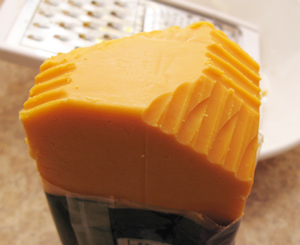
    For some reason I always start grating on a corner. Then I rotate the block so I’m grating on another corner. After doing this a few times I noticed the angles I was creating:

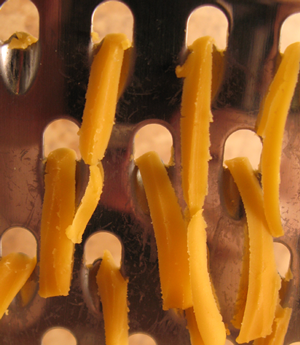
    And what exactly are the shapes, anyway? What is the shape of the grating holes of the grater? And what is the resulting shape of the cheese sliver?

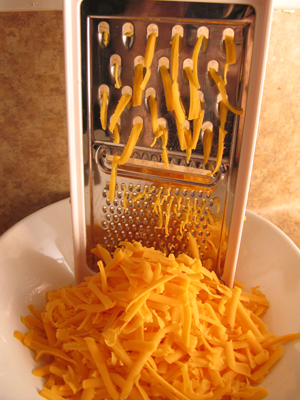
    How much cheese is in the pile after you “fluff” it by grating it? What’s the volume of fluffed cheese compared with stuck-together-in-a-block cheese?

    More importantly, is there enough for two grownups and a toddler? (When one of the grownups loves cheese!)

    What are your math curiosities in the kitchen?

    Related articles
  • Teaching Geometry with Pickles

    Teaching Geometry with Pickles

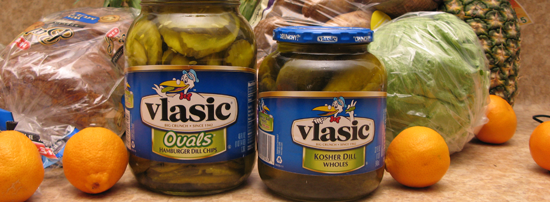
    Daughter is into pickles. Like way into pickles. If I were to start a blog just for her, it would be called www.PicklesAndPretzels.com. (She’s also into pretzels.)

    So when Husband grabbed two instead of one jar yesterday, it seemed natural.

    Unloading the groceries, I saw the two jars a little more closely.

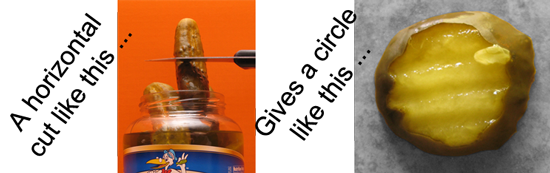
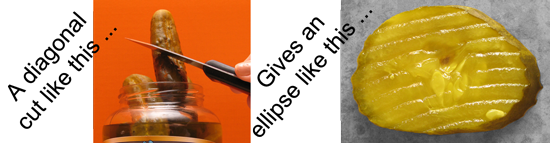
    “Holy cow,” thought I. They’ve made ellipses (pickle ovals) out of segmenting cylinders (the whole pickles)! And they’re marketing them!

    Math in action – via Vlasic!

    Interested in more about ellipses? Check out Wolfram MathWorld’s bit on it.

    Related articles
  • Cuisenaire Rods Go Pythagorean!

    Cuisenaire Rods Go Pythagorean!

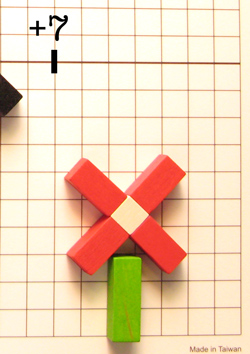
    I’ve been playing with the lovely Cuisenaire Rods for a few weeks now. I made the (fortunate) mistake of creating this flower in a past article about coordinate pairs.

    The mistake was that I would eventually have to come up with the coordinates for this thing. Fortunate because it gives the MathFourTicians out there something else to teach with the rods!

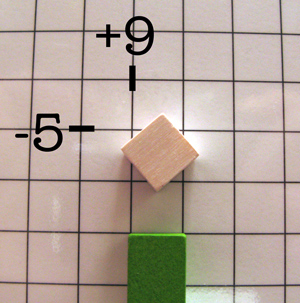
    The center of the flower is the place to start.

    Since all the “petals” are attached to the center, that’s probably the best place to begin.

    I converted to something I could see.

    Since everything is tiny (1 cm), I went to a bigger setup. And some of the coordinates were easy to pick out. So I put those in the big grid, too:

    And then I started to do some work…

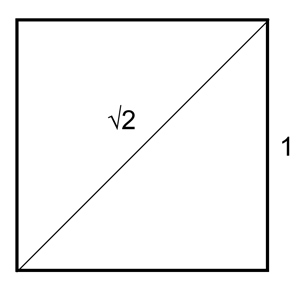
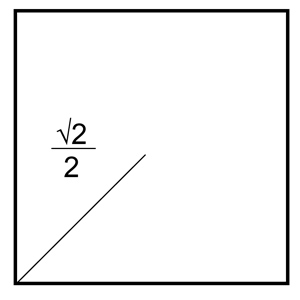
    Next I considered what I was really dealing with: a square. And each side was 1 cm.

    According to those crazy Pythagoreans, the diagonal measures 2\sqrt2:

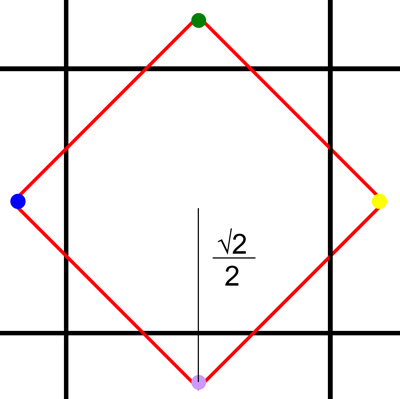
    So half the diagonal is 22\frac{\sqrt{2}}{2}:

    I went back to the big grid.

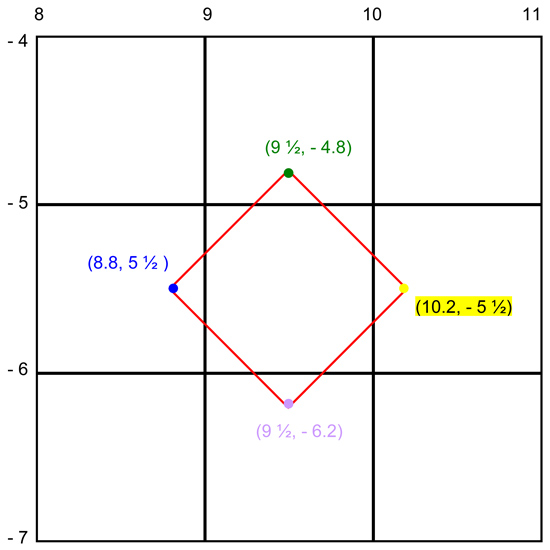
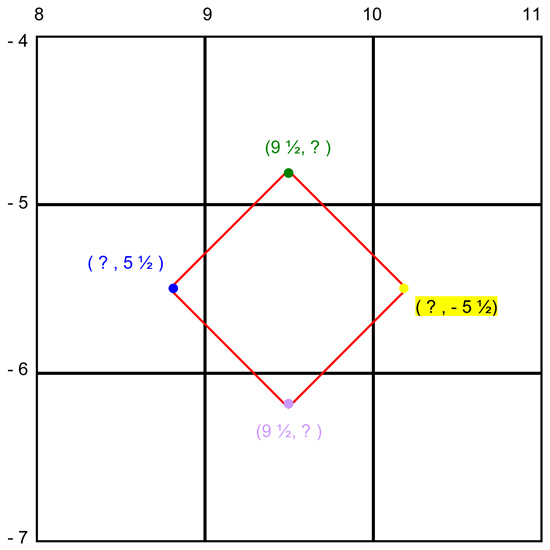
    When I put this information on the big grid, it looks like this:

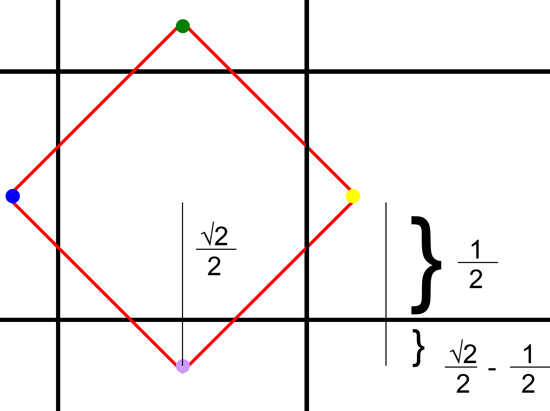
    Doing some arithmetic and geometry, I get:

    Using my very cool TI-30 calculator, I get that 22120.2\frac{\sqrt{2}}{2}-\frac{1}{2}\simeq0.2.

    I can accurately name the points!

    Knowing that each corner pokes out roughly 0.2, I can calculate the coordinates:

    From this I can create the ordered quadruples as described here for the petals of the flower. But at this point I’m pretty much needing a break. So I’ll leave that for next time.

    Whatcha think? Fun? Share your thoughts in the comments and on Twitter:

    Related articles