I just got a notification that today, September 16, is 100 days until Christmas. When I read this many thoughts went through my mind:
What’s our obsession with 100?
I wonder why we chose 24 days of advent and not 25, 50 or 100.
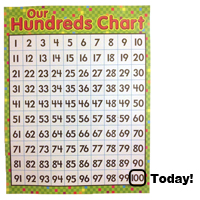
Hey — we could count 100 days to Christmas on a Hundreds Chart!
Two good things to do…
First, sign up to get the fun things from the site 100 Days to Christmas. I just found this site, so I’ll be getting those emails brand new like you!
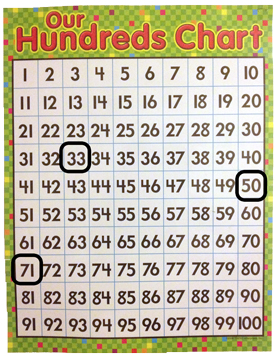
Get out your Hundreds Chart and use it for your 100 Days to Christmas countdown. Pick some favorite or familiar numbers and figure out when it will be that many days to Christmas.
My best friend’s favorite number is 33, half of 100 is 50 and I was born in 1971. I’ll start with those!
Or choose some special dates and figure out how many days to Christmas those dates will be. Like if your wedding anniversary is on September 29, that’s 87 days to Christmas.
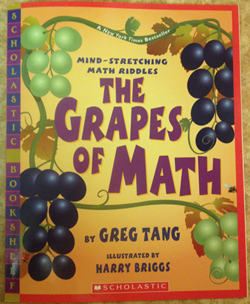
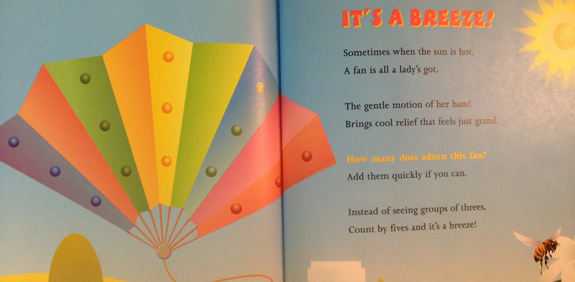
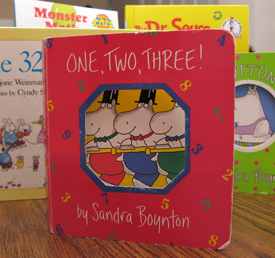
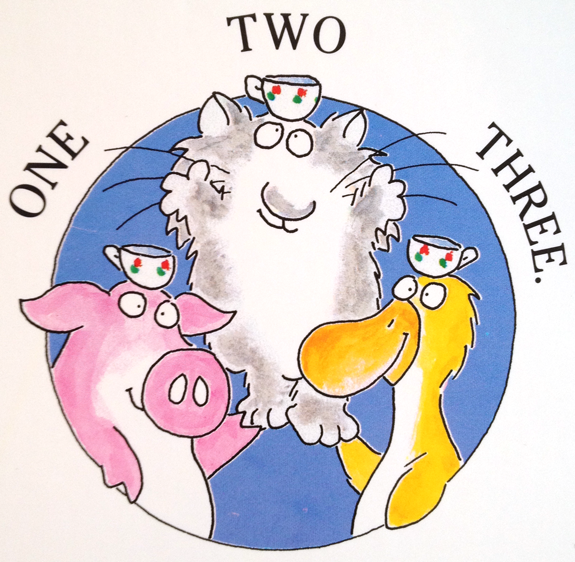
The first thing you see in this math picture book are the bright but simple images. Looking at them you feel like you’ve stepped into the surreal world of those old View-Master reels.
The rhymes are catchy and cute!
I’m all about iambic pentameter. Well, I really don’t know exactly what that is, but it sounds like it means bouncy poetry.
And that’s what this math picture book has!
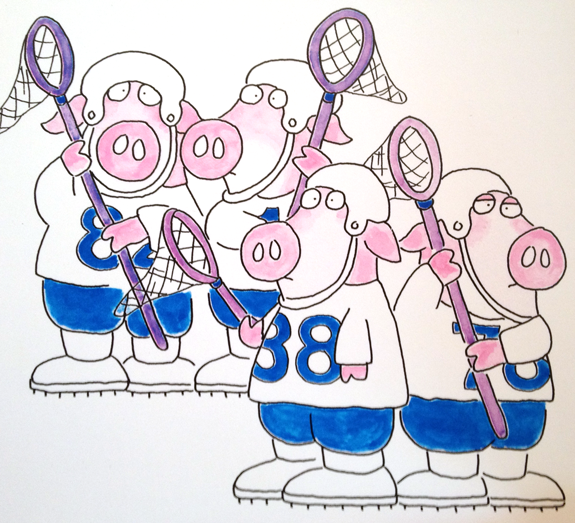
While scallops on the beach look great, I’d rather see them on my plate.
Unfortunately it’s their loss, They swim their best in butter sauce.
Oh, but the counting’s even better!
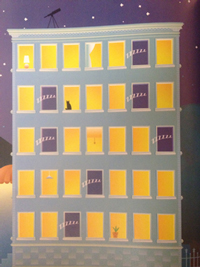
Each page has objects (fruit, bugs, dice, etc.) spread out so that children can experiment with different ways to “see” how many there are. You can subitize, group, multiply, subtract – or do them all!
The answer key in the back helps you understand the intent of the authors.
But I recommend you try various ways yourself before turning to the back. Some of their methods were very different than what I came up with.
And you can try it at home!
There are 16 different pictures and riddles to practice on. But it doesn’t have to stop there.
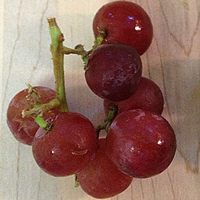
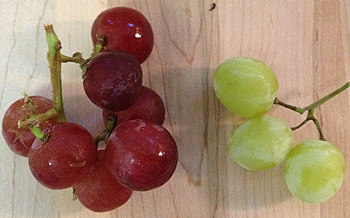
You can do your own playing at home. Check out the grapes I did here:
I’ve never been a believer in the real number line. It just always felt wrong that between any two numbers, there’s another number. Sure, you can go between two things – but is there a number there?
And then I think, “Well, add up the numbers you’re standing between and divide it by 2 – that’s the number between them.”
But it still doesn’t feel right.
I could be onto something, though.
I listened to Episode #110 of Stuff To Blow Your Mind called “Is math a human invention or a human discovery?” They pointed out that tiny babies can perceive quantities.
“Curious,” I thought.
Then I peeked at their math series, in particular the article on What are Numbers? Which led me to Stanislas Dehaene and his appearance on RadioLab’s episode on Innate Numbers.
Here’s the discussion.
I was particularly interested when they noted (around minute 11) that we don’t naturally switch from logarithmic thinking to this 1-2-3-4-counting we do now!
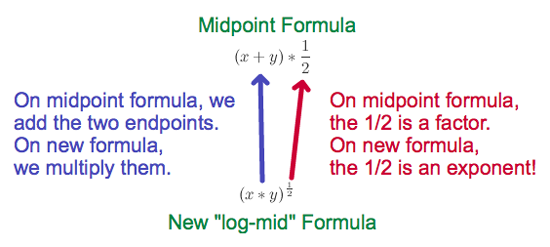
Around minute 12 in the audio, they consider the idea of midpoint. Dehaene notes that in logarithmic thinking, the midpoint between 1 and 9 isn’t 5, but 3.
The midpoint between 1 and 9 is… 3?
Here’s how we think of the middle: “What do I add to 1 twice to get 9?”
We can add 4 to 1, twice, to get 9. So then we add it only once to get halfway there – and halfway there is 5.
(Of course this leads to a whole ‘nother discussion about how the square root is really just “half” with respect to multiplication. But that’s going a bit to far for this article)
And the bigger the numbers, the more “ish” things become. And apparently, that’s okay!
So maybe we do have it wrong.
I’ve told thousands of students over the years that mathematicians just make this crap up. There’s no truth to that “mathematics is the universal language” hoo-ha that they feed you in the movies.
Leopold Kronecker noted:
God made the integers; all else is the work of man.
And just maybe man has messed it up.
So is there really a number between any two numbers? Or is there just something “sort of” between any two numbers?
What does this mean to math learners?
Okay – now the bottom line. What does this mean to grownups teaching math – and the kids learning math?
These little super heros have amazing powers – right when they’re born!
Well – one thing is that we grownups can lay off. Let the kids learn their own ways. Let them inquire, discover and develop their own methods for doing things.
If they’re logarithmic thinkers (which they are from the start), let them ride that wave a while.
Also, remember that we, the grownups, have been conditioned out of logarithmic thinking. Which means that their way (the natural way) seems wrong.
But we are the ones who are wrong.
So if your kids don’t believe what you’re feeding them. Let them doubt. They’ll learn enough eventually to pay their rent, balance their checkbook and meet their friends halfway.
Seems that I’m learning something called “addition” these days. My parents say things like “two bottles of vitamins plus one bottle of vitamins equals four bottles of vitamins. That’s addition!”
I’ve figured out that “addition” means you use the words “plus” and “equals” in the same sentence.
You can do addition with counting too!
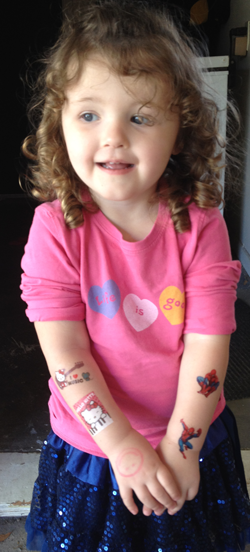
I’m into tattoos. I have kitten tattoos and Spider Man ones. To put them on, we have to use a wet rag and count – first to 20 and then to 10. My mom says that “twenty plus ten equals thirty.”
That sentence has both of the important words: “plus” and “equals.”
So doing tattoos is not just counting, but addition too!
So tattoos are math!
My dad doesn’t like me to have so many tattoos. He prefers I use the fun band-aids. Band-aids are okay, but you don’t have to count or add to put them on.
The more tattoos I put on, the more counting and addition practice I can get. So he should be happy I’m getting lots of tattoos!
Tattoos and counting teach other stuff also.
I’m learning “patience.” That means waiting without whining or screaming.
I don’t mind “patience” when I’m counting. Because I’m doing something fun.
Do you have a 2 year old like me, that can count? Are you teaching him or her addition too? And what kinds of tattoos do y’all have?
I previously wrote about preschool math readiness after I found a list for preschool studies. There are many more preschool math concepts inside all the other subjects, too.
Here’s the list for reading readiness and how math is really a part of these!
Reading Readiness
Remembers objects from a given picture.
If a student can remember things that happened in previous problems in their math homework, they will make the connections faster. This remembering thing is huge in math!
Knows what a letter is.
This helps them to understand the difference between symbols with value (numbers) and sybols with no value (letters). Later they’ll be able to see that both letters and numbers can “signpost” things – like in an outline or the answer options on a test.
Has been read to frequently.
And count as many things in those books that you can!
Looks at books and magazines. Make sure to include magazines like Time that have graphs and statistics in them.
Recognizes some nursery rhymes.
Great silly math one: “A dillar a dollar a 10 o’clock scholar – why do you come so soon? You used to come at 10 o’clock and now you come at noon!”
Identifies parts of the body.
The body is full of the symmetry and pairings. Not to mention patterns – like 5 fingers, 5 fingers, 5 toes, 5 toes.
Identifies objects that have a functional use.
Scissors cut things in half, glue allows you to add things.
Knows common farm and zoo animals.
Notice the pattern in the number of feet animals have. Also, if you multiply the number of animals by 4, you get the number of feet!
Pronounces own first name.
Identifying self helps to “name” things – in particular name a numeral with a word (like 2 is “two).
Pronounces own last name.
If a child has the same last name as one or both parents, you can point out that as a pattern.
Expresses self verbally.
Toddlers have to be ready for everything!
This includes desires – so it’s a great opportunity to teach them to desire “three more,” and then count down. When they say, “one more,” they think it means “another” – unless they see they can go from three to two to one, etc.
Identifies other children by name.
Again – this is a forerunner to identifying the names of numerals.
Tells the meaning of simple words.
Number words are words too. Knowing the meaning of number words is important.
Repeats a sentence of 6-8 words.
When kids can repeat a sentence, they are ready to start repeating math facts. The sentence, “Four times eight is thirty-two” is pretty much a sentence of six words.
Completes incomplete sentence with proper word.
Can you say more math facts? Sweet!
Has own books.
And if some of these are counting books, how wonderful!
Understands that print carries a message.
This is the basis of equations too. An equation is a “printed” thing that means something, that has a message.
Pretends to read.
If your books also have basic math concepts, they can pretend to read those too.
Uses left-to-right progression.
Math is also read left to right.
Answers questions about a short story.
Include fun math stories and they can practice answering questions about those too.
Tells the meaning of words heard in story.
Use stories that have more than one of the same thing like two children – Hansel & Gretel – and Three Little Pigs. Discuss what it would change in the story if there were three children, or four little pigs.
Looks at pictures and tells a story.
If the pictures have multiples, they can use some counting and subitzing to explain what’s happening with those many objects.
Identifies own first name in manuscript.
Identifying manuscript letters is like identifying written numbers. It takes some time to see the differences between a 4 in print and a 4 in writing.
Prints own first name.
When they can do this, they also can print their phone number, zip code and street number.
What you can do
Notice that there’s math in so much – even toddler reading readiness. When you get your children ready for school – whether it’s homeschool or classroom school – you remind them that they are also doing math.
The more they hear that they’re doing math, the better they’ll be when the get into an “official” math class.
Through the Living Math Yahoo Group, I got a list for the typical courses of study for various grade levels. In each grade level link, there’s a list of math concepts.
Since daughter is two, I immediately clicked on the preschool link. I was a little offended to find such a long reading list and no list titled, “Math.”
And then I read the list. In almost every line I found math concepts!
If you teach your little one these things on this list, check out the advanced math they will also be getting!
(Note: my comments are italicized.)
Size
Understands big and little.This preschool math concept sets them up for volume comparisons.
Understands long and short. This one gets them ready for length comparisons.
Matches shapes or objects based on size. Forerunner to inscribing shapes in other shapes, dissecting shapes to understand area formulas, etc. Also getting them ready for pattern recognition.
Colors and Shapes
Recognizes and names primary colors. This preschool math concept is the beginning of pattern recognition.
Recognizes circles. Getting ready for the idea of a shape with no sides and a shape with infinite sides.(whoa!)
Recognizes rectangles. Setting up for all sorts of area formulas – since just about every regular shape can be made into a rectangle with scissors and glue.
Matches shapes or objects based on shape. The math concepts here get them ready for the geometric concept of similar and even more pattern recognition.
Copies shapes. Kinesthetically understanding concepts of geometry. This one also helps them get ready for pattern recognition – or making their own patterns!
Numbers
Counts orally through 10. This is less of a preschool math concept and more of a “you just really gotta know this” concept – kinda like the alphabet.
Counts objects in one-to-one correspondence. One-to-one correspondence is a huge and important concept in algebra.
Understands empty and full. Volume comparisons as well as the grouping of objects to fill a volume.
Understands more and less. The foundation of ordering numbers and understanding relations.
Position and Direction
Understands up and down. Forerunner of the number line.
Understands in and out. This preschool math concept gets them into early set theory.
Understands front and back. More number line stuff.
Understands over (on) and under. The math concepts here get them ready for setting up fractions.
Understands top, bottom, middle. Standard preschool readiness and also the basics of ordering.
Understands beside and next to. Gets them ready to multiply a number by a variable by just standing the number next to the variable: 3x means 3 times x.
Understands hot and cold. Getting ready to measure temperature.
Understands fast and slow. Getting ready to measure speed as well as rates.
Time
Understands day and night. This preschool math concept gets them ready to expand into bigger and bigger time units – which will allow them to eventually understand the ideas of infinity and infinitely small. Curiously, this is also pattern recognition – every day you get day and every day you get night!
Knows age and birthday. This seems to be another “good to know” thing. However, it is another forerunner to big time units.
More…
There are many more preschool math concepts that can be spun off from the other lists, like Reading and Social-Emotional Development. I’ll be writing up how to integrate math in those in a few days!
Am I missing anything? Let me know in the comments.
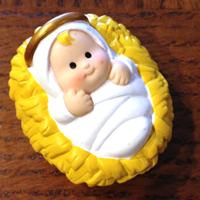
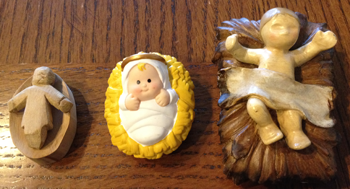
I’ve been stumbling over baby Jesuses for a few weeks now. I realized that with three working nativity sets in the house it was time to do a little math with Jesus.
All of them.
You can count the bits and pieces.
Animals, people, buildings – count them for each nativity set and count them up total.
How many total Jesuses do you have?
How many angels?
How many “visitors” does Jesus have?
How many sheep? Cows? Donkeys? Camels?
How many total animals?
You can compare the numbers.
My three nativity sets have varying numbers of characters and structures. It’s curious how some sets include more animals that visitors – and some sets don’t have any animals.
Which of your nativity sets have more animals? Which has more people?
Which has more buildings (or non-people/non-animal things)?
Are there more visitors than animals or more animals than visitors?
Arrange the sets in order of least to greatest – people, animals, etc. Are they always in the same order?
Is one set bigger or heavier than the others?
Do some arithmetic.
Take the opportunity to show how counting and arithmetic are kinda the same thing.
If you add up the number of sheep you have with the number of donkeys, how many is that? Is it the same if you group them together and just count them?
What if all the shepherds left? Talk about how you can count them, or you subtract the number of shepherds from the total number of visitors.
How many nativity sets do you have? Talk about how 3 times that number is the number of wise men you have.
Do fractions – but only if you must.
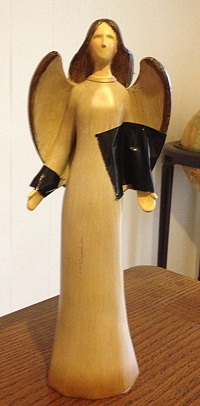
I know many people avoid fractions. I wish I could have avoided it with Math with Jesus. Daughter gave us the opportunity to talk about fractions by breaking the angel (or the “butterfly” as she calls it). Good thing we have Gorilla Tape.
It’s sad, really, because we’ve managed to keep her off TV and any screens for two years. And now she thinks the iPhone is the place for cartoons and all sorts of flashy lights and sound.
But she can also learn math on the iPhone!
Occasionally I’ll find an app that makes me glad she’s on the iPhone. Like Toddler Counting.
This app does something grownups don’t think about – it teaches kids the one-to-one correspondence between numbers and objects. That’s a very advanced topic in math that we grownups take for granted.
Here’s a demonstration of it:
What do you think? Will you get it for your little one? At $0.99, Toddler Counting’s a deal!
Un-Disclaimer: I paid for this app and don’t have any affiliation with the folks who created it. Heck – I haven’t even told them I’m writing this!
I recently read about the difference between a number path and a number line in the book Mastering the Math Rack to Build Mathematical Minds.
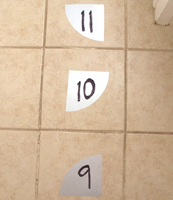
Walking up and down my hallway I noticed the tiles made a very nice number path. So I used some removable whiteboard wall decals and cut them in quarters.
I wrote the numbers 0-11 on them with a permanent marker and slapped them down on the tiles.
Later, while reviewing Carlito C. Caterpillar’s Math House Games for The Homeschool Post, I noticed Carlito suggested the same thing!
My hallway is now a counting lesson!
When we run down the hallway, now, we say the numbers as we step on them. This integrates counting, recognition of numbers and linearity all with body movement – which serves to solidify the learning.
Not only that, but the removable decals don’t hurt the floor!
And there’s more…
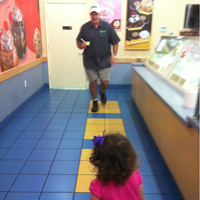
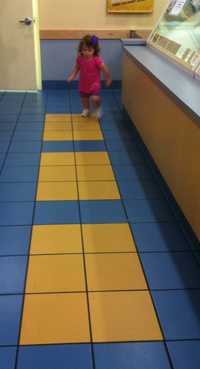
When we were at the ice cream parlor, she noticed the tiles on the floor and started running along them and saying numbers! This was something I didn’t expect at all.
Not only that, the three sets of three tiles created a number path of 11 when you included the two spacers. I don’t know if she recognized this, or if it was merely a coincidence. But it was fun to see.
Will you do it?
You can do this with anything that has a “block” pattern – at home, or in a classroom.
Let me know if you try it – and the reaction of your kids – in the comments below.
Disclaimer: The sweet folks over at MathRack.com sent me a bunch of MathRacks and the book, at no charge, for me to check out and report to you on, if I wanted to. You’ll be seeing more articles about these soon (they are really cool!).