Tag: counting

  • Practicing Math Skills Early in Life Is a Brain Changing Event

    Practicing Math Skills Early in Life Is a Brain Changing Event

    Thanks to Will Summer who inspired this post with a retweet to me.

    Seems researchers have previously studied the differences in math skills among children vs. adolescents and grownups. Dr. Vinod Menon with has done new research on early math training that focused on kiddos who where merely one year apart.

    Turns out that in one year of math, the brain changes quite significantly!

    You can integrate early math learning into just about anything.

    Daughter is heavy into Brown Bear, Brown Bear by Bill Martin, Jr. and Eric Carle. This is not a math book. Nor does it pretend to be. But I’ve found a way to use it to develop math skills.

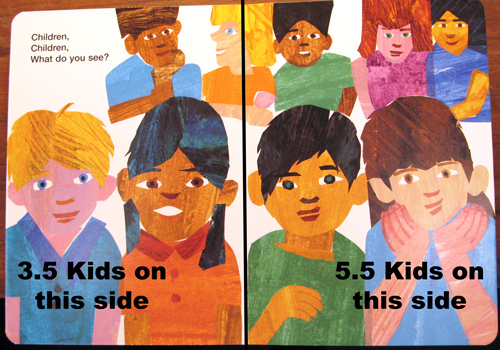
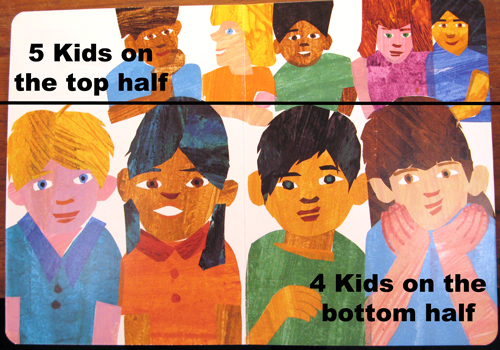
    When we arrive at the page with the children, we practice counting the kids. First in one direction, then in the other – as direction matters to kids. It isn’t inherent that if you count one way you’ll get the same number as if you count the other way.

    Sometimes we’ll count the top row of children and add it to the number of the bottom row. We can practice the commutative property by adding 5 + 4 = 9 and the adding 4 + 5 = 9.

    As an alternative twist, we’ll count and add the kids on the left page to the kids on the right page. This one gets fun, because that little blond girl is half and half!

    So we can now add fractions and practice the commutative property at the same time!

    What else?

    With Dr. Menon’s research, we now know how important it is to get started early with math learning. What other things can you do to start teaching math skills early?

    Related articles
  • Counting with Ordinal Numbers

    Counting with Ordinal Numbers

    In the last post I discussed cardinal and ordinal numbers. I gave definitions but not much in the way of examples.

    Here’s an example of using ordinal numbers to count up to arrive at the final cardinal number. Oh – and I’m using the fun little critters from Discovery Toys!

    Whatcha think? Does it make you want to count some bugs?

    What other ways can you use to teach counting?

  • An Observation of Cardinals and Ordinals at the Playground

    An Observation of Cardinals and Ordinals at the Playground

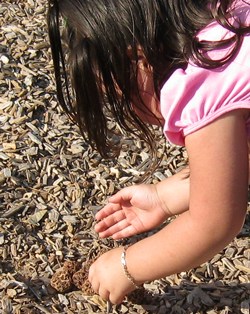
    We were hanging at the playground on Mother’s day. Daughter had taken up with a cute little girl – a good playmate for the teeter-totter. I watched Daughter’s new friend do something interesting. She was “counting” some gumballs that had fallen off the sweetgum tree.

    Here’s what she said: ONE TWO THREE FOUR FIVE SIX SEVEN EIGHT

    I looked and there were ten gumballs. I watched her more and saw that while she was reciting the terms and pointing at the gumball pile, she wasn’t associating each number word with the next gumball in the pile.

    Developmentally, I’m not sure if this is okay or not. I wonder.

    Mathematically, I know that there’s still a disconnect with this girl and what numbers mean to her.

    There are two types of numbers.

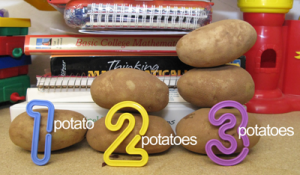
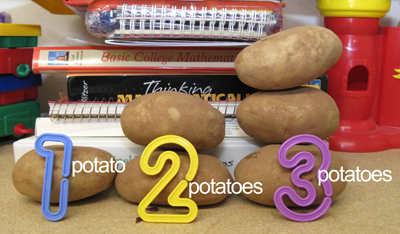
    In the realm of counting numbers, there are two types. Cardinals and ordinals. A cardinal number tells us how many we have. Like this:

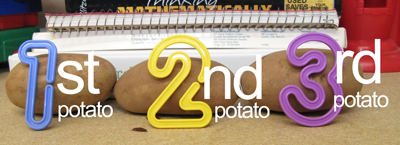
    And ordinal number tells us the order:

    When we count, we use both types of numbers.

    The group of gumballs has the cardinal number of 10. But to arrive at that cardinal number, to determine how many there are, the friend had to “order” them. She was trying to point to each one and assign it a position. “YOU, I label 1st, you are 2nd … and since you are 10th, I know I have 10 gumballs.”

    We grownups take advantage of this procedure. Indeed most people don’t know what cardinals and ordinals are.

    But knowing this when you teach counting is quite helpful. At home you can do something similar to the potatoes in the pictures above. At school, you can buy some great posters (I found one at Teacher’s Heaven last night) that demonstrate this.

    Will you change the way you think and talk about numbers?