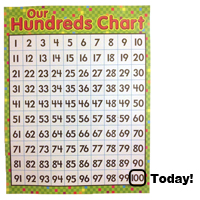
I just got a notification that today, September 16, is 100 days until Christmas. When I read this many thoughts went through my mind:
What’s our obsession with 100?
I wonder why we chose 24 days of advent and not 25, 50 or 100.
Hey — we could count 100 days to Christmas on a Hundreds Chart!
Two good things to do…
First, sign up to get the fun things from the site 100 Days to Christmas. I just found this site, so I’ll be getting those emails brand new like you!
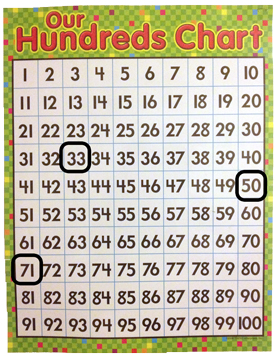
Get out your Hundreds Chart and use it for your 100 Days to Christmas countdown. Pick some favorite or familiar numbers and figure out when it will be that many days to Christmas.
My best friend’s favorite number is 33, half of 100 is 50 and I was born in 1971. I’ll start with those!
Or choose some special dates and figure out how many days to Christmas those dates will be. Like if your wedding anniversary is on September 29, that’s 87 days to Christmas.
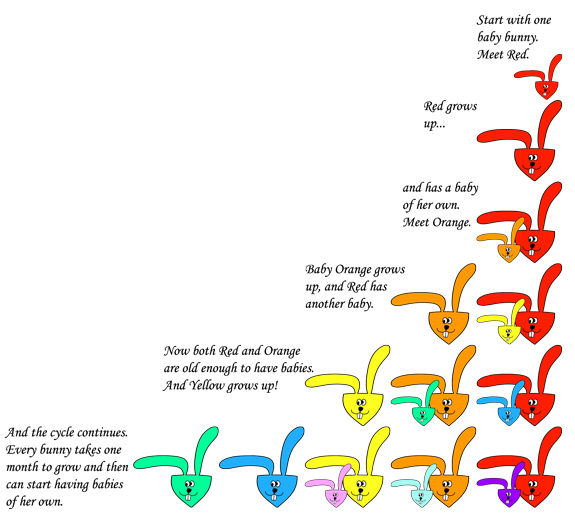
Give information about Fibonacci Numbers on the invitation or just let guests figure it out?
In trying to make these decisions, I’ve found a number of resources full of Fibonacci finds and glorious Golden Rectangle goodies. I thought I’d share:
Oh — and I also learned how we get the golden ratio. It’s the number that the ratio of consecutive numbers in the Fibonacci sequence approaches. We call it phi and it’s sort of 1.62.
I’m on a counting roll. I’m not sure, but it could be because this song is stuck in my head. It plays all the time on Sprout TV, the channel where my other addiction is – Lazy Town.
Don’t press play unless you want it in your head. It’s very catchy.
My mom is a big fan of flash cards. So when she figured out how to use my School Zone Numbers 0-25 Flash Cards with MATH, she was so excited.
We’ve been doing MATH a lot – but she says we can only do it once a day. I love doing it because I get to eat the MATH after we’re done.
No fair that we can only do it once each day.
So here’s what it is…
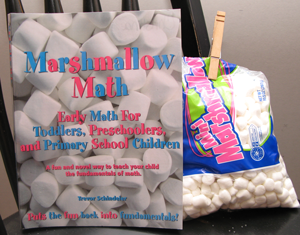
There’s a bag full of them in the cupboard. The individual MATHs are tiny white things that taste SO good! They’re chewy and squishy and fun in my mouth.
They’re about the size of Cheerios. (Oh – and comparing sizes is something called “math” – but Cheerios don’t taste like this, so it must be different).
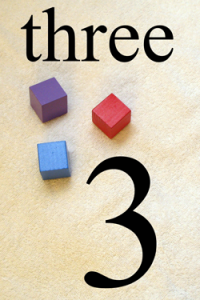
Taica took the picture at the top of this article so I could show you what I’m talking about. Look to the right of the book in the photo – that’s MATH. YUM!
You can do it with flash cards.
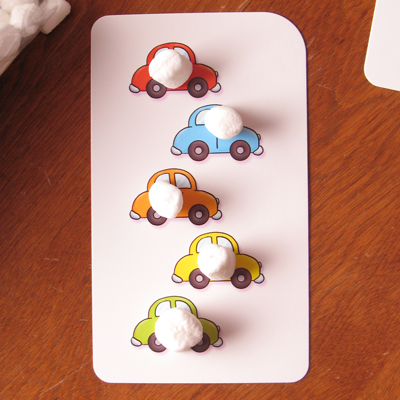
She pulled out my number flashcards (made by School Zone and given to me by Granfuffy) and let me pick a card. I chose the one with cars. I like cars.
I put one MATH on each car. Taica counted as I did this. After a while I got really good at putting them on and taking them off. It’s called “one-to-one correspondence,” apparently. Or at least she kept saying that.
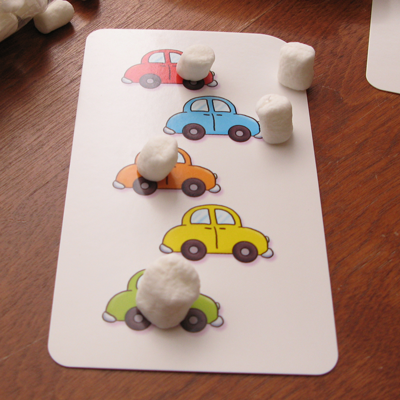
Then she turned the card sideways!
This was a little harder. But I managed.
Then upside down – I was really wanting to eat the MATH at this point, but I continued to play along.
At one point the marshmallow rolled off the car. So I left it there. I knew where it was supposed to be so it wasn’t a big deal.
When I finished, I was out of MATHs and still had the yellow car left! Like this:
Taica told me that if I didn’t make sure that the MATH was directly on the car, I would lose the “one-to-one correspondence” and end up with a leftover car.
We figured it out and then it was time to eat.
Do you want to try?
I’m looking forward to the next time – there are some flash cards that have lots and lots of things to match!
If you want to do it, you can get everything you need at a store. You have to “pay for them” before you take them home, but that’s easy for grownups.
A number system is a highly advanced concept. And yet we throw it at first grade math students expecting them to immediately grasp it.
Our number system is based on place value, like any number system (like clocks, years, etc.). Which means everything wraps around. Once you get to the “top” of the list of numerals, you have to start over, in a sense. This is crazy weird – it’s no wonder kids struggle at this point!
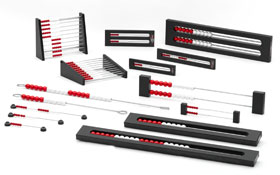
I promised to help a teacher this weekend who was struggling teaching place value to her first grade math class. I dug out a MathRack, a brand of rekenrek, which was part of a set MathRack.com shared with me months ago. I peeked at their book Mastering the MathRack to Build Mathematical Minds to get an idea of how to teach place value using this amazing tool.
The video above uses the MathRack 20 and some place value cards. I followed the Hidden Numbers activity on page 61 of the book. (As of writing this, I’m unable to find the book online. The site where it is supposed to be doesn’t seem to be functioning anymore.)
Glenda, the first grade math teacher, specifically wanted help teaching the comparing numbers and ordering numbers. So here goes…
Comparing numbers is easier when visualized.
Children can see the value of two digit numbers better when they see the quantity of beads. Let them practice comparing numbers for a while using both the rekenrek and the place value cards. The more they practice, the better feel they’ll get for the place values in our number system.
I’m not sure what the structure of a first grade math class is, but the more days they can “play” with their MathRack like this, the better they will get at comparing numbers. If you have limited time, do a few minutes each day for more days, rather than more time on fewer days.
Ordering numbers is also easier when children see it.
Once the children have played a while with the rekenrek, they will have some comparison skills. Ordering numbers is the next step. Teach them that the act of ordering numbers is just comparing numbers many times.
Computers order numbers by comparing them one at a time to each of the other numbers. Let students try ordering numbers this way, as well as other ways. The one-at-a-time method might be slower, but it could be what the child needs.
Keep trying and share what you learn.
How about it – can you use this for your first grade number system lessons? Do you have a MathRack or can you make one? Share your successes in the comments!
It’s sad, really, because we’ve managed to keep her off TV and any screens for two years. And now she thinks the iPhone is the place for cartoons and all sorts of flashy lights and sound.
But she can also learn math on the iPhone!
Occasionally I’ll find an app that makes me glad she’s on the iPhone. Like Toddler Counting.
This app does something grownups don’t think about – it teaches kids the one-to-one correspondence between numbers and objects. That’s a very advanced topic in math that we grownups take for granted.
Here’s a demonstration of it:
What do you think? Will you get it for your little one? At $0.99, Toddler Counting’s a deal!
Un-Disclaimer: I paid for this app and don’t have any affiliation with the folks who created it. Heck – I haven’t even told them I’m writing this!
I recently read about the difference between a number path and a number line in the book Mastering the Math Rack to Build Mathematical Minds.
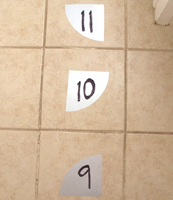
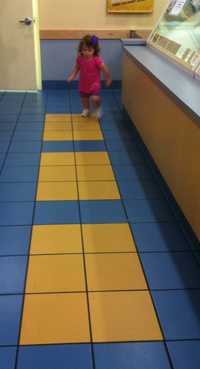
Walking up and down my hallway I noticed the tiles made a very nice number path. So I used some removable whiteboard wall decals and cut them in quarters.
I wrote the numbers 0-11 on them with a permanent marker and slapped them down on the tiles.
Later, while reviewing Carlito C. Caterpillar’s Math House Games for The Homeschool Post, I noticed Carlito suggested the same thing!
My hallway is now a counting lesson!
When we run down the hallway, now, we say the numbers as we step on them. This integrates counting, recognition of numbers and linearity all with body movement – which serves to solidify the learning.
Not only that, but the removable decals don’t hurt the floor!
And there’s more…
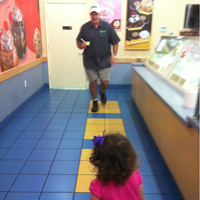
When we were at the ice cream parlor, she noticed the tiles on the floor and started running along them and saying numbers! This was something I didn’t expect at all.
Not only that, the three sets of three tiles created a number path of 11 when you included the two spacers. I don’t know if she recognized this, or if it was merely a coincidence. But it was fun to see.
Will you do it?
You can do this with anything that has a “block” pattern – at home, or in a classroom.
Let me know if you try it – and the reaction of your kids – in the comments below.
Disclaimer: The sweet folks over at MathRack.com sent me a bunch of MathRacks and the book, at no charge, for me to check out and report to you on, if I wanted to. You’ll be seeing more articles about these soon (they are really cool!).
Last night I had the privilege to meet and teach Eddie*, an ESL student from Mexico, at Literacy Advance of Houston. He was there to learn in the “Math and Your Life” class, as part of the “Math and…” class series.
I didn’t realize I was there to learn too.
I walked in prepared to discuss just about anything math related. And I’m glad that was the preparation I did.
Eddie was interested in something that I’ve long struggled with. And I’m guessing many children struggle with it, too.
In English, the number 1600 is pronounced both as sixteen hundred and as one thousand six hundred. I still get these mixed up. Not when I stop and think about them, but when I casually and quickly throw them out.
Husband is often stunned when I tell him I saw a new suburban at the low low price of thirty-five hundred dollars. Of course I mean thirty-five thousand dollars!
It’s not just me, I guess.
I wonder how many other grown-ups still struggle with this. And how often we neglect to teach this to children.
We are quite accustomed, and comfortable, with teaching our youngsters to count from 1 to 10. Were amazingly proud when we can get them to count from 1 to 20.
Is that enough? Based on my conversation with Eddie last night, no.
Teach them skip counting with hundreds!
Why not use the 1-20 model with hundreds? Like this:
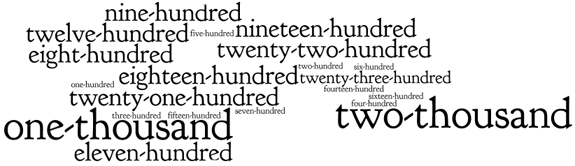
one hundred two hundred three hundred . . . eight hundred nine hundred one thousand eleven hundred twelve hundred thirteen hundred fourteen hundred . . . nineteen hundred two thousand twenty one hundred . . .
Teach them all sorts of counting!
I suggested in this article to count with your children by fractions. It never occurred to me to count by giant numbers.
What other ways should we teach children to count? Share your ideas in the comments.
*”Eddie” is used as a variable – i.e. his name has been changed because I didn’t ask his permission to talk about him.
The comparison of numeracy to literacy is curious.
Learning math is the opposite of learning to read. When you read, usually simultaneous to learning a language, you sound out words and then put meaning to them. When you learn to count and do math, you know the meaning inherently and then put a language to it.
At some point we learn to recognize words without sounding them out. And at some point we learn to recognize quantities without counting them out. This is called subitizing.
The Your Baby Can Read program uses the concept of subitizing to teach reading – you show your baby the word alongside the object. So the shape of the word car is as recognizable as a car itself.
The children using Your Baby Can Read don’t learn to sound out words. They don’t understand the concept of letters any more than babies not using the program. But they instantly recognize the shapes of the words – giving them an (assumed) advantage.
Aside: We didn’t use the “Your Baby Can Read” program, not because it was gimmicky (I love anything that looks gimmicky), but because there is a huge DVD element to it. We decided not to put Daughter in front of the TV for her first 2 years. A decision we stuck with, but sometimes was a struggle!
This article contains a “your baby can count” type program. (And it’s a free download!)
How did we learn subitizing?
I don’t recall having been taught it directly. Although I could be wrong. The research on it has been happening since the early 1900s, so it might have been taught without being labeled “subitzing.”
I wonder how many of us do that. Are grownups so adept at subitizing that they forget that’s how we assess quantity? Maybe we’re taught to chant-count because that’s the way we think counting is.
But it isn’t!
How do you teach subitizing?
Images are accompanied by the written numeral as well as the number spoken aloud. The images would be printed on cards, done via video or “live” with 3D objects.
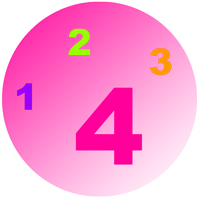
I’m still working on the numbers 5-10 and up, but for the numbers 1-4, the following 8 styles of image sets would be done twice. Once using the same objects for each image set, and once using different objects for each image set.
Organized in a row vertically.
Organized in a row horizontally.
Organized in a row diagonally.
Organized in a row other way diagonally.
Organized in a regular shape (triangle, square).
Organized in a differently oriented regular shape.
Organized in an irregular shape.
Organized in a different irregular shape. (There will be more of these for 4 than 3, etc.)
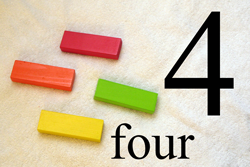
The objects could be blocks, cars, little dolls, just about anything. I created the set below from blocks I found left in Daughter’s block set.
Each zip file contains a few .jpg files with 4″ x 6″ pictures. You can print them at home or ship them to Walmart, Target, CVS, etc. for printing. I left off the MathFour.com logo so the kiddos wouldn’t get distracted. Please share them along with links back here.