
Author: Bon Crowder

  • Mathematician Parent: David Wees

    Mathematician Parent: David Wees

    Most parents aren’t professional mathematicians. But there are a few. This is the fifth in a series of interviews with mathematician parents with the goal of helping parents integrate math teaching into parenting.
    I am quite excited to feature David Wees who teaches at Stratford Hall in Vancouver. David and I have been on numerous #mathchats together and I’ve found him engaging, fun and knowledgeable. He publishes the website The Reflective Educator (formerly 21st Century Educator).

    MathFour: Thanks so much, David for taking the time to answer some questions. First, can you share some more about your degree and career? How long have you been in math?

    David: I have a bachelor of science in mathematics with nearly 60 credits in honors level mathematics. I finished my degree in 1998, but have never been officially a mathematician. Instead, I teach mathematics in middle school and high school, and have recently moved into a new position as a learning specialist for technology.

    MathFour: Tell me about your family – how many kids do you have and how old are they? How do your family members feel about math?

    David: I have a wife, and a nearly 5 year old son. My wife found math to be painfully difficult for her entire career, but hides it well around our son. My son loves math. He recently confided in me that he knows math only slightly less than me, but that I know more technology, and he knows more science.

    MathFour: How cute! And great that your wife tries to keep the math environment positive.

    Do you have any worries about your son academically? In particular, do you think he will do better in math than in other subjects?

    David: I have no concerns at all about my son academically. He is bright, creative, and independently minded. He will almost certainly do better in math than his other subjects. Today he ripped a book because the “binding was loose.” So we told him to find $11 dollars in his piggy bank. He pulled out five $2 coins and one $1 in about a minute, carefully counting by 2s for the first $10, and then adding another dollar.

    MathFour: How do you play with your son? Do you inject math a lot?

    David: I think we play ordinary games, with some exceptions. Certainly we include mathematical play in our sessions. We count everything, and introduce different ways of counting. We play dice games and practice adding small numbers. We stack blocks in patterns. I’ve also recently introduced a “how can we get this number game.” For example, “How can we get 5?” My son responded with “1 and 1 and 1 and 1 and 1 makes five. Hrmm. 2 and 3 makes five. 4 and 1 makes five.”

    MathFour: Great game!

    Do you think you speak with your son or behave differently than other parents because you have a math background?

    David: Definitely. We spend much more time talking about numbers than other parents do.

    MathFour: Has your son ever expressed negative thoughts about math?

    David: I’ve not noticed any negative thoughts from my son on math, with the exception that he thinks I know more math than he does. He did ask me today about the odd, even pattern. “Why does it matter if a number is odd or even?” I told him it helped us know quickly if we could split the number into two equal parts. I don’t think he was terribly impressed by that explanation.

    MathFour: LOL! I guess that is a little unimpressive.

    Your son is almost five, so I’m guessing he’s not had many math teachers. Do you anticipate you’ll ever disagree with any of his math teachers? And what do you think you’ll do if that happens?

    David: My son is just starting school. As I work at the same school as he will be attending, I will have to handle disagreements with his math teachers very carefully.

    MathFour: Now to change direction a little to a more worldview of math. What do you see as the biggest challenge in math education today?

    David: Mathematics, as it is usually taught, is neither interesting or relevant to students. Given that relevance and engagement are key to deep learning of a subject, it pretty much means that in most generations of people, the vast majority of them lack any functional numeracy.

    MathFour: What do you see great happening in the world of math education?

    David: These types of conversations are amazing in my mind. I love that I can speak my mind about problems in math education and not have everyone jump down my throat.

    MathFour: What advice can you give to non-mathematician parents that might help them raise their kids to like and appreciate math.

    David: Count lots. Play number games early. Treat learning mathematics as important as learning how to read. Spend time playing and learning early math with your kids. Don’t let your kids learn that worksheets and rote memorization are math.

    MathFour: Wow, that was awesome, David! Thanks so much for your time and sharing with us.

    How about You? What are your questions for David? Ask them in the comments. And don’t forget to check out all the great stuff on his website!

    Related articles
  • How to Teach Right Triangles when Crossing the Street

    How to Teach Right Triangles when Crossing the Street

    This morning Daughter and I went to the gym.

    When we crossed the street, I exposed her to undo risk by crossing at an angle.

    So on our way out, I explained to her that we were walking a little further to get to the car this time. And we would minimize the risk of getting hit by a car by taking the longer route.

    (Of course she’s not yet two, so she really didn’t care. But it was important for me to say.)

    Crossing at an angle is shorter than going straight across.

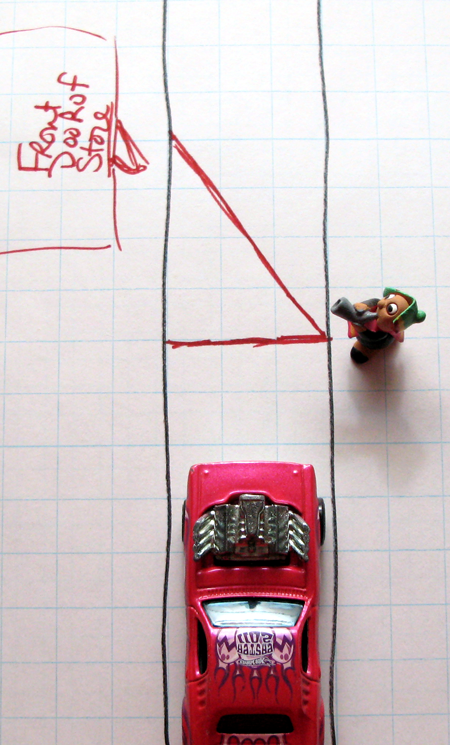
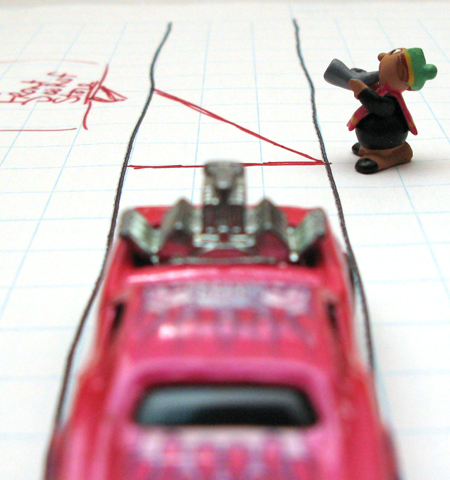
    People most often cross the street at an angle. Intuitively we know it’s shorter. Look at the tiny person in this picture. He needs to get to the front door of the store.

    It’s five yards to go at the angle, while if the little guy walked straight across then up, it would be seven yards.

    Suppose walking one yard takes 5 seconds. It will take the little guy 15 seconds to cross the street straight across. (And with a toddler, it does take 5 seconds to walk a yard.)

    Then he has to walk the four yards along the side to the door. Which means his total time is

    3 yards across at 5 seconds per yard = 15 seconds

    4 yards up at 5 seconds per yard = 20 seconds

    Total walking time = 35 seconds

    If he went at an angle, it’s 5 yards total (by the Pythagorean Theorem).

    5 yards diagonally at 5 seconds per yard = 25 seconds

    Total walking time = 25 seconds!

    Crossing at an angle puts you at risk for longer.

    For the pedestrian in a hurry (and wearing the shirt that reads “Safety Third”) the angled route is the way to go. But for a parent with toddler in tow, minimizing risk is a better option.

    If the little guy were to cross at the angle, he’d be in front of the oncoming cars for 25 seconds. If he were to take the route that is longer overall, he’d be in front of oncoming traffic for only 15 seconds.

    The car doesn’t care what angle you’re walking, it can squish you pretty easily either way.

    Not to mention he keeps the driver happy.

    Getting out of the driving area faster means keeping the driver happy. That might not be your goal, but adding some cosmic happy juice into the world of drivers never hurts.

    Plus, if someone were to “hypotenuse you” by taking the angled route when you were driving, wouldn’t you get a little annoyed?

    Next time you practice safety, practice math!

    So be safe. And tell your children why.

    It’s all about the math!

    Share your thoughts in the comments.

    Related articles

  • The 1-2-3 Song

    The 1-2-3 Song

    Part of the Count 10 Read 10 series to help parents connect with kids through math a little each day.

    Did you know that the alphabet song, Twinkle Twinkle Little Star and Baa Baa Black Sheep are all the same tune!?

    Well, now there’s another!

    Thanks to all the great folks who have public domain images out there that I could use for this.

    Specifically

    Related articles
  • How to Integrate Math into Geography

    How to Integrate Math into Geography

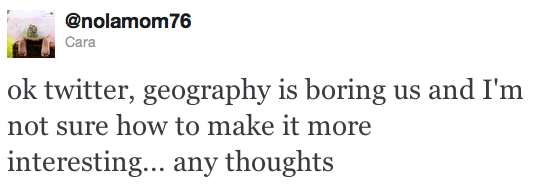
    Everyone’s getting back into the schooling groove. So twitter is filled with questions like Cara’s:

    And since my world revolves around math, here are my thoughts.

    Use the Four Color Theorem (but don’t say it out loud).

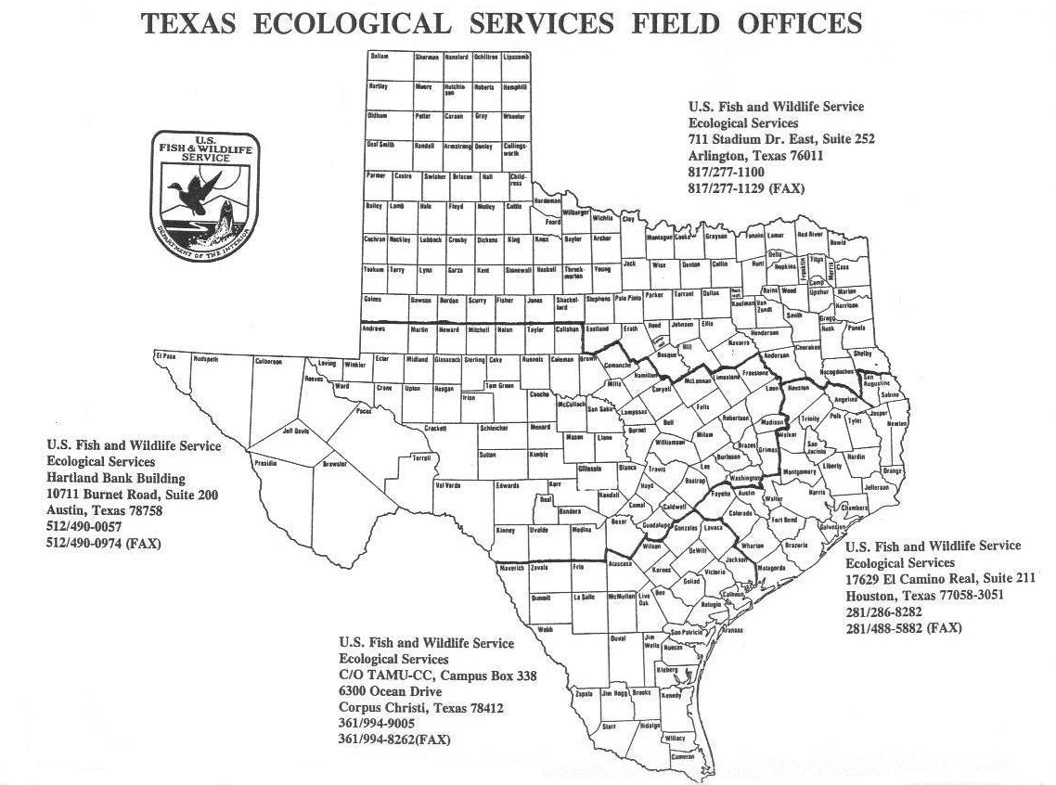
    The Four Color Theorem says that if you only have four crayons, you’re good to color your map and not have any colors touching. (That’s the he kiddo version of the theorem.)

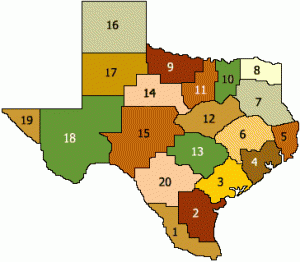
    So get out your google and print out some map coloring pages. Choose ones with lots of borders. (As fun as it is to color Texas as a whole, use a map of Texas’s counties.)

    Caution: don’t tell the children they’ll be using math. Let them figure it out.

    Now it’s coloring time!

    And here’s the challenge: color the map with as few colors as possible so that no two touching territories have the same color.

    While they color, you can talk about the names of the locations and some of the details. Even have them label them.

    Once they finish coloring, have them remember how few colors they used.

    Next time you talk about this map, ask them to use one less color than they did before. Continue labeling and discussing the locations.

    After a while they’ll figure out that they can’t do it with three, but they can do it with four.

    Shower, rinse, repeat.

    From the Texas Environmental Education Providers (how cool is that!)

    Kids are experimental. And they don’t believe that what works once, automatically works again (that’s why they drop Cheerios on the floor over and over and over again).

    So you can do this with the next map when you’re ready to go to another part of the world.

    Indeed, they’ll eventually figure out that four is the magic number. Then they can google it and learn all about the theorem!

    How about it? Did it work? Share your experiences in the comments.

    Related articles
  • Wordless Wednesday: An Example of Count 10 Read 10

    Wordless Wednesday: An Example of Count 10 Read 10

    In an attempt to join the Wordless Wednesday crowd, I’m sharing this photo. But as you can see, for MathFour.com, this is only a Somewhat Wordless Wednesday.

    Before this photo we were discussing size of shirts – a numeracy concept that is visually displayed through the inability for grownups to fit 4T nightshirts on their bodies. Count 10 Read 10 is part of our family’s afterschooling routine.

    Related articles
  • Finding Patterns in a Lokta Paper Blank Book

    Finding Patterns in a Lokta Paper Blank Book

    Written as part of the Count 10, Read 10 series.

    For my 40th birthday, I bought myself this beautiful Lokta paper book from a fabulous little store in the Houston Heights called Write Now!

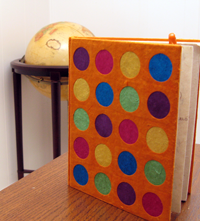
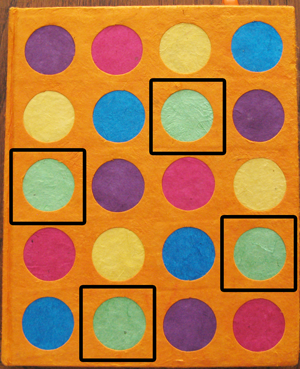
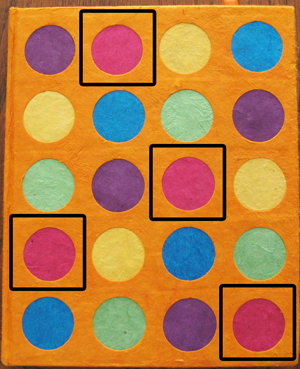
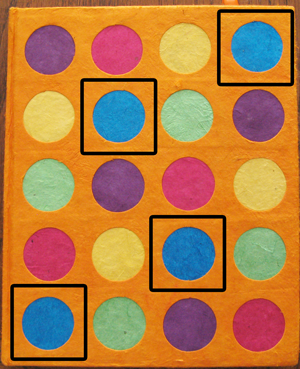
    It has circles on it – one of my “things.” I love circles. But then I saw how the colors were laid out.

    “Holy cow! This is a teaching opportunity!” I thought.

    And it got even better at the Texas Home School Coalition’s convention this last week. I shared it with former math teacher and now-homeschooler Sharon Brantley and she saw even more goodies in it!

    You can use it to teach math!

    Anything that has more than one aspect/characteristic/color (pretty much everything) can be checked for patterns. Patterns are an essential, perhaps even the most important, building block for mathematical thinking and development.

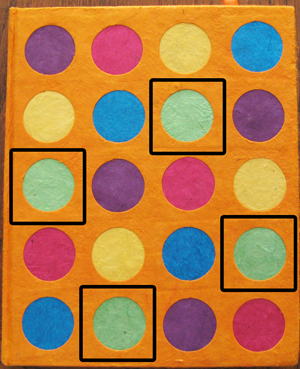
    Here’s what you can see in this book cover:

    Connect the green dots and you get a square. (Also the yellow dots.)
    The pink dots form a line and then the one dot off to the side can make a perpendicular line to the other line. (Purple dots, too.)

    These blue dots make a funny little shape.

    But wait! There’s more!

    What Sharon pointed out to me was that you can draw an L from any dot to another dot of the same color!

    Optional: This “L” thing links directly to the slope, by the way. Between any two points of the same color, the slope is either 1/2 or -2. Cool, huh?

    Where do you see patterns in your world? Share it (and a link to the picture) in the comments!

    Related articles
  • Mathematician Parent: Marilyn Curtain-Phillips

    Mathematician Parent: Marilyn Curtain-Phillips

    Most parents aren’t professional mathematicians. But there are a few. This is the fourth in a series of interviews with mathematician parents with the goal of helping parents integrate math teaching into parenting.

    I am honored to be able to interview one of math education’s leading minds, Marilyn Curtain-Phillips, author of Math Attack – How to Reduce Math Anxiety in the Classroom, at Work and in Everyday Personal Use. She also created the amazing playing card deck (also named Math Attack) where the numbers on the numbered cards are tiny expressions –  the 4 of diamonds has 22 on it!

    MathFour: Thanks so much, Marilyn for sharing some of you time with us. First, I’d like to ask about your background. What is your degree and career? How long have you been in math?

    Marilyn: My bachelor of science degree is in mathematics. My master degree is in education with a concentration in mathematics and then an additional 30 hours of mathematics. I have been teaching mathematics for 21 years. I have taught grades 6 through 12. In addition I am now teaching on the college level at a local university for the past three years in the evenings while teaching high school during the day. Prior to teaching, I worked in government and banking for 10 years in the area of accounting.

    MathFour: Wow, your life has been so full of math stuff! Tell me about your children. Are any of them more or less interested in math than the other children?

    Marilyn: I have two children ages 23 and 18. My son, the oldest, has a degree in graphic design. His interest since elementary school has always been in art. Therefore he never showed an interest in mathematics and it was a bit of a struggle. My daughter has just graduated from high school and is going to college with a major in early childhood education. She has been much stronger in mathematics than her brother. But she doesn’t want to teach mathematics, of which I think she is really capable of.

    MathFour: Did you have any worries about your children academically? In particular, did you think they will do better in math than in other subjects because of your influence?

    I encourage them to do what they enjoy. I feel they have adequate mathematics skills and a good foundation due to my additional help provided at home. As a high school mathematics teacher, I have grown more concerned at the foundation that students are coming to high school with.

    MathFour: How did you play with your kids? Did you incorporate math into your play?

    Marilyn: We enjoyed playing board games such as checkers, chess, uno, sorry, playing cards. I wanted to use games that help thinking and reasoning skills. This made great family discussion times while having fun.

    MathFour: Do you think you speak with your children or behave differently than other parents because you have a math background?

    Marilyn: I have always spoken positively about mathematics. Many parents will say in front of children that they dislike mathematics or is not good at it. To me this almost like telling children that mathematics is something that is tolerated and should be dreaded and avoided whenever possible. As a mathematician I know how much mathematics is a gateway to many
    opportunities. This is one of the reasons that I list careers in my book, Math Attack.

    MathFour: Have you ever had any of your children express negative thoughts about math and how did you handle it?

    Marilyn: Yes, my children have spoken negatively from time to time, mostly during test times. I offer advice and encouragement. It is important to stay positive and listen to their concerns and make suggestions.

    MathFour: Have you ever disagreed with one of your children’s math teachers? What happened and how did you handle it?

    Marilyn: Yes, I have had a different method of solving math problems. I talked with my children and let them know that many math problems can be done in different ways. Actually I prefer for my children elementary and middle school teachers not know that I am a mathematics teacher. I didn’t want my children to be graded on a tougher standard than other students.

    I experienced this growing up in a small town. My mother was a high school mathematics teacher, I felt looking back that I was graded on a tougher level and was expected to be extremely strong in mathematics. My sister experienced this also. She is an artist and doesn’t like mathematics.

    MathFour: Now to change direction a little to a more worldview of math. What do you see as the biggest challenge in math education today?

    Marilyn: I feel that many students do not have a strong foundation and understanding of mathematics. I have far too many high school students who do not have their times table and or addition facts memorized. Many mathematics textbooks cover too many topics. Studies have shown that the United States textbooks are thicker than other countries that are stronger in mathematics. It almost feels like a cram session.

    By the time students get comfortable with a concept it is time to move onto something else. I feel this makes students feel less confident about their mathematics abilities. I think these feelings continue throughout the rest of their adult lives. Which leads to many adults going into careers that require as little mathematics as possible.

    MathFour: What do you see great happening in the world of math education?

    Marilyn: I think that it is good that a more hands on approach to teaching mathematics is now being used. Teachers are teaching to the different learning styles. I think that it is good that more high schools are requiring students to have more mathematics credit before graduating from high school. Many states require students to have three or four credits of high school mathematics. Also many of the mathematics curriculum are teaching with everyday life application.

    MathFour: What advice can you give to non-mathematician parents that might help them raise their kids to like and appreciate math.

    Marilyn: I would suggest to non-mathematician parents to speak positively about mathematics. Let their children understand that mathematics is like anything else – it takes practice and patience. Just as parents tell their children to practice at playing sports, they should feel that mathematics takes the same time and effort. Also parents should show their children positive ways they use mathematics in everyday activities such as sewing, cooking, planning a family trip, budgeting and grocery shopping.

    MathFour: I noticed that you also have a new math workbook Who is This Mathematician/Scientist? Can you share with us a little about it?

    Marilyn: It is a workbook for grades 6 through 12, after reading the biography paragraph, students must solve the math problems to see who the bio is about. The activities can also be used as a way to promote multicultural awareness and appreciation.

    MathFour: I can’t wait to check it out! Thanks again for your time and sharing with us.

    How about You? Got any questions for this week’s mathematician parent? Ask them in the comments and we’ll drag her in here to answer them.

    Related articles
  • Cuisenaire Rod Art Inspires Thought and Decision

    Cuisenaire Rod Art Inspires Thought and Decision

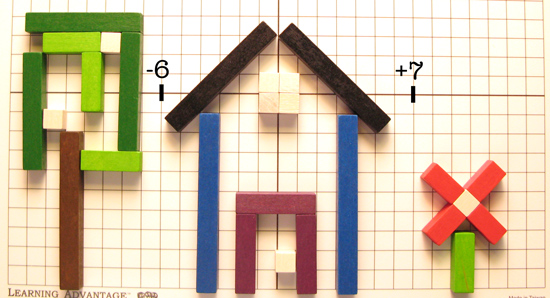
    As with all good mathematics, I just spent hours pondering how to set up my super cool Cuisenaire Rod quadtuple.

    It was a great experience. Made me wonder why I was being so selfish in keeping it to myself.

    This is a perfect thing for kids to do!

    The Setup

    Seems simple enough. Make a picture on 1cm square graph paper with Cuisenaire Rods. Then write down the coordinates of the rods. Voila! You have the coordinate representation of your picture. Furthermore, you’ve practiced coordinates!

    Cool, right?

    The rub is that you have to correctly identify the orientation of the rods – are they up-and-down or side-to-side? Or worse – at an angle!

    So now we have four things to identify: size/color, angle of rotation, x coordinate, and y coordinate.

    Since the rods have width, we can’t just say “put it at (3,2).” What part of the rod goes at (3,2)? One of the four corners? The midpoint of one of the sides?

    I just picked one.

    My official Cuisenaire Rod Ordered Quadtuple (CROQ) looks like this:

    (size of rod, angle of rod, x-value of anchor, y-value of anchor)

    The size of the rod is easy.

    The angle of the rod is clear, but we have to define what is zero (up-and-down or side-to-side) and how we rotate (always clockwise, counter-clockwise, either way, etc.).

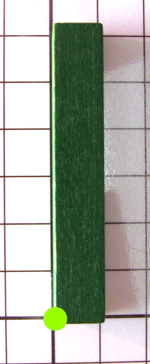
    I picked up-and-down to be zero degrees. It is the way I naturally look at the rods. Like this:

    See the bright green dot? That’s the anchor point. It stays there (in your mind) and is the bit that you’ll put on the (x, y) point.

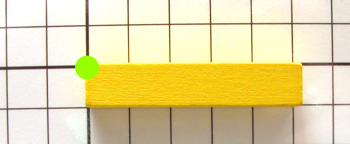
    Which means that as you change the orientation (or rotate your rod), it sticks around. Like this:

    This rod is (5, 90, 0, 0) because it is 5cm long, rotated 90 degrees (clockwise) and the anchor is at (0, 0).

    You can do interesting angles too!

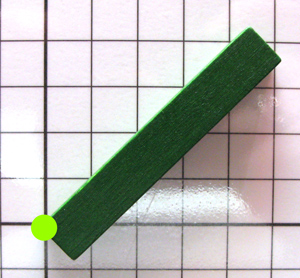
    Check out the 45 degree one:

    This one has the 4-tuple (6, 45, 0, 0). Notice that the rotation is always clockwise.

    This works, but isn’t the best way.

    When we graph (typically), zero degrees is horizontal. And sticking out to the right of the origin.

    Perhaps the best way to represent the rods on the plane is to use this type of set up. But it wasn’t the natural choice for me.

    Which is right?

    It doesn’t really matter. Unless you’re running a contest (which I think ETA Cuisenaire is putting together).

    Try this at home. It simulates what researching mathematicians do everyday:

    1. Let your child make a piece of artwork with the rods on graph paper. Go ahead and spring for another home set of rods and let him glue it. You can frame it and put it on the wall later.
    2. Ask him to do this: “Using only numbers, letters and punctuation, write the instructions to recreate your picture.”
    3. Take a piece of graph paper and recreate their picture yourself, based on what he’s written.
    4. Compare yours and his. Are they the same? If not, what happened? If so, were there any challenges for you while redoing it?
    5. Discuss it and let him think about this as long as he wants (minutes, days, weeks, years). Then ask him if he can think of a different way to describe it so it is easier to recreate.
    6. Repeat as many times as is enjoyable. After a while – sometimes years – he’ll create something similar (probably better) than what I have above.

    But, really, which is right?

    This is exactly what mathematics is all about. Not which is right, but which feels best. And which one will we agree on.

    When ETA Cuisenaire puts together their contest, they’ll have the rules clearly defined. “Right” will only be according to how they set it up. When you enter, they’ll recreate your art based on their rules.

    I like my rules. So much so, I’m going to use them next week to give the coordinates for the image at the top of this article. Wanna compare? Do it and post your CROQs in the comments.

    (Notice there’s a whole-lotta math goin’ on in that image – not just coordinates!)

    Related articles
  • [50 Word Friday] A Conversation Between Parents After a Homeschool Convention

    [50 Word Friday] A Conversation Between Parents After a Homeschool Convention

    “That homeschool convention was wonderful!” she says to him.

    “Yes, and it wasn’t anything like I expected! Daughter is only two, but I’m already thinking about homeschooling.”

    “What changed your mind?” she says.

    “Everything it has to offer – not only great teachers, but all the right content. It’s awesome!”

    Learn more about 50 Word Friday here.

    Related articles
  • Long Division with Playing Cards

    Long Division with Playing Cards

    I have since shot another video showing this with number tiles instead of playing cards.

    In response to a post on the Living Math Forum, here’s a way to teach long division with playing cards.

    Whatcha think? Will it work? Let me know if it does!

    Related articles