As promised in a previous post, here’s some math explanation behind the Monty Hall Problem.
Questions or thoughts? Shoot me an email via the about page or comment below.

Share the knowledge! Tweet this!


As promised in a previous post, here’s some math explanation behind the Monty Hall Problem.
Questions or thoughts? Shoot me an email via the about page or comment below.
Share the knowledge! Tweet this!

Apparently Mythbusters took a stab at the Monty Hall Problem last night. I missed it because I have poor-man’s cable. But I’ve already gotten requests to explain it. (UPDATE: Here’s The Math Behind the Monty Hall Problem.)
There’s two ways to explain it:
It’s Thanksgiving here in Texas and I have to make two batches of Aunt Margaret’s Cheesy Potato Casserole. I’d much rather explain this the hard way, but that’ll have to wait until tomorrow – cheesy potatoes call…
In the meantime, check out the easy way. This is a great video explaining intuitively what’s going on:
So how about it? Do you get it? Can’t wait ’til tomorrow’s video? What are you making for your Thanksgiving dish? Share all your answers in the comments.
And Happy Thanksgiving!
feature image By Genista | Flickr.com | CC BY SA

This post originally appeared on The HSBA Post on November 22, 2011.
How to Make an Apple Pie and See the World by Marjorie Priceman is an “instructional” picture book that takes children on a journey through the world to pick up ingredients to make an apple pie.
An apple pie recipe is included in the back which has obvious math. But you can use the rest of the book for some math lessons as well!
Here’s a set of math stimulators to share with your kids. Don’t forget that math is a discovery process; if your children are compelled to answer a question or not answer a question, that’s okay.
Here are the questions and some hints and coaching tips for you, the parent.
See if you can find circles, trapezoids, ovals and rectangles. Also identify the irregular shapes. Have your children trace them and see if they’re made up of regular shapes.
Also ask: How fast will the ship have to go in order to get to Europe from your house in six days?
How many words are there in an average Italian’s vocabulary? How many words do you need to be considered fluent in Italian?
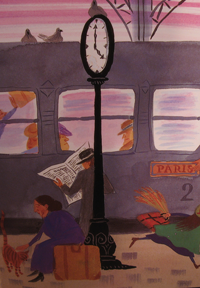
This one encourages children to look at the pictures as well as the text. Also ask, “How far is it to France from Italy?” And to take it farther, “What time would you arrive in France?”
Pull out an atlas or globe to get some geography lessons. Also ask, “Which route do you think is the fastest to get there? Which would be the most fun?”
This is what many students would call a trick question. In the book, she picks 8 apples so that she and her friends can enjoy 3 and use 5 to make the pie.
It takes some thought for a child to realize you only need 5 apples for the pie, so you’re not doubling the amount you pick. You have to double the amount for the pie (2 x 5) then add the 3 apples for the friends to enjoy.
This question allows them to double everything on the recipe. You can also triple or quadruple or get into fractions by asking, “What if you made one regular sized pie and one mini pie – how much of each ingredient would you need then?”
You can use the book How to Make an Apple Pie and See the World and the math stimulators in your Five in a Row math day or integrate it into any other math curriculum. Also try using the same line of questioning with other picture books you have.
Oh – and don’t forget to share how it went in the comments!

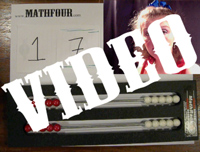
A number system is a highly advanced concept. And yet we throw it at first grade math students expecting them to immediately grasp it.
Our number system is based on place value, like any number system (like clocks, years, etc.). Which means everything wraps around. Once you get to the “top” of the list of numerals, you have to start over, in a sense. This is crazy weird – it’s no wonder kids struggle at this point!
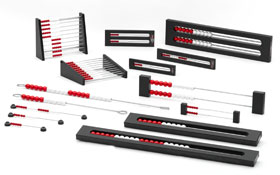
I promised to help a teacher this weekend who was struggling teaching place value to her first grade math class. I dug out a MathRack, a brand of rekenrek, which was part of a set MathRack.com shared with me months ago. I peeked at their book Mastering the MathRack to Build Mathematical Minds to get an idea of how to teach place value using this amazing tool.
The video above uses the MathRack 20 and some place value cards. I followed the Hidden Numbers activity on page 61 of the book. (As of writing this, I’m unable to find the book online. The site where it is supposed to be doesn’t seem to be functioning anymore.)
Glenda, the first grade math teacher, specifically wanted help teaching the comparing numbers and ordering numbers. So here goes…
Children can see the value of two digit numbers better when they see the quantity of beads. Let them practice comparing numbers for a while using both the rekenrek and the place value cards. The more they practice, the better feel they’ll get for the place values in our number system.
I’m not sure what the structure of a first grade math class is, but the more days they can “play” with their MathRack like this, the better they will get at comparing numbers. If you have limited time, do a few minutes each day for more days, rather than more time on fewer days.
Once the children have played a while with the rekenrek, they will have some comparison skills. Ordering numbers is the next step. Teach them that the act of ordering numbers is just comparing numbers many times.
Computers order numbers by comparing them one at a time to each of the other numbers. Let students try ordering numbers this way, as well as other ways. The one-at-a-time method might be slower, but it could be what the child needs.
How about it – can you use this for your first grade number system lessons? Do you have a MathRack or can you make one? Share your successes in the comments!
Click here to share this on Twitter/X.
Do you have any Pre-K and/or K12 kids in your family? I spent the day at Teacher Heaven on the Southwest Freeway in Houston, Texas yesterday and found some great math games!
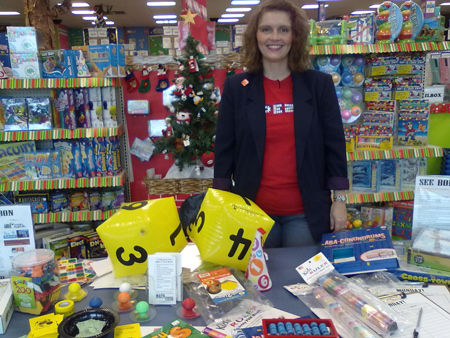
I was there for the day to demonstrate math games and manipulatives and generally help parents and teachers of K12 kiddos with math goodies.
Meagan, Shantrelle and the crew had chosen a couple of math games to start me off. I also went and browsed the rest of the math section for others. By the end of the day, my table was jam-packed with math games!
The big push at Teacher Heaven was the “fill-the-tub” sale – and I fell for it before I left. Hook, line and sinker!
I resisted too many goodies for myself, but made sure to do a little Christmas shopping. Here’re a few of my excellent finds. Luckily my family members a) don’t read this site much and b) don’t know that these things were originally shrink wrapped!
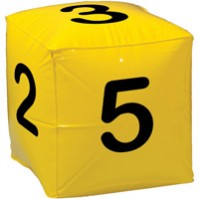
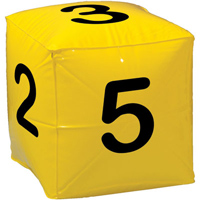
I nabbed these number cubes early in the day to have something to get the little ones engaged as they walked in the door. They were so cool I couldn’t resist taking them home to Daughter.
They’ll be great for helping her identify the numeral and saying the word. Plus, I’ll be able to create a bunch of math games with it – like doing arithmetic with the numbers when she gets older, etc.
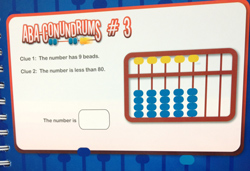
Aba-Conundrums comes with an abacus and a fun puzzle book. Using logic, you practice creating numbers and working with the tool.
I can’t decide if I’ll give it to one family member, keep it for myself or give it to Ma as a “house” game.
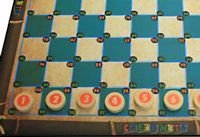
Also by Fat Brain Toys, Check Math is totally for my niece. I’ll likely open it and play it with Husband first, though!
You set the number pieces up and you capture your opponents pieces like checkers. The movement of pieces is a little different, though: a number piece can move to any square that’s a multiple of it. For example, the 2 can move to a 6 or 14. The 3 can move also to the 6 but not to the 14.
Pick up one of these math games at your local teacher supply store. And if you’re in Houston, head over to Teacher Heaven!

Count 10 Read 10 is a family numeracy and literacy initiative. Read more about it on the Count 10 Read 10 page and watch this video explaining all about it:
Tell all your followers about Count 10 Read 10! on Twitter
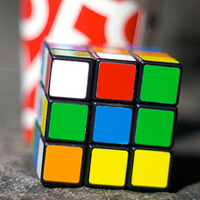
I stumbled upon the Paul Smith Gallery in Las Vegas a couple of weeks ago and was completely drawn by the Rubikcubism art by Invader on the wall.
It was a pixelated image that looked interesting from afar, but when you got close, there was a whole new surprise. It was made from 225 Rubik’s Cubes!
I spent a good 30 minutes in the shop talking to David, the Paul Smith associate. So many questions came up, including:
It might be fun. It could get expensive, though: at $10 a pop, and after sales tax, 225 Rubik’s Cubes come to about $2500.
I don’t have this kind of money to drop on cubes, and I’m guessing that most homeschoolers don’t either. But for only $10 and the technology you already have around the house, you can let your child be a Rubikcubist!
If your children are inclined to give this a shot, buy them each a Rubik’s cube. Let them explore the number of sides, and the number of “pixels” on each side. If they don’t already know about how colors work together, they can either research or learn through experimentation.
They can choose to use graph paper & colored pencils, Microsoft Excel, or a paintbrush program to map out what they want their image to look like.
As they twist the Rubik’s Cube into each pattern, take a photo of it, or a color scan. Print it at full size and let them use the prints to create the final artwork.
Throughout the projects, explore the concepts of area and patterns. Also encourage them to think about color theory (of which I know squat, but your kids will be learning as they experiment).
Questions to ask:
By the way, the solution to a Rubik’s cube is mathematical. It’s actually part of mathematics called group theory. My office mate in grad school was able to solve a Rubik’s cube in about 20 minutes.
I was never able to figure it out.
Put your child’s final artwork on Flickr.com or other photo service and post a link to it in the comments.
Feature image is by Robin Iversen Rönnlund on Flickr.com, CC BY.

I went to my H-E-B pharmacy the other day to pick up my prescriptions. My total came to \$59.82, before my coupon for $15 off one of the medications.
The gen-Y pharmacy clerk, Brandy, looked at my coupon, looked at the total and thought for a minute. She said, “So your total is now $44.82.”
I was so impressed. It’s rare that I find a clerk, especially a younger clerk, who will confidently do basic mental arithmetic. Almost all of the clerks I’ve encountered would’ve reached for a calculator to do that $15 subtraction!
I didn’t have a chance to talk to her long, but it turns out that she’s a chemistry student who’s also looking to get a teaching certificate. Yay, Brandy!
I’m quite curious how she remained confident in her abilities to do mental math. Did she learn math at a public or private school or was she homeschooled? At what age was she allowed a calculator?
Are you a calculator addict like I was or are you confident in your mental arithmetic? How did you get the way you are? What can you do to help your children be great arithmeticians?
Please share your story and/or thoughts in the comments. And keep your fingers crossed that we can get Brandy in here to share more of her story!
Note: Banner and feature image for this article are by euthman on Flickr.com CC-BY-SA.
Have you run into this? You get the “wrong answer” when you use a calculator and the Law of Sines to find an obtuse angle.
The problem isn’t that the Law of Sines doesn’t work (thanks @GMichaelGuy), but that you have to be cautious when dealing with the arcsine with an obtuse angle. Here’re the details:
I’ve concocted a triangle that’s pretty simple but has an obtuse angle. That’s the key here. The law of sines always “works” when you have all acute angles. It’s only when the angle in question is an obtuse angle that we have a problem. (and, as @GMichaelGuy pointed out, it always works, it just makes us do a little more work.)
Notice I used the arcsine. Turns out, the arcsine isn’t a function. Which means when you “undo” all the bits in the law of sines, technically you’ll get an infinite number of answers.
So it all boils down to the calculator not being able to determine if you want the obtuse angle when you solve for x using the law of sines!
What do you think? Any other questions on trig? Ask them in the comments.
And a big thanks to @mrlove314 for this question!
Daughter is addicted to the iPhone.
It’s sad, really, because we’ve managed to keep her off TV and any screens for two years. And now she thinks the iPhone is the place for cartoons and all sorts of flashy lights and sound.
Occasionally I’ll find an app that makes me glad she’s on the iPhone. Like Toddler Counting.
This app does something grownups don’t think about – it teaches kids the one-to-one correspondence between numbers and objects. That’s a very advanced topic in math that we grownups take for granted.
Here’s a demonstration of it:
What do you think? Will you get it for your little one? At $0.99, Toddler Counting’s a deal!
Un-Disclaimer: I paid for this app and don’t have any affiliation with the folks who created it. Heck – I haven’t even told them I’m writing this!