Author: Bon Crowder

  • Why I Believe in Santa Claus

    Why I Believe in Santa Claus

    This post originally appeared on The HSBA Post on December 25, 2011.

    I’m not sure how I discovered that my parents acted as Santa Claus. But I distinctly remember the sinking feeling. I also remember quickly making the connection for the Easter Bunny and the Tooth Fairy. Within five minutes all mysticism in my life had vanished.

    Ten years later, it all came back.

    It was the middle of the 80s. My parents were recently divorced. My dad was in oil and gas and had been laid off. We had no money. Mom said we were broke — not poor. But it sure felt like we were poor.

    We had Christmas lights and ornaments from all the past years. We lived in the country so we got a tree from the “backyard.” It required a couple of long needle East Texas pines wired together, but it worked.

    And we were told not to expect to find much underneath it on Christmas Day.

    Strange Phone Calls

    I remember overhearing a conversation my mom was having on the phone in mid-December.

    “We have water and electricity and food. It’s not much, but we’ll be okay. <pause> Really? But I’m sure there are many other families in more need than we are. <pause> I see. Well if that’s the case, yes. We would appreciate it very much. Thank you.”

    My best friend called with an interesting question. “We’ve exchanged names for family Christmas, and I’ve drawn the name of a cousin that’s about your little brother’s age. I don’t have any idea what to get for him. Can you ask him what he likes, and maybe that will help me?”

    Looking back, there were many other strange and unusual phone calls the two weeks leading up to Christmas.

    A Christmas Eve Like No Other

    On Christmas Eve we had a constant flow of visitors. A local car dealership showed up offering a bag filled with wrapped presents. Some people from my best friend’s church came by with three bags of gifts. Another church sent a handful of representatives with a huge basket of turkey and dressing and all the fixings. Friends and churches from all over the neighborhood, and even people we’d never met, were showing up to share with us.
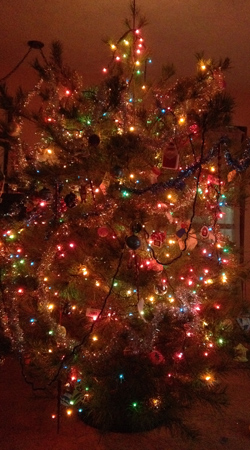
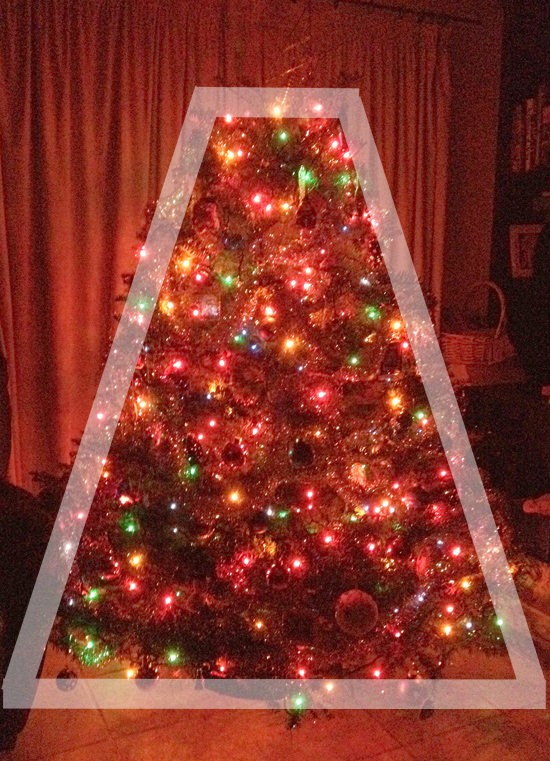
    2011 Christmas Tree
    Stlll in the same house, this is what the 2011 Christmas tree looks like. (We can afford to buy one now, but we still like a non-standard shape.)

    It was so amazing to see such love and caring — and for it to come our way. I was too young to really understand the generosity, but I knew it was special. Very special.

    We went to midnight mass, as we always did, and mom was crying just a little more than normal.

    A Magical Christmas Morning

    Christmas day was insane. Santa Claus had really come.

    I remember opening presents and seeing mom’s face. In years past her look was of excitement to see if we liked what she had given. This year, she had a different look. She was truly curious. And she was excited and amazed that her young children wouldn’t have to know the heartache of an empty Christmas morning.

    I’m quite sure it didn’t occur to her, though, that the gifts the community had shared included one more: believing that people really can love one-another. The very heart of Christianity.

    The Gifts of God

    Jesus gave us a gift with His death. We get to live in Him forever. But with His birth, He also gave us a special gift, one that we get right now. He gave us generosity and love to share with each other. And at Christmas, that comes out in the shape of a fat, old, hairy, jolly character we call Santa Claus. A man who’s famous for his generosity.

    I hope that no one ever has to be poor or even broke. While it wasn’t easy going through that part of my childhood, I am thankful for the lessons we learned. I am grateful that I was able to see first hand the generosity and love of my fellow man that Christmas.

    Merry Christmas… and may we all be filled with the Christmas spirit!

  • [50 Word Friday] Math in Christmas Lights

    [50 Word Friday] Math in Christmas Lights

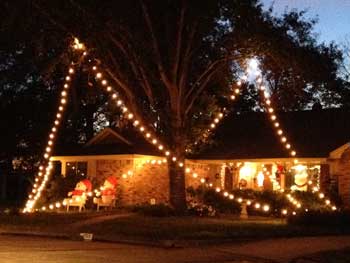
    When looking at Christmas lights with a child, you see things you might never have seen before.

    Lights around a window make a rectangle. Lights that droop might be a parabolic or catenary curve.

    And some people hang their Christmas lights in triangles!

    What shapes are in your Christmas lights?

    This article is a part of the 50 Word Friday series. Learn more about this strange, limited writing style here…

    Related articles
  • Math Gifts – Three Days Left!

    Math Gifts – Three Days Left!

    Last minute shopping? Me too! How about some of these math gifts for your favorite folks…

    For Kids

    For Grownups

    • Math T-Shirts by ExBoyfriend Collection – Sad? Funny? These are cute for even the “non-math” people.
    • Want something a little more fancy? How about math jewelry like this Fibonacci necklace!

    For Families

    • Math games are great for full family fun – and games like Uno… well, that’s math too!

    For Math Geeks

    • Old math books! Husband found a College Algebra book from 1947 for me – gave it to me as a “just because” gift. Here’s a Trig book by the same guy. You probably can get an old math book for your favorite geek at any second hand book store!
    • Math Music! The Klein Four Group’s instant download Musical Fruitcake CD (I just downloaded it, myself!) To give you a sample of how cool these guys were (they are now professors all over the world), here’s a fun Christmas song from them:

    How about it – what are you up to for last minute shopping? Are you done?

    Related articles
  • Wrapping Paper – Doing the Math this Season

    Wrapping Paper – Doing the Math this Season

    As you wrap presents this holiday season, take a minute to notice the patterns in the wrapping paper. You might just find some math!

    Christmas Paper

    How does the paper come together in the back? Does it neatly match up, seamlessly? Or is it way off?

    Are you able to scootch things a little so that you can get the paper to line up?

    What happens when you use a different box?

    Is this really math?

    Absolutely!

    Consider wallpaper: it has a pattern that repeats every so many inches. When you put wallpaper in your home it’s important to know how often it repeats so that you can match patterns in the corners and around windows, etc.

    Patterned wrapping paper also repeats. Most people ignore it because they don’t think about matching the patterns in the back when wrapping gifts.

    Unless they are particularly detail oriented, a perfectionist, or want to teach a little bit of math at home while wrapping presents…

    Choose your wrapping paper to match your boxes!

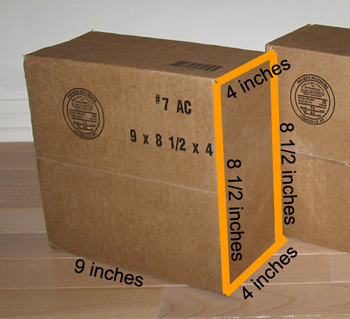
    On this box your wrapping paper would go around 8 1/2 + 4 + 8 1/2 + 4 inches.

    This means the wrapping paper would travel 25 inches before meeting back up with itself. So any wrapping paper that repeats after 5 inches or 25 inches will match back up in the back. Both 5 and 25 are factors of 25 – and that’s math!

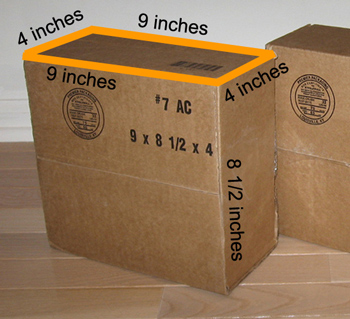
    If you wrap the box the other way, instead, like this,

    …the wrapping paper would travel 26 inches. Therefore any patterned wrapping paper that repeated after 2 inches, 13 inches or 26 inches would match in the back perfectly.

    A box whose “wrap around” distance was 30 inches could use any wrapping paper that repeated after 2 inches, 3 inches, 5 inches, 6 inches, 10 inches, 15 inches or 30 inches. All those are factors of 30.

    Choose your boxes to match your wrapping paper!

    Or do it the other way – figure out how frequently your pattern repeats. Any box that has a girth of a multiple of this number can be wrapped perfectly. (Girth is the distance around the box – where you wrap the paper.)

    For instance, if your wrapping paper repeated after 2 1/2 inches, you would look for boxes that have a girth of 2 1/2 inches (a tiny ring box), 5 inches, 7 1/2 inches, 10 inches. All the way up to giant boxes that have a girth of 314 1/2 inches.

    Your turn!

    How often does your favorite wrapping paper repeat? Have you found the perfect box/wrapping paper combination? Share your wrapping paper math discoveries in the comments!

    Box photos by z287marc | Flickr.com | CC BY

    Related articles
  • Teaching Time Isn’t Only About Telling Time

    Teaching Time Isn’t Only About Telling Time

    There are tons of great products out there to help with teaching time. White board clocks, clocks with movable hands, games, etc.

    But teaching time isn’t only about telling time.

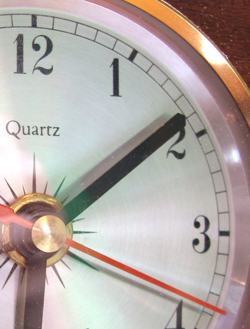
    When we teach children how to tell time, we are merely giving them another “reading” skill. We’re teaching them how to interpret the hands on a clock.

    We also teach them how to understand what time things happen during the day. With this we’re getting closer to giving them an appreciation of what time is. But we’re still not there.

    We “spend” time like we spend money.

    My friend, Paul Cunningham once told me he was, “time poor.” We all have the same amount of time in each day. So why would one person be “poor” with respect to time, while others are not?

    Time is relative to the “must do” work.

    Parkinson’s law is: “Work expands so as to fill the time available for its completion.”

    Which also means that if you have something that must be accomplished, and extremely limited amount of time, then you figure out a way to get it done. Which sometimes means to do it at a less than perfect quality.

    Grownups experience this all the time – with work and personal tasks.

    Must do it.
    Must do it fast.

    So do it as best as you can and be done.

    Kids are required to sleep. That’s about it. Daughter sleeps 10 hours each night and about 2 hours during nap. She’s got a whopping 12 hours every day to do just about anything else!

    Of course she’s corralled in various places against her (very strong) will. But nevertheless, her only “work” is to learn.

    Parkinson’s law allows her all the time she can to “perfectly” learn everything she can.

    Time is relative to our age.

    I remember as a child understanding that Christmas was two weeks away. As an adult I can calculate that two weeks to a five-year-old is equivalent to four months as a 40-year-old!

    See… I’m 14,600 days old. My nephew is 730 days old. For me, Christmas is about \(\frac{14}{14,600}\) of my life away. For my nephew, Christmas is \(\frac{14}{730}\) of his life away!

    There are two things going on when we anticipate something in the future. As shown above, there is the amount of time we have to wait as a fraction of the amount of time we’ve been alive.

    And there is also the “habit” of waiting that gets established over time. I can wait two weeks (or even four months) because I’ve done it many many times before. A five year old rarely waits two weeks for anything!

    Can we teach the full appreciation of time?

    These subtleties and intricacies make time a very slippery subject. Teaching all these strange bits might not be doable. But it’s important as grownups that we know that they exist for us – and they don’t exist for them.

    Some of us, like Paul Cunningham, have “less time” than others.

    So when you teach time – either telling time or knowing what time things happen – don’t forget that there’s so much more. And when your child is able to grasp it – share it!

    Oh, and share your thoughts on this in the comments. 🙂

    Related articles
  • Links for Learning – December 11, 2011

    Links for Learning – December 11, 2011

    I’ve been sitting on these links for math learning for too long – wanted to share them with y’all…

    Mental Floss offers the “Monday Math Square” – I’m not keen on these types of puzzle, but that doesn’t mean a lot of your kids aren’t! (They’ve been discontinued, but I found some here for you to try.

    This one’s really better for Valentine’s Day, but it’s beautiful any time of the year – The Love Formula : How to Draw a Heart Shaped Curvy Graph

    Sweet Gary over at Republic of Mathematics shares some stories about fear in Mathphobia: its existence, severity and possible remedy. Really interesting read – including his own experience on the elevator!

    Found anything lately that was amazing? Share it in the comments!

    Note: Feature image for this article is by Marc Falardeau on Flickr.com CC-BY.

    Related articles
  • Scalar Factors of Scalar Ratios

    Scalar Factors of Scalar Ratios

    What? Really?

    You can’t get a more dense set of math words crammed into a small space than “scalar factors of scalar ratios” – shoot me.

    @Milehimama, a friend of mine on Twitter and fearless leader of the Houston Blogging Chicks asked me yesterday what was up with this strange math thing. And why her son was being asked to do a table with them instead of doing it the way it seemed most natural to him.

    I could go on and on – not just about the boring-ness of the table, but also the coolness of scalar factors. I’ll spare you (and her) the insane rant/passionate pep rally. I’ve limited my answer to 6 minutes in the video below.

    What I left out was that this works when you’re playing with matrices, polynomials and even the distributive property. Scalar factors are also why things like reducing a fraction works!

    Ready to scale your world? Share with us what you used at home and in the classroom by leaving a comment below!

    Related articles
  • Math Holiday Shopping Day

    Math Holiday Shopping Day

    There’s a lot of math involved in shopping. And around the holidays, since there’s a lot more shopping, there’s a lot more math.

    Today is special.

    Today is Sibling Christmas Shopping Day. An unofficial holiday created by my mother’s children a few years ago. My three siblings and I head out to the mall. Just us. No children, no spouses.

    We act like a bunch of wild 10 year olds stuck in grown-up bodies. And we’re not small grown-ups.

    If you’re in Memorial City Mall today, look out.

    There’s math in Sibling Christmas Shopping Day.

    There are three sisters and one brother. All of us wear clothing and accessories according to traditional gender roles. So how many Christmas earring ornaments do we need?

    And who will bring them?!

    There are four of us, and we’re shopping for each other. In how many different ways can we group together in pairs of two to optimize shopping for each other?

    And how on earth will we make sure to stay hidden!?

    My Christmas shopping budget for the day is $200. I have seven people to buy for and want to spend roughly the same on each one. I also want to buy coffee at Starbucks, lunch, and take some picture booth pictures. What’s a good estimate for me to spend on each of my seven people?

    And why can’t I have a bigger budget? *sigh*

    The probability for us getting thrown out of a store for horsing around is .04. There are about 200 stores in Memorial City Mall. If we visit 150 stores, how many times will we be kicked out for horsing around?

    And how can I make sure to blame it on them?

    We’re meeting at 9:30 and wanting to get done around 3:30. If we each have seven people on our lists, how many presents should we buy each hour to make sure we get everything done?

    And who’s going to be late to mess up all the math we’ve done figuring this out?

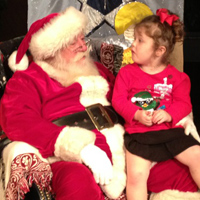
    If the line to see Santa is 45 minutes long and we all want to crowd on that poor man’s lap together, when should we arrive to do this so that we don’t take away any shopping time?

    And who’ll be the lonely sib stuck in line holding our place until the others finally show up?

    Math Fun, Mall Fun

    When you take your children shopping this season, start your day with a budgeting conversation. Even if the sky’s the limit you can visit about how much each child wants to spend. Revisit the topic at the end of the day and discuss their impressions of the value of things – were items more or less expensive than they’d anticipated? Did they go over budget?

    During the shopping trip, point out places where there are discounts. Discuss “just-for-you” deals that the kiosk clerks offer. Consider real value and how it compares with perceived value.

    Look around for ways to count, talk about time or money and look for patterns. When you do, point it out and say, “and that’s math!”

    And share what you see!

    Leave a comment below if you find anything interesting. And if you see a bunch of grownups acting worse than any kid you’ve seen… well, it’s not me. Really.

    Related articles
  • Math Songs

    Math Songs

    I’ve been wanting to write about all the cool math songs out there for quite some time. I’ve been somewhat collecting them in hopes that I’ll have the world’s biggest collection of math songs.

    Alas, I’m fairly confident that I’ve only managed to round up about 10%. They range in educational value, music quality and catchiness. Songs that I love, Daughter isn’t quite interested in. The one she loves I sometimes find slightly boring (especially after 3,000 times of replay).

    Not all math songs are good.

    Math and music are very similar in that everybody has their preference. I’m not a fan of calculus. And I’m not a fan of rap music. (Not that calculus is the mathematical equivalent of rap music, but for me it’s just as annoying.)

    If you’re searching for math songs, make sure you give them a listen before you buy. There’s a lot of garbage out there (sometimes that’s an opinion and sometimes that’s a technical fact).

    There’s also some NSFW stuff too – which can be fun for grownups, but you don’t want to inadvertently play something nasty for your parrot two year old (I’m speaking from experience here, #jussaying).

    Here’s my collection of songs and albums.

    • Do The Math by Ralph’s World is a song about friends… who happen to be shapes: Sanderson the Square, Tony the Triangle, Poly the polyhedron (non-Euclidean) mass. So fun!
    • Schoolhouse Rock: Multiplication Rock – the best ever. I’ve been singing this to Daughter since she was born! “Three is a Magic Number” still makes me tear up.
    • The Math Song by Scott Perry – I just downloaded this off iTunes and I’m excited about listening to it – over and over!
    • Another I grabbed this morning is I, Pythagoras (The Math Song) by Nikki Shultz. This is more of a grown up song, but she’s got an amazing voice.

    You can even make your own!

    Like I did (and had Husband sing it) with The 1-2-3 Song.

    Or have your students do it! This song was recorded about ten years ago for me by Sidney & Dale, two Art Institute students in my Fundamentals of Math class:

    So how about it – what math song is your favorite? And what math song would you like to hear, sing or write? Share it in the comments (and include a link to the audio or YouTube video).

    Sing the news loud and click here to share this on Twitter/X.

    Related articles