Part of Wordless Wednesday…



In my Mustang I get 20 miles to the gallon. Currently gas is hovering at three dollars per gallon. Which means for every 20 miles I drive, it costs me $3.
It’s 5 miles to school from my house. If I take her to school and back in the morning, and then retrieve her in the evening, it takes me 20 miles – or $3. (These are true numbers – even though they are working out rather nicely.)
Which means in addition to tuition, it’s another $15 a week. So in a 40 week school year, I spend another $600 in gas!
Maybe I should consider toddler carpooling…
Some forward facing car seat models can go up to 80 pounds. Even in the 97th percentile of weight, our daughters won’t grow out of one of these car seats until they’re about eight years old. That’s another five years!
The first car seat I find on Amazon.com that goes to 80 pounds is the Cosco Juvenile High Back Booster Car Seat. It’s $46.54 and eligible for free shipping. Add tax, and you’re right at $50.

Sharing the duties with my neighbor means cutting my gas bill in half. So I would save $7.50 each week by carpooling. After seven weeks of carpooling, I would save
\(7 \times \$7.50 = \$52.50\)
That car seat would pay for itself after less than two months!
After this year, I have three more years of carpooling available before we start homeschooling.
Three years at 40 weeks/year in school and $7.50 savings per week gets me at
\(3 \text{ years} \times 40 \text{ weeks} \times \$7.50 = \$900\)
I’ll save $900 over the next three years. And so will my neighbor!
I’m off to buy the carseat!
Do you take your kids to a co-op or day-school? Is there a family you can carpool with that you haven’t yet considered because of the logistics? Will you now work the numbers to see if it makes sense?
Share your thoughts in the comments!
The order of operations includes two types of rules: those that are based on the way the operations work, and those that are arbitrary. My friend @harrisonalg from the Twitter chat #mathchat and I have been discussing this.
You can explain the truly arbitrary elements of PEMDAS (the left to right of AS and MD) through an experiment. Allow students, independently, to do these two problems any way they want, ignoring any stupid arbitrary rule they might have previously memorized:
The idea is that they will come up with many different answers:
If they were on a team building a bridge with these calculations, things wouldn’t work so well.
Because we need to all come up with the same answer, we need a rule to follow. Really, it can be any stupid arbitrary rule (SAR). But we agreed, at some point in history, to all follow the “left to right” thing once we were down to addition & subtraction or multiplication & division.
It’s important to note that kids didn’t get to be part of that agreement we made. Just like they don’t get to vote in elections.
Is it fair? Probably not. They would probably do a better job of choosing leaders as well as determining the order of operations. But that’s the way things likes SARs work.
To throw a few more kinks into it, check out how wikipedia explains some special cases of the order of operations. . Factorials aren’t covered in PEMDAS, neither are the order of exponents.
Here’s another fun one: even calculators do things differently (and arbitrarily). Check out the way the the TI-92 and the TI-30XII handles exponents. Clearly you get to make up your own order of exponents!
Let your students determine the order of operations for addition & subtraction and multiplication & division – just for the class. Make sure to write the rule down and tack it to the wall so everyone remembers what they decided. In your class, and your class only, they are to follow that rule.
Remember the back of the book, as well as your answer keys or teacher edition textbook, will now be totally wrong. But it’s worth it.
Doing it this way they might start to understand which pieces of PEMDAS are dependent upon the way the operations are constructed () and which pieces of PEMDAS are arbitrary (left to right).
Once the class determines their special arbitrary rule, practice creating expressions whose result is some important number. Some options could be:
Create the expression using the Class Rule as well as the stupid arbitrary rule. Then translate and have a good laugh. I just did my age with my “Bon Rule.”
Bon Rule: addition and subtraction go from left to right, and multiplication comes before division.
My age is 120 ÷ 2 x 3.
If I did this according to the SAR, I’d be dead. Or really famous.
Can you teach the order of operations like this with your kids? If you classroom school, how much trouble are you going to get in when you become the math teaching rebel?
Share your experiences in the comments!
Feature image by tim846 | Flickr.com | CC BY SA

My business partner, William Devine, a licensed professional counselor, has been doing lots of research these past few weeks. He’s been reading up on math anxiety and the effects of adults’ attitudes and behavior on children’s math performance.
He started looking into this because I was basing the That’s Math product we’re developing on my experiences with student math performance – both high and low.
Of course I’ve been watching student math performance some 20 years. But he still wasn’t about to spend hundreds of hours building a product based on my soap-box rantings.
Indeed, what I was offering was merely…
I’ve been using the standard proof by blatant assertion method on MathFour.com for a year. So it seemed that building That’s Math on the same premise would work.
Everyone knows that the things grownups say in front of kids about math has a huge impact.
When I brought Wil in as a partner, the first thing he said was, “You can’t just say it’s true.”
“Well, it is true,” I said.
“You may be right, but saying it really loud doesn’t make it true. And pushing it on people doesn’t make them believe it.”
So here we go. Off into research world – finding out what causes math anxiety. Or at least what pieces we can help change to relieve math anxiety.
Thankfully Wil’s great at it. And I’ve managed to convince him to share a little with y’all – even before we launch That’s Math.
I’m officially introducing William “Wil-with-one-L” Devine, MA, LPC, CART, as a writer on MathFour.com.
We’ll be sharing what he finds, each week. And of course I’ll give my two cents when I’m inclined.
If you’re interested in knowing more, let us know in the comments. And what do you think is true about math anxiety and its effect on math performance? What about the effect of adults on the math performance of children?
Feature image by xb3 | Flickr.com | CC BY
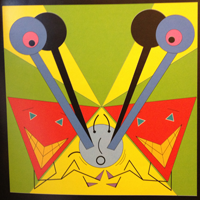
I’ve been dying to check out the book You Can Count on Monsters for a while. My sweet niece, without knowing how much I wanted it, gave it to me for Christmas!
You Can Count on Monsters is a book that illustrates the numbers 1-100 in a very special way. Each of the prime numbers has an original “monster” that has a link to it. For instance, 2 has two eyes, 7 has a body with seven sides, and the edges of 19’s eyes – they total nineteen.
Each of the composite numbers is a blend of mosters from the prime numbers of its factorization.
So 14 is the 2-monster hanging around in the mouth of the 7-monster. The other composite numbers range from cute to crazy-hard-to-recognize (like the 72-monster).
For each number, you can examine the monster and see how it was created – what aspects of the monster correspond to the number.
Starting at the beginning seems to be the best bet. Jumping into the middle got me lost. When I began at 1 and then allowed the composite numbers to “grow” on each other, things made much more sense. And as the prime numbers get larger, it’s harder to tell what piece of the image to count.
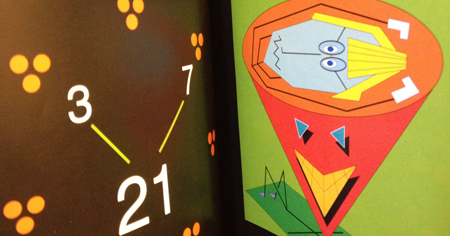
Walking through it with a child will be very interesting too. Daughter is two, so she’s pretty much not interested in numbers higher than five. Although I can start using the terminology “composite numbers” and “prime numbers.”
Making your own monsters is a fun, crafty way to explain prime numbers and composite numbers. Children would notice quickly that there aren’t many ways to represent 2 – drawing two sided figures is a bit of a challenge.
The obvious 2 monster has two circles, while the 3 monster has either three circles or is a triangle. But the bigger the prime numbers get, the more creative (and different from the book) you can get.
And how you put them together – well, that’s where the real fun is. There are so many different ways to create the composite numbers!
I was showing You Can Count on Monsters to my Ma. When I showed her the 6-monster she said, “That’s not counting.”
Indeed the images represent factorizations, not summations. Which means the image that involves 2 and 3 “officially” represents 6 but there are only 5 things “going on” in the picture.
She’s got a point.
Have you seen the book? Are your kids open to drawing number critters? And do you, or your kids, see it like Ma does?
Share your thoughts and experiences with You Can Count on Monsters in the comments!

Gary commented on an article I wrote called, How to Get People to Stop Saying “I Hate Math”.
He spent tons of energy defending his position, explaining how “math people” really anger him and his fellow “math haters.”
My initial reaction was to type out a response demonstrating where he does math, how he does it, and even the parts in his comments where he admitted he does math everyday.
But I stopped. It seemed… wrong somehow. So I’ve been thinking about his comments for a couple of weeks now – wondering how I should respond.
Gary has taught me something about learning and teaching math: when we push, others push back.
For so long I’ve told people to stop saying, “I hate math.” I’ve tried to convince them they can’t hate math because they do math everyday. Clearly (I see now) this helps people say it more.
When told they don’t really hate math – they find reasons that they do. They work very hard at digging up all the experiences that support it. They can’t remember the experiences that might have been good. Everything they’ve got is poured into defending their stance.
Every time I tell someone they don’t hate math, I’m invalidating their feelings! How is this fair?
It isn’t. It’s yukky and hurtful.
If you hate math, good for you! That’s the way you feel.
I hate magic – something that lots of people think is stupid. But that’s the way I feel. And I don’t want those turds invalidating those feelings.
People have the right to feel the way they feel. And if they hate math, that’s okay.
The fact is that people do math. Everybody. Everyday. Even Gary.
Gary writes in his comments: “this isn’t to say that I can’t perform basic math or even a few not-so-basic mathematical/arithmetic disciplines.” He does math everyday, but I’ve given him reason to dig out all the horrid things about it.
My business coach, Sarah Shah, has a really cool way of handling things like this. She gets people to open up. But not by telling them what they should think or feel. Instead she yields and acknowledges the other person. She validates their feelings.
Up until now I’ve been doing just the opposite. And I feel terrible about it.
So Gary, and everyone else in Gary’s shoes, please accept my apology. You hate math. And I’m not going to push you on that anymore.
And from here out, when someone says “I hate math,” I’m going to open up. I’m going to say, “You hate math,” and I’ll wait for them to offer more.
I’m not going to give the “mom look” ever again.
What happens when someone says, “I hate math” in front of you? What happens when you say it to others? Will you do anything differently now? Share your thoughts in the comments.
And a huge thanks to Gary for his honesty!
Feature image by Alesist | Flickr.com | CC BY SA

I gave up New Year’s resolutions years ago. I never kept them, so I figured they were pointless.
Instead I took up creating a yearly manifesto – a short declaration of my current life stance. This year I’m going to do a professional manifesto as well. This is it.
The mission of MathFour.com is to enhance the effectiveness of student math programs by helping every adult have a more positive influence on children with respect to math.
In less fancy terms – I want all the programs like Mathnasium, TenMarks, Stinky Kid Math, Sokikom and ABC Mouse to be successful. Negative math-talk from parents can diminish the effects these wonderful programs can have. MathFour.com’s goal is to help parents turn off negative math-talk and turn on helpful and effective math influences.
I have partnered with a licensed professional counselor. He is currently reading through the social science and psychological research and discovering the value of positive adult influences on children’s success in math. He is presenting a paper on the subject at the Western Social Science Association Conference this year.
The programs in development at MathFour.com will be based on this research.
The Facebook fan page isn’t working for the mission anymore. I will turn it into something useful. @MathFour on twitter is strong, so I will continue to interact there and be helpful.
I’ll also up the quantity and quality of articles posted here on MathFour.com– making them helpful for parents and teachers and maximizing SEO so they can be found easily.
The target of the mission is parents. And parents who access MathFour.com must be able to read English and have access to a computer.
These two assumptions could eliminate much of the world’s population from this content.
I’m in the process of forming a non-profit organization so MathFour.com can reach those parents. I have a grant writer on standby ready to get the ball rolling as soon as it’s formed.
In 2011 I diluted the efforts with various projects. This year holds only one project. And it speaks directly to the mission.
That’s Math! is launching March 1, with a soft launch for MathFourTicians on January 23. Over the course of the year my partner and I will be creating new content, managing the social learning aspect of the project and promoting it like crazy.
MathFour.com will continue as a foundation of robust and helpful content, free from outside advertisements.
There are hundreds, maybe even thousands, of student math programs in existence: on the web, software-based, speakers, books, workbooks, kits, summer camps, tutoring companies…
There are also many websites, books and programs to help adults with math.
MathFour.com is not one of these. MathFour.com is for parents. Not adult students. It’s for parents who are uncomfortable with math. It’s also for parents who are comfortable with math – because even engineers who are parents sometimes use negative math-talk!
The goal is not to turn grown-ups into lovers of math. It’s to increase the effectiveness of parents who are trying to positively influence their children in math.
The research indicates that student math programs could be much more effective if students’ adult influences in math were positive.
Parents need to know that. And I can’t get the word out alone. The world is large and this is a global problem. I need to find websites and organizations with a similar mission.
I will solicit questions from parents and teachers so I can be sure MathFour.com is the resource they need. It’s not helpful if I’m not helping.
So here’s my first solicitation: As a parent, what would you like to see MathFour.com do for you this year? If you are a mathematician and/or math teacher, how can I help you and the parents of your students?
Please let me know in the comments.
Feature image by storebukkebruse | Flickr.com | CC BY
![[50 Word Friday] Two Thousand Twelve](http://mathfour.com/wp-content/uploads/2026/05/FireworksFlickr_bayasaa_CCBY-1.png)
Two thousand twelve
Into what will you delve?
12 plus 2000 more.
Will you be rich or will you be poor?
12 years past Y2K
Do you want to change what you weigh?
Half of 4-0-2-4
Do you want to change the score?
2-0-1-2
What will you decide to do?
This article is a part of the 50 Word Friday series. Learn more about this strange, limited writing style here…
Feature image by bayasaa | Flickr.com | CC BY
This post originally appeared on The HSBA Post on December 29, 2011.
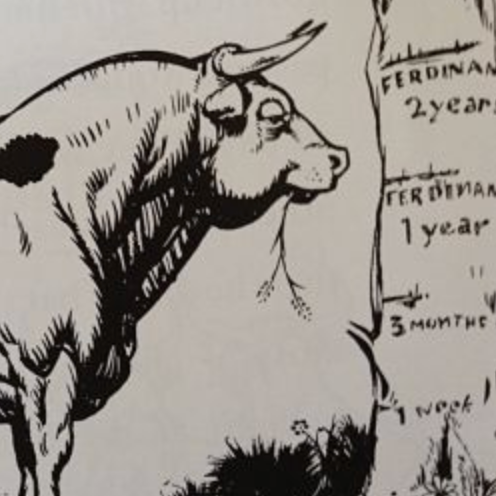
The Story of Ferdinand, by Munro Leaf, is a tale of mistaken identity: Ferdinand is a sweet bull who loves to smell flowers and has no interest in anything remotely violent. He is selected to be part of the Madrid Bullfights due to an unfortunate event with a bee.

I’ve enjoyed this book since I was very young. The nifty thing is the breadth of teaching opportunities Ferdinand gives us. There’s even math in it!
To integrate math in this wonderful tale, try using some of these questions when you read the story:
Where is Spain? Where do we live? How far away is Spain from us?
Look at the page where it shows how tall Ferdinand is. How many marks are there on the tree stump? How long was the time between each of the measurements? Is that equal? Would there be a better amount of time between each mark?
Suppose the marks for Ferdinand’s height were at 6 months, 1 year, 1.5 years and 2 years. Approximately where on the stump would those be?
Five men came to to pick the “biggest, fastest, roughest bull.” Why do you think there were five?
How many Banderilleros are there? How many Picadores?
Most books have page numbers. Ferdinand doesn’t. Why do you think that is? How many pages is Ferdinand? Could the book be written in fewer pages? How would that be done?
You can use the book Ferdinand and these math stimulators in your Five in a Row math day or integrate it into any other math curriculum. Or do it just for fun! Also try doing math with other picture books you have.
Oh – and don’t forget to share how it went in the comments!

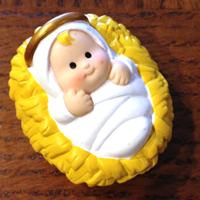
I’ve been stumbling over baby Jesuses for a few weeks now. I realized that with three working nativity sets in the house it was time to do a little math with Jesus.
All of them.
Animals, people, buildings – count them for each nativity set and count them up total.
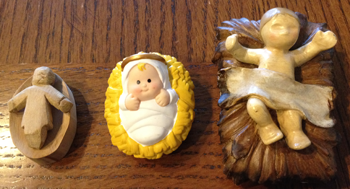
My three nativity sets have varying numbers of characters and structures. It’s curious how some sets include more animals that visitors – and some sets don’t have any animals.
Take the opportunity to show how counting and arithmetic are kinda the same thing.
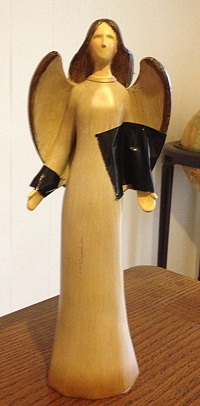
I know many people avoid fractions. I wish I could have avoided it with Math with Jesus. Daughter gave us the opportunity to talk about fractions by breaking the angel (or the “butterfly” as she calls it). Good thing we have Gorilla Tape.
Where can you find math in your Christmas things?