March 14 is Pi Day. Mathematicians, teachers, and math geeks around the world celebrate.
Especially at 1:59. That’s when the date and time is 3/14 1:59 — pi to 5 digits.
My treat for you last year was a photo of pi decorated cookies. This year the treat is even more delicious — a Pi Song from Vi Hart and a Pi Limerick from me.
Vi Hart can sing!
You can’t deny Vi Hart has mathematical and creative talent. But who knew she had a musical voice!
Unfortunately she’s since taken that video down. 🙁
My Pi Limerick — because I can’t sing.
I can’t carry a tune in a bucket much less associate digits with musical notes.
But I can remember pi to 5 decimal places with the help of this limerick:
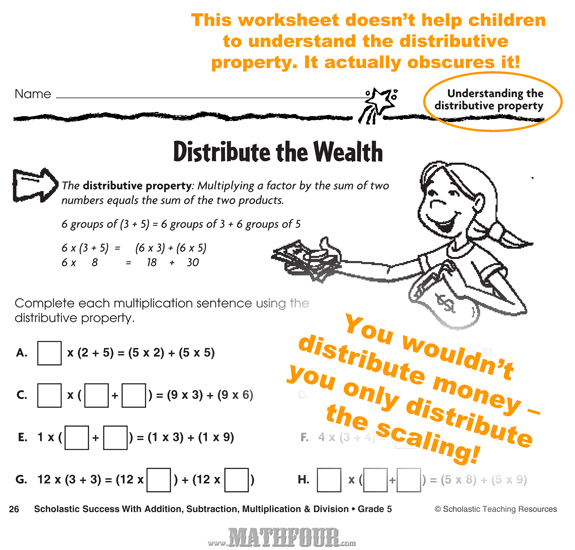
Scholastic Publishing has been accused of pushing the liberal agenda by Eric Bolling on the Fox News network. The problem with Eric Boling’s rant isn’t that he’s wrong, but that he uses the wrong argument.
The analogy of “distributing the wealth” was clearly meant to explain the situation. But there are two problems here:
Scholastic’s analogy fails
Eric Bolling doesn’t know that the analogy fails
Scholastic should be on the hook here, but less for indoctrination and more for obscuring mathematics!
What IS the distributive property?
The distributive property allows us to “distribute” a scaling number. For example, my cookie recipe calls for
1 pound butter
1 1/2 cups sugar
4 1/2 cups flour
This means my cookies will be made from this addition:
3 x 1 pound butter + 3 x 1 1/2 cups sugar + 3 x 4 1/2 cups flour
You’re not distributing anything real, but you’re distributing the scale!
How would this look for money?
You don’t distribute money, because money is something real. (Remember you can only distribute the scale.)
If money were to be involved in an example it could look like this (liberal indoctrination included for entertainment value):
Every year Karen, the rich girl, donates $500 to the Salvation Army, $250 to her local food bank, and $1200 to her church.
$500 + $250 + $1200
This year she got a big fat raise, because the rich get richer, and she wants to triple all her donations. So this looks like:
3 x ($500 + $250 + $1200)
3 x $500 + 3 x $250 + 3 x $1200
Scholastic attempts an analogy — and fails.
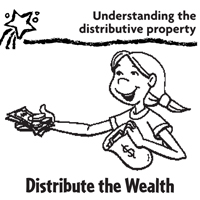
The image and title of the scholastic worksheet implies that money can be distributed in the manipulation of algebra. This is not just misleading, but completely wrong.
And since the subheading is “understanding the distributive property,” it’s also offensive.
Eric Bolling was making the wrong point.
Eric Bolling’s argument should have been:
“The distributive property distributes the scale, it can’t distribute money. Therefore either scholastic developers don’t know what they’re doing, or they are specifically inserting liberal indoctrination.”
I sincerely believe that the developers of scholastic use the “distribute the wealth” as an attempt of an analogy. Unfortunately the analogy fails mathematically and it also frustrates the politically conservative.
What do you think? Share your thoughts in the comments!
Note: I purchased this worksheet from Scholastic for the purposes of commenting here.
I first saw this video over at MathFail. It’s cute, and I have to admit, kind of cool.
But anything this simplistic always sends me into skeptical mode.
Before we go any further, check it out:
Do you believe it?
This might be the question to start a discussion with a student. It’s certainly the first question that comes to my mind.
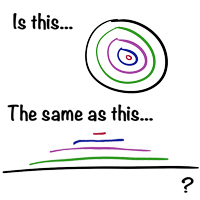
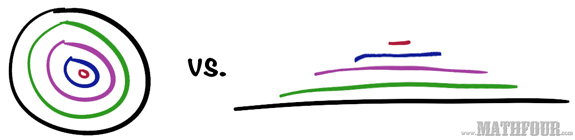
If it were really this simple, wouldn’t we have used it to “prove” the formula for the area of a circle much earlier?
What’s wrong with it?
For the “proof” in the video to work, you have to assume (or believe) that the circumference is 2πr. This seems a bit cheesy to me, since that formula is as complex as the one we’re trying to prove. Not to mention quite closely related. But I’ll let this one go.
The thing that really bothers me is that they use only a few chains — each of which has thickness.
If you filled the inside of a circle (a disk) with concentric circles, none of those circles would have a thickness. In fact there’s an infinite number of those circles.
Is it realistic to take each of those circles and fold them out and get a triangle?
Can you use it to teach?
I believe the makers of the video intended this to be a fun way to remember the area formula of a circle.
But the video would be better used to allow students to ponder the relationship of a circle to an isosceles triangle.
What do you think?
Are you okay with this video? Are you as skeptical as I am, or am I a little too sensitive?
As a mom of a girl child, I’m supposed know all about braiding hair. But I don’t. <cue dramatic bad mom music>
I know how to braid three basic strands of hair… mostly. But when I try the French braiding thing, K8’s hair looks like a feral goose nested in it overnight.
“There must be some way of knowing how much extra hair to pull in — and when!” I thought.
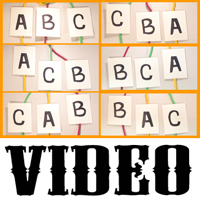
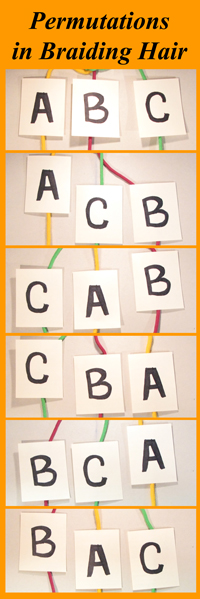
When trying to figure it out (mathematically, of course), I noticed that the strands of the braid weave to give all possible permutations of three things!
Check it out:
So we have all of these:
Are there more?
This makes me wonder what happens with four strands. Of course that kind of thinking will send any incompetent braiding mom into fits!
What do you think? Share your thoughts in the comments or on twitter/x.
It’s no secret that I’m an opponent of calculators. In fact, I recently suggested to readers of 12Most.com that they burn their calculators!
But there is one calculator that isn’t burn-worthy.
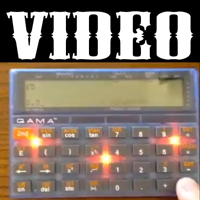
The QAMA Calculator requires the user to input a reasonable approximation before it churns out an exact answer.
So if you asked your QAMA Calculator to find the square root of 5, it would ask you first what \(\sqrt{5}\) is really close to. Like this:
That’s annoying!
Okay, maybe. If you need the calculator to do some quick work (the real reason to use a calculator), then you don’t need the darn thing quizzing you about an approximation.
But the QAMA Calculator people thought of everything. You can turn off that feature!
But then the kids will cheat!
Ah! You would think so. But check out what it does when you turn the feature off:
So what do you think? Will you get a QAMA Calculator? (It’s only about $25 after shipping & handling.) Will you let your kids use it?
P.S. I paid full price for it — it’s not expensive and it’s a crazy brilliant idea, so I went for it.
I get sent all sorts of things that claim to show the beauty of numbers. For the most part they show various number theory concepts that make a math mom think, “I wonder why that works.”
The 2012 STEMie Award competition is open to all schools and homeschools in the United States and is sponsored by McGraw-Hill. The deadline to enter has passed.
I work hard to convince you to see math around you — in even the most obscure things like lipstick, tattoos and cheese.
You may not have noticed that none of these, or any other articles I’ve written about the math you can find around us, contain science. At least not in the textbook sense.
But one of the fastest and easiest ways to see math around you is through science. So it’s kinda ridiculous that I haven’t really talked about it.
My Nephew is Learning Science
I received an e-mail from my dad today encouraging me to vote for my nephew’s school’s science program, SMORE. Turns out, they’re in competition to win a grant from McGraw-Hill, and 30% of their score comes from online voting for their video. (BTW, that’s math too!)
Knowing that he’ll be learning a lot of math when he’s learning the science, I’m supporting his school.
Make sure to support your kids and schools in science — they’re doing math!
I’m on a counting roll. I’m not sure, but it could be because this song is stuck in my head. It plays all the time on Sprout TV, the channel where my other addiction is – Lazy Town.
Don’t press play unless you want it in your head. It’s very catchy.