Tag: games

  • Personalized Number Puzzle Gift

    Personalized Number Puzzle Gift

    I’m working on a $0 budget for Christmas this year. And now that I’m in the wrapping phase, I’m noticing some missing checkboxes on my list.

    So my big question this morning was, “How do I stay at $0 — but still give something they’ll love?”

    Make something cool!

    My abilities redefine crafty. Well, they defy crafty anyway.

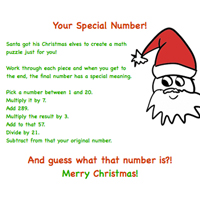
    I remembered seeing this number puzzle in a textbook a few weeks ago:
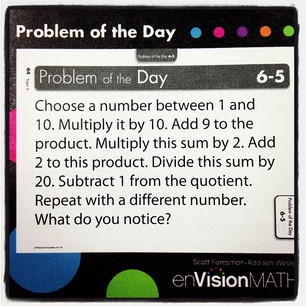
    I dissected it and came up with a formula for recreating the number puzzle using any numbers I wanted.

    And I figured out how to make it so the end result would be anything — not just the number you picked at the beginning.

    Personalized number puzzles as gifts!

    So I’m taking each person’s “special number” and creating a number puzzle out of it. For some, that’s their birth year. For others it will be their favorite number or last four digits of their phone number.

    And I’m making them into a pretty little gift sheet:
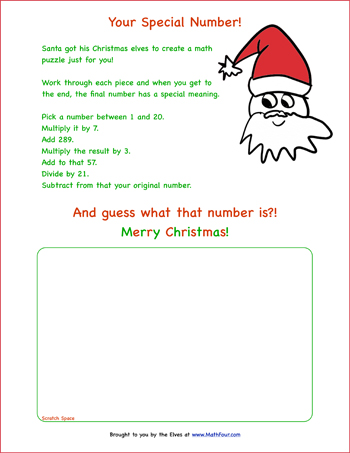
    You can do it too.

    I’ve put all this neatly in a spreadsheet so you can put in your own numbers — and make a number puzzle gift for your cherished math people!

    1. Open the spreadsheet and the document.

    2. Put the person’s number in the green box next to “Number to get.” Use their year of birth, birth date, favorite number, graduation year, etc.

    3. Put some various numbers in the green boxes next to a, b, c and d. Or use the ones that are there. They will work fine.
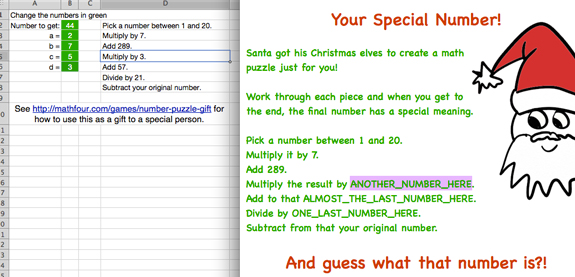
    Christmas number gift by MathFour.com

    4. Copy the numbers in the sentences in the spreadsheet to the corresponding places in the cute document.

    5. Print it, tag it and hang it on the tree!

    Have fun!

    What numbers will you pick? To whom will you give it?

    Share it in the comments and don’t forget to share on twitter/x too!

    You might also like:
  • 8 Digit Puzzle — Rules, Downloadable and Questions to Ponder

    8 Digit Puzzle — Rules, Downloadable and Questions to Ponder

    A friend of mine is putting together an amazing class on using mathematics as meditation.

    One of the tools she’ll be using is the 8 Digit Puzzle.

    The 8 Digit Puzzle

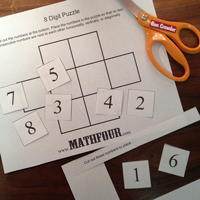
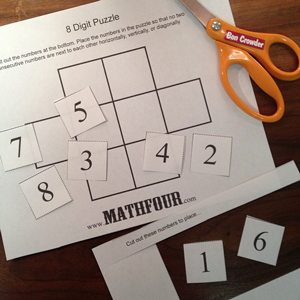
    To play, download or draw out the puzzle board on a piece of paper.

    Then cut out the numbers 1-8 from slips of paper. Make sure your numbers will fit in your puzzle board’s boxes.

    You can download the 8 Digit Puzzle Board & Numbers here (it also has some fun questions to ponder).

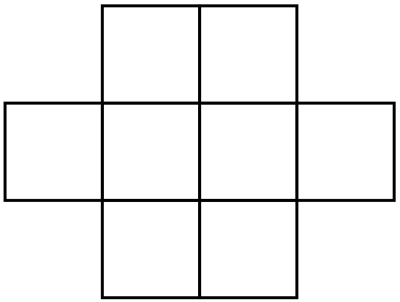
    The board looks like this:

    Place the numbers in the puzzle so that no two consecutive numbers are next to each other horizontally, vertically, or diagonally.

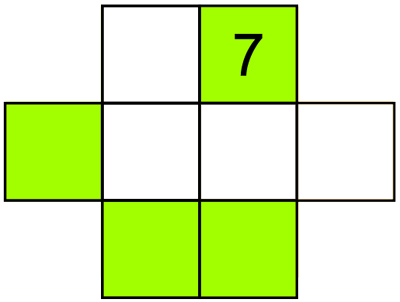
    For example, if you place the 7 as it is in the picture here, the other colored spots are the ones available for 6 and 8. The white spots are “off limits” for the consecutive numbers of 7.

    Play it alone or with your kids.

    The best part about this (and my friend’s class) is that you get to think about how you’re doing the puzzle. How do you process the rules and arrive at a solution?

    And then you can share your methods with others!

    This lets you (and them) discover new and curious ways of doing things — creating new neural pathways for more learning!

    Ask questions!

    If you get frustrated, don’t go right to googling the solution. First ask yourself these questions:

    • For each number, ask, “How many consecutive numbers does this have?” For example, 5 has two consecutive numbers — 4 and 6.
    • For each box in the puzzle area, ask, “If a number is here, where can its consecutive numbers go?”

    And there’s also these questions to ask as you work through:

    • Is there really a solution to this?
    • If there is a solution, is there any other solution?
    • Are there many solutions? How many?

    Get freaky!

    The 8 Digit Puzzle works great. But could there be a 6 digit puzzle with the same rules? Or a 7, 5 or 15 digit puzzle?

    Can you create it?

    Download the 8 Digit Puzzle Board & Numbers now and have fun. Don’t forget to share via Twitter/X. And let me know how it goes in the comments!

    You might also like:
  • Math Quote Cryptogram: Bragging Rights

    Math Quote Cryptogram: Bragging Rights

    This is the fourth in the Math Quote Cryptogram series.

    This series is inspired by the Dszquphsbnt! cryptogram puzzles in GAMES Magazine that I used to play with my dad.

    If you need help solving it, check out Cryptograms.org for instructions.

    Click here for a printable version of Math Quote Cryptogram #004
    Print it, work it, tweet it and let me know what you think!


    The Puzzle: “Bragging Rights”

    Y Z   A W O   F Q M C G Q   W R G C O Z   W   M R Y M A Q   Z C   L Q G W L X

    Z A W Z   D C F C P S   F C W O Z O   C I   Y K D C L W D M Q   C I

    R Y Z Q L W Z B L Q ,   F B Z   Y Z   Y O   O C M Y W R R S

    W M M Q H Z W F R Q   Z C   F C W O Z   Y K D C L W D M Q   C I

    O M Y Q D M Q   W D P   H L C B P R S   M R W Y G

    Y D M C G H Q Z Q D M Q   Y D   G W Z A Q G W Z Y M O .

    — L Y M A W L P   P W V X Y D O


    Share your thoughts in the comments or on twitter/x.

    You might also like:
  • Riddle: What are the ages of the kids?

    Riddle: What are the ages of the kids?

    I met the dad of a homeschool family on the plane yesterday who told me a riddle. Now that I’ve enjoyed solving it, I thought I would share it with you:

    Two math moms, Lisa and Gwen, are carpooling to a play date with Heather. Lisa is telling Gwen about Heather and her family. The conversation turns to the ages of Heather’s three children.

    Lisa says, “If you multiply their ages together, you get 36.”

    Gwen says, “How nice, but that doesn’t give me enough information to determine their ages.”

    “Good point. If you add up all of their ages, you get that house number,” Lisa says pointing to a house.

    “Interesting,” Gwen says, “but that’s still not quite enough information.”

    Lisa says, “Well, you’ll meet two of them soon. But the oldest is with her grandma.”

    “Oh, great,” Gwen says, “They’re perfect ages to play with our kids!”

    What are the ages of Heather’s kids?

    The end of the riddle is “what are their ages?” But the real value in the riddle is the logic and work it takes to arrive at the final answer.

    The “answer” is easy, but getting there (or explaining how you got there) is much more challenging.

    There’re not that many possibilities. So the trick is to imagine what each mom is thinking as they talk. What makes Gwen think, “that’s not enough information”?

    Share this with your children.

    Tell this riddle to your children. Let them play with it. If they get discouraged and want a hint, ask them these questions — one at a time — and see how far they can get:

    • What are all the possible answers? In other words, what sets of three numbers can multiply to give you 36?
    • Lisa points to a house number. What are the possible numbers that are the house number?
    • Go through each possible answer and imagine what Gwen was thinking when she said, “that’s not enough information?”

    And there’s more…

    When your child solves the riddle, see if he or she can try to replicate it with other numbers. What kinds of things do you need to make another riddle just like this one, but with other numbers?

    And don’t forget to share what happens in the comments below or on twitter/x!

    (P.S. I’m specifically not giving the solution here because I believe it’s valuable to find the solution independently. If this angers you, tweet me and I’ll give you the answer.)

    You might also like:
  • Math Quote Cryptogram: Trapped

    Math Quote Cryptogram: Trapped

    This is the third in the Math Quote Cryptogram series.

    This series is inspired by the Dszquphsbnt! cryptogram puzzles in GAMES Magazine that I used to play with my dad.

    If you need help solving it, check out Cryptograms.org for instructions.

    Click here for a printable version of Math Quote Cryptogram #003
    Print it, work it, tweet it and let me know what you think!

    And since it’s based on a famous book, you might consider buying and watching the movie version. (And look out soon for a review on it!)


    The Puzzle: “Trapped”

    Q R R   L X   Y E   Q I V   E R Q Z V E   K L   K S V

    D I V O Y G C P V E   L X   L Y I   L U T   G C J V T E C L T .

    — K S L J Q E   N Q T P S L X X

    (C T   K S V   C T K I L G Y P K C L T   K L   X R Q K R Q T G)


    Share your thoughts in the comments or on twitter/x.

    You might also like:
  • Chutes and Ladders  — It’s a Math Game!

    Chutes and Ladders — It’s a Math Game!

    I was playing Chutes and Ladders with K8 the other day when I noticed something. It might seem a little obvious, but I just saw it.

    Chutes and Ladders is played on a Hundreds Chart!

    It is! And as you look at it, and play it, you can see it’s totally a math game.

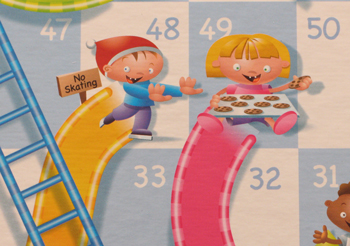
    You can practice numeracy with your children by counting up from a number. In Chutes and Ladders, if you’re on space #46 and you spin a three, you count up three: 47, 48, 49.

    The whole game is numeracy practice like this.

    It’s even good for the bigger kids.

    Sometimes big kids don’t want to play the little kid games. In Chutes and Ladders, the big kids have the opportunity to calculate how big the loss is on a chute. And how big the gain is on a ladder.

    Get freaky with your rules!

    You can also team a big kid with a little one and create some house rules. After spinning the wheel, the team gets 5 seconds to calculate the number square to which they’ll advance. If they get it right, they get a bonus of a free spin or to skip over any chutes.

    And if you really want to get advanced, choose a new function at the beginning of each game. Like SPIN + 2 or 3 x SPIN + 1. After spinning the wheel, the team gets 5 seconds to calculate the number square to which they’ll advance using that formula! If they can’t do it, they only get to advance the number of spaces on the original spin.

    You can make your own!

    And don’t forget you can make your own game using an $.88 Hundreds Chart that you can find at your local teachers’ supply store. Break out the construction paper, scissors and glue and start creating some Chutes and Ladders on it.

    And please share your photos and house rules in the comments or on twitter!

    You might also like:
  • Review of ThinkFun’s Roll & Play Toddler Game

    Review of ThinkFun’s Roll & Play Toddler Game

    This post originally appeared on The HSBA Post on September 14, 2012.

    How does a kid go from from having the attention span of a distracted gnat to an active game player? Baby steps!

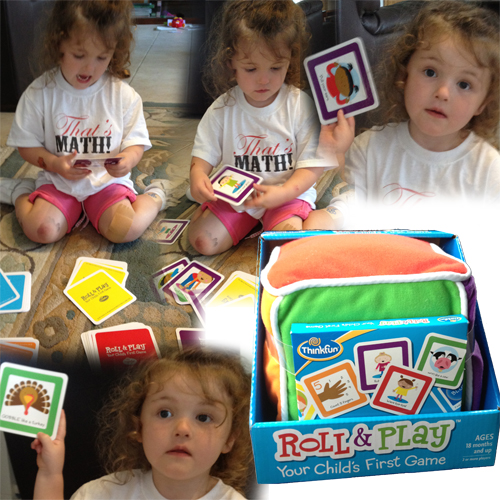
    ThinkFun has created Roll & Play, a “my first game” to start your little one out to becoming a regular part of family game night.

    Roll the die!

    The die in the Roll & Play game is a large plush cube. Each side is a different color. Players roll the die and then draw a card of the same color.

    This seems lame to older kids and grownups. But consider what you have to know in order for the die rolling to work.

    When the die stops, there are five sides showing and one hidden. You have to know that you’re focus is on the side that is face up. Rolling the big die teaches little ones that the top of the die is the indicator – not one of the sides facing him or her.

    Read the card!

    Each card has an activity on it. The pictures are sufficient for little ones to know what to do.

    When they “read” the card, they get to do the activity. To keep them engaged, you can have them read the cards to the other players.

    And then they get to pass the turn to the next person – another important game playing skill.

    Play, do, and change the rules at will!

    When you play Roll & Play, you’ll be hopping around, dancing, making animal noises, and having a great time. And if you want, you can adjust the rules to fit your little one.

    We started out by skipping some of the cards. They just weren’t as engaging as the others. We’ll work around to getting to all of them.

    Your turn!

    How have you integrated your little ones into game play? Would your toddler do well with ThinkFun’s Roll & Play?

    Share your thoughts in the comments and tweet this out!

    P.S. I got the Roll & Play game for free on accident. ThinkFun meant to send me another game and accidentally shipped this one. I refused to return it, promising instead to enjoy it and write about it.

  • Graphing with the Lite-Brite

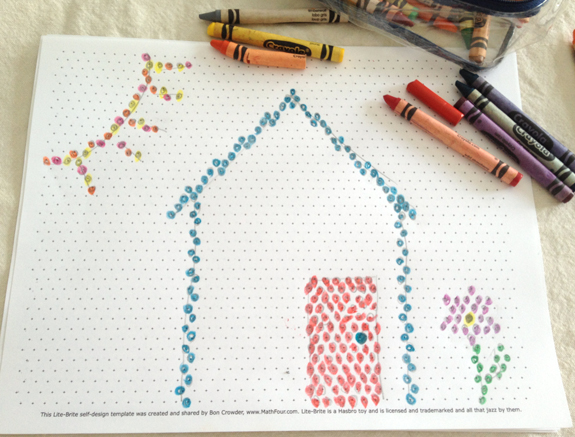
    Graphing with the Lite-Brite

    It’s not just for playtime anymore!

    Drag out the old one, pick up a used Lite-Brite or grab a brand new Hasbro Lite-Brite.

    Or… click to get the online Lite-Brite simulator (the technology these days!). And get ready — because that old classic is about to become your child’s favorite graphing lesson!

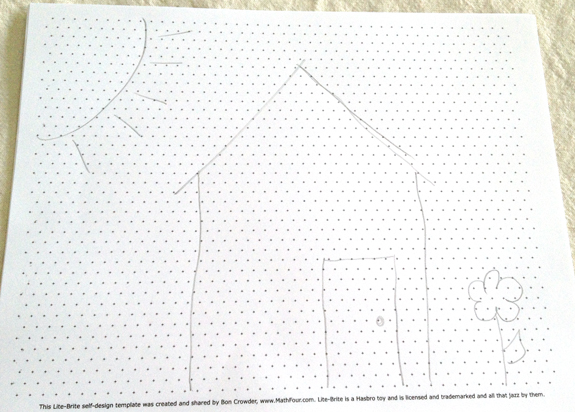
    1. Draw a picture on a Lite-Brite template.

    Download the Lite-Brite Classic Template if you have the classic toy. If you’re using the new one or the simulator, get the Lite-Brite Square Template.

    Draw a picture on it in pencil. Here’s mine:

    2. Determine the best peg placement.

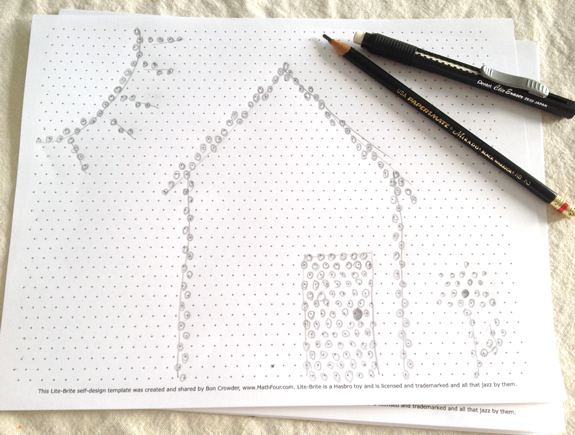
    Rough sketches don’t quite work with the peg placement. So draw the peg holes on the template as close to your lines as possible. Start noticing patterns.

    3. Use colors!

    Pick some good colors you’ll want to use when you’re graphing your picture. Unless you and your kids know the exact number of Lite-Brite pegs you have, in which colors, you’ll probably have to tweak this in the next few steps.

    4. Figure out where to start

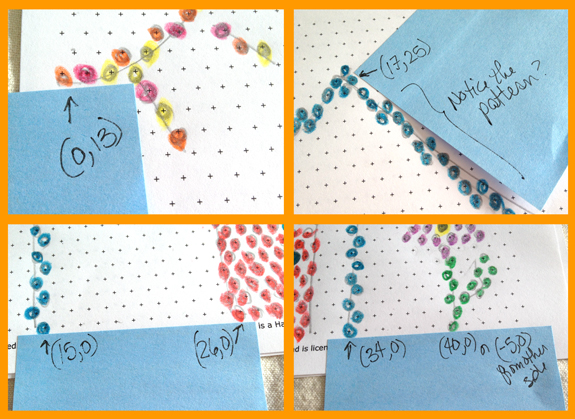
    Here’s where things get very interesting. The peg holes are NOT lined up in what you would call a Cartesian coordinate plane. They’re not really in any kind of coordinate plane system. At least not that I know of.

    The crazy structure in the grid doesn’t really matter. The fact that you can still count over and up to get where you want to go is what matters.

    You and your children get to devise the way you count over and up.

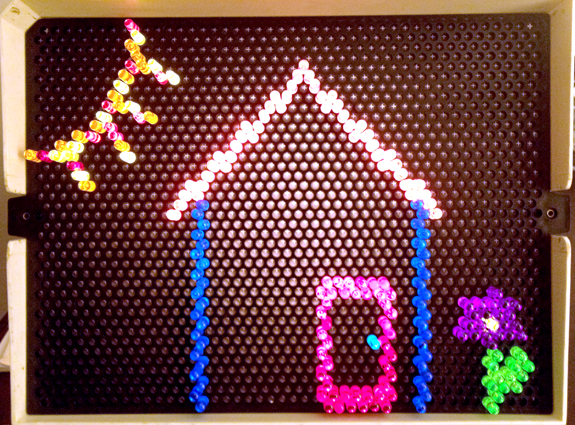
    5. Count and push!

    Your child can follow the pattern on the template and push the pegs in the Lite-Brite. This offers practice for the skills they’ll use when graphing and working with the slope of a line. This is the precursor of calculus!

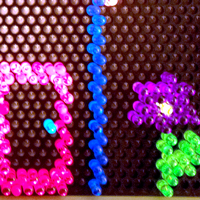
    Notice that when I was graphing my drawing, I had to change the door from solid to hollow. I ran out of pegs. #ARG

    Try it!

    Find your Lite-Brite and download the template: classic or square. Post a link to your finished work in the comments and tell me how it went!

    Share your thoughts in the comments or on twitter/x.

    You might also like:
  • Math Quote Cryptogram: Need More Space

    Math Quote Cryptogram: Need More Space

    This is the second in the Math Quote Cryptogram series.

    This series is inspired by the Dszquphsbnt! cryptogram puzzles in GAMES Magazine that I used to play with my dad.

    If you need help solving it, check out Cryptograms.org for instructions.

    Click here for a printable version of Math Quote Cryptogram #002
    Print it, work it, tweet it and let me know what you think!


    The Puzzle: “Need More Space”

    J K   N Q A Q N O   T   V C L O   Q X J K   J F K   K J Z O S   V C L O P ,   T

    B K C S J Z   H K F O S   K S   Q X   I O X O S T W   T X R   H K F O S

    F Z T J O A O S   Q X J K   J F K   H K F O S P   K B   J Z O   P T G O

    N O X K G Q X T J Q K X   T L K A O   J Z O   P O V K X N   Q P

    Q G H K P P Q L W O ,   T X N   Q   Z T A O   T P P C S O N W R

    B K C X N   T X   T N G Q S T L W O   H S K K B   K B   J Z Q P ,

    L C J   J Z O   G T S I Q X   Q P   J K K   X T S S K F   J K   V K X J T Q X   J .

    — H Q O S S O   N O   B O S G T J


    Share your thoughts in the comments or on twitter/x.

    You might also like:
  • Marble Math iPhone Apps

    Marble Math iPhone Apps

    Artgig studio recently released two iPhone apps for math learning support: Marble Math & Marble Math Junior.

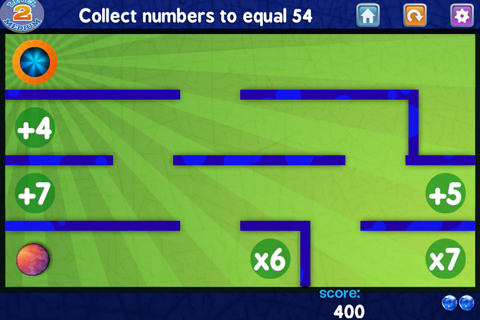
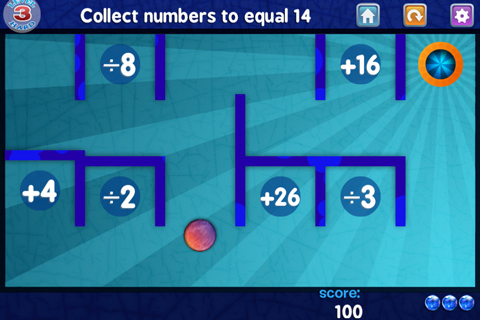
    In the games, you roll or drag a marble around a maze collecting right answers (or the pieces of a right answer) to a math question.

    Husband likes to roll the marble. He says that’s more fun because dragging the marble isn’t a challenge.

    But I like to drag it.

    Marble Math is fun and educational!

    Both of the Marble Math games have the same features: it’s a maze with obstacles, vortexes, bonus items and point decreasers.

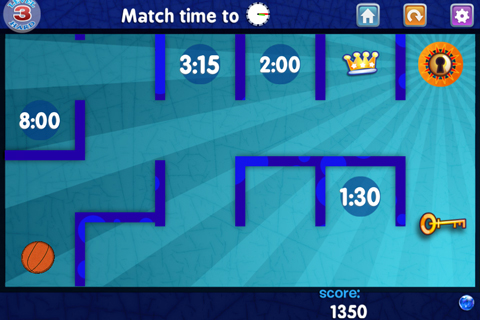
    The difference between the two apps is the level of math. So before you see the cool screenshots, check out some of the things covered in each version of the iPhone app:

    In Marble Math, I encountered

    • Addition (three digits)
    • Subtraction
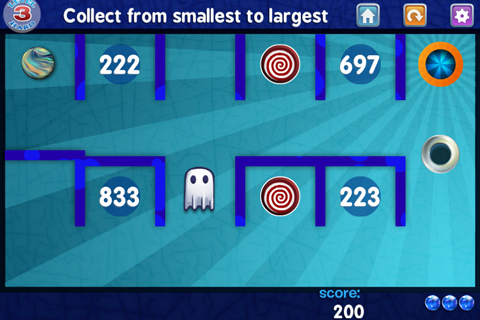
    • Ordering Roman numerals (yipes!)
    • Addition of fractions
    • Algebra with addition, subtraction, multiplication, division
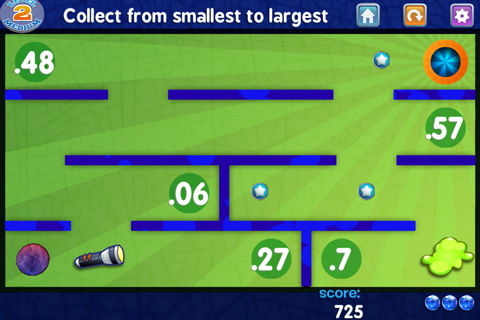
    • Ordering decimal numbers
    • Combining things to get a number using order of operations
    • Factors of a given number

    In Marble Math Junior, I encountered

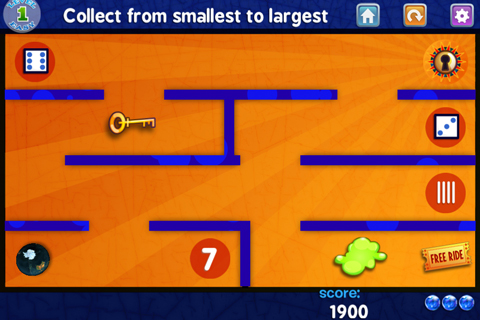
    • Ordering things (including a mixture of dice, tallies, arabic numerals, etc.)
    • Finding items that are the same as a given number
    • Identifying shapes
    • Adding up to a number
    • Telling time
    • Finding numbers less than a number
    • Multiples of 2 and multiples of 10
    • Basic multiplication (by 10)
    • Some basic fractions
    • Basic algebra with addition (10+?=17)

    The pictures are worth 103 words!

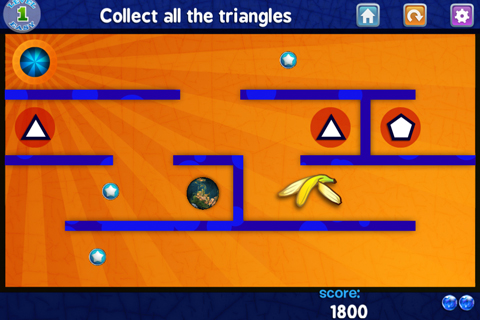
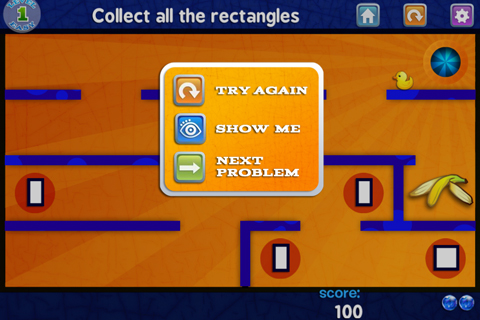
    The “pick the shapes” puzzles are fun. The banana will make your marble slip, but collect all the stars and you’ll get an extra life.

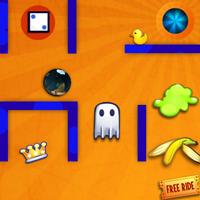
    The ghosts look like badguys — but they’re actually your friends. They let you go through the walls. (Come to think of it, it might be bad if you’re rolling the marble and not dragging it!)

    Collect all three tiny stars and you earn another “life.” Roll over the flashlight and… well, I’ll let you see what happens then!

    I like that they use time, but that tiny little clock is hard to see. (But my eyes are a good 30 years older than the target audience!)

    The key opens the “I’m done” portal.The green slick sends you spinning. The Free Ride ticket give you extra points:

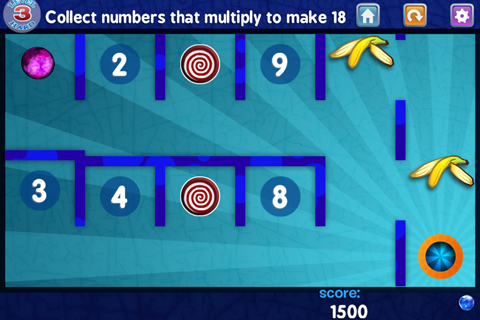
    Here’s a sample of a multiply one. The bananas here will make your marble slip and the swirlies will transport you between them!

    Having problems? Skip it, get the solution or give it another shot:

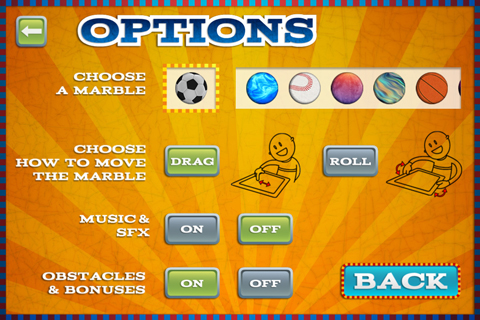
    But at some point the math will be hard enough to turn off the obstacles and bonuses. You can also choose your marble — but you have to earn them first!

    Here’s a nice order of operations one:

    This one almost killed me. I kept plugging at it, though. It’s from Level 3 of Marble Math.

    Give it a shot!

    Get the Marble Math & Marble Math Junior apps — one or both. Try your hand at them and share them with your kids!

    P.S. The cool folks at Artgig Apps were kind enough to share the app with me free of charge.

    Share your thoughts in the comments or on twitter/x.

    You might also like: