I learned a great deal of logic and thinking skills by playing the Dszquphsbnt! cryptogram puzzles in GAMES Magazine with my dad.
There are many places to get online cryptograms, but I thought I would offer a series of “pencil and paper” ones for the old fashioned folks (like me).
If you need help solving it, check out the amazing Cryptograms.org site for instructions.
This is the 6th in the draft purge series. It was first drafted in May 2011. If you have examples of this type of math puzzle, please include them in the comments.
Since the first time I used email back in 1991, people have sent me various versions of the puzzle “I can guess your birth year.” The results end up as something like:
This year (and this won’t work for any other year)
Your phone number
Your birth date
Your favorite number and the year you were born
Your blood type
Okay, that’s exaggerating a little. But it seems like these puzzles get wilder and wilder.
When I receive these emails, it’s usually from a family member with the preface: “Can you tell me how this works?”
So I’ve dissected tons of these over the years. And I’ve always thought, “You know – I could totally make my own math puzzle like this!”
You can invent your own math puzzle!
The trick to this math puzzle is to add zero and multiply by one in clever ways.
First you pick the result you want. Like the last four digits from my childhood phone number: 4347.
Factor it into primes, if you can. Let your kids do this by hand if you want them to have practice on factoring. If they struggle, you or they can calculate the prime factors using an online service like this one.
Mine is: (3)(3)(3)(7)(23)
If you can’t factor into primes, subtract a single digit number and try it.
Like 4349 – it’s prime, so subtract 2 and then use that to do the rest of this.
At the end of the whole math game you’ll just need to put one more step that includes subtracting this number.
Start constructing the math game.
The starter line for your game will be “Choose a single digit number from 1 to 9.”
We’re going to construct our game using this, with x as the chosen digit.
I’ll keep going until I have a nice set of instructions. Then I can do this on my Ma, Paps, my siblings and all my childhood friends that remember that phone number.
And it’s a great learning tool!
Kids will learn and practice order of operations and algebra. At the same time, they create something they can email or perpetrate on another person – preferably a grown up – and impress them!
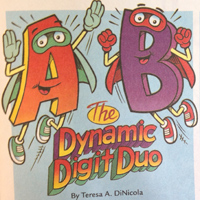
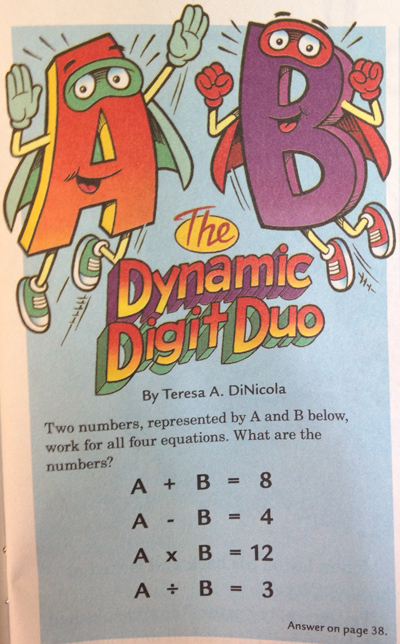
The March 2012 edition of Highlights magazine for kids fell in my lap this morning. Thumbing through it, I found a fun little algebra puzzle.
After looking at the equations and discovering my solution, I began to wonder some things. Then I realized that these ponderances of mine were good for kids to consider as well.
Let the curiosity flow!
Here are the extra questions you can offer your children in case they’re curious:
Did you use all four equations to decide your answer?
Could you have used three, two or only one of the equations to decide your answer?
Try to use only one equation to decide an answer. Did you discover anything?
Try to use only two equations. What did you discover now?
How about three – what happens when you choose three equations?
Can you make a puzzle like this of your own?
How about you?
As a grown up, what do you discover about math in this Highlights puzzle? What do you see your children doing with these extra questions?
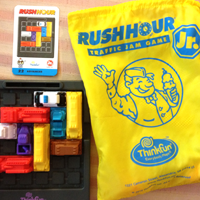
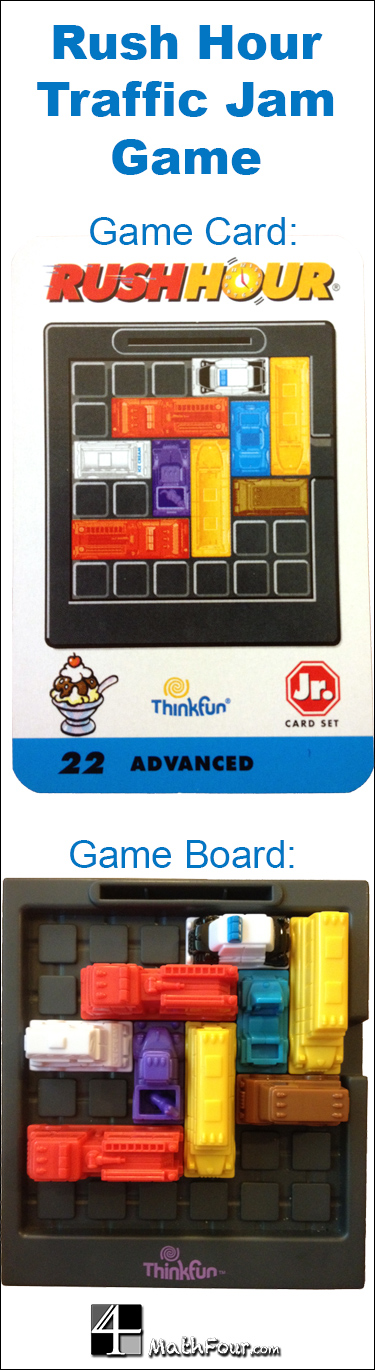
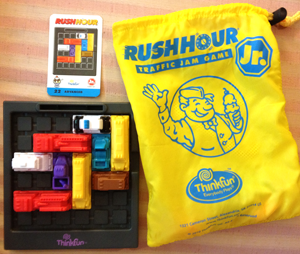
My sister-in-law showed me the Rush Hour Traffic Jam Game by Think Fun this weekend. She “assigned” one of the harder cards in the deck to me (sometimes it sucks to be known as the math mom) and assured me that I could do it.
The Set-up
You set up the 6×6 game board with the plastic vehicles just like the game card shows. Here’s where the math starts.
The skills children develop doing this support graphing on the Cartesian coordinate plane later on.
Even if your child isn’t ready for the actual game play, this step supports them in math!
The Goal
Allow the ice cream truck to “escape” the maze.
In order to do this, you are allowed to slide any of the cars forward or back. They can’t crash into other cars to push them out of the way. And you can’t lift any of them off the game board.
A more challenging goal is to also do this in the minimum amount of moves possible.
The Strategy
Everyone has their own plan. My nephew likes to scooch the cars around until he stumbles upon an answer. I decided to pick up the cars and move them to the most unique solution to see what the end result should look like.
The Math
You’ve the coordinate plane. You have logic. And you have strategy. But you have someone much more amazing here.
The beauty of the game is the way it simulates mathematical research and discovery.
Everyone has their own style.
Everyone has their own solution.
If you follow the rules and “win” then you’ve done it right, regardless of how someone else did it.
There are many levels of success – and the player determines which level he or she is shooting for.
Given the board and the colorful cars, you can create your own game.
Wanna play?
The next time you’re tutoring or teaching math, consider treating it like the Rush Hour game. Give it to your child then back off. Refrain from telling or showing. Let him or her play.
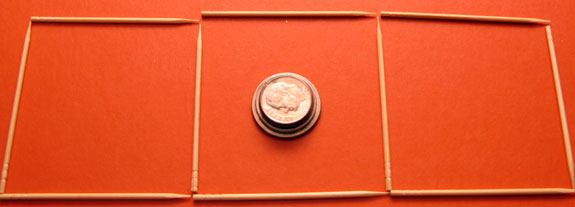
One of my favorite math games as a kid was The Tower of Hanoi. I had no idea what it was called until college, though. To me it was another cheap wooden puzzle. Or a game you could play with four coins and 10 toothpicks.
The object of the game:
Move the stack from where it is, to another square or post.
The rules of the game:
You can only move one disk (or coin) at a time.
You can only put a disk (or coin) on top of one that’s bigger – physically. (I.e. you can’t put a big one on top of a smaller one.)
You can play it online for free or buy a physical version in classic or kid-friendly versions.
How can you use The Tower of Hanoi with your kids?
In the Tower of Hanoi puzzle, the math is vast – especially for such a simple little puzzle. But the math can be discovered gradually.
Present these challenges to your kids, one at a time:
Move the stack according to the rules (just get it to another place.)
Move the stack according to the rules in as few moves as possible. How many moves is that?
Make the stack smaller or larger. Then move the stack according to the rules in as few moves as possible. How many moves is that?
Repeat challenge #3 with many different numbers of coins/disks. Use cut out pieces of paper if necessary.
Determine how many moves it would take to move a stack of 100 disks. Or 1000 disks.
Then figure out a way to say this without numbers. In other words, create some sort of formula that will tell you how many moves you need to move any number of disks.
These challenges might range over many many years. I first learned of The Tower of Hanoi when I was about ten. And I’m still learning about it 30 years later.
Oh, and try to resist giving them any answers – ever. Instead let them work on it in their spare time.
Your turn!
Have you played The Tower of Hanoi math game, or a version of it? Do you remember the first time you came across it? Did you learn or teach math with it?
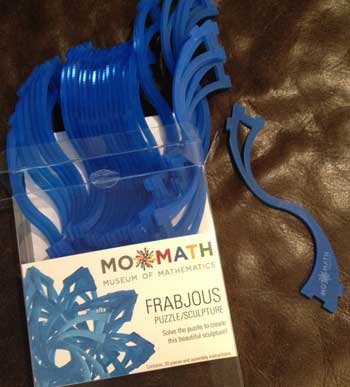
I had to wait for Daughter to be in bed before digging in – the box states, “Recommended for ages 16+.”
I was pretty sure that a precocious 10 year old could handle it but I was unwilling to risk a 2 year old eating my cool puzzle.
My “solution” to the puzzle…
Oh, my… all the pieces are exactly the same!
No biggie, though – I’m pretty smart. “I can do this!” I thought.
I thought.
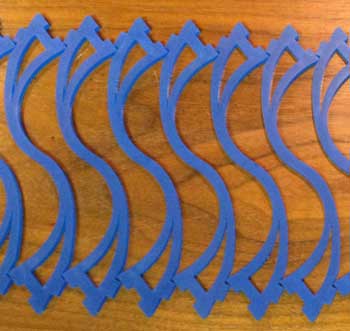
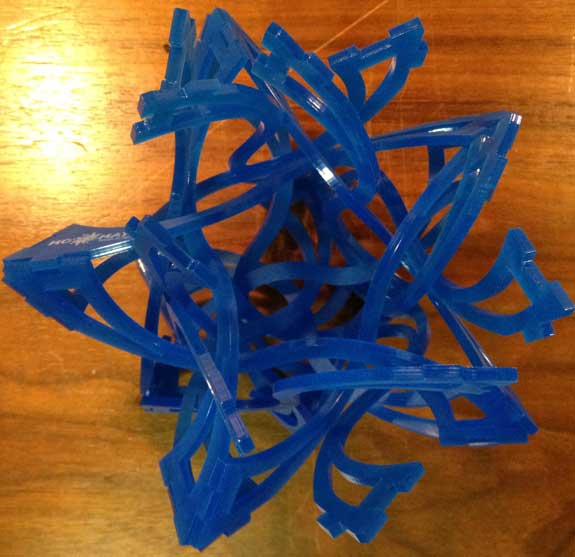
After a while, I felt like maybe I was doing it right, and maybe not. Here’s the view from the top when I had 12 of the 30 pieces left to go:
Guess what – the instructions clearly state “check that no parts are touching in the interior.”
Everything in mine is touching!
I’m (maybe) throwing in the towel!
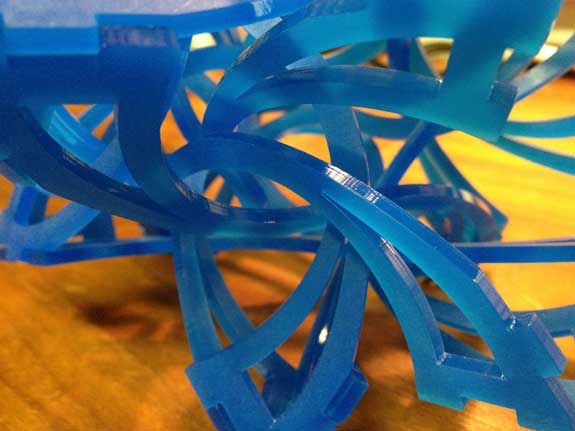
I keep looking at the mostly-built thing. It’s pretty, even in its unfinished state. I’m not one to quit, but I will pause temporarily.
So for now, I have the wad of blue looking at me everyday. Staring. Saying, “Are you smart enough to finish me?”
Sometimes I tell it to hush.
Sometimes I google it.
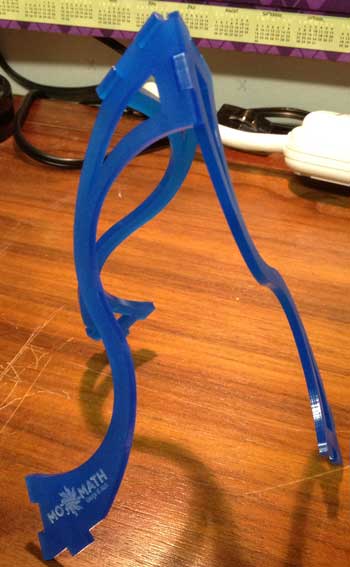
Windell Oskay, an Evil Mad Scientist, has some great images on his writeup of making your own Frabjous. I’ll likely use these when I get the courage tackle this thing again.
I could just watch the video.
I’m against looking in back-of-the-book answer pages. So I’m certainly not about to let a video tell me how to work a puzzle.
But my cantankerous attitude doesn’t mean that you get deprived. Here’s the video:
You can buy the Frabjous online for $29 plus about $7 shipping within the U.S. Technically, you can save the $36 bucks and build your own. But that might be a real pain. Plus, if you buy it from the Museum of Mathematics, you support them!
What do you think? Do you want one? Have you built one? Share your thoughts and links to pictures in the comments.
The Museum of Mathematics (MOMath) will open in New York City in 2012.
Last minute shopping? Me too! How about some of these math gifts for your favorite folks…
For Kids
Numb ‘n’ Number by Peter Weatherall – A collection of fun math songs.
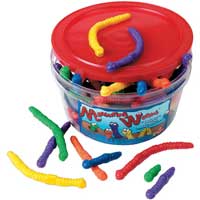
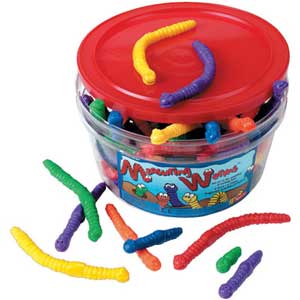
Worms! What kid doesn’t like worms? And these are measuring worms!
For Grownups
Math T-Shirts by ExBoyfriend Collection – Sad? Funny? These are cute for even the “non-math” people.
Want something a little more fancy? How about math jewelry like this Fibonacci necklace!
For Families
Math games are great for full family fun – and games like Uno… well, that’s math too!
For Math Geeks
Old math books! Husband found a College Algebra book from 1947 for me – gave it to me as a “just because” gift. Here’s a Trig book by the same guy. You probably can get an old math book for your favorite geek at any second hand book store!
Math Music! The Klein Four Group’s instant download Musical Fruitcake CD (I just downloaded it, myself!) To give you a sample of how cool these guys were (they are now professors all over the world), here’s a fun Christmas song from them:
How about it – what are you up to for last minute shopping? Are you done?
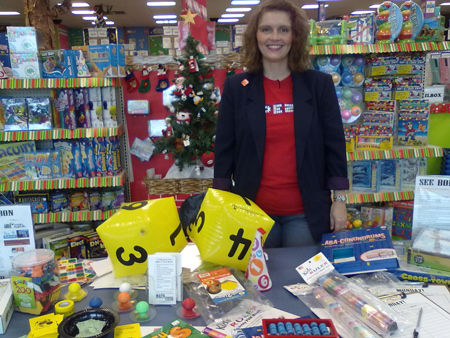
Do you have any Pre-K and/or K12 kids in your family? I spent the day at Teacher Heaven on the Southwest Freeway in Houston, Texas yesterday and found some great math games!
I was there for the day to demonstrate math games and manipulatives and generally help parents and teachers of K12 kiddos with math goodies.
Meagan, Shantrelle and the crew had chosen a couple of math games to start me off. I also went and browsed the rest of the math section for others. By the end of the day, my table was jam-packed with math games!
I fell for the loss leader!
The big push at Teacher Heaven was the “fill-the-tub” sale – and I fell for it before I left. Hook, line and sinker!
I resisted too many goodies for myself, but made sure to do a little Christmas shopping. Here’re a few of my excellent finds. Luckily my family members a) don’t read this site much and b) don’t know that these things were originally shrink wrapped!
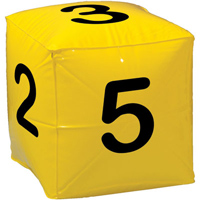
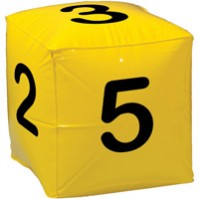
The Pre-K find of the day was inflatable number cubes!
I nabbed these number cubes early in the day to have something to get the little ones engaged as they walked in the door. They were so cool I couldn’t resist taking them home to Daughter.
They’ll be great for helping her identify the numeral and saying the word. Plus, I’ll be able to create a bunch of math games with it – like doing arithmetic with the numbers when she gets older, etc.
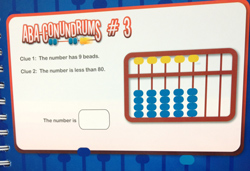
One K12 treasure was the Aba-Conundrums by Fat Brain Toys.
Aba-Conundrums comes with an abacus and a fun puzzle book. Using logic, you practice creating numbers and working with the tool.
I can’t decide if I’ll give it to one family member, keep it for myself or give it to Ma as a “house” game.
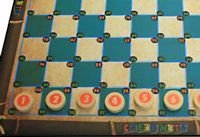
My other K12 find was the Check Math Game.
Also by Fat Brain Toys, Check Math is totally for my niece. I’ll likely open it and play it with Husband first, though!
You set the number pieces up and you capture your opponents pieces like checkers. The movement of pieces is a little different, though: a number piece can move to any square that’s a multiple of it. For example, the 2 can move to a 6 or 14. The 3 can move also to the 6 but not to the 14.
Time for Christmas shopping!
Pick up one of these math games at your local teacher supply store. And if you’re in Houston, head over to Teacher Heaven!
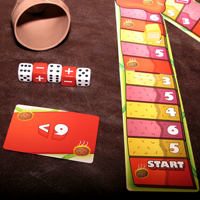
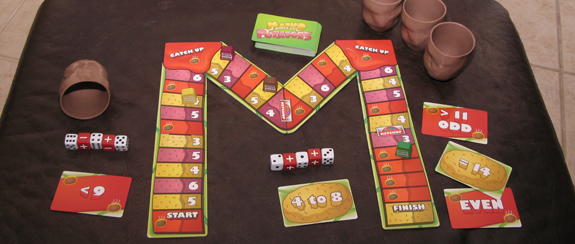
I was at my dad’s house the other day and decided to pull out my new Math’d Potatoes game to see how my super-gaming family liked it.
The kids in the house were too young to play, so my sister and I asked Aunt Linda and our stepmom to play with us.
They quickly claimed they were “math Neanderthals” but agreed to play anyway. My dad, an engineer, was asleep.
The game has simple rules.
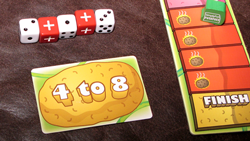
You play Math’d Potatoes by drawing a card, rolling five dice and making an expression that “satisfies” the card.
The card requests various types of “answers”:
Even or odd
Equal to a certain number
Between two numbers
Less than/greater than a certain number
Everybody got into it.
Aunt Linda and Louise (my pet name for my stepmom) both agreed that it was a fun math game. This is in spite of the fact that neither one of them like math, and Aunt Linda doesn’t even like to play games at all!
My dad saw the game the next morning.
I had intentionally not waken up my father to play with us the night before. My decision was validated the next morning.
My dad is an engineer, and as such tends to use the phrase “all you have to do is,” and the word “just.” He’s a very smart man, and I’ve learned lots from him through the years. And one of those lessons is: “Keep an engineer away from sensitive math learners.”
Sure enough, when he saw the game, he eagerly said, “What’s this? Are we going to play it?”
When I explained we played the night before he responded with, “Why didn’t you wake me? I totally would’ve won.”
Math learning is slowly build, and quickly destroyed.
When we were playing, Aunt Linda and Louise were both starting to warm to the idea of math. They were enjoying the game. My sister and I were holding back just a little to give them an opportunity to discovery their own skills. (We both experienced the engineer–math–dad super push growing up.)
So by the end of the game that night, they were excited, confident, and enjoying themselves.
Had I woken up my father to play the game, he certainly would have won. He might’ve turned it into a competition, or he might have tried to help a little too much.
Either way they would’ve lost interest. Their confidence would have been destroyed. And two beautiful, smart and happy women would have their, “I’m a math Neanderthal” thoughts validated.
You can use this with your children.
If you or your spouse are in a math related field, or was “always good at math,” be aware of your potential intimidation factor. Hold back. Don’t help. Allow discovery and confidence to come at its own slow and natural pace. Your children will learn math, in their own time.
Don’t force it, or you might destroy it.
Note: They sent me this game for free. This is not a review, per se, but still – you should know how I got it.
Learning math isn’t just about being taught math. It’s about fun, discovery and experimentation. In the Count 10, Read 10! program, parents get to spend 10 minutes a night playing math with their children.
Like many games you’ll find here, this is a version of Calvinball (from Bill Watterson’s Calving & Hobbes cartoon). You and your children make up the rules as you go along or as you see fit.
The next player says “plus” and another number. Then adds them and says the result.
The next player says “plus” and another number. She adds that to the previous result and says the new result.
Play continues until a winner is determined.
Example
Leader: Five!
Player 2: Plus three is eight!
Leader: Plus one is nine!
Player 2: Plus two is eleven!
Leader: WINNER!
End game, and how to choose a winner.
The round ends when the youngest child reaches their limit of counting or adding. The winner is determined by a rule or random choosing. The older the children, the more “real rules” you’ll need to follow.
Possible winning rules:
The first person to add up to 10 – or a number designated by the leader at the beginning of the game.
The person who noticies that another player is wrong in their calculations (this is perfect for the parent to “test” the kid).
At the whim of child or parent.
Variations
The point is to have fun with counting and math. As your children grow, you’ll have to adjust the rules to give them more challenge and to fit the “real game” model. Here are some options for variations:
Each player can only add a multiple of their age (grownups use one of the digits from their age).
Each player can only add a multiple of a roll of a die (get foam dice for bedtime).
Subtraction – instead of adding up, start with a higher number and add down.
Multiplication – instead of adding, multiply each new number. This one could get “fun” really quick!
Will it work?
All games created at MathFour.com are tested or will be tested on Daughter. The rub is that Daughter is almost 2 – we’ll have to wait a while to do this one. So your input is important.
Will it work? Did it work? Try it and let me know how it goes in the comments, please. Also share your own variations.