Tag: Christmas

  • Does Santa Exist — Mathematically?

    Does Santa Exist — Mathematically?

    Every year people try to prove or disprove the existence of Santa. There are sites like iCaughtSanta.com for grownups to create “proof” and write-ups like Keith Devlin’s The Mathematics of Christmas that counter any proof that photos might provide.
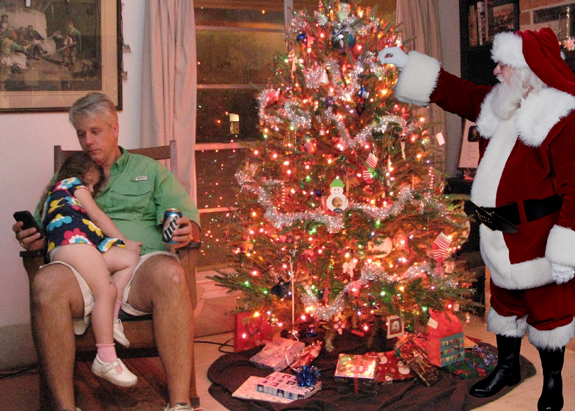
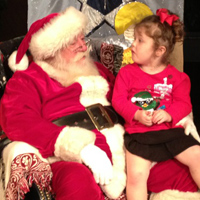
    I used the super cute service at www.iCaughtSanta.com to create this. You gotta love how Husband doesn’t even see Santa because he’s too busy on the iPhone!

    But to really prove anything about Mr. Jolly-Red-Boy, we must think about what it really means to prove something — mathematically.

    Say what you want to prove.

    The first thing you need for a nice mathematical proof is a “conjecture.”

    A conjecture is a statement that you think can be proven. Or that you want to prove. According to the google dictionary a conjecture is

    an opinion or conclusion formed on the basis of incomplete information

    Our working conjecture here is: Santa exists.

    It’s pretty straight up. But this isn’t quite enough. We need to know what “Santa” means.

    Then define and refine.

    Before we can work with the conjecture, it’s important to know the details. The details are usually definitions and assumptions.

    So this is where it gets fun. I often tell people that mathematicians “make all this crap up.” This is because we start with definitions and assumptions — not reality.

    So define Santa to be a human male who can enter the living room of every house with Christian children within a span of 24 hours.

    We can refine our conjecture to be:

    In the set of all human males, there exists x such that x can enter the living room of every house with Christian children within a span of 24 hours.

    Now think about how to prove it.

    There are many ways to prove something. Some of the common ones are:

    • Direct proof
    • Proof by contradiction
    • Proof by blatant assertion

    Here is a quick definition of each:

    Direct proof — proving it without using any fancy logical methods. This is more difficult that you would think.

    Proof by contradiction — proving it by saying if the conclusion weren’t true, then it would be really stupid. Or the earth would implode. Or 1 would be the same as 0. Etc.

    Proof by blatant assertion — proving it by saying it is true. Usually in a really loud voice and with a shaking of the fist. It’s helpful in this method to use swear words, but not required. (Note: all mathematicians attempt this type of proof at least once in their lives. But they never accept this method from others.)

    A myth is that mathematicians (and math teachers) know how to do something before they tackle it. In fact, they typically never know how to do something or what will happen when they try something.

    So as good Christmas mathematicians, we’ll give these our best shots…

    Play with the proofs and see what shakes out!

    A direct proof would be to show that everything in our known world supports the existence of Santa. Without doing any calculations, we can easily see that no standard human would be able to visit every living room in a small country, much less the whole world.

    So a direct proof won’t work for us.

    A proof by contradiction would be “if Santa doesn’t exist, then the world doesn’t really exist either. Well, at least in the way we know it.”

    This one doesn’t quite work either.

    Of course if we adjust our conjecture to say the opposite of what it does, a proof by contradiction would work.

    New Conjecture: In the set of all human males, there does not exist x such that x can enter the living room of every house with Christian children within a span of 24 hours.

    Proof: Suppose Santa does exist. Using some calculations regarding physics (found in this article on the Math in Christmas), we can see that Santa must be able to time travel or break the general laws of physics.

    Since breaking the laws of physics cannot be done, we have just shown (by contradiction) that Santa doesn’t exist.

    Well that’s certainly not good for our original, and preferred, conjecture. But we have one more proof method left.

    Say “Santa exists!” regardless of what the logic says.

    Now we get to turn to proof by blatant assertion.

    I believe in Santa in a way that can’t be shaken. But to be honest, my belief uses a different definition.

    It doesn’t matter — if you want to believe you can. People all over believe in God, the spirit of the trees and some people even believe that the real line doesn’t exist. There are tons of ways to “prove” the opposite of all of these.

    But these are things from the heart. Not from any logical or mathematical standpoint.

    So go ahead, believe in Santa. Ignore the physics and go print out proof of Santa for your kids!

    And don’t forget to talk about logic and proofs. At least on the surface.

    Share your thoughts in the comments or on twitter/x.

    You might also like:
  • Personalized Number Puzzle Gift

    Personalized Number Puzzle Gift

    I’m working on a $0 budget for Christmas this year. And now that I’m in the wrapping phase, I’m noticing some missing checkboxes on my list.

    So my big question this morning was, “How do I stay at $0 — but still give something they’ll love?”

    Make something cool!

    My abilities redefine crafty. Well, they defy crafty anyway.

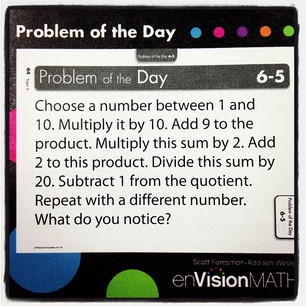
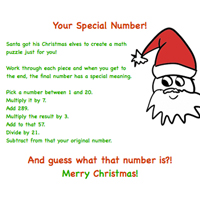
    I remembered seeing this number puzzle in a textbook a few weeks ago:

    I dissected it and came up with a formula for recreating the number puzzle using any numbers I wanted.

    And I figured out how to make it so the end result would be anything — not just the number you picked at the beginning.

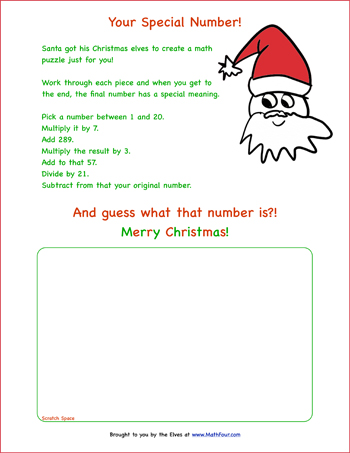
    Personalized number puzzles as gifts!

    So I’m taking each person’s “special number” and creating a number puzzle out of it. For some, that’s their birth year. For others it will be their favorite number or last four digits of their phone number.

    And I’m making them into a pretty little gift sheet:

    You can do it too.

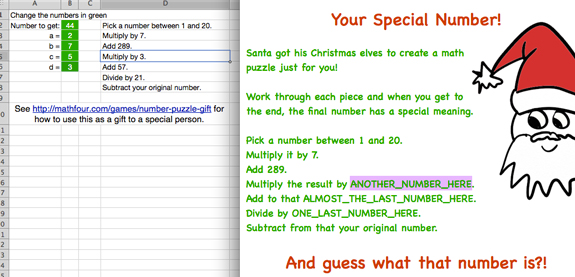
    I’ve put all this neatly in a spreadsheet so you can put in your own numbers — and make a number puzzle gift for your cherished math people!

    1. Open the spreadsheet and the document.

    2. Put the person’s number in the green box next to “Number to get.” Use their year of birth, birth date, favorite number, graduation year, etc.

    3. Put some various numbers in the green boxes next to a, b, c and d. Or use the ones that are there. They will work fine.

    Christmas number gift by MathFour.com

    4. Copy the numbers in the sentences in the spreadsheet to the corresponding places in the cute document.

    5. Print it, tag it and hang it on the tree!

    Have fun!

    What numbers will you pick? To whom will you give it?

    Share it in the comments and don’t forget to share on twitter/x too!

    You might also like:
  • Christmas on a Budget of $0

    Christmas on a Budget of $0

    This post originally appeared on The HSBA Post on December 17, 2012.

    This year, money’s tight. But we’ve had tight Christmases before. And what I know from tight budget Christmases is that they’re a drag.

    I know – giving isn’t the reason for Christmas. But it’s really fun to choose things for the ones you love that make their faces light up.

    Nothing makes you feel like you’re celebrating Jesus’s birthday like having a family member say, “Oh, wow! This is the coolest thing ever!”

    So when I first thought about how we were going to manage Christmas giving this year, I had a small idea: give things I already have.

    I had no idea that small idea would grow to be huge.

    “If you don’t use it, pitch it.”

    I’m married to a professional organizer. So I constantly hear stories of his clients and the things he coaches them. The big one is, “Yes you could use it, but do you use it?”

    I own a lot of things that I don’t use. But they are beautiful or special — so much so that I ignore the advice. I just can’t pitch them — or even donate them — because… well, because I just can’t.

    But if I shared it, now that’s a different story.

    Excitement welled!

    As I looked around at the things in my home that are fabulous and unused, I got excited. I went from shelf to shelf, drawer to drawer, discovering all the cool things that I could give.

    Then I thought about all the things in my mother’s attic. I gave her a call.

    “How about a special Christmas gift for you, Ma?” I asked. “Can I come over and get all my boxes out of your attic?”

    Now she got excited.

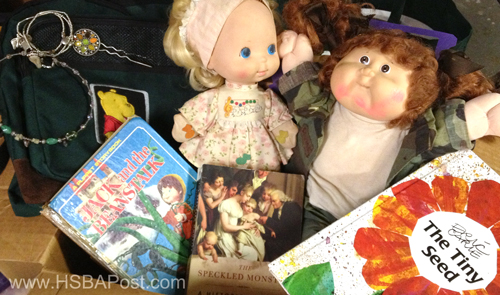
    So last week I went “shopping” in Ma’s attic. All my old toys, books, crafts, clothes, and jewelry are going to find their way into hands that will love them like I do. And use them!

    I’m recycling, reusing, cleaning out my home and Ma’s attic – all on a $0 budget.

    And I’m celebrating the way Jesus would – by sharing!

    How about you – are you on a shoestring budget or a $0 budget, too? Tell us about it in the comments!

  • Great Gift Wrap Up — Math Gifts

    Great Gift Wrap Up — Math Gifts

    Looking for some great gifts? Look no further!

    Here is a collection of games, toys, books and other goodies — all educational.

    For each, there’s a link where you can buy it (some are affiliate links) and most have reviews or other discussions of the product.

    Happy holidays!


    Games

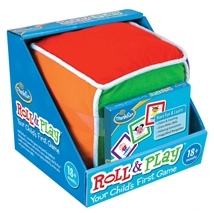
    Roll & Play

    Billed as “Your Child’s First Game,” this helps the little ones understand game play. Non-competitive, but fun. All activities are marked on the cards with pictures as well as words, so they are easily deciphered by the non-readers of the family.

    Ages: 18 months and up
    Players: 2 or more
    Review: Review of ThinkFun’s Roll & Play Toddler Game
    Cost: $19.99 on Amazon


    Quoridor

    Moving pawns or putting up fences. Deceptively simple. Ridiculously challenging after you and a friend have played 5 times. Which will your strategy be?

    Ages: Ages 8 and up
    Players: 2 to 4
    Review: Coming soon!
    Cost: $29.95 on Amazon


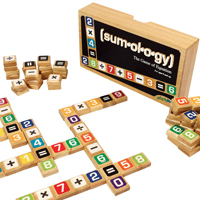
    Sumology

    Helps children build equations and do advanced math using the basic operators. Players place their tiles in crossword fashion either horizontally or vertically to create valid equations.

    Ages: 8 and up
    Players: 2 to 6
    Review: Long Division with Sumology Number Tiles
    Cost: $40.00 on Amazon


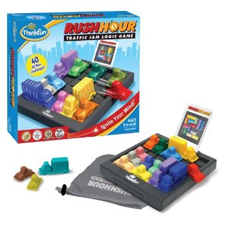
    Rush Hour Traffic Jam Game

    Playing Rush Hour helps build sequential thinking, reasoning and planning skills. Challenges range from beginner to expert, so everyone in the family will enjoy it! Rush Hour can be played at home or on-the-go — perfect for on road trips, airplane rides or physician waiting rooms.

    Ages: 8 and up
    Players: 1
    Review: Rush Hour Traffic Jam Game
    Cost: $17.78 on Amazon


    Toys

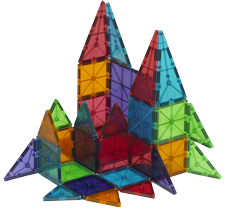
    Magna-Tiles

    These tactile, colorful translucent Magna-Tiles stick to each other for fun 3D exploration or practicing basic shapes and colors. Magna-Tiles develops patterning, shape recognition, building and motor skills. They store nicely on the refrigerator too!

    Ages: 1 and up
    Review: Magna-Tiles — Must-Have Magnetic Shapes
    Cost: $51.50 on Amazon


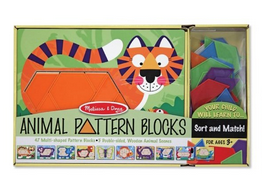
    Animal Pattern Blocks

    Complete the colorful animal pictures with geometric shapes. The 47 geometric shapes come in a rainbow of bright colors, and can also be used outside of the boards for counting, sorting and original designs. Great for developing shape and color recognition, fine motor skills and language skills!

    Ages: 3 and up
    Review: Melissa & Doug’s Animal Pattern Blocks Set
    Cost: $24.95 on Amazon


    Books

    There are so many! Click here to see a list of all the math picture books I’ve reviewed so far. Here are my two favorite ones:

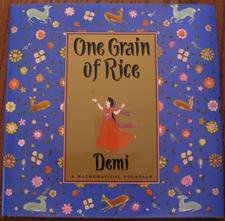
    One Grain of Rice

    Exotic, beautiful, and instructive, this “mathematical folktale” by author-illustrator Demi emerged from her love of India. This retelling of the classing “doubling” story is about Rani, a clever girl who outsmarts a very selfish raja and saves her village. When offered a reward for a good deed, she asks only for one grain of rice, doubled each day for 30 days.

    Ages: 3 and up
    Review: Math Picture Book: One Grain of Rice
    Cost: $14.95 on Amazon


    You Can Count on Monsters

    You Can Count on Monsters

    This special counting book visually explores the concepts of factoring and the role of prime and composite numbers. The playful and colorful monsters are designed to give children (and even older audiences) an intuitive understanding of the building blocks of numbers and the basics of multiplication.

    Ages: 8 and up
    Review: Prime Numbers Are Fun to Learn!
    Cost: $16.47 on Amazon


    Something for you…

    And after all this shopping for your kids, make sure you get some number jewelry for yourself!

    Let me know how your math shopping goes!

    Share your thoughts in the comments or on twitter/x.
  • 100 Days to Christmas

    100 Days to Christmas

    I just got a notification that today, September 16, is 100 days until Christmas. When I read this many thoughts went through my mind:

    • What’s our obsession with 100?
    • I wonder why we chose 24 days of advent and not 25, 50 or 100.
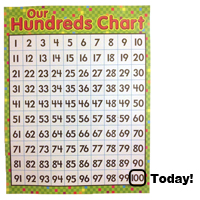
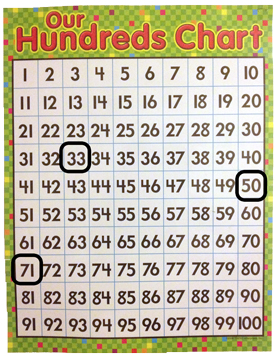
    • Hey — we could count 100 days to Christmas on a Hundreds Chart!

    Two good things to do…

    First, sign up to get the fun things from the site 100 Days to Christmas. I just found this site, so I’ll be getting those emails brand new like you!

    Get out your Hundreds Chart and use it for your 100 Days to Christmas countdown. Pick some favorite or familiar numbers and figure out when it will be that many days to Christmas.

    My best friend’s favorite number is 33, half of 100 is 50 and I was born in 1971. I’ll start with those!

    Or choose some special dates and figure out how many days to Christmas those dates will be. Like if your wedding anniversary is on September 29, that’s 87 days to Christmas.

    Please share what you’re doing in the comments or on twitter/x.

    You might also like:
  • 3 1/2 Ways to Do Math with Jesus

    3 1/2 Ways to Do Math with Jesus

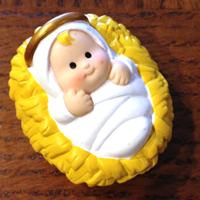
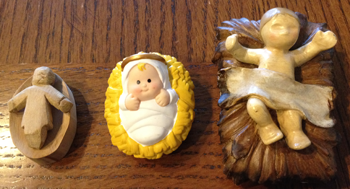
    I’ve been stumbling over baby Jesuses for a few weeks now. I realized that with three working nativity sets in the house it was time to do a little math with Jesus.

    All of them.

    You can count the bits and pieces.

    Animals, people, buildings – count them for each nativity set and count them up total.

    • How many total Jesuses do you have?
    • How many angels?
    • How many “visitors” does Jesus have?
    • How many sheep? Cows? Donkeys? Camels?
    • How many total animals?

    You can compare the numbers.

    My three nativity sets have varying numbers of characters and structures. It’s curious how some sets include more animals that visitors – and some sets don’t have any animals.

    • Which of your nativity sets have more animals? Which has more people?
    • Which has more buildings (or non-people/non-animal things)?
    • Are there more visitors than animals or more animals than visitors?
    • Arrange the sets in order of least to greatest – people, animals, etc. Are they always in the same order?
    • Is one set bigger or heavier than the others?

    Do some arithmetic.

    Take the opportunity to show how counting and arithmetic are kinda the same thing.

    • If you add up the number of sheep you have with the number of donkeys, how many is that? Is it the same if you group them together and just count them?
    • What if all the shepherds left? Talk about how you can count them, or you subtract the number of shepherds from the total number of visitors.
    • How many nativity sets do you have? Talk about how 3 times that number is the number of wise men you have.

    Do fractions – but only if you must.

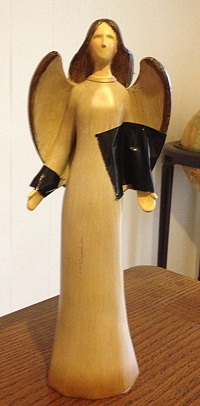
    I know many people avoid fractions. I wish I could have avoided it with Math with Jesus. Daughter gave us the opportunity to talk about fractions by breaking the angel (or the “butterfly” as she calls it). Good thing we have Gorilla Tape.

    Where can you find math in your Christmas things?

    Related articles
  • Why I Believe in Santa Claus

    Why I Believe in Santa Claus

    This post originally appeared on The HSBA Post on December 25, 2011.

    I’m not sure how I discovered that my parents acted as Santa Claus. But I distinctly remember the sinking feeling. I also remember quickly making the connection for the Easter Bunny and the Tooth Fairy. Within five minutes all mysticism in my life had vanished.

    Ten years later, it all came back.

    It was the middle of the 80s. My parents were recently divorced. My dad was in oil and gas and had been laid off. We had no money. Mom said we were broke — not poor. But it sure felt like we were poor.

    We had Christmas lights and ornaments from all the past years. We lived in the country so we got a tree from the “backyard.” It required a couple of long needle East Texas pines wired together, but it worked.

    And we were told not to expect to find much underneath it on Christmas Day.

    Strange Phone Calls

    I remember overhearing a conversation my mom was having on the phone in mid-December.

    “We have water and electricity and food. It’s not much, but we’ll be okay. <pause> Really? But I’m sure there are many other families in more need than we are. <pause> I see. Well if that’s the case, yes. We would appreciate it very much. Thank you.”

    My best friend called with an interesting question. “We’ve exchanged names for family Christmas, and I’ve drawn the name of a cousin that’s about your little brother’s age. I don’t have any idea what to get for him. Can you ask him what he likes, and maybe that will help me?”

    Looking back, there were many other strange and unusual phone calls the two weeks leading up to Christmas.

    A Christmas Eve Like No Other

    On Christmas Eve we had a constant flow of visitors. A local car dealership showed up offering a bag filled with wrapped presents. Some people from my best friend’s church came by with three bags of gifts. Another church sent a handful of representatives with a huge basket of turkey and dressing and all the fixings. Friends and churches from all over the neighborhood, and even people we’d never met, were showing up to share with us.

    2011 Christmas Tree
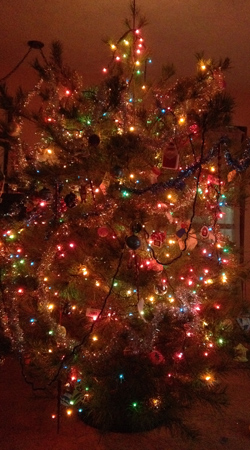
    Stlll in the same house, this is what the 2011 Christmas tree looks like. (We can afford to buy one now, but we still like a non-standard shape.)

    It was so amazing to see such love and caring — and for it to come our way. I was too young to really understand the generosity, but I knew it was special. Very special.

    We went to midnight mass, as we always did, and mom was crying just a little more than normal.

    A Magical Christmas Morning

    Christmas day was insane. Santa Claus had really come.

    I remember opening presents and seeing mom’s face. In years past her look was of excitement to see if we liked what she had given. This year, she had a different look. She was truly curious. And she was excited and amazed that her young children wouldn’t have to know the heartache of an empty Christmas morning.

    I’m quite sure it didn’t occur to her, though, that the gifts the community had shared included one more: believing that people really can love one-another. The very heart of Christianity.

    The Gifts of God

    Jesus gave us a gift with His death. We get to live in Him forever. But with His birth, He also gave us a special gift, one that we get right now. He gave us generosity and love to share with each other. And at Christmas, that comes out in the shape of a fat, old, hairy, jolly character we call Santa Claus. A man who’s famous for his generosity.

    I hope that no one ever has to be poor or even broke. While it wasn’t easy going through that part of my childhood, I am thankful for the lessons we learned. I am grateful that I was able to see first hand the generosity and love of my fellow man that Christmas.

    Merry Christmas… and may we all be filled with the Christmas spirit!

  • [50 Word Friday] Math in Christmas Lights

    [50 Word Friday] Math in Christmas Lights

    When looking at Christmas lights with a child, you see things you might never have seen before.

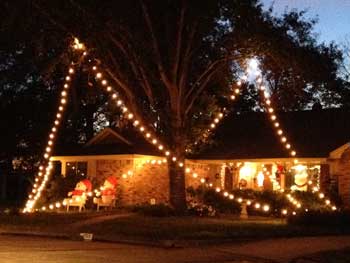
    Lights around a window make a rectangle. Lights that droop might be a parabolic or catenary curve.

    And some people hang their Christmas lights in triangles!

    What shapes are in your Christmas lights?

    This article is a part of the 50 Word Friday series. Learn more about this strange, limited writing style here…

    Related articles
  • Wrapping Paper – Doing the Math this Season

    Wrapping Paper – Doing the Math this Season

    As you wrap presents this holiday season, take a minute to notice the patterns in the wrapping paper. You might just find some math!

    Christmas Paper

    How does the paper come together in the back? Does it neatly match up, seamlessly? Or is it way off?

    Are you able to scootch things a little so that you can get the paper to line up?

    What happens when you use a different box?

    Is this really math?

    Absolutely!

    Consider wallpaper: it has a pattern that repeats every so many inches. When you put wallpaper in your home it’s important to know how often it repeats so that you can match patterns in the corners and around windows, etc.

    Patterned wrapping paper also repeats. Most people ignore it because they don’t think about matching the patterns in the back when wrapping gifts.

    Unless they are particularly detail oriented, a perfectionist, or want to teach a little bit of math at home while wrapping presents…

    Choose your wrapping paper to match your boxes!

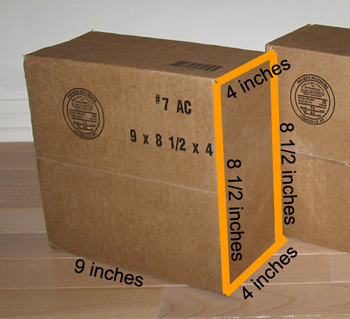
    On this box your wrapping paper would go around 8 1/2 + 4 + 8 1/2 + 4 inches.

    This means the wrapping paper would travel 25 inches before meeting back up with itself. So any wrapping paper that repeats after 5 inches or 25 inches will match back up in the back. Both 5 and 25 are factors of 25 – and that’s math!

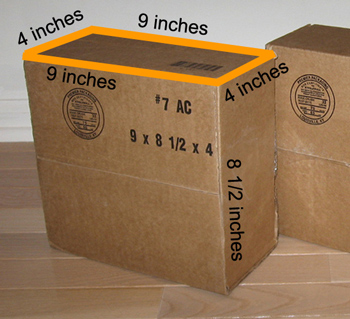
    If you wrap the box the other way, instead, like this,

    …the wrapping paper would travel 26 inches. Therefore any patterned wrapping paper that repeated after 2 inches, 13 inches or 26 inches would match in the back perfectly.

    A box whose “wrap around” distance was 30 inches could use any wrapping paper that repeated after 2 inches, 3 inches, 5 inches, 6 inches, 10 inches, 15 inches or 30 inches. All those are factors of 30.

    Choose your boxes to match your wrapping paper!

    Or do it the other way – figure out how frequently your pattern repeats. Any box that has a girth of a multiple of this number can be wrapped perfectly. (Girth is the distance around the box – where you wrap the paper.)

    For instance, if your wrapping paper repeated after 2 1/2 inches, you would look for boxes that have a girth of 2 1/2 inches (a tiny ring box), 5 inches, 7 1/2 inches, 10 inches. All the way up to giant boxes that have a girth of 314 1/2 inches.

    Your turn!

    How often does your favorite wrapping paper repeat? Have you found the perfect box/wrapping paper combination? Share your wrapping paper math discoveries in the comments!

    Box photos by z287marc | Flickr.com | CC BY

    Related articles