Tag: downloadable

  • Playing with Algebra Concepts

    Playing with Algebra Concepts

    I’ve been itching to get into some basic abstract algebra goodies. With the help of the Cuisenaire Rods, Simply Fun Sumology number tiles and the Discovery Toys Busy Bugs, I’m able to do that.

    Start with wrap around addition.

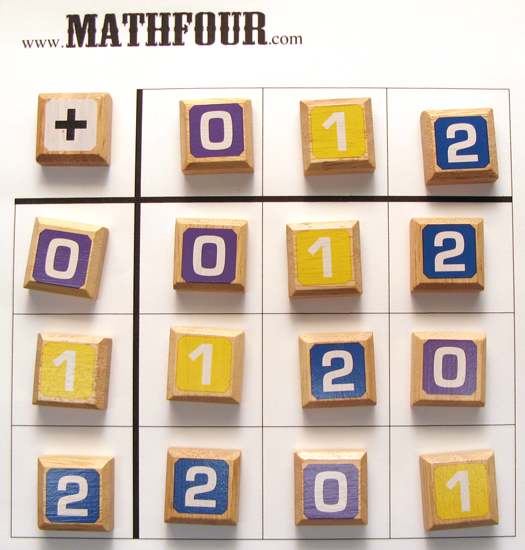
    This type of math is officially called “modular arithmetic.”  We are only going to use the numbers 0, 1 and 2.

    It begins as regular addition. And since we are only using those three numbers, all our answers have to be either 0, 1 or 2. So when we add 1+2, we wrap around.

    If we were to count in our system, we’d say: “0, 1, 2, 0, 1, 2, 0, 1, 2, 0, 1, …”

    The addition table looks like this:
    (Notice you could do this with numbers from 1- 12 and it would be clock addition!)

    Now things get buggy.

    Switch out all the number tiles with some pretty color Cuisenaire Rods. They don’t have to be the “right” rods. We’re only looking at the colors. Here’s the progression I did:

    The end result is a very abstract chart!
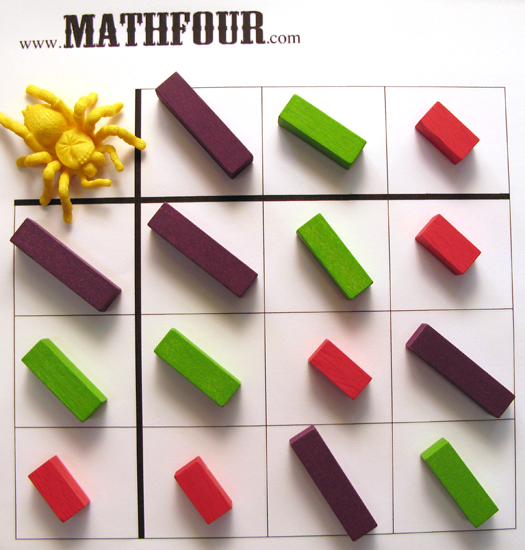
    You can “bug” two things together.

    Like this:
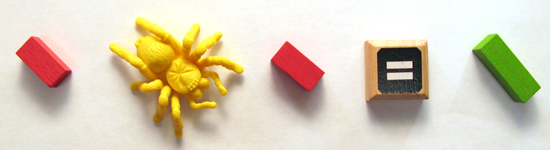
    (I know – a spider isn’t a bug. But run with me on this, okay?)
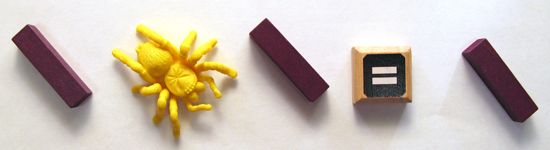
    Notice that each of these are directly from the “spider table” above.
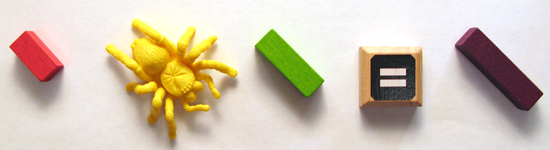
    You can read this as, “Purple spider green equals green,” just like you would say, “Zero plus one equals one.”
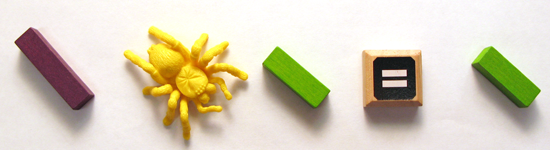
    And then turn your child loose!

    First make a chart, or download this one.

    You can, but don’t have to, start out with numbers. The rules are this:

    • You can only use three colors.
    • All three colors must go across the top.
    • All three colors must go down the left.
    • Fill in the 9 spaces however you want, as long as it’s only those three colors.

    I did this one with the blue beetle as the “addition” piece:
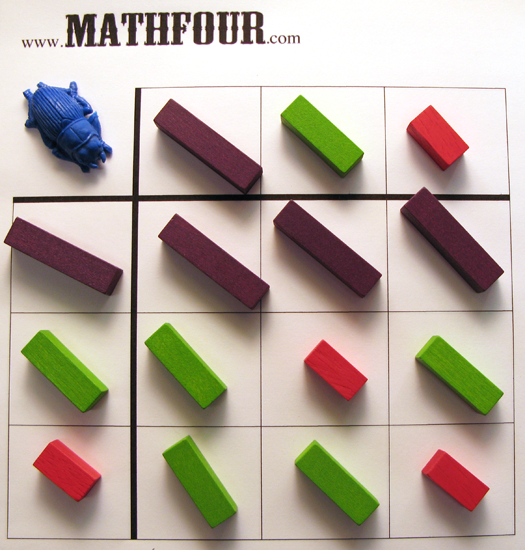
    So what can you do with a goofy “blue beetle table”?

    Let your child play, for one. And experiment.

    You can also talk about commutativity and associativity, identities, inverses… but I’ll leave that for another article!

    What do you think? Does your child want to play like this? What else can you do? Share your thoughts in the comments.

    Related articles
  • Long Division with Sumology Number Tiles

    Long Division with Sumology Number Tiles

    A few articles back, I published a video called Long Division with Playing Cards.  I did it super-fast in response to a comment at  Living Math Forum.

    I’ve pondered this a bunch since then and decided I like the idea, but the playing cards are too cumbersome. I ran across a game called Sumology (from Simply Fun) at the Texas Home School Coalition Convention. The heavens parted and angels sang.

    Or at least my heart started beating and my head started spinning.

    So here’s the same teaching method, but with a little more pizzazz and a couple of free downloads:

    What do you think? Will your child like it? Please share your thoughts in the comments.
    Related articles
  • How to Teach Subitizing: 1 – 4

    How to Teach Subitizing: 1 – 4

    The comparison of numeracy to literacy is curious.

    Learning math is the opposite of learning to read. When you read, usually simultaneous to learning a language, you sound out words and then put meaning to them. When you learn to count and do math, you know the meaning inherently and then put a language to it.

    At some point we learn to recognize words without sounding them out. And at some point we learn to recognize quantities without counting them out. This is called subitizing.

    The Your Baby Can Read program uses the concept of subitizing to teach reading – you show your baby the word alongside the object. So the shape of the word car is as recognizable as a car itself.

    The children using Your Baby Can Read don’t learn to sound out words. They don’t understand the concept of letters any more than babies not using the program. But they instantly recognize the shapes of the words – giving them an (assumed) advantage.

    Aside: We didn’t use the “Your Baby Can Read” program, not because it was gimmicky (I love anything that looks gimmicky), but because there is a huge DVD element to it. We decided not to put Daughter in front of the TV for her first 2 years. A decision we stuck with, but sometimes was a struggle!

    This article contains a “your baby can count” type program. (And it’s a free download!)

    How did we learn subitizing?

    I don’t recall having been taught it directly. Although I could be wrong. The research on it has been happening since the early 1900s, so it might have been taught without being labeled “subitzing.”

    In a previous article about why learning to subitize is importantChristine Guest commented that she learned it out of frustration for counting with chanting.

    I wonder how many of us do that. Are grownups so adept at subitizing that they forget that’s how we assess quantity? Maybe we’re taught to chant-count because that’s the way we think counting is.

    But it isn’t!

    How do you teach subitizing?

    Images are accompanied by the written numeral as well as the number spoken aloud. The images would be printed on cards, done via video or “live” with 3D objects.

    I’m still working on the numbers 5-10 and up, but for the numbers 1-4, the following 8 styles of image sets would be done twice. Once using the same objects for each image set, and once using different objects for each image set.

    1. Organized in a row vertically.
    2. Organized in a row horizontally.
    3. Organized in a row diagonally.
    4. Organized in a row other way diagonally.
    5. Organized in a regular shape (triangle, square).
    6. Organized in a differently oriented regular shape.
    7. Organized in an irregular shape.
    8. Organized in a different irregular shape. (There will be more of these for 4 than 3, etc.)

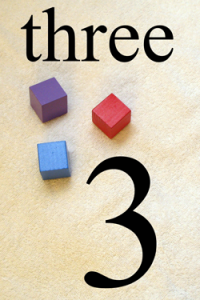
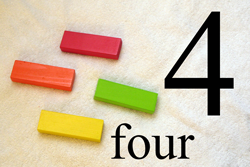
    The objects could be blocks, cars, little dolls, just about anything. I created the set below from blocks I found left in Daughter’s block set.

    Each zip file contains a few .jpg files with 4″ x 6″ pictures. You can print them at home or ship them to Walmart, Target, CVS, etc. for printing. I left off the MathFour.com logo so the kiddos wouldn’t get distracted. Please share them along with links back here.

    What do you think? Can you use these? Did you?

    Related articles
  • How to Create a Maze

    How to Create a Maze

    I just finished Dan Pink’s book A Whole New Mind in which he discusses the difference between a maze and a labyrinth. It made me think of this wonderful video of dissecting a maze into two walls to solve it:

    I learned about this method from David Chandler of www.MathWithoutBorders.com in the Math Future Google Group.

    Creating a maze becomes easy do-able!

    From the discovery that David and his class of Math Explorers made, I learned that you can take two colors and create a maze. So off I went…

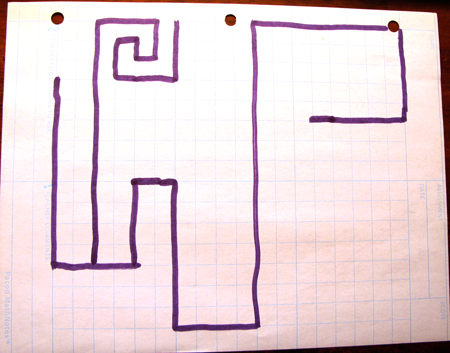
    I’ve been dying to use this elementary school graph paper I got the other day so out it came. I grabbed a purple marker and started:

    I immediately began creating the “rules” of what would be good maze design. And almost as quickly I began seeing that I was all wrong.

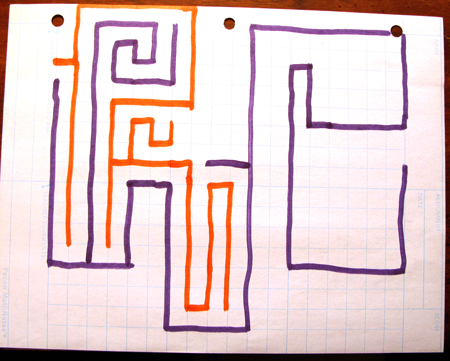
    After a while I got out the orange marker:

    More rules… more “…no, that’s not really a requirement” thoughts from me.

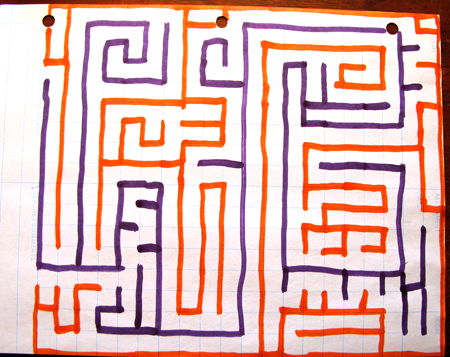
    After a while I just gave up on making rules and decided to make sure that my purple and orange would come out at some point together.

    Then with a little photoshop magic, I made it all black. You can download it here and play it!

    Okay, your turn!

    This might not be something to teach, but rather something to do at home together. It’ll be a learning experience for the whole family.

    Grab anything with lines or a grid on it and two different color pens or markers and give it a shot. Let me know how it goes. You can even post a link to the pictures of them in the comments!

    Check out the interview with David Chandler here.

    This article was previously part of a We Are That Family “Works for Me Wednesday” post.

    Related articles

  • How to Quit Saying “I Hate Math”

    How to Quit Saying “I Hate Math”

    Is changing how you feel about math like changing who you are?

    My Little Brother is a licensed professional counselor. He often tells me that you can change your attitude by changing your behavior.

    Apparently the behavior-attitude door swings both ways. If you don’t want to do something because you feel frustrated, do it anyway and that will clear up the frustration.

    So that’s how you can get your attitude and your child’s attitude aligned with positive feelings of math.

    Stop saying angry math things.

    I’ve pointed out that the real place kids learn math is at home. And I’ve discussed why grown-ups should quit talking about hating math. But until now, I’ve never said how to do this.

    Because it’s easier said than done right? When you’re frustrated, or your children are frustrated, you’ve gotta say something. So you can’t “just stop.”

    HOW do you quit saying “I hate math” (when you really do hate math)?

    First, make a list of all the math things you do (download the handy helper here). Here’s a starter list for both you and your children:

    • I know how long it takes to get dressed and so I can calculate when I have to wake up in the morning.
    • I can figure out if our car is getting good gas mileage.
    • I can figure out if I have enough money saved to by a nice toy.
    • I know what I have in savings and if that’s enough to buy the fancy shoes I want.
    • I know how many minutes it takes me to walk to my friend’s house.
    • I know that riding my bike to my friend’s house is faster than walking.
    • I know that in the past I couldn’t reach the middle of the dinner table, and now I can – because my arms are longer.
    • I can figure out how much I’ve grown in the past year by looking at my growth chart.

    Copy your list and put it on the refrigerator, in the bathrooms, on the front door and next to your bed. When you find your child or yourself wanting to say, “I hate math,” instead say, “I can do math because __” and fill in the blank with something from the list. If you need to, continue like this:

    This particular math problem I’m working on is more challenging than what I already know, but it isn’t hard. I just have to figure it out. And since I’m smart enough to do all that other math, I can figure this out!

    The behavior of changing what you say will have a positive affect on how you and your children feel about math!

    Try it. Let me know how it goes!

    This article was previously part of a We Are That Family “Works for Me Wednesday” post.

    Related articles
  • Teaching Patterns with Playful Bath Shapes

    Teaching Patterns with Playful Bath Shapes

    Do you get “why” questions often from kids?

    Differentiation is the foundation of learning. Curiosity comes in the form of “Why is that different?” And right behind it is “Why is that the same?”

    So patterns – and the lack of patterns – are essential in the development of a child.

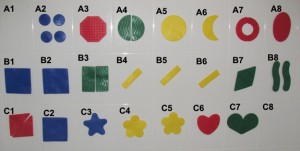
    The picture below is a collection of Discovery Toys (not all of them because they live in a house with a 19mo child).

    While in the tub, I encourage Daughter to see which ones are the same color. You can label the bathtub tiles with soap crayons so you can discuss the patterns more easily. Use the Cartesian Coordinate plane or Excel cell names like I did in Photoshop.

    Here are some things to talk about to encourage pattern discovery and learning. Or click here to download this as a printable MSWord Document.

    • Which shapes are similar? Which are congruent?
    • Which shapes are kind of the same (similar, but not in the official math sense of “similar”)
    • Put shapes together that “go together” – these could be same shape, color, “feel” (like B6 and B7 are both angled).
    • Compare shape A5 to the shapes A3, A4, A6, A7 and A8.
    • What do cells B3 and B8 have in common?
    • How are C3 and C4 different?
    • What’s in common in cells A2 and B2?
    • How are shapes C1 and C2 different?
    • How are C2 and B3 similar?

    And then look at the world!

    When you’re out of the tub, make sure to encourage observations – of everything. For something like the gate trim in the picture you can ask questions like:

    • What is similar?
    • What pieces are different?
    • Do you see spots that are kind of the same but mirror imaged?
    • If you were to make this symmetric, what other parts would you have to add to it?

    Have fun. See patterns. Enjoy the discovery!

    Download the activity questions here.