I met the dad of a homeschool family on the plane yesterday who told me a riddle. Now that I’ve enjoyed solving it, I thought I would share it with you:
Two math moms, Lisa and Gwen, are carpooling to a play date with Heather. Lisa is telling Gwen about Heather and her family. The conversation turns to the ages of Heather’s three children.
Lisa says, “If you multiply their ages together, you get 36.”
Gwen says, “How nice, but that doesn’t give me enough information to determine their ages.”
“Good point. If you add up all of their ages, you get that house number,” Lisa says pointing to a house.
“Interesting,” Gwen says, “but that’s still not quite enough information.”
Lisa says, “Well, you’ll meet two of them soon. But the oldest is with her grandma.”
“Oh, great,” Gwen says, “They’re perfect ages to play with our kids!”
What are the ages of Heather’s kids?
The end of the riddle is “what are their ages?” But the real value in the riddle is the logic and work it takes to arrive at the final answer.
The “answer” is easy, but getting there (or explaining how you got there) is much more challenging.
There’re not that many possibilities. So the trick is to imagine what each mom is thinking as they talk. What makes Gwen think, “that’s not enough information”?
Share this with your children.
Tell this riddle to your children. Let them play with it. If they get discouraged and want a hint, ask them these questions — one at a time — and see how far they can get:
What are all the possible answers? In other words, what sets of three numbers can multiply to give you 36?
Lisa points to a house number. What are the possible numbers that are the house number?
Go through each possible answer and imagine what Gwen was thinking when she said, “that’s not enough information?”
And there’s more…
When your child solves the riddle, see if he or she can try to replicate it with other numbers. What kinds of things do you need to make another riddle just like this one, but with other numbers?
(P.S. I’m specifically not giving the solution here because I believe it’s valuable to find the solution independently. If this angers you, tweet me and I’ll give you the answer.)
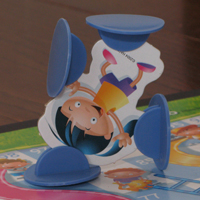
I was playing Chutes and Ladders with K8 the other day when I noticed something. It might seem a little obvious, but I just saw it.
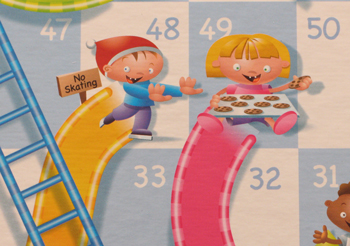
Chutes and Ladders is played on a Hundreds Chart!
It is! And as you look at it, and play it, you can see it’s totally a math game.
You can practice numeracy with your children by counting up from a number. In Chutes and Ladders, if you’re on space #46 and you spin a three, you count up three: 47, 48, 49.
The whole game is numeracy practice like this.
It’s even good for the bigger kids.
Sometimes big kids don’t want to play the little kid games. In Chutes and Ladders, the big kids have the opportunity to calculate how big the loss is on a chute. And how big the gain is on a ladder.
Get freaky with your rules!
You can also team a big kid with a little one and create some house rules. After spinning the wheel, the team gets 5 seconds to calculate the number square to which they’ll advance. If they get it right, they get a bonus of a free spin or to skip over any chutes.
And if you really want to get advanced, choose a new function at the beginning of each game. Like SPIN + 2 or 3 x SPIN + 1. After spinning the wheel, the team gets 5 seconds to calculate the number square to which they’ll advance using that formula! If they can’t do it, they only get to advance the number of spaces on the original spin.
You can make your own!
And don’t forget you can make your own game using an $.88 Hundreds Chart that you can find at your local teachers’ supply store. Break out the construction paper, scissors and glue and start creating some Chutes and Ladders on it.
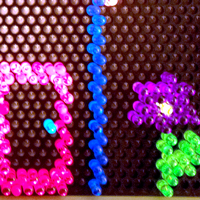
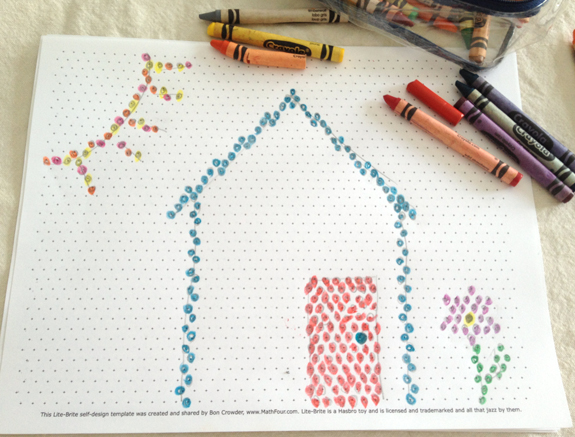
Or… click to get the online Lite-Brite simulator(the technology these days!). And get ready — because that old classic is about to become your child’s favorite graphing lesson!
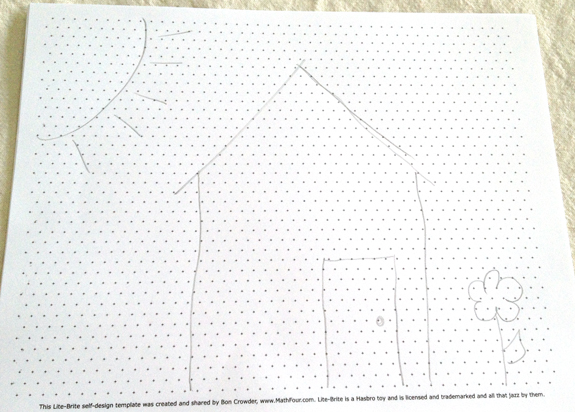
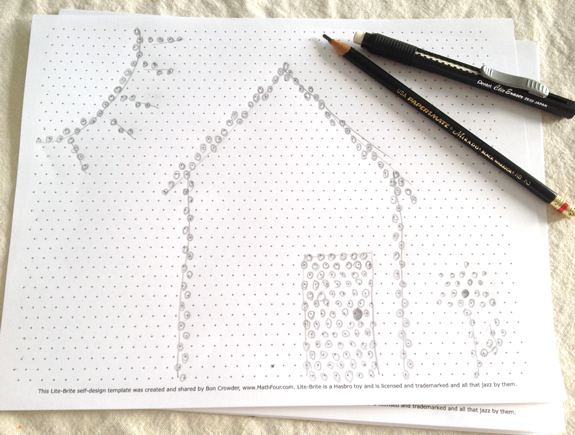
Rough sketches don’t quite work with the peg placement. So draw the peg holes on the template as close to your lines as possible. Start noticing patterns.
3. Use colors!
Pick some good colors you’ll want to use when you’re graphing your picture. Unless you and your kids know the exact number of Lite-Brite pegs you have, in which colors, you’ll probably have to tweak this in the next few steps.
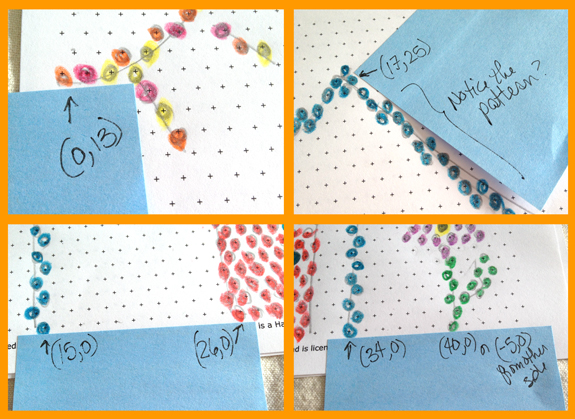
4. Figure out where to start
Here’s where things get very interesting. The peg holes are NOT lined up in what you would call a Cartesian coordinate plane. They’re not really in any kind of coordinate plane system. At least not that I know of.
The crazy structure in the grid doesn’t really matter. The fact that you can still count over and up to get where you want to go is what matters.
You and your children get to devise the way you count over and up.
5. Count and push!
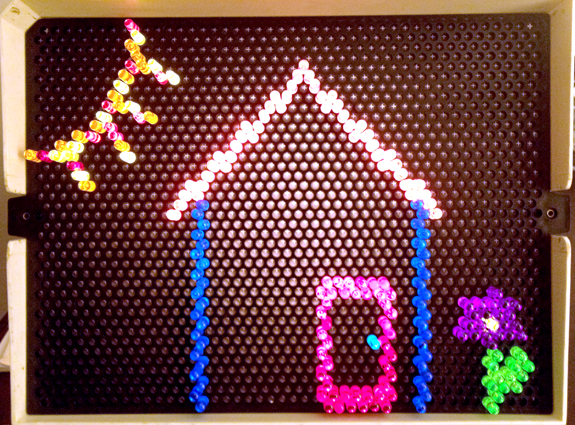
Your child can follow the pattern on the template and push the pegs in the Lite-Brite. This offers practice for the skills they’ll use when graphing and working with the slope of a line. This is the precursor of calculus!
Notice that when I was graphing my drawing, I had to change the door from solid to hollow. I ran out of pegs. #ARG
Try it!
Find your Lite-Brite and download the template: classic or square. Post a link to your finished work in the comments and tell me how it went!
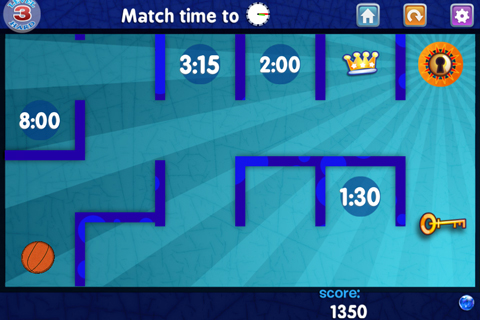
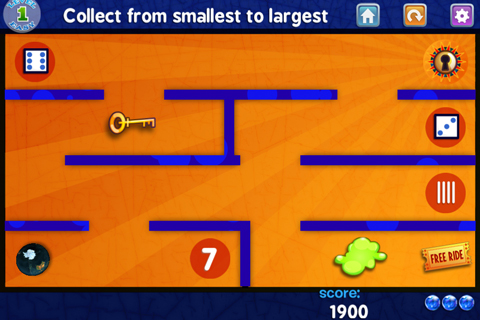
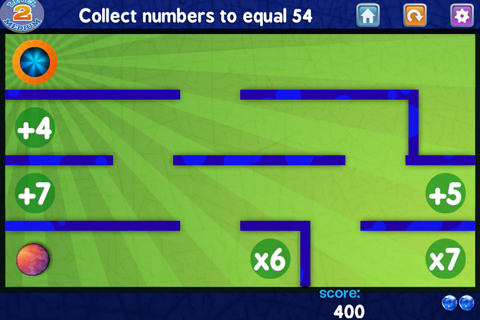
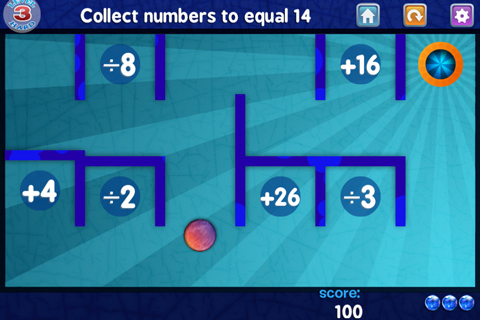
In the games, you roll or drag a marble around a maze collecting right answers (or the pieces of a right answer) to a math question.
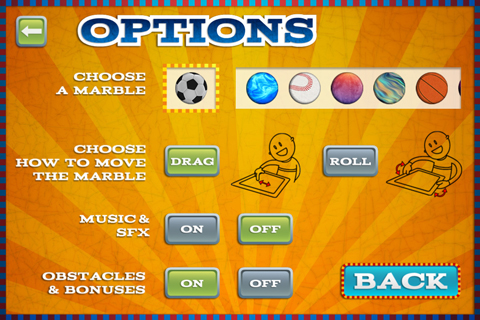
Husband likes to roll the marble. He says that’s more fun because dragging the marble isn’t a challenge.
But I like to drag it.
Marble Math is fun and educational!
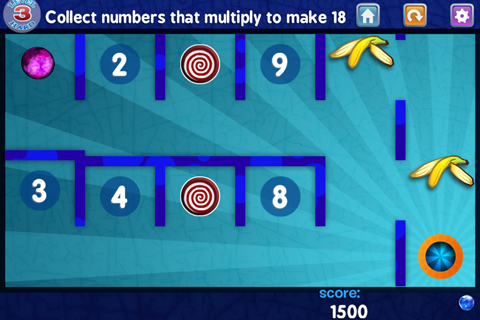
Both of the Marble Math games have the same features: it’s a maze with obstacles, vortexes, bonus items and point decreasers.
The difference between the two apps is the level of math. So before you see the cool screenshots, check out some of the things covered in each version of the iPhone app:
Ordering things (including a mixture of dice, tallies, arabic numerals, etc.)
Finding items that are the same as a given number
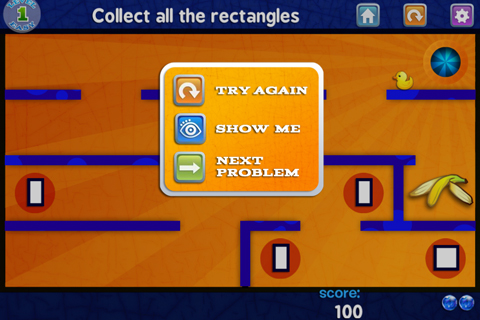
Identifying shapes
Adding up to a number
Telling time
Finding numbers less than a number
Multiples of 2 and multiples of 10
Basic multiplication (by 10)
Some basic fractions
Basic algebra with addition (10+?=17)
The pictures are worth 103 words!
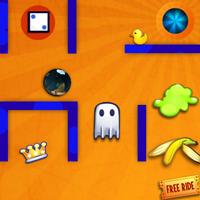
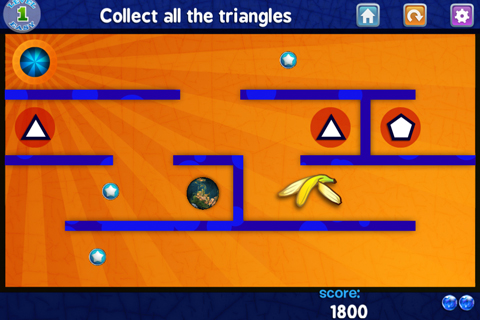
The “pick the shapes” puzzles are fun. The banana will make your marble slip, but collect all the stars and you’ll get an extra life.
The ghosts look like badguys — but they’re actually your friends. They let you go through the walls. (Come to think of it, it might be bad if you’re rolling the marble and not dragging it!)
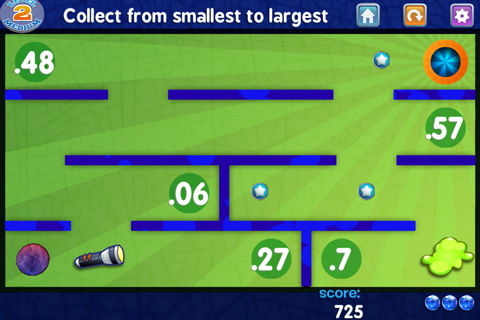
Collect all three tiny stars and you earn another “life.” Roll over the flashlight and… well, I’ll let you see what happens then!
I like that they use time, but that tiny little clock is hard to see. (But my eyes are a good 30 years older than the target audience!)
The key opens the “I’m done” portal.The green slick sends you spinning. The Free Ride ticket give you extra points:
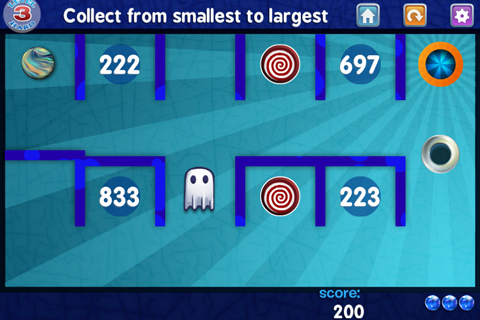
Here’s a sample of a multiply one. The bananas here will make your marble slip and the swirlies will transport you between them!
Having problems? Skip it, get the solution or give it another shot:
But at some point the math will be hard enough to turn off the obstacles and bonuses. You can also choose your marble — but you have to earn them first!
Here’s a nice order of operations one:
This one almost killed me. I kept plugging at it, though. It’s from Level 3 of Marble Math.
I learned a great deal of logic and thinking skills by playing the Dszquphsbnt! cryptogram puzzles in GAMES Magazine with my dad.
There are many places to get online cryptograms, but I thought I would offer a series of “pencil and paper” ones for the old fashioned folks (like me).
If you need help solving it, check out the amazing Cryptograms.org site for instructions.
This is the 6th in the draft purge series. It was first drafted in May 2011. If you have examples of this type of math puzzle, please include them in the comments.
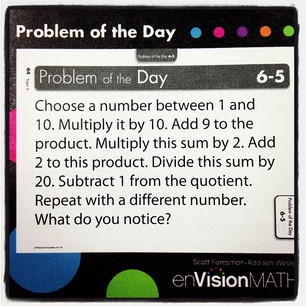
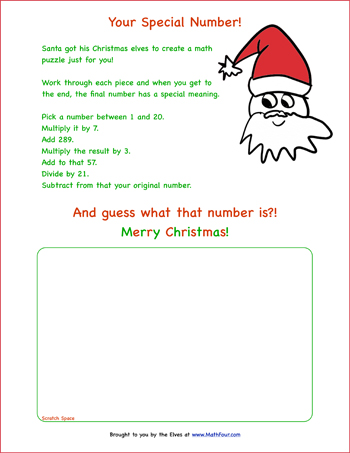
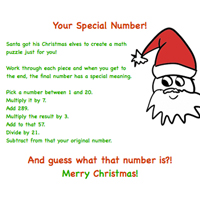
Since the first time I used email back in 1991, people have sent me various versions of the puzzle “I can guess your birth year.” The results end up as something like:
This year (and this won’t work for any other year)
Your phone number
Your birth date
Your favorite number and the year you were born
Your blood type
Okay, that’s exaggerating a little. But it seems like these puzzles get wilder and wilder.
When I receive these emails, it’s usually from a family member with the preface: “Can you tell me how this works?”
So I’ve dissected tons of these over the years. And I’ve always thought, “You know – I could totally make my own math puzzle like this!”
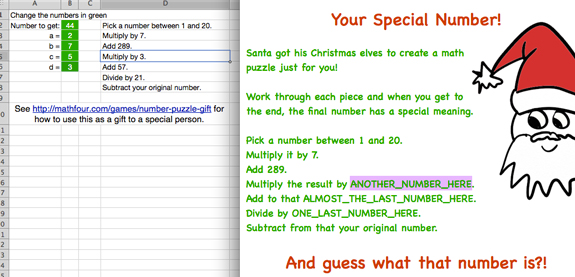
You can invent your own math puzzle!
The trick to this math puzzle is to add zero and multiply by one in clever ways.
First you pick the result you want. Like the last four digits from my childhood phone number: 4347.
Factor it into primes, if you can. Let your kids do this by hand if you want them to have practice on factoring. If they struggle, you or they can calculate the prime factors using an online service like this one.
Mine is: (3)(3)(3)(7)(23)
If you can’t factor into primes, subtract a single digit number and try it.
Like 4349 – it’s prime, so subtract 2 and then use that to do the rest of this.
At the end of the whole math game you’ll just need to put one more step that includes subtracting this number.
Start constructing the math game.
The starter line for your game will be “Choose a single digit number from 1 to 9.”
We’re going to construct our game using this, with x as the chosen digit.
I’ll keep going until I have a nice set of instructions. Then I can do this on my Ma, Paps, my siblings and all my childhood friends that remember that phone number.
And it’s a great learning tool!
Kids will learn and practice order of operations and algebra. At the same time, they create something they can email or perpetrate on another person – preferably a grown up – and impress them!
The March 2012 edition of Highlights magazine for kids fell in my lap this morning. Thumbing through it, I found a fun little algebra puzzle.
After looking at the equations and discovering my solution, I began to wonder some things. Then I realized that these ponderances of mine were good for kids to consider as well.
Let the curiosity flow!
Here are the extra questions you can offer your children in case they’re curious:
Did you use all four equations to decide your answer?
Could you have used three, two or only one of the equations to decide your answer?
Try to use only one equation to decide an answer. Did you discover anything?
Try to use only two equations. What did you discover now?
How about three – what happens when you choose three equations?
Can you make a puzzle like this of your own?
How about you?
As a grown up, what do you discover about math in this Highlights puzzle? What do you see your children doing with these extra questions?