The two most commonly used operations in math are addition and multiplication.
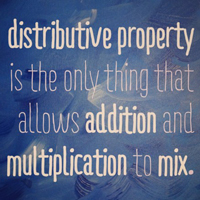
And although we intermingle addition with multiplication (along with division and subtraction), these two can only mix using the distributive property.
How the distributive property works
Multiplication, in a crude sense, is a shortcut of addition. Like 3 x 8 is the number 8 added to itself three times. Or 8 + 8 + 8.
Look at 3 x (6 + 2). This is the number (6 + 2) added to itself three times. (Refrain from adding those two together, no matter how tempting. Leave them separate as 6 + 2.)
So we have (6 + 2) + (6 + 2) + (6 + 2).
And we know that when it comes to only adding, we don’t need any parenthesis. Which gives us
6 + 2 + 6 + 2 + 6 + 2
Also, addition is commutative. So we can scramble these numbers around.
6 + 6 + 6 + 2 + 2 + 2
And if we want, we can squish them together in parenthesis (seems lame, but stay with me…)
(6 + 6 + 6) + (2 + 2 + 2)
And, hey! We know that 6 + 6 + 6 means 3 x 6 (and the same with 2’s) so we have:
(3 x 6) + (3 x 2)
Remember what we started with. Put it together with what we ended with. And we’ve just demonstrated (the long way) that
3 x (6 + 2) = (3 x 6) + (3 x 2)
or, more visually…
3 x (6 + 2) = (3 x 6) + (3 x 2)
This is the Distributive Property of Multiplication Over Addition. (That’s the fancy name for the distributive property.)
It works with something else, too…
Since exponents are a shortcut of multiplication, we can play the same game.
Consider (6 x 2)3
This is (6 x 2) x (6 x 2) x (6 x 2)
And we can get rid of parenthesis and scramble:
6 x 6 x 6 x 2 x 2 x 2
And re-group:
63 x 23
Showing that:
(6 x 2)3 = 63 x 23
This, by the way, is the Distributive Property of Exponentiation Over Multiplication!
Yes — this IS useful.
Seems ridiculous, right?
But when learning algebra, students often get lost when faced with 3(y + 2). “What do I do now?” they think, going into panic mode.
If they know that y is just a number with lipstick on (as a disguise), they can think about the above example.
Remembering what it means is the key to knowing what to do with the algebra stuff!
What do you think? Share your thoughts in the comments or on twitter/x.