Category: Math Around Us

  • Happy Meal Coupon Reveals Lack of Thinking at McDonald's

    Happy Meal Coupon Reveals Lack of Thinking at McDonald's

    It was Monday. My “day off” from my diet. So Daughter and I decided to use the McDonald’s coupon we got in the mail yesterday.

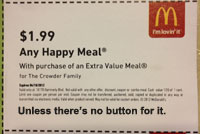
    $1.99 for a Happy Meal for her if I buy a grownup value meal.

    Easy enough, right?

    I informed the speaker: “I have a coupon for a $1.99 Happy Meal with value meal. I’d like a #2 and a Cheeseburger Happy Meal.”

    The voice said great and gave me my total: $9.97.

    Something didn’t add up.

    As I drove around, I couldn’t help thinking my $5.50 value meal, plus her $2 happy meal, plus tax shouldn’t get me all the way to $10.

    So I asked about it when I got to the first window.

    “Well,” she started, “We don’t have a button for that.”

    “I’m sorry…?”

    “Those coupons got sent out and they never put a button on our register for it. So I can’t give you the $1.99 Happy Meal. Sorry.”

    I was stunned.

    “So you’re telling me you sent me this coupon and I can’t use it because there’s no button for it?”

    She smiled and shrugged cheerily, “Right. When they sent out the coupons, they didn’t put a button on here for it. If you want to use the coupon later, they might give us a button for it in the next couple of days.”

    “Can I talk to a manager?”

    The manager was equally unhelpful.
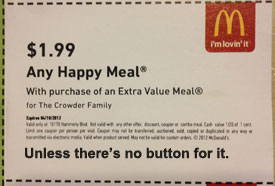
    The conversation was similar. With a lot of “there’s no button for it.”

    She told me they would be happy to take down my name. Later I could come back for “a small fry or something.” And she tried to keep my coupon.

    I was totally confused.

    The obvious solution was, well… not obvious.

    “There’s no button for it.”

    But they have a $.99 menu. And two $.99 menu items is pretty close to $1.99. So why didn’t they merely charge me for two of those?

    I have been frustrated many times at the inability of clerks to do simple arithmetic (and to be fair, I’ve also been pleased).

    But this was more than arithmetic.

    This was thinking.

    They were both paralyzed by the fact that there was no button for it. They couldn’t see past that.

    Their lack of thinking created a terrible lack of customer service.

    I took my coupon back and said that I would be happy to patronize the McDonald’s down the road from now on.

    “Oh,” she said, “So you don’t want anything?”

    Really, lady?

    Can anything be done?

    Can we fix the lack of thinking ability in normal people?

    I don’t know the answer to that. And I don’t know the cause.

    Sometimes I think that early calculator use caused this. But there are lots of parents who allow calculator use early on and raise brilliant, thinking kids.

    Sometimes I think it’s the education system.

    And sometimes I think it’s society.

    What I do know is that my Grams had a 6th grade education and more thinking power than many high school graduates.

    Don’t raise blind button pushers.

    However you can. Whatever method you find.

    We need our kids to learn: If there’s no button for it, you can make it work another way.

    Raise them to be thinkers.

    Comments?

    Related articles
  • The Math of Weight Watchers Points Plus

    The Math of Weight Watchers Points Plus

    Laura over at Math For Grownups wrote an article on the math behind the points system that Weight Watchers uses.

    It was interesting. But since I didn’t do Weight Watchers, I merely found it a fun novelty. Until…

    I joined Weight Watchers last week.

    I was inspired by a combination of Fitarella’s 12 in 12 super motivational plan, Laura’s “How Many Points Is That?” article and my Ma declaring, “This is the last diet I will ever pay for!”

    The points are fun to count and add and play with. After all, it’s math.

    But I’m an electronic girl. So I downloaded the Weight Watchers iPhone app and began to plug in my food numbers there.

    But the math isn’t quite what the math is supposed to be.

    Like Laura said:

    Instead of counting just calories, we’re considering four components of our food: protein, fiber, carbohydrates and fat.

    Which means that all four of these bits go into a fun (and probably secret) math formula to arrive at the final number of official POINTS for a food.

    Which was good with me. Until Ma recommended a great 1-point bread.

    1-point for her, that is.

    Apparently the iPhone app uses the decimals! Which means…

    This 1-point bread is really more than one point!

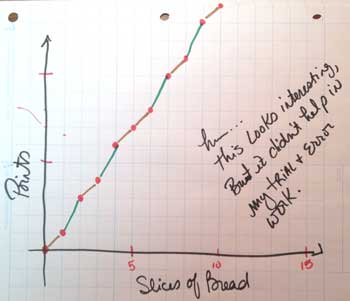
    The points, according to the iPhone app, go like this:

    • 1 slice = 1 point
    • 2 slices = 3 points (excuse me?)
    • 3 slices = 4 points
    • 4 slices = 6 points (really?)
    • 5 slices = 7 points
    • 6 slices = 8 points
    • 7 slices = 10 points (now you’re really getting on my nerves)
    • 8 slices = 11 points
    • 9 slices = 13 points
    • 10 slices = 14 points (*sigh*)

    So what’s that about?

    Shafting me out of points, is what!

    Clearly the iPhone app uses the decimals that the paper version rounds to.

    So from the information above, can you do the math? Can you figure out exactly how many points the Weight Watchers app assigns to a slice of this so-called 1-point bread?

    You could put together a fancy math formula.

    But that would be painful (yup, it’s as painful for you and me as it is for the kids – remember that).

    Or you could just do some trial and error.

    Here’re the assumptions:

    • Weight Watchers rounds like normal people. If it’s .5 or more, they round up. If it is .4 or less, they round down.
    • A slice of bread is more than one point. If it wasn’t, I wouldn’t be so mad.

    Now to go in for the guesses:

    Guess #1: A slice of bread is 1.2 points.

    Does this work? If so, you can stop and go have a 2-point beer*, if not, continue.

    How do you check it? See if it works in the “chart” above:

    • 1 slice = 1.2 point
    • 2 slices = 2.4 points YIPES!

    This doesn’t work. 2 slices have to round up to be 3 points. This would round down to 2 points.

    So on to the next guess:

    Guess #2: A slice of bread is 1.3 points.

    Check it in the “chart”:

    • 1 slice = 1.3 points
    • 2 slices = 2.6 points (good to go! this rounds up to 3 points)
    • 3 slices = 3.9 points (sweet! 3.9 rounds to 4 points)
    • 4 slices = 5.2 points (ARG! this shuts it down)

    4 slices is supposed to be 6 points. So it needs to be at least 5.5 points.

    Again…

    Guess #3: A slice of bread is 1.4 points.

    Check it in the “chart”:

    • 1 slice = 1.4 points ~ 1 point
    • 2 slices = 2.8 points ~ 3 points
    • 3 slices = 4.2 points ~ 4 points
    • 4 slices = 5.6 points ~ 6 points
    • 5 slices = 7.0 points = 7 points
    • 6 slices = 8.4 points ~ 8 points
    • 7 slices = 9.8 points ~ 10 points
    • 8 slices = 11.2 points ~ 11 points
    • 9 slices = 12.6 points ~ 13 points
    • 10 slices = 14.0 points = 14 points

    Woohoo!

    You can use this with your kids!

    Okay, you might not want to share dieting things with kids. But you can share the “Dirty is better than pain” philosophy:

    Why go through the pain of variables and formulas, when you can get your hands dirty with trial and error?

    And guess what – if the kids are confident with the trial and error, they might someday see if they can generalize it themselves. Which means they could come up with a formula – on their own!

    What do you think? Do you use formulas for your everyday math? Or do you “dirty>pain” it? Can you teach this to your kids?

    Share your thoughts in the comments.

    *Note that the 2-point beer is also more than 2 points! #ARG

    Feature image by dno1967b | Flickr.com | CC BY

    Related articles
  • Chuck E. Cheese & Math

    Chuck E. Cheese & Math


    This is a feature article by “K8” Crowder. She is the Daughter of Bon, the publisher of MathFour.com.


    MawMaw & Pawpaw take my cousins and me to Chuck E. Cheese every month. We have a great time running around, playing games and riding rides. There’s not any math lessons there, per se. But Taica (my mom) always manages to get some math in there somewhere.

    Every so often Chuck E. Cheese himself will come out and do a dance with a bunch of kids. Sometimes I go dance too, and sometimes I just hang back and watch.

    Mawmaw says that other people “paid for” Chuck E. Cheese to come out and play. This means I shouldn’t muscle my way in and dance too. I’m not sure what that means. But it seems important to her.

    Grownups “pay for” things.

    Grownups get stuff from other people if they give them stuff. Taica says that’s what Mawmaw means when she says other people paid for Chuck E. Cheese.

    Someone else gave Chuck E. Cheese something so he would dance with their kids. Not with me.

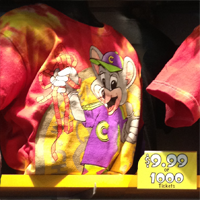
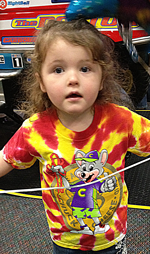
    I got a Chuck E. Cheese t-shirt today – just like my cousin’s. Taica gave the man a bunch of pieces of paper and he gave me the shirt. Taica pointed out to me the sign on the shirts. She said it was math.

    This was it:

    See those numbers on the yellow sign at the bottom? They represent what one grownup has to give another grownup in order for me (or another kid) to score that shirt.

    Taica said that she gave 1000 tickets for the shirt. And then she said, “That means that each ticket is the same as one penny.”

    Tickets are the same as pennies? Really?

    I’ve seen pennies. I like to put them in my mouth. And they do not look like tickets.

    She rambled on about 9 dollars and 99 cents being mostly 10 dollars. And then if you divide 10 dollars by 1000 tickets, you get one penny per ticket.

    I know that dividing means sharing your cookies with your friend. In particular, sharing so that nobody gets mad because the other kid got more. And since dividing is math, cookies are math.

    I’m good with that.

    But I’m not sure how sharing cookies has anything to do with tickets, pennies and shirts.

    But in the end, I got my Chuck E. Cheese t-shirt.

    But I still don’t believe a ticket is the same as a penny!

    What do you think about this tickets and pennies thing? Do you like to give people stuff to get other stuff? Do you use tickets, pennies or something else?

    Write about it below in the comments.


    K8

    K8 is a full time kid who can count to 20 and only miss the number 15. Her favorite songs are “A-B-C-D” and “Had a very shiny nose.” Connect with her in the comments or on Twitter at @KateCrowder.


    Related articles

  • FIAR: Snowy Evening Math Photos

    FIAR: Snowy Evening Math Photos

    This post originally appeared on The HSBA Post on January 26, 2012.

    Robert Frost’s Stopping by Woods on a Snowy Evening is a curious poem – challenging for grownups and particularly interesting for kids.

    I’m keen on looking for math in our FIAR books, but this time I’m thinking about doing some math in a new way. There’s math in poetry – tons of patterns with the iambic pentameter and such. But this picture book took a short poem (it’s only 16 lines) and added illustrations to give it that extra touch.

    Illustrations… hmm…

    There’s a classroom teacher who created a math assignment around photography. What a cool project for homeschool families; you can make it as strict or as loose as you want.

    He blogged all about the process, including the challenges and results,which makes modifying it for homeschool super easy and fun!

    Snowy Evening Math Photos

    If you have snow around, use the beautiful images in Stopping by Woods on a Snowy Evening to inspire a photo field trip in the neighborhood. Use the assignment and rubric from the above links or just go with the flow. Encourage your children to look at the world with math eyes!

    I live in Houston, where it snows once every nine years. So I had to depend on Flickr for these examples.

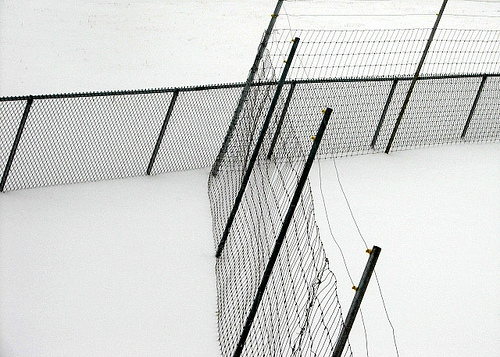
    Abstract, curious, math-y!

    There’s some fun math in the angle of the snow, and also in the shadow in this pictures. It makes me wonder if the camera is tilted or if the snow is on a hill. Click on the image to get some math thoughts from the photographer.

    nail in snow
    by windiepink | Flickr.com | CC BY

    Mr. Rene’ Descartes would love this one!

    Lots of snow, but also some coordinate plane stuff here:

    by Jan Tik | Flickr.com | CC BY
    by Jan Tik | Flickr.com | CC BY

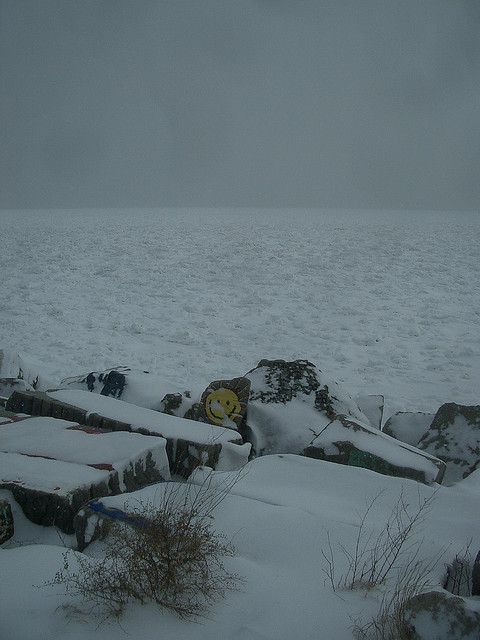
    Blocks and smiley faces!

    These look like snow covered blocks – big ones! Fancy math term: rectangular parallelepiped. (Get your two year old to say that – it’s SO cute!)

    by plizzba | Flickr.com | CC BY
    by plizzba | Flickr.com | CC BY

    Graphing animal tracks is fun!

    You know how you put a bunch of dots on a grid and then connect them? That’s graphing in math. That’s what these animal tracks look like! Incidentally, this photo is from my favorite Flickr person who has a great collection of math photos!

    by woodleywonderworks | Flickr.com | CC BY
    by woodleywonderworks | Flickr.com | CC BY

    What do your photos look like?

    What kinds of math do your kids see in the snow or other weather you might have? Share the links and their thoughts in the comments!

  • The Math Behind Carpooling Toddlers

    The Math Behind Carpooling Toddlers

    But should it be?

    In my Mustang I get 20 miles to the gallon. Currently gas is hovering at three dollars per gallon. Which means for every 20 miles I drive, it costs me $3.

    It’s 5 miles to school from my house. If I take her to school and back in the morning, and then retrieve her in the evening, it takes me 20 miles – or $3. (These are true numbers – even though they are working out rather nicely.)

    Which means in addition to tuition, it’s another $15 a week. So in a 40 week school year, I spend another $600 in gas!

    Maybe I should consider toddler carpooling…

    But is it worth it to buy another car seat?

    Some forward facing car seat models can go up to 80 pounds. Even in the 97th percentile of weight, our daughters won’t grow out of one of these car seats until they’re about eight years old. That’s another five years!

    The first car seat I find on Amazon.com that goes to 80 pounds is the Cosco Juvenile High Back Booster Car Seat. It’s $46.54 and eligible for free shipping. Add tax, and you’re right at $50.

    Sharing the duties with my neighbor means cutting my gas bill in half. So I would save $7.50 each week by carpooling. After seven weeks of carpooling, I would save

    \(7 \times \$7.50 = \$52.50\)

    That car seat would pay for itself after less than two months!

    Will it be worth it long term?

    After this year, I have three more years of carpooling available before we start homeschooling.

    Three years at 40 weeks/year in school and $7.50 savings per week gets me at

    \(3 \text{ years} \times 40 \text{ weeks} \times \$7.50 = \$900\)

    I’ll save $900 over the next three years. And so will my neighbor!

    I’m off to buy the carseat!

    What will you do?

    Do you take your kids to a co-op or day-school? Is there a family you can carpool with that you haven’t yet considered because of the logistics? Will you now work the numbers to see if it makes sense?

    Share your thoughts in the comments!

    Related articles
  • 3 1/2 Ways to Do Math with Jesus

    3 1/2 Ways to Do Math with Jesus

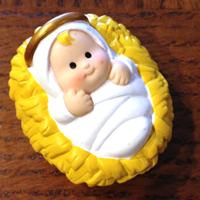
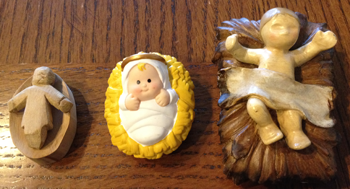
    I’ve been stumbling over baby Jesuses for a few weeks now. I realized that with three working nativity sets in the house it was time to do a little math with Jesus.

    All of them.

    You can count the bits and pieces.

    Animals, people, buildings – count them for each nativity set and count them up total.

    • How many total Jesuses do you have?
    • How many angels?
    • How many “visitors” does Jesus have?
    • How many sheep? Cows? Donkeys? Camels?
    • How many total animals?

    You can compare the numbers.

    My three nativity sets have varying numbers of characters and structures. It’s curious how some sets include more animals that visitors – and some sets don’t have any animals.

    • Which of your nativity sets have more animals? Which has more people?
    • Which has more buildings (or non-people/non-animal things)?
    • Are there more visitors than animals or more animals than visitors?
    • Arrange the sets in order of least to greatest – people, animals, etc. Are they always in the same order?
    • Is one set bigger or heavier than the others?

    Do some arithmetic.

    Take the opportunity to show how counting and arithmetic are kinda the same thing.

    • If you add up the number of sheep you have with the number of donkeys, how many is that? Is it the same if you group them together and just count them?
    • What if all the shepherds left? Talk about how you can count them, or you subtract the number of shepherds from the total number of visitors.
    • How many nativity sets do you have? Talk about how 3 times that number is the number of wise men you have.

    Do fractions – but only if you must.

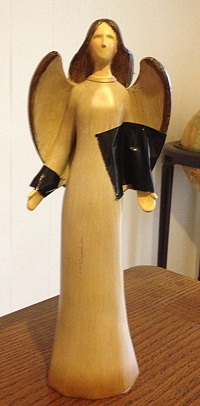
    I know many people avoid fractions. I wish I could have avoided it with Math with Jesus. Daughter gave us the opportunity to talk about fractions by breaking the angel (or the “butterfly” as she calls it). Good thing we have Gorilla Tape.

    Where can you find math in your Christmas things?

    Related articles
  • Wrapping Paper – Doing the Math this Season

    Wrapping Paper – Doing the Math this Season

    As you wrap presents this holiday season, take a minute to notice the patterns in the wrapping paper. You might just find some math!

    Christmas Paper

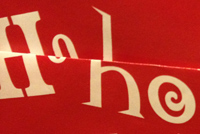
    How does the paper come together in the back? Does it neatly match up, seamlessly? Or is it way off?

    Are you able to scootch things a little so that you can get the paper to line up?

    What happens when you use a different box?

    Is this really math?

    Absolutely!

    Consider wallpaper: it has a pattern that repeats every so many inches. When you put wallpaper in your home it’s important to know how often it repeats so that you can match patterns in the corners and around windows, etc.

    Patterned wrapping paper also repeats. Most people ignore it because they don’t think about matching the patterns in the back when wrapping gifts.

    Unless they are particularly detail oriented, a perfectionist, or want to teach a little bit of math at home while wrapping presents…

    Choose your wrapping paper to match your boxes!

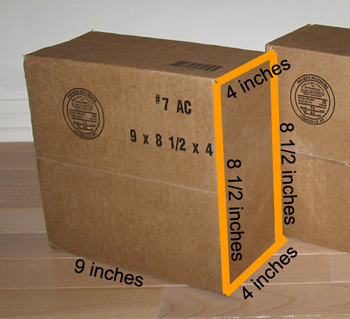
    On this box your wrapping paper would go around 8 1/2 + 4 + 8 1/2 + 4 inches.

    This means the wrapping paper would travel 25 inches before meeting back up with itself. So any wrapping paper that repeats after 5 inches or 25 inches will match back up in the back. Both 5 and 25 are factors of 25 – and that’s math!

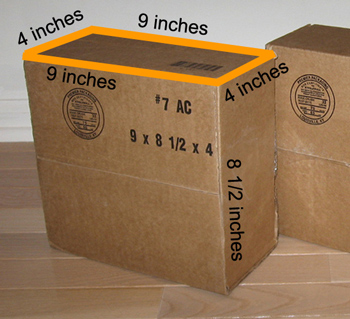
    If you wrap the box the other way, instead, like this,

    …the wrapping paper would travel 26 inches. Therefore any patterned wrapping paper that repeated after 2 inches, 13 inches or 26 inches would match in the back perfectly.

    A box whose “wrap around” distance was 30 inches could use any wrapping paper that repeated after 2 inches, 3 inches, 5 inches, 6 inches, 10 inches, 15 inches or 30 inches. All those are factors of 30.

    Choose your boxes to match your wrapping paper!

    Or do it the other way – figure out how frequently your pattern repeats. Any box that has a girth of a multiple of this number can be wrapped perfectly. (Girth is the distance around the box – where you wrap the paper.)

    For instance, if your wrapping paper repeated after 2 1/2 inches, you would look for boxes that have a girth of 2 1/2 inches (a tiny ring box), 5 inches, 7 1/2 inches, 10 inches. All the way up to giant boxes that have a girth of 314 1/2 inches.

    Your turn!

    How often does your favorite wrapping paper repeat? Have you found the perfect box/wrapping paper combination? Share your wrapping paper math discoveries in the comments!

    Box photos by z287marc | Flickr.com | CC BY

    Related articles
  • Math Holiday Shopping Day

    Math Holiday Shopping Day

    There’s a lot of math involved in shopping. And around the holidays, since there’s a lot more shopping, there’s a lot more math.

    Today is special.

    Today is Sibling Christmas Shopping Day. An unofficial holiday created by my mother’s children a few years ago. My three siblings and I head out to the mall. Just us. No children, no spouses.

    We act like a bunch of wild 10 year olds stuck in grown-up bodies. And we’re not small grown-ups.

    If you’re in Memorial City Mall today, look out.

    There’s math in Sibling Christmas Shopping Day.

    There are three sisters and one brother. All of us wear clothing and accessories according to traditional gender roles. So how many Christmas earring ornaments do we need?

    And who will bring them?!

    There are four of us, and we’re shopping for each other. In how many different ways can we group together in pairs of two to optimize shopping for each other?

    And how on earth will we make sure to stay hidden!?

    My Christmas shopping budget for the day is $200. I have seven people to buy for and want to spend roughly the same on each one. I also want to buy coffee at Starbucks, lunch, and take some picture booth pictures. What’s a good estimate for me to spend on each of my seven people?

    And why can’t I have a bigger budget? *sigh*

    The probability for us getting thrown out of a store for horsing around is .04. There are about 200 stores in Memorial City Mall. If we visit 150 stores, how many times will we be kicked out for horsing around?

    And how can I make sure to blame it on them?

    We’re meeting at 9:30 and wanting to get done around 3:30. If we each have seven people on our lists, how many presents should we buy each hour to make sure we get everything done?

    And who’s going to be late to mess up all the math we’ve done figuring this out?

    If the line to see Santa is 45 minutes long and we all want to crowd on that poor man’s lap together, when should we arrive to do this so that we don’t take away any shopping time?

    And who’ll be the lonely sib stuck in line holding our place until the others finally show up?

    Math Fun, Mall Fun

    When you take your children shopping this season, start your day with a budgeting conversation. Even if the sky’s the limit you can visit about how much each child wants to spend. Revisit the topic at the end of the day and discuss their impressions of the value of things – were items more or less expensive than they’d anticipated? Did they go over budget?

    During the shopping trip, point out places where there are discounts. Discuss “just-for-you” deals that the kiosk clerks offer. Consider real value and how it compares with perceived value.

    Look around for ways to count, talk about time or money and look for patterns. When you do, point it out and say, “and that’s math!”

    And share what you see!

    Leave a comment below if you find anything interesting. And if you see a bunch of grownups acting worse than any kid you’ve seen… well, it’s not me. Really.

    Related articles
  • Math Songs

    Math Songs

    I’ve been wanting to write about all the cool math songs out there for quite some time. I’ve been somewhat collecting them in hopes that I’ll have the world’s biggest collection of math songs.

    Alas, I’m fairly confident that I’ve only managed to round up about 10%. They range in educational value, music quality and catchiness. Songs that I love, Daughter isn’t quite interested in. The one she loves I sometimes find slightly boring (especially after 3,000 times of replay).

    Not all math songs are good.

    Math and music are very similar in that everybody has their preference. I’m not a fan of calculus. And I’m not a fan of rap music. (Not that calculus is the mathematical equivalent of rap music, but for me it’s just as annoying.)

    If you’re searching for math songs, make sure you give them a listen before you buy. There’s a lot of garbage out there (sometimes that’s an opinion and sometimes that’s a technical fact).

    There’s also some NSFW stuff too – which can be fun for grownups, but you don’t want to inadvertently play something nasty for your parrot two year old (I’m speaking from experience here, #jussaying).

    Here’s my collection of songs and albums.

    • Do The Math by Ralph’s World is a song about friends… who happen to be shapes: Sanderson the Square, Tony the Triangle, Poly the polyhedron (non-Euclidean) mass. So fun!
    • Schoolhouse Rock: Multiplication Rock – the best ever. I’ve been singing this to Daughter since she was born! “Three is a Magic Number” still makes me tear up.
    • The Math Song by Scott Perry – I just downloaded this off iTunes and I’m excited about listening to it – over and over!
    • Another I grabbed this morning is I, Pythagoras (The Math Song) by Nikki Shultz. This is more of a grown up song, but she’s got an amazing voice.

    You can even make your own!

    Like I did (and had Husband sing it) with The 1-2-3 Song.

    Or have your students do it! This song was recorded about ten years ago for me by Sidney & Dale, two Art Institute students in my Fundamentals of Math class:

    So how about it – what math song is your favorite? And what math song would you like to hear, sing or write? Share it in the comments (and include a link to the audio or YouTube video).

    Sing the news loud and click here to share this on Twitter/X.

    Related articles