Category: Math Around Us

  • Time Zone Math: Using the Fret & Grind Method

    Time Zone Math: Using the Fret & Grind Method

    It took me a long time to learn how to figure out what time it was in Los Angeles when it was at 7 AM in Houston.

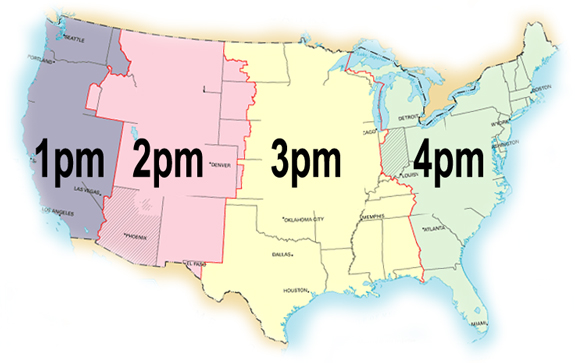
    Notice on this time zone map that the numbers count in a very intuitive way across the US:

    This works just fine if you’re managing locally.

    Global time zones are more of a challenge.

    I used to send out a weekly newsletter. Generally it was set to arrive in people’s inboxes between 3 PM and 6 PM Thursdays — in their local time zone.

    Which means any changes that I had to do would have to happen before they got the e-mail at 3pm on Thursday.

    But not everybody lives in Texas. So my deadline was not 3 PM on Thursday, really. It was the first time anyone in the world encountered 3 PM Thursday.

    In order for me to make the deadline for a global audience, it was essential to figure out what time in Houston that is.

    Greenwich Mean Time -6

    According to the website Greenwich Mean Time:

    Greenwich Mean Time (GMT) was established in 1884 at the International Meridian Conference, when it was decided to place the Prime Meridian at Greenwich, England.

    All time zones range from GMT -12 hours GMT +12 hours. Houston is Greenwich Mean Time -6 hours. Which means it should be a rather easy exercise.

    All I have to do is add my six hours on the left side of the Meridian to the 12 hours on the right side to see that I’m 18 hours difference.

    I subtract 18 hours from 3 PM Thursday to arrive at 9 PM Wednesday as my true deadline.

    But we all know what happens when you say, “all you have to do is.”

    I used maps, charts and a lot of time.

    As I mentioned in the discussion of the book What Your Math Problem?, I often use very crude methods to solve problems.

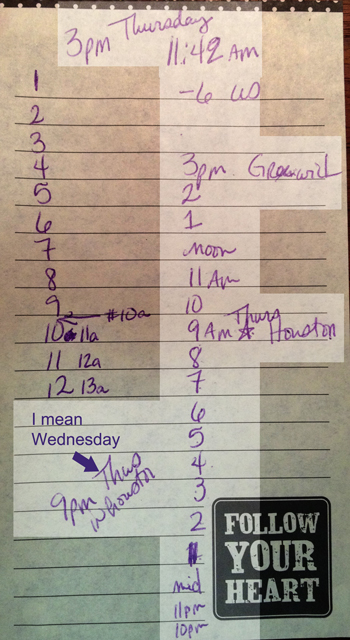
    I opened up a world time zone map, started counting and making charts:

    I didn’t solve the problem traditionally.

    Often when grownups present math problems to kids, they’ve prepared. They demonstrate working a problem like I worked it above:

    Add my six hours on the negative side of Greenwich Mean Time to the 12 hours on the positive side. I’m 18 hours difference. Subtract 18 hours from 3 PM Thursday to arrive at 9 PM Wednesday as my true deadline.

    But that’s not the real way we do math. We often use the Fret & Grind method. Fret about what’s going on, grind out some rough sketches. Then fret some more…

    So why do we show kids the nice way?

    If they see the “all you have to do is” way, then they won’t gain the confidence to use the Fret & Grind method.

    And the Fret & Grind method is the best way — sometime the only way.

    How do you teach time zone math? Do you encourage Fret & Grind?

    Share your thoughts in the comments or on twitter/x.

    You might also like:
  • Furry Fibonacci Numbers

    Furry Fibonacci Numbers

    A strange mixture of birthday party planning, birthday present searching and math magic landed the new #MathShack mascots in my house. Seems the “Furry Fibonaccis” are here to stay.

    They are Fibonacci numbers in action!

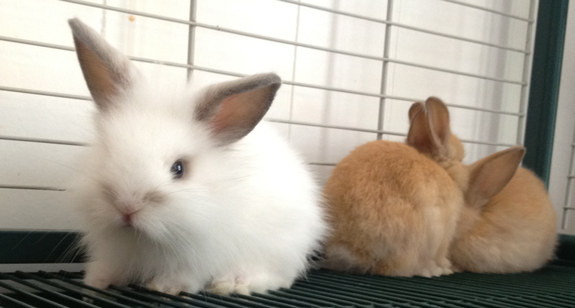
    Notice there is one white bunny (already named Abek). And one is a Fibonacci number.

    There are two brown bunnies (yet to be officially named). And two is a Fibonacci number.

    And there are three total bunnies, another Fibonacci number.

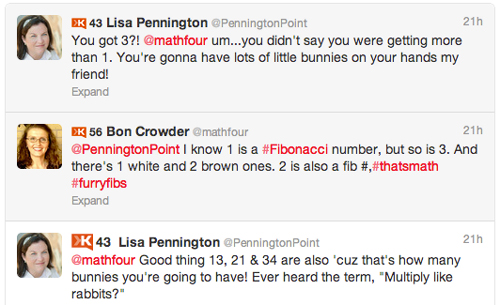
    My friend Lisa Pennington assured me that a fluffy addition would not break the bank. Apparently, she didn’t realize that I would end up with three of these furry cuties.

    We’ll see…

    It’s not so easy to determine the sex of these three little guys.

    Assuming there’s an equal probability of a rabbit giving birth to a male as a female, I have a one in four chance that they won’t be able to reproduce.

    Keep your fingers crossed for me!

    According to the traditional Fibonacci rabbits explanation, each pair of rabbits can reproduce every month.

    Keep your fingers crossed that I get lucky, and we don’t end up with 987 bunnies a year from now!

    But they ARE cute!

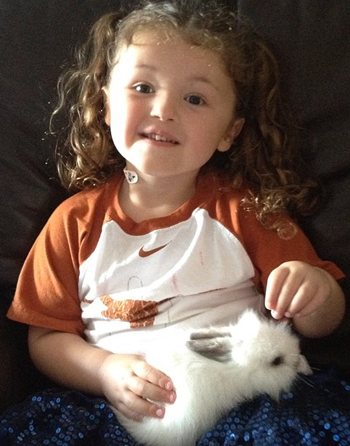
    K8 totally loves them. And they’re a great way to teach caring, responsibility and, well… maybe the facts of life.

    And if we do end up with 987 bunnies next year, we’ll have an economics lesson too. After all, I paid $10 for each of these — that could be a significant profit!

    Have you ever had bunnies? What do you think’s going to happen with Kate’s Furry Fibonaccis? Share your thoughts in the comments, and on twitter.

    You might also like:
  • Science Shows Math Too!

    Science Shows Math Too!

    The 2012 STEMie Award competition is open to all schools and homeschools in the United States and is sponsored by McGraw-Hill. The deadline to enter has passed.


    I work hard to convince you to see math around you — in even the most obscure things like lipstick, tattoos and cheese.

    You may not have noticed that none of these, or any other articles I’ve written about the math you can find around us, contain science. At least not in the textbook sense.

    But one of the fastest and easiest ways to see math around you is through science. So it’s kinda ridiculous that I haven’t really talked about it.

    My Nephew is Learning Science

    I received an e-mail from my dad today encouraging me to vote for my nephew’s school’s science program, SMORE. Turns out, they’re in competition to win a grant from McGraw-Hill, and 30% of their score comes from online voting for their video. (BTW, that’s math too!)

    Knowing that he’ll be learning a lot of math when he’s learning the science, I’m supporting his school.

    Make sure to support your kids and schools in science — they’re doing math!

    Share your thoughts in the comments.

    You might also like:
  • Concrete Math — Like in Your Driveway

    Concrete Math — Like in Your Driveway

    They poured my new driveway yesterday. We ate breakfast and watched as they worked.

    And we witnessed an amazing feat of engineering.

    A tiny twist is all it takes!

    I was watching one of the workers smooth the concrete. He was using a bull float:

    I noticed he was twisting the handle as he worked. On closer inspection, I saw the engineering of the device:

    And here’s the other side:

    As the worker twisted the handle, it would change the angle of the surface of the bull float. This prevented him from having to change the angle of the handle. Like this:

    Watch it in action:

    Oh, yeah — those angles and changing the of length of the chain… That’s Math!

    Share your thoughts in the comments or on twitter/x.

    You might also like:
  • Lipstick Math

    Lipstick Math

    My best friend used to buy $1 lipstick when we were in high school. I think she still does.

    Her logic: “If I only pay a dollar for it, I can have lots of different ones. And I don’t have to fret about losing it or having it melt in the car.”

    Like a good friend, I went along with this logic.

    For years.

    Is expensive lipstick really expensive?

    I’m not here to convince you of the quality of expensive lipstick. There are blogs out there dedicated to lipstick. I’m merely a serious lipstick user.

    I will, however, attempt to convince you of the math (economics?) in lipstick.

    There’s some psychology in this.

    Suppose you buy your own lipstick (which you probably do). If you pay $1 for it, the perceived value is quite low – regardless of the actual quality. And you treat it like that — leaving it in the car to melt, forgetting it in a public restroom, etc.

    Just like my friend does.

    Now let’s assume that you pay $10 for a tube of lipstick. That’s ten times what you’ve been paying.

    All of a sudden the perceived value is huge!

    The loss factor is indirectly proportional to the price of the lipstick!

    If you pay ten times as much for a tube of lipstick, you’re 1/10 as likely to lose it. Okay, I have no empirical evidence to confirm this, merely empirical experience.

    But it’s true!

    As soon as I started buying expensive lipsticks, I quit losing them. And I quit leaving them in the car to be melted by the Houston heat!

    Note for my mathematician friends — the constant of proportionality is affected by the lipstick wearer and that crazy butterfly down in South America. There’s not strict math here. Yet. 😀

    The finish-factor is directly proportional to the price of the lipstick.

    Not only do I keep an expensive tube much longer, but I tend to finish it. In fact, the more expensive it is, the more likely I’ll use a lip brush to dig out the stuff crammed deep in the tube!

    My current favorite, Chanel Allure Rouge, is a shocking $30 per tube. I keep the old broken tube in the Math Shack so I can dig lip color out of the bottom of it when it’s time to video or do a daily mug shot.

    Lipstick Math applies to everything!

    If your child uses his own allowance to buy a new toy, he really knows the value. Furthermore, if he spends more, he’s more likely to care for it.

    When you notice this, point it out. Make sure to note how it’s math – and that your kiddo is doing it effortlessly!

    Share your thoughts in the comments or on twitter/x.
    You might also like:
  • On Time? You Used Math!

    On Time? You Used Math!

    Are you ever on time? Are you always on time?

    Are you sometimes close to being on time?

    Chances are, you did math to make that happen.

    And you do a lot of math to be on time.

    If you have to be at work at 8:30, you might do math like this:

    8:30am – 30 minutes – 1 hour – (3 x 9 minutes) = 6:30am

    or

    be there at 8:30am – 30 minutes drive time – 1 hour get dressed time – (3 x 9 minute “snooze” on alarm) = set alarm for 6:30am

    Which means you did conversions (minutes to hours), approximations (a 9 minute snooze is basically 10 minutes), subtraction and multiplication.

    You might even do algebra to be on time.

    You might even do some “what can I give up to sleep more” algebra. It goes like this:

    7:00am + 30 minutes + 1 hour + 9 minutes + x = 8:30am

    or

    it is now 7:00am + 30 minutes drive time + 1 hour get dressed time + 9 minutes for the snooze button I really want to hit – x (approximately 9 or 10 minutes of something like washing hair, eating yogurt instead of eggs or shaving legs) = be there at 8:30am

    Notice this is also substitution!

    Use this to positively influence your children.

    The next time someone says, “I haven’t done math in years,” point out to them they do math all the time. In fact, they likely did math to get there on time!

    Especially point this out if you’re in earshot of a child.

    When kids hear how math is used effortlessly and frequently, it helps to demystify it. And when it’s demystified – they become more familiar and comfortable with it.

    And you know what that means? They’re more engaged!

    You might also like:
  • Birthday Party Fibonacci Style!

    Birthday Party Fibonacci Style!

    This year K8 is turning 3, a Fibonacci number. So we’re having a Fibonacci Birthday Party!

    Her birthday parties the previous two years have been non-math. And I’m fairly certain at some point she’ll want to choose her own birthday party theme. So this might be my last chance to do a Fibonacci birthday party.

    Fibonacci Birthday Party Decorations

    Spiral streamers, pinecones, whole pineapples and sunflowers will adorn the house.

    We’ll have blue painter’s tape outlining the spiral on the tiles of the floor. And we’ll each wear a fun Fibonacci t-shirt!

    Birthday Party Foods

    We’ll have bananas, apples and pineapples as healthy snacks for the kids. And I’ll likely do an arrangement of Cheez-its glued down with peanut butter. Of course there’ll be plenty of free floating Cheez-its too!

    For the grownups, we’ll have broccoli and cauliflower along with cucumbers.

    If we serve a meal, we’ll do lasagna with Fibonacci rectangles outlined in spinach fettuccine noodles!

    Party Favors

    I’ll buy a bunch of Fibonacci paperback children’s books, including Rabbits Rabbits Everywhere and Wild Fibonacci. I’ll print some fun stickers to put on them that read

    And those will be the party favors!

    Fibonacci Birthday Party Gimmicks

    We’ll play some games, including Fibonacci Hopscotch (as suggested by @mathhombre). The adults can play, “What is My Fibonacci Number?” based on the popular party game, Who Am I?

    And the best part – we’ll have live rabbits for the kids to pet!

    What do you think?

    Have you ever given a Fibonacci Birthday Party? or a math party? Do you have any other ideas to make this awesome?

    Please share via twitter or in the comments!

    You might also like:
  • I'm Throwing Out Fifty Things!

    I'm Throwing Out Fifty Things!

    I bought the book Throw Out Fifty Things a few weeks ago and it’s changed my life.

    My latest accomplishment – getting rid of 50 things from this (now neat) bookshelf!

    Of course, I haven’t read it – inspirational books like this only need me to purchase them to apply their basic principles.

    But I have thrown out multiples of 50 things in the past few weeks. All because of this book!

    “What’s that got to do with math?”

    Great question; I’m glad you asked.

    Well, for starters, “fifty” is a number. In particular a positive integer.

    And if you buy this book (adding one more thing to your pile of stuff, as Husband points out), then you probably have at least 50 things you can throw out.

    Which means you have way more than 50 things.

    How many things do you have?

    Take a quick inventory. No – not of everything. But just of what you see right in front of you at this very moment.

    Chances are you stopped counting and started estimating at around 50. Then you stopped altogether at around a few hundred.

    Even if you divide this by two (if you’re married or partnered) that’s still a ton of stuff.

    “Things” are more than what you see.

    Now take a quick peek at your email. How many things are clogging your inbox?

    If you’re online, I’ll bet you have a plethora of people you’re friends with and following.

    And if you write a blog… look at how many drafts you have.

    So throw out fifty things.

    Well, make sure to recycle them or donate them. But get them out of your world.

    If it helps, think of how many thousands of things you have. If you have 500 things in each room and you have ten rooms, that’s 5000 things.

    Throwing out 50 of those is 1% of your stuff. That’s practically nothing. And you’ll feel great!

    I’m throwing out 70 things in the next three weeks!

    I’ve pitched books, sold cloth diapers and donated socks – at least 50 pair of the cutest 1980’s socks you’ve ever seen!

    Shirts, pants and shoes… if I didn’t love them, I gave them to someone who would.

    And now it’s time for the e-throw-out.

    I have 70 articles on this site – in draft mode! So for the next three weeks, every one of them is getting published or pitched.

    Many will be conversation starters, as my twitter friend Miles MacFarlane suggested. Some might turn into full articles.

    And some drafts will meet their fate with the “File 13” button of death.

    And I’ll be free!

    Okay, there’ll certainly still be things that haunt me. Things I need to do, want to do and have to do.

    But I won’t have a mountain of “should-haves” sitting on my shoulders.

    So how about you? Share in the comments what kinds of things you’ll throw out for your first 50 things. And let others join the fun – tweet this out!

    Related Articles:
  • Everyday Math Exposure: Just Saying It Helps

    Everyday Math Exposure: Just Saying It Helps

    Previously in an article about math anxiety parents may feel, I mentioned how grown-ups inadvertently teach kids to be scared of certain things.

    It’s not our fault. We learned it from adults when we were younger.

    But we still do it.

    “I hate rats.”

    “Math? I’ve always had math anxiety.”

    “Ew, roaches, yikes!”

    “Math is hard. I don’t do math.”

    What’s psychology got to do with it?

    From the principles of psychology, we know that hearing other people talk about things, we adopt some of those same attitudes – especially being young and impressionable as kids.

    And your kids are like that, too.

    An example: Think about butterflies. They’re insects and they have erratic movement patterns. So why don’t we hate butterflies like we do roaches?

    Ok, to be fair, roaches invade our living spaces given the slightest chance. And they carry diseases. But are these things the reason why we feel a shiver?

    Not really – it’s seeing others freak out when they see a roach.

    And seeing others say, “Ooo, how pretty!” when they see a butterfly!

    And the research shows…

    In the previous article, I mentioned that the reason why this is important lies in the immediate and long-term effect on children. I presented on how this impacts math anxiety recently at the Western Social Sciences Association Conference.

    Research and experience show that when we display math anxiety or a negative attitude toward math, kids do to. And this causes them to have lower confidence in their math ability, higher math anxiety, and more avoidance toward doing math.

    And when we (or our children) don’t engage in something, we don’t have an opportunity to learn.

    But noticing everyday math gives them more confidence – and more opportunity!

    Is it up to parents?

    You might have heard (or even said), “That’s the teachers job.” Well, they can only do so much. The best prescription for helping kids to learn is to make it enjoyable. Or at very least, neutral so they don’t avoid it.

    The less avoidant (and more engaging) they are on their own, the more they take it upon themselves to do math things. They’ll see the everyday math. And they’ll do it without having someone over their shoulder all the time.

    Learning then happens even outside the math class.

    They’ll do math on their own?

    Yes.

    Learning doesn’t just happen in the classroom. It occurs when we explore, follow our curiosity, ask questions, and think about why something is the way it is.

    Math is no different.

    Ever wonder how many packs of taco shells you need for everyone to have two?

    Math.

    Or how long it will take to wash and dry all the laundry?

    Yup – everyday math again.

    Confidence in doing math make these things more palatable, and more likely to be thought of as math.

    We don’t need an “answer” for there to be math.

    We’re a bit trained (brainwashed may be a little harsh, but accurate) to think that doing math is sitting with a pencil and paper, and with numbers, letters, lines and answers.

    If you think about it, it’s like saying reading only happens in the library or bookstore. The idea of doing math has a fairly limited scope.

    Because of this, we don’t realize how much we really do it.

    So what can WE do.

    Say it when it happens. Say it when you recognize it. Say it when you see someone else doing it.

    Tacos in the grocery store? Yep, there it is again. Say it out loud to your kid.

    How about how long it takes to get somewhere walking vs. driving in a car.

    “Hey, little Billy, it takes us longer to walk to the store than to drive. That’s math.”

    Any time we compare two things and decide one is larger than the other, we’re doing math.

    If we count items to determine how many we have, we’re doing math there, too.

    When you recognize everyday math, just say whatever you’re thinking out loud. And watch as the “Ew, roach!” avoidance turns into the “Ooo, butterfly!” interest.

    Share your thoughts on this in the comments and tweet it out, too!

    Related Articles:
  • Addition with Tattoos

    Addition with Tattoos

    Seems that I’m learning something called “addition” these days. My parents say things like “two bottles of vitamins plus one bottle of vitamins equals four bottles of vitamins. That’s addition!”

    I’ve figured out that “addition” means you use the words “plus” and “equals” in the same sentence.

    You can do addition with counting too!

    I’m into tattoos. I have kitten tattoos and Spider Man ones. To put them on, we have to use a wet rag and count – first to 20 and then to 10. My mom says that “twenty plus ten equals thirty.”

    That sentence has both of the important words: “plus” and “equals.”

    So doing tattoos is not just counting, but addition too!

    So tattoos are math!

    My dad doesn’t like me to have so many tattoos. He prefers I use the fun band-aids. Band-aids are okay, but you don’t have to count or add to put them on.

    The more tattoos I put on, the more counting and addition practice I can get. So he should be happy I’m getting lots of tattoos!

    Tattoos and counting teach other stuff also.

    I’m learning “patience.” That means waiting without whining or screaming.

    I don’t mind “patience” when I’m counting. Because I’m doing something fun.

    Do you have a 2 year old like me, that can count? Are you teaching him or her addition too? And what kinds of tattoos do y’all have?

    Let me know in the comments – and don’t forget to tweet out this article.

    Related articles