
Category: General

  • 9 Ways Teaching Math is Like Giving Birth

    9 Ways Teaching Math is Like Giving Birth

    Now that school’s officially in session, I’m really thinking about all the homeschooling moms who are taking on teaching math. I can’t help but see the similarities to something they’ve already done – given birth.

    For each, I noticed that…

    It’s darn scary.

    Giving birth is pretty freaky. Especially if you’ve never seen or done it before. If you have the privilege of seeing another arrive in this world, it makes it easier. (I watched both my sisters and my best friend give birth!)

    Teaching math might be a whole new world – and pretty strange if you’ve never done it. Dig back to some good math experiences you had as a child and draw on those.

    It’s gonna happen no matter what.

    Kids get born. They must. And they do. So you might as well make the best of it and enjoy the process the best you can – with a happy and positive pregnancy!

    Kids learn math. They must. And they do. So you might as well make the best of it and encourage them in the best way – with a happy and positive math environment!

    You get to choose how you do it!

    You can give birth at home, in a hospital, with a doctor, with nobody, with drugs, without drugs… pretty much any way you want.

    We’ve got more freedom now that we ever had. In Texas, where Betsy and I live, a homeschool is an independent private school. We get to teach in an unschooling way with lovely things like Math on the Level.

    It may not go the way you want,

    You’ve got a great plan. You know what to do and how to do it. You’ve taken the classes and my goodness! You’re in hard labor for 32 hours and you’re still at labor station -4.

    You might think you have the best curriculum in the world. You’re all prepared. You start teaching an holy cow! Your sweet student couldn’t be less interested in everything you’re presenting.

    …so be flexible.

    Yes you’re frustrated. Remember the goal – a healthy child. Put away the frustrations and go for the C. Make it up by being a breastfeeding champion.

    Likewise, you’re wanting a happy, healthy child. Choose a different curriculum. Let your child choose a different one. Experiment. Make it up by taking the crew to a great museum.

    There are professionals for this.

    Get a good ob/gyn, doula or midwife. You don’t have to go-it alone.

    Get a tutor, enroll in a program like Kumon, join a homeschool co-op. You don’t have to go-it alone.

    There is lots of information online.

    With books like Betsy Dewey’s Birthright and sites like this one, there’s no reason to go into either blind.

    It’s hard,

    Giving birth is no piece of cake. However you choose to do it, you’re gonna have pain – in some way. Not to mention the nine months of puberty-like hormone swings!

    Teaching math is a challenge. It’s not about conveying information, it’s about following a child’s natural curiosity and pointing out the math that happens along the way. Which means having to recognize math and the learning/curiosity style of another human. Not an easy task.

    …and it’s worth it.

    AH, the prize! When you are presented with a slimy little mini-human, you can’t help but think how cool it is!

    And when a munchkin comes to you and says, “Did you know…” your heart fills with the glee of knowing that she extrapolated to get that – not just memorized it.

    Are there more?

    Any other similarities that I missed? Share them in the comments!

    Betsy Dewey, my cousin, was a huge help and resource when I was pregnant with Daughter. She was pregnant with her second at the same time – that made it even cooler!

    Betsy is an advocate of natural home birth and homeschooling. This article is written in honor of her and everyone else that listens to the beat of their family’s drum – and marches to it!
    Related articles
  • The Math of Parenting

    The Math of Parenting

    Today’s article is from Laura Laing, author of the book Math For Grownups and publisher of the website of the same name.

    So you think you don’t use math on a daily basis? Think again.

    You may not be solving for x, and the distance formula may not roll off the tip of your frontal lobe—mainly because you haven’t used it in years and years. But if you can put “parent” among your titles, you do math. I promise.

    Just look at a typical day:

    6:35 a.m.

    Your darling daughter went to bed late last night. Seems that she couldn’t pull herself away from the most recent novel she’s devouring, and she had to finish, “just one chapter.” Problem is, she’s a bear to wake up when sleep deprived, and she’s got an 8:00 checkup at the pediatrician. She can usually get ready in about 45 minutes, and it takes 15 minutes to get to the doc’s office. How much longer can you let her sleep in?

    9:03 a.m.

    Check-up is done, and you’re waiting to pay the bill. You’ve got $33.65 in your wallet and a $25 co-pay. But after a morning of running errands, you’ve promised dear daughter lunch at the local fast food place. Should you use your cash for the co-pay or pay with plastic?

    11:21 a.m.

    At the grocery store, you’re deciding between three brands of ketchup. One is on sale for $2.27. For another, you have a 50¢ off coupon. And the third is a smaller container for only $1.49. Which one should you buy?

    12:08 p.m.

    At Burgers ‘R’ Us, your daughter has requested the chicken nuggets and a drink – no fries! You’d like to eat the fries that come with her kids’ meal, but you’re not sure you can afford the calories. Luckily, the restaurant has a handy sign displaying the caloric values for each menu item. What can you order to go with her fries that won’t force you to eat only carrot sticks for dinner?

    1:31 p.m.

    You need to fill up, and you have your choice of gas stations. One offers regular unleaded for $3.27 per gallon, plus a free car wash (a $10 value). Another offers $3.15 per gallon—no car wash. Which station offers the best deal?

    2:47 p.m.

    It’s time for your daughter to practice piano—a task that she hates. You thought the practicing contest that her teacher started would give her the motivation to practice every day. Nope. So today, she’s going to try to catch up on the days that she slacked off. She’s expected to practice a total of 15 minutes a day, but she’s only practiced a total of 25 minutes for the week. Her lesson is tomorrow. How many more minutes does she need to practice to please her teacher?

    5:32 p.m.

    Time for dinner, and you’re exhausted. Instead of making a meal from scratch, you decide to order from the local pizza joint. Your daughter wants plain cheese, your husband wants pepperoni and sausage and you want a veggie pizza. What’s the most cost-effective way to order dinner?

    8:35 p.m.

    Thankfully, your daughter has crashed early, meaning she can catch up on the sleep she lost last night. If you wake her up at 7:00 a.m., how much sleep will she have gotten?

    Typical day? Perhaps. Typical math? Definitely.

    So the next time you think, “I can’t do math,” keep in mind the number-based tasks that come across your path on a normal day. You might be surprised at what you accomplish without even thinking about it.

    Where is the math in your day? Tell us in the comments!

    Laura Laing is the author of Math for Grownups, a funny and accessible look at how the over-18 set uses math in everyday situations. While this post is not based exactly on a day out of her life, it could be. She is a freelance writer and the parent of a pre-teen in Baltimore.

    Related articles
  • Wordless Wednesday: An Example of Count 10 Read 10

    Wordless Wednesday: An Example of Count 10 Read 10

    In an attempt to join the Wordless Wednesday crowd, I’m sharing this photo. But as you can see, for MathFour.com, this is only a Somewhat Wordless Wednesday.

    Before this photo we were discussing size of shirts – a numeracy concept that is visually displayed through the inability for grownups to fit 4T nightshirts on their bodies. Count 10 Read 10 is part of our family’s afterschooling routine.

    Related articles
  • What makes grownups learn?

    What makes grownups learn?

    Originally published as a guest post on MathForGrownups.com, a math blog by Laura Laing.


    Guest Post: Grownups can learn new tricks!

    Bon Crowder, another math evangelist

    A couple of weeks ago, a fellow freelance writer wrote me about her foray into graduate school. She needed to brush up on some math skills, and she wasn’t sure how. I have a feeling that her questions weren’t unique. Whether you need to learn a little extra to help your kid with his homework or you need to take a math class to further your education, learning math again (or for the first time) can be daunting.

    Luckily, my friend and fellow math blogger, Bon Crowder offered to write a guest post on this very topic. I swear, Bon and I were separated at graduation or something, because we approach math education in very similar ways. Plus she’s fun. (See? Math folks aren’t always boring and difficult to understand!)

    I wanted to title this “Being a Great Adult Learner.”

    But that’s dumb. All adults are great learners. If we weren’t, we’d be stumbling around, bumping into doors, starving and naked. We know how to learn, and the proof is that we’re still alive.

    And dressed.

    The question is “What makes you learn?”

    1) You need confidence.

    Confidence involves two things: feeling worthy and knowing you have the ability.

    When people feel they’re entitled to something, they’re more likely to feel confident in getting it. Hang around any Best Buy service desk and you’ll see this in action. People say all kinds of strange things when trying to return a broken product, and these things are said with a sense of entitlement. BY GOLLY they’re going to get their way!

    So how do you gain worthiness and ability? You’re worthy of it because you already have it. And you’re able to do it because you already do.

    You have it all. It’s just hidden behind a wall of words you or someone else (or both) has told you for years. Now’s the time to ignore everybody, even yourself.

    Because here’s the gosh-honest truth: There is not a single thing within a mathematician that is not within you.

    You’ve done math since you were a kid. Even before you were in school. You knew at a deep level that if there was one toy and there was another kid around, you’d better run like the dickens to get it. There’s no dividing that toy evenly between kids.

    You balance your checkbook (or you would be in jail right now), you probably have some rough idea of your gas mileage, and you know that if you have 12 people coming over, you’re going to have to double or triple that recipe for shepherds pie. You know math. Now’s the time to admit it.

    So say this every night before your prayers. If you don’t pray at night, say it twice:

    I do math. Today I woke up on time because I calculated how long it would take to get dressed. I knew how much money to spend because balanced my checkbook. I figured out how much weight I needed to lose – and I used math to do it.

    Modify this statement to fit your lifestyle and run with it. Every night.

    2) You need the right environment.

    Once you’ve tapped in to the realization that you’re inherently good at math, you need the right learning environment.

    This includes location, timing and the other people involved. If you have to drive too far away after working all day and all you get is a lousy quarter-pounder-with-cheese, you’re going to be tired, grumpy and irritable. If your class is full of teenagers fresh out of high school and the professor is 400 years old and believes in death by PowerPoint, things are not going to go well.

    How do you know the right environment?

    Look at all the learning experiences you’ve had through the years. List out the good ones and the bad ones. And then dig deep – what made the good ones good? Why were the bad ones so detrimental?

    Include timing, location, student body, temperature in the room and details of the instructor. List out the attitude of the instructor, his/her teaching style, voice intonations – even how he wrote on the board.

    Pick out the deal-breakers and the nice-to-haves and write them on a special piece of paper. This is your official “Environment Requirement” page. Laminate it, put it in Evernote, tatoo it to your bottom – whatever you do to keep it close so you can refer to it often.

    How do you make sure your Environment Requirements are honored?

    Here’s where that sense of entitlement comes back into play. If your class has a deal-breaker environment element, do something about it. Think, “If this were a faulty remote control that I bought at Best Buy, how would I handle it?”

    Ask the instructor to manage the loud students better. Ask building maintenance to change the temp of the room (or bring a sweater). Don’t sign up for a class during a time when you’ll be tired, hungry and irritable.

    And if you can’t change the environment – leave. Drop the class. Get your money back.

    If it were a crappy remote control, that’s what you’d do, right?

    You’re dressed…

    And fed. You learn all the time. And you do math.

    Now go find a class that fits and have fun!

    Bon Crowder publishes www.MathFour.com, a math education site for parents. But that’s not all! Bon has launched a really, really, really cool initiative called Count 10, Read 10. While parents are encouraged to read to their infants, toddlers and preschoolers, we’re rarely encouraged to inject a little bit of math into the day. Bon will show you how. Take a look at her blog for more information on developing math literacy (or numeracy). I’ll be writing about this more in the coming months.


    Questions or comments? Leave them in the comments section below!

  • Embracing the Not-Knowing at a Homeschool Convention and in Math

    Embracing the Not-Knowing at a Homeschool Convention and in Math

    I’m heading to the Texas Home School Coalition’s Convention this weekend in The Woodlands, close to Houston, Texas. The excitement I have for it makes me think of the excitement due to math…

    (and I have on Husband’s Roger Creager shirt that is faded brown – I’m NOT naked.)

    Related articles
  • Help! I’m Going to the Texas Home School Coalition Conference!

    Help! I’m Going to the Texas Home School Coalition Conference!

    On Friday and Saturday I’ll be attending my first ever homeschool conference.

    And boy am I pumped!

    I’m so fresh and new at this – but really, I’ve been doing it forever. My ma sent us to public school (a really good one, Tarkington ISD) but as a single parent, she didn’t have much choice. At least back then.

    But she started her own business cleaning houses so she could be an afterschooling mom. She really REALLY wanted us to have the learning and interaction she could provide from 4pm to bedtime.

    Almost everything I know about math, I learned from her. She (and you) might be surprised at that because her degree is in English! But she taught me puns, patterns and a way to look at the world in a totally different light. Which is exactly what math is.

    I’m an afterschooling graduate and parent.

    Husband and I haven’t decided on how we’ll educate Daughter. Right now she’s going to a day school, which is really good for her and us.

    And we afterschool like crazy. It takes me forever to get anywhere with her because I let her observe everything. For as long as she wants.

    Everything I publish on this site is either used on her or I can’t wait to use it on her.

    I need your help!

    My mission is to help the first and most important teachers – parents – to be comfortable enough with math to teach it to their children through experiences. Which means I need to know what parents need from me. How can I help?

    I’ve got experience with infants and toddlers at this point. I know grownups, too (taught college for 15 years). But school-aged kids? I’m depending on y’all.

    So what should I ask when I go to the conference? What should I learn and discover that will help me help you?

    Please, please, let me know in the comments!

    (Oh, and if you want to meet up, let me know that too – I’d love to connect!)

    Related articles
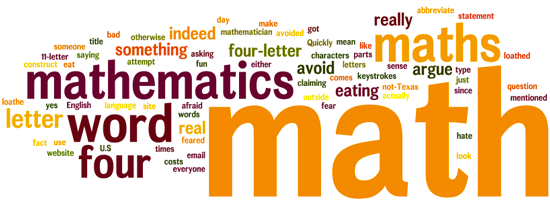
  • Is Math a Four Letter Word?

    Is Math a Four Letter Word?

    It’s been mentioned more than a few times that ‘math’ is indeed a four letter word. Quickly after that’s said comes a look of, “So why are you claiming otherwise in your website title?!”

    I just got an email from someone asking the same question.

    Math isn’t a four letter word.

    When we type “math” we use four keystrokes. But we actually mean “mathematics” which has 11 letters. In some parts of not-Texas, outside the U.S., they abbreviate mathematics as maths. So really, math and maths are both 11-letter words!

    Math isn’t a four-letter word, either.

    The real statement of this site is that math isn’t a four-letter word. It isn’t a bad word. It isn’t something that should be feared, loathed or avoided. In fact, since everyone does it, it doesn’t make sense to fear, loathe or attempt to avoid it.

    It’s like saying, “I’m afraid to eat,” “I hate eating,” or “I avoid eating at all costs!”

    It’s something you do. You were born with it.

    Math is a four letter word.

    But indeed, yes. Math, the English language construct, has four characters:

    1. M
    2. A
    3. T
    4. H

    So I can’t really argue.

    Or I can argue all day.

    And THAT’s the real fun of being a mathematician!

    Related articles
  • The Key to Tutoring Your Own Kids

    The Key to Tutoring Your Own Kids

    Originally posted on MathsInsider.com as a guest post.


    Are you thinking about tutoring your own children?

    Are you hesitant?

    The toughest thing about giving instruction to a family member is how close you are to the situation.

    Hire a math tutor and you can watch him peacefully manage your sweet offspring.

    Try it yourself and they turn into maniacs.

    And why?

    Because you’re still frustrated that they haven’t learned to pick their clothes up off the floor. And you’re annoyed that they don’t clean up the milk they spill. They want to go to the movies and you won’t let them. And they feel like you aren’t letting them be themselves. And…

    But you can pull away from all that and still tutor!

    Make yourself into a tutor

    It’s time to be creative, parents. If you’ve tried to tutor as “the mom” and failed, well, try to tutor as “Mrs. Fibonacci.” Get a smock and a hat or pair of fake glasses. Put on some earrings that you would never wear. Don’t get too goofy, but have fun with it.

    Let your sweet dear know that you’ll be tutoring as Mrs. Fibonacci and set aside a specific amount of time. Depending on the needs of your child, you might try one hour on Tuesdays and Thursdays or a half hour each day. Go to a set place and close the door. Get the rest of the family on board with this, too, so they won’t interrupt.

    Also pay for the math tutoring. Instead of paying an outside tutor, set up a reward system for both you and your child. Every hour that you successfully tutor, you get an hour of fun on the weekend doing something as a treat. Or you earn points toward a trip. Or you can use monetary rewards – depending on how effective they are with your family.

    Prepare ahead of time

    Many math tutors will ask what the subject and topic is a few days ahead of time. This gives them the opportunity to brush up.

    Find out what the next few lessons are and get help before the next session. That way when you’re Mrs. Fibonacci and in session, you’ll have some of the answers on hand.

    And allow yourself to be wrong – mathematicians do it all the time. If he asks a question that you don’t know the answer to, let Mrs. Fibonacci offer to do research and get back to him in the next session.

    Let the tutoring session be professional.

    As Mrs. Fibonacci, speak differently to your child. Forget the clothes he left all over the floor this morning and the milk he spilled that he didn’t clean up. Those are all out. He’s a new, fresh kiddo. Beautiful, smart and ready to learn.

    And have him call you Mrs. Fibonacci. Keep that role alive through the whole session. You’ll feel the difference and be able to talk math in a professional way to him.

    Make it happen!

    Are you ready? You might start getting your “kit” together now – in the summer before the school year starts. Create your outfit and choose your name. “Mrs. Fibonacci” is okay, but you might want to find another mathematician’s name that speaks to you more.

    Start getting the whole family on board. Let them choose the location and times. Get ready. Get set. So when the school year starts, you can GO!

  • Can You Teach All K-12 Math in 8 Weeks?

    Can You Teach All K-12 Math in 8 Weeks?

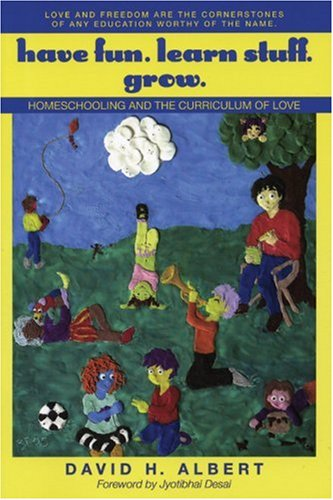
    Elizabeth, @Ser3nd1pity, tweeted an excerpt from a book by David H. Albert called Have Fun. Learn Stuff. Grow.

    Reading through it, the thought that came to mind over and over was, “Finally.”

    Here was my favorite part:

    …the subject matter itself isn’t all that hard. What’s hard, virtually impossible, is beating it into the heads of youngsters who hate every step.

    Indeed there is a gracious sufficiency of beating – and resistance – when teaching math.

    But everyone already knows math!

    In the book, Albert wrote:

    If you never teach a stitch of math, in a mathematical culture your kids will learn heaps of it anyway. …learning math along the journey is a difficult thing to avoid.

    You can’t not do math and exist. It’s like not breathing. Impossible.

    We survived for a very long time without the written word. But we’ve never existed without math.

    Early humans knew that to divide a chunk of meat between two people would yield too little:

    meat2<what I need\frac{\text{meat}}{2} < \text{what I need}

    He might not have have had the fancy way to write it – but he could learn how to write it in 8 weeks.

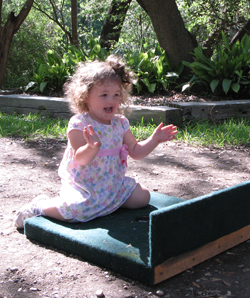
    Daughter playing with washers: counting them and learning math in her world.

    Can you teach all of K-12 math in 8 weeks?

    The short answer – it depends on to whom. In Albert’s article, he’s teaching children. You can totally do this with kids. And cavemen, I suspect.

    Grownups are a different story. Innumerate adults already have anxiety, anger or fear associated with math. There’s a whole lifetime of un-doing that would have to take place.

    But once you undo this, then the 8 weeks would work.

    The way I teach college classes is this: we’re going to spend 48 contact hours together – I’m going to wow you in ways you’ve never expected. When we’re done, you’ll be much calmer. You’ll be able to learn math much better, both on your own or in a classroom.

    I don’t force learning. I don’t even require learning. I let it happen. It’s the closest I can get, in the classroom, to what Albert is saying.

    Can you get closer to the 8-week method?

    Related articles
  • 6 Confusing Terms in Mathematics

    6 Confusing Terms in Mathematics

    Thanks to David Ginsburg for inspiring this post.

    Do you struggle explaining to your students what “simplify” means? Do you wonder why they won’t reduce fractions to their lowest terms?

    Here’s how to explain and teach some of the top confusing terms in mathematics – without throwing you or your students into a tizzy!

    Where

    Really! “Where.”

    As in “Where do the lines intersect?” or “Where is the highest point of the graph?”

    “Where” in math almost always means “at what x-value?” Every now and then “where” can mean “at what point?” In the first case, “Where do the lines intersect?” can be just as easily satisfied by a point (x, y) as the x-value only.

    When you get into calculus, the word “where” is used everywhere (pardon the pun). “Where is the slope of the tangent line equal to zero?” and “Where are there discontinuities?” among others.

    Keep your eyes peeled in the textbooks for this tricky term.

    Reduce

    Typically this means to reduce to lowest terms. Which isn’t really helpful, since you still need the definition of “terms.”

    Numerators and denominators (tops and bottoms of fractions) that have one or more common factors are not officially “reduced.” Once they have no common factors at all (except 1), they are said to be reduced or reduced to lowest terms.

    A reduced fraction helps in many ways. You can “feel” the value more easily: 2/5 is a lot easier to picture than 14/35. Also, when you add fractions, starting out with all the numbers in their reduced form will often help to find common denominators.

    Zeros, Real Zeros and Roots

    Zeros, real zeros and roots all mean the same thing. It is where a graph passes through the x-axis. We can write “where are the zeros” meaning at what x-value (“where” from above) does the graph pass through the x-axis? We also will write “what are the zeros” and mean the same thing.

    To find the zeros or roots, we set a function (or any equation solved for y that involves x) equal to zero. Then we solve for x. This will give the result that we want – the x-values where the graph will go through the x-axis.

    We call them zeros because they are where y = 0. We call them real zeros because there can be complex or imaginary zeros that don’t exist on the graph.

    Finding the zeros or roots of a function help when graphing it. If you know all the places it goes through the x-axis, you can then determine where it’s above or below the x-axis. Then you can roughly sketch the graph.

    Simplify

    Of all the terms in mathematics, this one is the most slippery. This meaning of this term is always in context to the book or situation. What it means is “manipulate the expression.” The end result may or may not be “simpler” than the starting expression.

    Better textbooks use phrases that are clearer, like “multiply the polynomials” and “combine like terms.”

    If “simplify” is the instruction to a problem set in a textbook, consult the examples to see what type of manipulation to do.

    In later courses, students have to recognize when a situation requires a different form of the expression. Practicing various forms of manipulation (or “simplifying”) gives them tools to manipulate the expression to satisfy their needs.

    Do you run into other terms in mathematics that are hard to explain to students? Hard to understand yourself? Share them in the comments!

    Related articles