Have you seen the kid that isn’t getting the attention he needs at home? Wonder what’s going to become of him?
Well, the “it takes a village” concept isn’t far off. You might not be able to change his world, but sharing a little about math might help with one corner of it.
Share math in small bites.
Every time you see the child, pose a fun puzzle. It doesn’t have to be blatantly mathematical. Anything to get his logic working helps. I love the Childcraft Mathemagic book for puzzle ideas.
Ask her random math facts. Tell her you’ll give her something for each one she gets right – or each 10 she gets right in a row. Find out what’s important to her that you can’t get in trouble sharing. Like money, chocolate, baubles, etc.
Tell him that when you were growing up you wanted to be a mathematician. Ask him to find his favorite mathematician online. Find one yourself that you can discuss – I’m partial to Abel and Galois.
Be positive about math.
There might be many things wrong in a child’s life. Let math be the one that isn’t. Be positive. Help make math the thing a kid can hold on to.
Be the village because it takes a village. Share your stories in the comments!
I’ve learned of a thing called “What can you do with this?” from dy/dan. This teacher sets up a situation so that students can ask questions.
I’ve been pondering the effectiveness of this for a while.
The thought is that if you allow students to observe something interesting and ask them “What can you do with this?” then they’ll create their own word problems.
This is in response to the fake or “made up” word problems from a textbook which mostly don’t work for teaching thinking skills.
But the issue remains the same. If someone presents a student with a video of Coke vs. Sprite and the student lacks curiosity about that subject, then it’s still a contrived problem. Or a contrived situation.
The only reason to do a word problem is if you’re emotionally attached to it.
Husband and I were talking about word problems the other night. After my demonstration about using to teach math, he said he wished he learned math that way. He needed something to hold on to. A reason for doing it.
He’s a set dresser in Hollywood for part of each year. Which means that he has to hang pictures on movie sets. And they have to be 55″ above the ground – at the center of the picture.
Not hard to measure, but there’s also the wire on the back to consider. Is the wire dead center? No. It’s probably above the center of the picture.
It becomes one giant word problem. But it isn’t written in a book. And it isn’t videoed by a teacher. It isn’t fake. There’s a real reason for him to do it.
Which made me realize that there’s only one reason to do word problems: if you’re emotionally attached to it.
If you need an answer to a question, you attach to it emotionally.
Parent: You’ve got 45 minutes to clean the kitchen before we leave for softball practice.
Kid: If I finish the kitchen before we leave, can I watch TV?
Parent: Sure, but the kitchen better be spotless.
Most likely the kid has a plan for TV – like watching his favorite cartoon on DVR that takes about 30 minutes. So he works out how fast he needs to clean the kitchen so he can get in his cartoon before leaving.
This is a real problem. His problem.
Watch your kids intently. See where they are doing word problems in their heads. Ask them to explain them. Give credit for work done – especially when self-created.
If someone else needs an answer, you attach to it.
Being helpful is a powerful motivator. Try this: with a pencil and paper sit in a public place. Act like you’re writing something important. Then ask out loud, “What’s 87 minus 13?” $5 says that at least four people will chime in to be helpful.
Let your kid help with balancing the checkbook or creating the budget. If you’re a classroom teacher, let the kids help figure out what teacher supplies to buy. Give them a limit on what to spend and the catalog and some guidelines.
If someone you like wants an answer, you attach to it.
I couldn’t have given a feathery duck’s tail about biology, but the teacher was crazy cute. So I wanted to please him. So I worked. Hard. And had a 100 average.
I suspect this is why the teacher at dy/dan is so successful. He’s cute, compelling and cool. Who wouldn’t want to engage with him?
If you have carisma and charm, use it. This might not work as a parent but will definitely work as a classroom teacher – at least for some students.
Give it a try. Tap into the emotion. And share your success below!
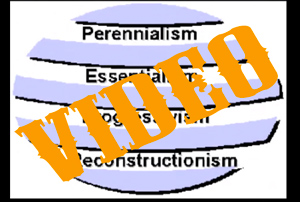
I discovered this video about the philosophies of teaching math from the blog Learning to Teach, The Empty Set of Education. Having degrees in math and not teaching I found it very interesting from a theoretical point of view.
And I totally love his conclusion – the 5th philosophy!
What is your philosophy for teaching math? Share your thoughts in the comments.
If you’ve ever taught or tutored math you’ve encountered the question, “When am I ever going to use this?” Maybe even hundreds of times.
And no doubt you’ve tried the answers that you’ve heard your math teachers give:
You’ll need it in a future job.
You’ll want to balance your check book someday.
Blah, blah, blah.
I was on the Teachers.net chatboard last night and there’s a discussion in the math teachers section about how to answer this question.
I was horrified to read that some teachers actually respond with, “How about as homework, you find the answer to that question.”
Egad!
We all know it’s a discrationary tactic. We know that there are lots of good uses of math. And we’ve experienced our answers shot down with, “I’m not planning on doing a math job for a living, so I won’t need it,” or “I’ll hire a CPA to do my checkbook.”
There’s only one right answer to this question.
“You’ll never use the math I teach you. Ever.”
I offer $10 to anyone who can come back to me in 10 years and tell me that graphing functions (or whatever we are learning that day) has actually had an applicable use in their life.
Of course they’re horrified at this answer. They give me looks like, “What? Are you an alien here to invade our classroom. Did you eat the real Bon?” No teacher has ever been that honest.
Graphing functions is virtually useless as a real tool. As is most of what we teach.
I used to get phone numbers from men at bars with my amazing use of the quadratic formula, but that’s only something you can tell college students. And they don’t buy it anyway.
Teaching math is teaching brain exercises.
The reason we teach and learn graphing functions (or other math) is to exercise a part of the brain that we rarely get to use. A part that will get used sometime later in a weird way.
We’re building new paths in the brain. We’re carving a way to alternative problem solving that might one day be useful in solving interpersonal, business, automotive, or other type of problems we have.
I tell them that math class is a game. A fun time to escape once a day. This is a play time to stretch their brains and do something completely different.
And I certainly don’t pile pissiness upon pissiness with the attitude of “If you’re going to challenge me, small menial student, then I’m going to give you extra homework.” That really motivates students… to hate math.
How about you? How do you answer the question? Are you supporting future math happiness? Share your thoughts in the comments.
I found an EdReach article through The Republic of Math‘s site and was so relieved. I’ve been hearing so much about the Khan Academy. Every time I look at it, I can’t help but think, “Same stuff, different medium.”
Math teaching is about connecting math with people in a way that works for them. If the Khan Academy helps a kid get it, then great. But if that’s the case, then it’s likely that they’ll get it regardless of the medium.
It’s time to step it up.
I’ve been hearing about experience selling for a while. You don’t sell a product, you sell an experience. I’m not typing on a Mac right now because it’s a better computer than a PC. I’m typing on a Mac right now because if I have a problem, the cute purple-haired kid at the Apple store 3.2 miles from here will help me fix it.
The same holds with math. We need the experience. Kids need the experience. It no longer works to sell “you’ll need this in life.” You have to sell the emotion behind it. The “what’s in it for me?”
And that’s easy – if we just step it up a bit.
This ain’t your daddy’s math class.
Nope – not anymore. Once kids are old enough to get it, they need to be allowed to get it. Until then, we can sell them the algorithms and the memorization. But once they hit that threshold (which is different for every kid), they have to be allowed to do it their way.
Which means no more rules. Math teaching is now about facilitation of learning. No more, “You must do it this way.” We’re losing them with forcing them to rationalize the denominator, simplify the fractions and write polynomials in descending order “because they’re supposed to.”
They should rationalize the denominator because it compares better when put next to another number. They should simplify fractions because it’s easier to wrap your brain around 1/4 instead of 13/52 (unless you play ). And polynomials add easier when you write them in some designated order.
Siggi over at Turkeydoodles wrote a post about her preference of calculators over flashcards. It’s her preference, but her arguments seem to be founded on the misuse of of flashcards. Furthermore, it seems she’s not seen the detrimental effects of early calculator use, yet.
When you should give a kid a calculator is a topic for another article. In the meantime, here are some tips on good flash card usage.
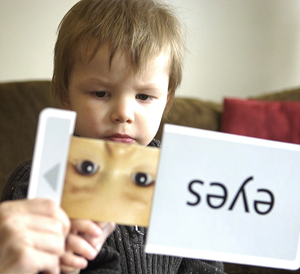
Flashcards are educational toys.
Flashcards shouldn’t be used as testing devices. They’re educational toys. They’re exploratory devices. Let them “peek” as much as they want.
As a first introduction, use them to build houses of cards. They should be fun and comfortable.
They are limited in scope.
The 6 x 8 = 48 card will never be able to give the cosine of 60 degrees. This makes the flashcards so beautiful. Once you understand what happens when you create a calculator addict, and see how that works as the kid enters college, you’ll know how important this limitation is.
Encourage variation to limit boredom.
I distinctly remember using flashcards in my dining room, sitting next to the sliding glass door. I was reading them. But because they would get boring, I would chant them. It became sing-songy and fun. I could go through them quickly this way.
And I looked forward to the ones that rhymed.
Let the flashcards be rejected.
If a kid really hates them, let it go. There are other ways to get that information across. Schoolhouse Rock’s Multiplication Rock is a fabulous tool for this.
And you can sing or chant multiplication facts yourself. My mother learned the most common prepositions by saying them as she jumped rope. You can vary some skip counting with jumping rope to learn multiplication facts:
3 x 1 = 3
3 x 2 = 6
3 x 3 = 9
and so on…
Allow the flashcards to be the context in and of itself.
It is not necessary that math be learned in context. So many people keep pushing this. Sometimes it’s just fun to know random stuff – including some quick and nifty facts.
Don’t push math for math’s sake, but offer it. There are kids, lots of them, who just like to do puzzles. Plain math – arithmetic and facts – is a great puzzler.
What do you think? Is this a better use of flashcards than the ones you’ve seen? Share your thoughts in the comments.
Actually, you get only one chance when teaching anything.
I was in an internal adult training class for corporate websites. In the middle of a discussion one student said, “How about if we each take something about Sharepoint that interests us, research it and report back to the group?”
Great idea, right?
The instructor put her face in her hands, breathed deeply, ran her fingers back through her hair and said, “Well, I want to make sure you get the things you need, so hold off on that.”
CRUSH.
End of learning.
Game over.
What are your thoughts on this? Share them in the comments below.
Do you have an especially difficult student? Does one kid stand out as just not getting it?
The answer lies not in your approach, but in their perception of their own capabilities.
My Former Drug Dealer Student
I was teaching Oilfield Math at a large oilfield services company to a group of new hires. One guy had particular difficulty.
Because I set myself up as approachable, he came to me to explain his plight. He was an ex-con and had spent 10 years in prison for drug dealing.
As soon as I heard this, I knew my way in. I watch much more drug-related TV that I should, so I knew that fractions were involved in drug dealing.
I asked him to explain some of the prices and measurements. Since he would have to work against time calculating cost, weights and prices, he was exceptionally good at fractions.
When I pointed out how good he was in math he was upset. “I’ve left part of my life behind me” he told me. “Yes,” I said, “but it shows that you could be just as good at legal fractions.” This Oilfield Math’s got nothing on drugs-on-the-street math.
His life turned around that day.
If you have a struggling student, find out where they already do math. Show them that they have the talent already. Let them see their abilities.
We had a lively discussion at last week’s homeschool math chat about teaching algorithms versus allowing a discovery learning process.
What I can’t help but think about when I reread this discussion is how this compares to teaching a child manners.
Teach kids manners early. Very early.
I know someone who elected to wait until their child understood the concept of appreciation before teaching them how to say thank you. The child is now eight years old and doesn’t say thank you unless prompted.
Daughter, at 18 months old, is being taught please, thank you, ma’am and sir. She has no concept of being polite. Her frontal lobe is about as advanced as the local neighborhood chimpanzee’s. Her favorite phrase these days is, “No. Mine.” I correct this with, “No ma’am.”
At some point it will become habit. Or at least the ritual of, “No,” from her and my “No ma’am” response will become habit.
And at some point shall make the connection that using these polite words will gain her something. She’ll be looked upon favorably, considered one of the “good kids,” or smiled at a little more.
And then she’ll connect it. She’ll see that the concept of politeness is directly tied to the “algorithm” of saying polite words.
Teach kids algorithms early. Very early.
I love the idea of teaching concepts before algorithms in math. But sometimes algorithms have to come first so that the rhythm and habit are in place when the brain is ready to understand the concept.
Each child’s brain is different. One of the beauties of homeschooling and private tutoring is that you can focus on a child and know when they’re ready for algorithms and ready for concepts. As a classroom teacher, it’s a little bit more difficult, but still can be done.
In the classroom you can teach algorithms at the same time as concepts. If you cycle them back and forth, you can catch each student as they are prepared to accept the learning.
But this is reality. And I have two issues with David’s opinion.
The conversation points for each focus is different.
He compares questions like “What is your grade?” with “What did you learn?” If a child takes a test, the question, “What did you learn?” is goofy. You can learn while taking a test, but the intent of the test is to prove what you have already learned.
Grades are specific measurements, learning is a general unmeasurable concept (not mathematically). You would do just as well switching the question, “How far is it to your house?” with “Do you like your commute home?”
The logistical questions about homework and report cards are a trained response for parents. Parents need hear this only once, 20 minutes before the bus ’rounds the corner: “OH NO! I FORGOT TO DO MY MATH HOMEWORK!” Yeah, try telling a mom to switch “What’s your homework?” with “Did you have fun today?”
Sometimes grades are all a kid’s got.
Occasionally there’s no energy around learning a subject. A good student will turn to the competition of the grade to get the job done. Either way, the kid gains some knowledge.
I did this with history. It’s not my bag. I did have a great history prof in college who made things come alive. But I still just wanted to get through. Focusing on the grades got me there. And I learned lots.
If a student doesn’t love math, that’s cool. They can focus on the algorithms to get the job done and measure that with the grades. If it keeps their confidence up, maybe they’ll run into something someday that gets them excited about math. And maybe they won’t.
And that’s okay.
Parents should use both types of conversation points.
David’s intention is pure, though. We should focus more on the learning. But to think that we’ll stop with the grades altogether is crazy. It’s against human nature. We always want to know how we measure up. Kids want to know. And parents want to know. So it’s okay to focus on grades.
As long as where it matters, we focus on learning.