Category: General

  • Math Anxiety – How to Empathize with Students

    Math Anxiety – How to Empathize with Students

    Have you ever experienced performance anxiety?

    If you don’t have math anxiety, remembering (or freshly experiencing) performance anxiety is a great way to understand what it’s about.

    This happened to me at the beginning of this semester.

    Anxious Wrinkled Forehead

    I try to memorize the names of all my students. I go through the roll and for each person, I say the name and then look at the student. I study where they are, who they are and their name. I say it a few times and try to get it solid in my memory.

    Doing this helps students with math anxiety relax a little. And students who are trying to stay in the shadows (so they can miss class, etc.) learn quickly that I’m going to connect with them, personally.

    Of course the act of memorizing names isn’t perfect. The second day of class I usually remember about 30% of the names. So I go through and try to match the names on the roll with different people – giving it my best shot.

    I often get it wrong.

    A few weeks ago, I mistakenly called one woman, “Sandra.” I was wrong. She said, “Awe, come on, now!”

    It was all in jest, I had no doubt. But the strong reaction to my mistake hit me. So when I was looking through the roll to find her correct name, I was nervous.

    I was experiencing performance anxiety.

    If I gave it a shot and chose the right name, I would look good. But if I picked incorrectly, I would likely get another round of jeers.

    Of course, I’m the instructor, so there isn’t that much risk. But there certainly was performance anxiety.

    Surprisingly, there was a lot of anxiety.

    I pointed this out to the students.

    Because the class is less of a content based course and more of a confidence building/math anxiety busting experience, I thought pointing this out might be enlightening.

    We talked about how they might have said things like, “That’s a good try, Bon. Unfortunately, Sandra’s not my name. Would you like to give it another try?”

    We talked about how that kind of encouragement compares with the “Awe, come on, now!” reaction that they gave before.

    And we talked about the parallels of those statements to the statements by math instructors to students – about math. And the parallel of my performance anxiety to the math anxiety many experience.

    Consider it yourself.

    The next time you try something and get it wrong, notice how you feel. Think about how your child might feel in a similar situation.

    And ponder how this feeling would manifest itself as math anxiety if this performance anxiety happens in a math class.

    Share your thoughts and experiences in the comments. And tell others about it…

    Related articles
  • Anxiety Safe Learning Environments

    Anxiety Safe Learning Environments

    Would you like to create a safe math learning environment free from anxiety? What would that look like? Let’s first peek at what it doesn’t look like:

    Okay class, what’s the answer to number 12?

    I think it’s 75, Mr. Jones.

    No, Emma. That’s wrong. Have you been paying attention?

    Unintentionally or not, this is often taken as ridicule by Emma and her classmates.

    They quickly learn to avoid this verbal punishment and the anxiety it causes.

    And the easiest way to avoid it is by not trying.

    There is a power-dynamic, a vulnerability, that goes along with any instructor-student relationship. In these situations, students must feel safe to engage. Encouragement and support are ideal. But more importantly, the learning environment must be free of criticism, shame, or overwhelming frustration.

    If a student feels that there is threat of criticism, shame and frustration in a math class, it’s curtains. Even if forced to “stay in that chair and listen,” they won’t mentally stick around to learn much of anything.

    So how do you get your learning environment safe from anxiety?

    Praise the “wrong.”

    Being wrong means the student’s trying. Trying means they are engaged. Engagement gives an opportunity to learn.

    Without the opportunity, learning can’t happen.

    When you praise the incorrect answers, you praise the trying. When you praise the trying, the students are more engaged in math class. They have an opportunity to learn.

    So when they’re “wrong” – praise them.

    Exercise patience

    You may say, “But they didn’t give the right answer!”

    Got it.

    But before performance, or getting the right answer, a student must take in and process information at a pace where they can retain it. Getting the right answer is only an indicator of understanding and effective learning of math. A confirmation. It’s not the learning itself.

    Letting them be wrong and process how they got the wrong answer is part of the process of learning. And sometimes this can be slow.

    But giving a student time to think about and mull over questions and answers is more effective for learning in the long run, than requiring the right answer.

    Yup – you’ve got things to do, kids to teach. So it might leave you feeling frustrated when you allow wrong answers and give them time to ponder it.

    So when your patience is running thin, step away. Adults need breaks, too. Take one to avoid a damaging experience.

    Learn from the “wrong”

    When an incorrect math answer is given, ask them how they got there. Get them thinking about it. There are more learning opportunities in the wrong than the right.

    Right answer given. Say: Good job! Let’s move on to the next one.

    Incorrect answer given. Say: Excellent. Let’s talk about how you got there…

    We can praise the attempt and find something in the incorrect answer to build on and learn from.

    Think about the teaching implications of this. How many more folks would be willing to try something if being wrong is okay? How many more kids will you engage if there’s no criticism or humiliation to avoid?

    Be ready, don’t force it

    Your students might have been trained to avoid verbal punishment by not trying. Remember Mr. Jones from above? Mr. Jones is everywhere. So take it easy when creating this “anxiety safe” environment.

    When the more vocal students get wrong answers, praise like crazy, be patient and help them learn from the wrong answers. The rest of the students will follow.

    And whatever you do, don’t be Mr. Jones.

    Your turn…

    How do you create a learning environment safe from anxiety? Have I missed anything? Share your thoughts in the comments.


    William Devine

    William Devine is a licensed professional counselor in private practice. He has joined the MathFour.com team as the Director of Research. Connect with him in the comments, on the contact page or via twitter @MathPsych.


    Feature image adapted from an image by Marshall Astor – Food Fetishist | Flickr.com | CC BY SA

    Related articles
  • Introducing K8 – Our Newest Writer!

    Introducing K8 – Our Newest Writer!


    Kate Crowder is the newest writer on MathFour.com. You already know her as “Daughter” – my kiddo referred to in many articles here.


    My name is Kate Crowder and I’m two years old. I know this because my mother (whom I call Taica, and you call Bon) tells me everyday.

    I repeat it and she smiles and says, “YAY!” So I’m good with saying it over and over again.

    She also tells me that two is the positive square root of four.

    I’m positive that she’s nuts, but again, she smiles when I try to repeat it, so I keep doing it. Sometimes you just have to keep the grownups happy.

    Taica and I do a lot of math. We say words like “associative” and “commutative” and talk about patterns.

    I worry about her counting though – “math” does have four letters – so I make sure to practice counting with her a lot.

    I’m the new writer!

    I’m excited about joining the writing team here at Math Is Not a Four Letter Word.

    Taica and Uncle Wil write and do videos here all the time, so I thought I could help out. Their mission is to make sure that all my friends are cool with math like I am.

    And I really am – you should hear me say “Yay math!”

    Everyone should know they’re good at math. That’s the first step in the process. If you know you do math anyway and you know you’re good at it by default, then you’ll be able to handle the stuff they throw at you in school.

    Most grownups don’t know that they already do math, though.

    And that’s where I come in.

    Taica shows me all the time where math is in our world. Whenever I eat a Vlasic Oval pickle slice, she tells me it’s an ellipse. Even grating cheese is a math discussion.

    I’ll be writing about the fun parts of my life with a mathematician mom. And you can see how my dad and I do math things too – sometimes for learning and sometimes to impress my mom, Taica.

    And maybe I can get you to see some math in your own life. And that will help you be more positive so that your kids will be as excited about math as I am.

    Yay math!


    K8

    Kate Crowder is a full time kid who can count to 20 and only miss the number 15. K8 has joined the MathFour.com team as a regular writer. Connect with her in the comments or on the contact page.


    Related articles
  • How to Teach Adults Math

    How to Teach Adults Math

    Today is my first day of teaching Developmental Math. I picked up two classes in the “late start session” at Lone Star College.(Yup – in Texas. How’d’y’guess?)

    And I’m so excited about teaching again!

    But how do I do it?

    A year ago the answer to that question would have been, “Duh!” Having taught for so many years I’ve gotten the art of explaining math on the chalkboard (and later whiteboard) down to a science. I’m good. Real good.

    But this past year, writing on MathFour.com, has changed things. I’ve connected with wonderful moms, dads, teachers of math and teachers of… well… just about everything. My philosophy on teaching math has been shattered.

    In the past, I’ve taught content. We’ll do the slope-intercept formula, talk about graphing and test over things like “Section 1.3 to 2.5.”

    But I’m not sure if that’s the right thing to teach. In fact, I’m not sure there’s anything to “teach” at all.

    I have to remember what they’re up against.

    This class is the most “remedial” of the classes offered in the math department. But the “gaps” they have in the math may not have anything to do with ability.

    I’m going to forego a syllabus – at least at first. Instead, their first assignment will be to read a research paper on math anxiety.

    From there, I’m going to let them guide what we do. We’ll likely get to content, but we’re not doing to push it.

    We’re going to get ready for whatever is next.

    They aren’t done after this class. In fact, this is the first of at least four math classes they’ll have to take. So whatever we do here lays the foundation for how they handle the other classes.

    The next math class they take might be inspirational and based on understanding, exploration and learning. Or it might be another content driven, talk-at-you-while-you-take-notes semester full of processes and methods to arrive at a RIGHT answer.

    Either way, I hope that by the end of this semester, they will feel empowered to take on their own learning. To demand learning facilitation instead of teaching. And join the teachers that have been leading the math revolution.

    Will I get fired?

    I hope not. But it’s possible. There’s no telling what’s fixing to happen.

    The only thing I know is that I’ll no longer sacrifice students for the sake of the system again.

    What are your thoughts? Please share them in the comments.

    Feature image by ralph and jenny | Flickr.com | CC BY

    Related articles
  • What Are Your Thoughts on This Fearful Parents Video?

    What Are Your Thoughts on This Fearful Parents Video?

    Wil showed up at the Math Shack this morning talking about a commercial he saw on TV last night. “Wow, this is what parents are up against!” he said shaking his head.

    Check it out for yourself:

    We’ve been talking about it all morning. Before we post our thoughts, we’d love to have yours.

    1. What’s the intended message?
    2. What’s the real or perceived message?
    3. How does it affect your view on math as a parent?

    Share your opinion in the comments and let others know via twitter.

    Related articles
  • Teach a Man to Fish… Really?

    Teach a Man to Fish… Really?

    This idea was inspired by something Tom with Leaving Work Behind wrote in an article about success months ago. He wrote:

    Principles are timeless – techniques are not. Would you rather I give you a fish, or teach you to catch your own?

    Here’s a week in the lives of Tom and me… “fishing”…

    Monday

    Bon: Hey, whatcha doing?

    Tom: I’m fishing.

    Why?

    Because I’m hungry. You can eat fish.

    Bon: I’m hungry too. Will you share your fish?

    Tom: Sure!

    Tuesday

    Bon: I wonder where Tom is. I’m hungry.

    Wednesday

    Bon: Hey Tom!

    Tom: Hi Bon!

    Bon: I’m hungry. I haven’t eaten in two days. You weren’t here yesterday.

    Tom: Well, I’m fishing now. Watch how I do it and if you ever need to, you can do it yourself.

    Bon: Swell!

    Thursday

    Bon: I wonder where Tom is. I’m hungry. Good thing I watched him yesterday. Now I can catch my own fish.

    <pause>
    Bon: What’s going on. I’m not catching any fish. And I’m doing it exactly as Tom did! I’m so hungry!

    Friday

    Bon: What’s up, Tom!

    Tom: Hey Bon. How are you?

    Bon: I’m SO hungry. I tried to fish yesterday but I couldn’t catch anything. And I was doing it exactly like you did.

    Tom: That’s strange. How about this. I’ll let you do the fishing today. Together we’ll see what you’re doing and adjust it so it works for you.

    Bon: That sounds great!

    Saturday

    Bon: Bummer. Tom’s not here. But I was successful catching fish yesterday so I’ll have no problem catching fish now!

    Sunday

    Bon: Hey Tom!

    Tom: How’s it going Bon?

    Bon: Excellent! Hey – wanna join me for lunch? I’ve caught enough fish for both of us!

    Do you really want to teach someone to fish?

    There’s a difference between teaching someone to fish and helping them learn to fish. In the case of Tom’s teaching medium – his website – he can only teach. Likewise, here at MathFour.com, my writings can merely teach.

    But when you’re face to face with a student, teaching isn’t nearly as valuable as helping them discover.

    Indeed, if you’re going to teach a child who really needs help learning, you might as well just give them the fish.

    Do you teach your kids to fish – or help them learn?

    Share your thoughts in the comments.

    Images by Tony the Misfit on Flickr, CC BY.

    Related articles
  • Improving Creativity with Technology

    Improving Creativity with Technology

    This article is based on the talk “Improving Creativity with Technology” given at the University of Houston teachHouston T3 Regional Conference.

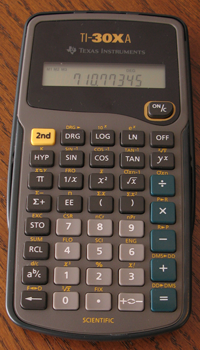
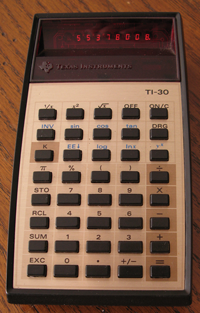
    Calculator

    Traditionally we give a concept or algorithm to the students and ask them to memorize, understand and use it. And by “give” I mean we serve it to them well done, fully baked, nothing left to do but eat it.

    Piaget’s research (and subsequently others) suggest that allowing students to discover or create the methods is more effective than handing them the method and asking them to take it, eat it, no questions asked.

    But how do you let them discover it?

    Since the math we teach in middle school and high school is based on real numbers, every concept can be demonstrated with “plain” numbers. Which means it can be discovered by playing with numbers.

    Calculators make this playing or experimentation fast – giving a student the ability to quickly see patterns and construct concepts.

    Introduce the topic with numbers.

    When you introduce a topic, give 10-20 “examples” of it with real numbers. Ask the students to play with them and notice any patterns they find.

    Notice you’re creating an inquiry-based learning environment, an Inquiry Zone for Math Learning. Remember to maintain positive body language, ignore negativity, and super-validate what any student says.

    Give the students the power!

    Until the student decides differently, everyone is wrong. Even the teacher and textbook. They get to validate it for themselves – and they can do this with real numbers.

    Ultimately, if they grow to be mathematicians, they’ll learn that verifying with lots of real numbers doesn’t mean “proving” it – but for the time being, this works fine.

    Giving them this power lets them experiment as much as they need, and only as much as they need, to verify a concept for themselves.

    Use the Play & Say method.

    You’ve heard of the “Plug & Chug” method? You take a formula, plug in the numbers and chug through the arithmetic. Plug & Chug is a non-discovery based practice tool. The practice is good, mind you, but the formula is given, not discovered.

    Remember, something discovered is more likely to be remembered than something given.

    So use the “Play & Say” method. Each student plays with the numbers until he or she can say what the formula or concept is.

    Caveats

    If you’re trying to teach a concept with this and one student discovers a different formula or concept. Run with it – as long as it’s mathematically sound. Don’t discourage the discovery of anything, even something not on the current curriculum.

    If a student gets frustrated, don’t force them to discover it themselves. Give them the concept or formula and encourage them to experiment later with it.

    Suggestions

    If you find there is a big difference in how much time each student takes, send the experiments home with them. Give them five minutes at the beginning of class to play – the students who realize they need more time will have done more the night before.

    How will you do it? Share your thoughts and experiences in the comments.

    Related articles
  • How to Create an Inquiry Zone for Math Learning

    How to Create an Inquiry Zone for Math Learning

    In a previous article, I suggested two ways to introduce inquiry-based math instruction into your teaching structure. One of them was to create a safe discovery environment – an Inquiry Zone. This is where students could ask anything and not be held responsible for performance.

    It can be a location or a time – or both. It can be announced or understood.

    As the facilitator, here are some things to do to create the safe Inquiry Zone.

    Maintain positive body language.

    When a student asks a question, make sure your body language and facial expressions say, “Wow, that’s a very smart thing to ask.” Do this regardless of how you feel about the question personally.

    Ignore negativity.

    If other students laugh at a question, ignore them. Instead validate the asker and the question through words and body language. Chastising the negativity only validates it.

    Super-validate every question.

    Follow up every question with a similar or extended question. If you can’t think of one, say, “That’s really interesting. Let’s write it down so we can look it up on Google later.”

    Post the rules.

    Set up rules so that all the students know what inquiry really means in math. The rules I use are:

    1. Until you decide differently, everyone is wrong. Even the teacher and textbook.
    2. Every question is a great question.

    These two rules build confidence. Not in getting the right answer, but in deciding what it means to be a right answer. If a kid gets to decide when the answer is right, they will ask more questions. Inquiry!

    Be wrong – often.

    Modeling this “wrongness” makes kids comfortable with it. The more comfortable they are with being wrong, the more likely they are to engage in inquiry.

    You can be wrong by not knowing something or actually doing a problem wrong (doing your arithmetic wrong, for instance).

    If you are normally perfect, fake it. Mess up. Do it for the kids.

    Destroy the back of the book.

    I’m not sure you can get away with this without being fired.

    If you don’t mind getting fired from your teaching job, or if you homeschool, get the kids to rip out the back of the book – you know, the part with all the answers in it. And don’t let them talk you into letting them “check their answers” on the calculator. That’s just as damaging.

    The more they get to decide if their own answer is right, the more they will ask. The more inquiry will happen!

    Will you create an Inquiry Zone?

    Share your experiences in the comments.

    Feature image by Crystl | Flickr.com | CC BY

    Related articles
  • Math Education Revolution – The Last Piece Is Easy & Cheap!

    Math Education Revolution – The Last Piece Is Easy & Cheap!

    The math education revolution has been growing. Last year Salman Khan and the Gates Foundation brought Khan Academy to everyone in the world with a computer.

    Dan Meyer jumped into the ring with his math class makeover. With his Any Questions? and Three Acts, he’s fighting the good fight to get kids to learn math.

    Social learning math games like Sokikom, iPhone apps like Motion Math and face to face programs like Mathnasium have joined the math education revolution, too. Thousands of tutors are taking part.

    Experts all over are helping kids understand that math is important, necessary and valuable to learn.

    Kids still resist math homework and avoid participating in math class. Why?

    Because everyone knows that math is boring, hard and has nothing to do with real life. Nobody really likes it – unless they’re an engineer or accountant.

    Math teachers are mean and professors write math books just to mess people up.

    Everyone knows this.

    Who is this “Everyone”?

    Grownups.

    Yup – you and me.

    When you hear people talk about math or math education, what do they say? Anything positive?

    The best I’ve ever heard was, “Actually, I kinda like math.”

    Which means, “I know it’s not cool, and I’m sorry for saying it, but I like math.”

    Would you do something nobody liked?

    No! Of course you wouldn’t. At least not on a regular basis.

    If everyone you knew and respected avoided something – you would too. If all your friends jumped off a cliff – so would you.

    We’re human. That’s what we do. We stick together.

    So we’re losing the math education revolution.

    By the very design of our society, Khan Academy, Sokikom, teachers, tutors and everything designed to help kids learn math are failures. The math eduction revolution is bust.

    We want kids to learn math because it’s important. Math is necessary and valuable to learn.

    But since nobody really likes math, or even does math, kids aren’t buying it.

    And I can’t blame them.

    Is it fixable?

    At this point it’s easy to throw in the towel. Give up. Quit. Decide that the world is going to end up like that movie Idiocracy.

    But we’re so close to the solution.

    The solution involves something that’s very cheap – and research based!

    Ready for it?

    The missing piece of the math education revolution is that we need to teach parents positive influence skills to encourage math.

    What? Will that work?

    We have seen this happen with reading – remember the Reading is Fundamental campaign of the 80s? It’s still going strong along with other programs like the “Read 3” program from HEB. Parents are encouraged, even pushed, by teachers to read to their children every day.

    These efforts have changed the culture in our world so that reading is viewed as something “everybody does.” Parents now have positive influence skills in encouraging reading.

    And those skills have extended across our entire culture!

    That’s the missing piece!

    Parents can develop the same skills for encouraging math. And when we do, everything will change.

    Just like it did with reading.

    When parents start talking about math in a positive way, all of society will.

    The math education revolution will succeed!

    It’s your turn…

    If you’re a parent, learn how to use some positive math talk. Join a program like That’s Math, read articles on Math for Grownups or any other math blog that strikes your fancy.

    If you’re a math teacher, blogger, tutor or developer of math products – make something teaching parents how to talk positively about math. We’re developing That’s Math, but there needs to be more of these.

    Feature image by woodleywonderworks on Flickr.com, CC BY.

    Related articles