Category: General

  • 12 Most Simple Ways to Have Math Confident Kids

    12 Most Simple Ways to Have Math Confident Kids

    This post originally appeared on 12most.com on September 17, 2012.

    Do you remember your parents saying, “Do as I say not as I do?” Do you remember what you thought of that nonsense?

    We learned more from our parents’ social modeling than we ever did through their words. And our kids will do the same.

    If you (as a grownup) scream when you see a roach, your kids’ll learn to fear roaches. Head to the gym three times a week and they’ll learn a healthy body is part of life. Read to your kids on a daily basis and they’ll think that reading is part of normal life.

    And you can use that same social modeling to turn your household into a hub of math confidence! Here’s how:

    1. Say the word “math” as much as you can

    The more you hear or see something, the more familiar with it you are. That holds for kiddos too. So mention math as much as you can.

    If you see a graph on CNN or Fox News, say, “Hey, that’s math.” If you’re looking for a cheaper alternative in the grocery store, use the M-word: “I’m using math to compare prices.”

    2. Point out where you do basic arithmetic

    When you set your alarm clock, point out that you’re doing subtraction to figure out what time to wake up. If you have to grab for the half-cup because the 1-cup is in the dishwasher, mention you’re doing some fractions.

    3. Let them read the users manual

    Sometimes math is about getting the job done by going through the right steps. When you set up the entertainment system, hand over a users’ manual to your child. Following those instructions reinforces logical instruction following — i.e. “plug and chug” math.

    And when they’ve set up the new big screen TV and hooked it up to the 7 other boxes of electronics, tell them they just used logic — a part of math!

    4. Play games

    Board games and card games are full of if-then statements. If you roll doubles, then you get another turn. If you draw a blank card, then you get to advance four more spaces.

    If-then statements are the foundation of math. Even the simple 1 + 2 = 3 is an if-then statement:

    If 1 and 2 represent the values we’re used to, then their sum is the value 3.

    The best part is that when they win a game, you can point out all the math they did to accomplish it.

    5. Play Calvin-Ball

    Calvin & Hobbes often engage in a sport in which they make up rules as they go along. Try doing this with your kids — play a game (of any type) and let each person make up one rule.

    Those rules will show up in the form of if-then statements, just like “normal” rules.

    Watch closely for the compound rules, too. “If your name starts with a B and you’re more than 10 years old, then you get two turns.” That “and” is part of set theory — a subject of math!

    6. Bite your tongue

    If you ever find yourself saying, “I’ve never been good at math,” stop yourself before it comes out. In fact…

    7. Fake it

    Fake it until you make it. Tell yourself you do math everyday (you actually do) and then tell your kids you do math everyday. Even if you don’t see it.

    The more you say it, the more you’ll believe it. And when you finally believe it, saying it will be effortless.

    8. Look at people like they’re nuts when they say they’re bad at math

    Remember, it’s all about social modeling. If you respond with, “Yeah, a lot of people aren’t so good at math,” you’re sending the message that it’s okay to be bad at math.

    Ever hear someone say they’re bad at reading? Heck no! Because it’s not socially acceptable.

    If you want math confident kids, make it just as nuts to say you’re bad at math as it it to say you’re bad at reading.

    9. Treat their math grades like they were PE or drama class grades

    If you pressure your kids to get good grades, then their motivation to be creative problem solvers goes down. (This is from Dan Pink’s Drive, by the way.)

    Since creativity is the source of great math learning, take off the pressure and let them learn math at their own pace. If they pass, that’s good enough.

    10. Discuss the Common Core Standards with them

    Talk to your kids about the requirements your school follows (or the ones you follow, if you homeschool). Discuss what each requirement or objective means. Talk about where they might have seen it in action.

    Point out where they already do it or make plans together on how they can do it in real life.

    11. Read popular math books

    There’s a whole slew of non-fiction books written about math for the non-mathematician. Let your child catch you reading one of those.

    My favorite is The Man Who Counted by Malba Tahan.

    12. Burn the calculator and banish the back of the book

    Having an external device to check their work is clear confirmation to a kid that he’s not smart enough to check it himself.

    If your child (or you) follows the rules of logic and the agreed on methods of applying them (like the order of operations), the answer they get will be right. Guaranteed.

    Furthermore, there are an infinite number of ways to do every problem. So checking your work is a matter of doing the problem a different way and seeing if you arrive at the same thing. Or working it backwards to see if you come up with the original question.

    Tear out the back of the book or staple the pages together. And refuse to fall for the “check your work” calculator usage scam. Your children will be better off for it.

    Are you ready for math confident kids? Which of these will you try?

    Featured image courtesy of Inkyhack licensed via Creative Commons.



  • Why You Should Ignore the Prerequisites in Math Classes

    Why You Should Ignore the Prerequisites in Math Classes

    You’ve seen the prerequisites part of a syllabus or course listing that begins:

    To take this course you should have completed…

    But what does that really mean anyway?

    A prerequisite is a way to keep out the rubbish.

    Have you ever sat in a class with someone asking tons of questions about things they should have known before signing up? To prevent this, instructors and institutions insert the “stay out if you’re going to get on everyone’s nerves” clause.

    It’s called the prerequisites.

    Prerequisites are a way out of a class that you didn’t want to take anyway.

    Prerequites are designed in such a way to allow you to escape. If you have any apprehensions about taking the class at all, you can just refrain from ever signing up — because of the prerequisites.

    Regardless of if you have the prereq’s, you can play this card. The course description reads: To take this course you should have completed College Algebra.

    You can convince yourself using one of these:

    1. “I passed College Algebra, but only with a C-. They probably mean that I should have made a B or at least a high C.”
    2. “I passed College Algebra with a B. But I was really uncomfortable about it. They probably mean that I should feel really good about all the content in College Algebra.”
    3. “I passed College Algebra with an A. But there were quite a few things I didn’t understand really really well. They probably mean that I should be really good with all of the stuff in College Algebra.”

    See how you can talk yourself out of anything?

    But there are no real prerequisites.

    All topics of math can be learned independently. Every topic can be learned before or after any other topic. And every topic can be used to support as well as be supported by any other topic.

    There is no order to this stuff. There is merely the order in which we learned it — one of a hundred bazillion ways that you could order it.

    My little sister was interested in math in college. I suggested she take Linear Algebra, a sophomore level class, in her first semester. The course catalog listed three semesters of calculus as the prerequisites. I told her that Linear Algebra had nothing at all to do with Calculus and she should ignore the prereq’s.

    She did.

    She finished her degree in her way — following her interests. (By the way, she’s currently the Business Administrator in that same math department!)

    Prerequisites are bogus.

    Education and learning should be focused on what you’re excited about. It’s about following what the learner wants — and what he or she (or you) will engage with.

    If you, or your kids, don’t want to do it, then don’t.

    But if you do — then don’t let some nutty arbitrary prerequisite statement stop you! Or even slow you down.

    Try it on this class…

    The sweet and talented Keith Devlin is teaching an online course in Math Thinking soon that has a “Recommended background of High School Mathematics.”

    Unfortunately those words sound like, “The prerequisite for this is high school math.”

    The class is online and it’s free. If your teens are interested, encourage them to join. If you have a precocious pre-teen, see if he or she is curious. And if you have a GED or no high school math at all, jump in — if you want.

    And the next time you’re faced with anything that looks like prerequisites, ignore them!

    Share your thoughts in the comments or on twitter/x.

    You might also like:
  • Fibonacci Birthday Party!

    Fibonacci Birthday Party!

    I’ve been preparing for months to have K8’s Fibonacci Birthday party. Last Saturday it happened.

    We did a lot of preparation.

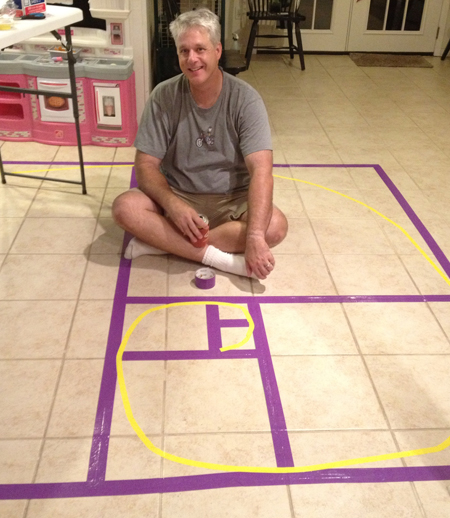
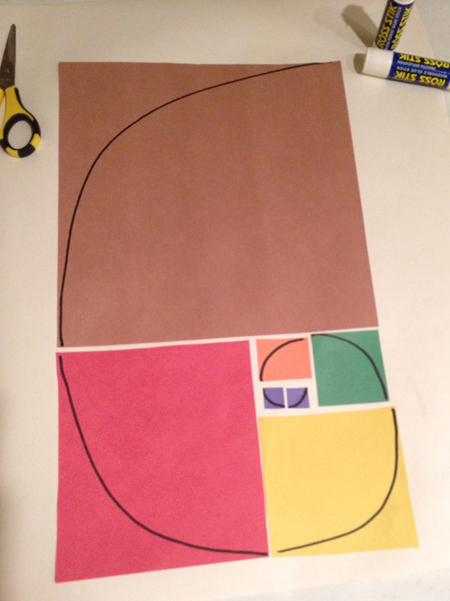
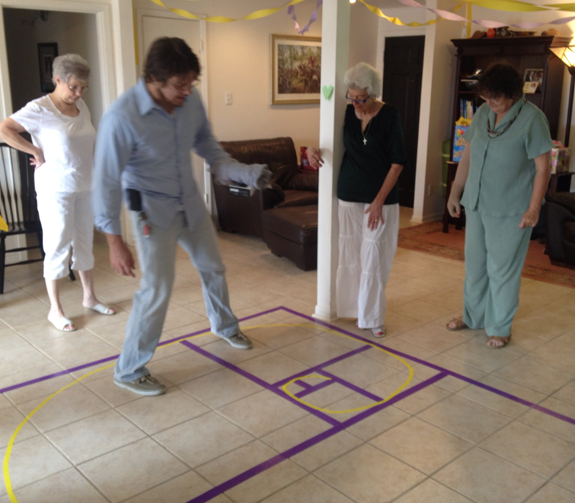
    Here is Judson creating the Fibonacci squares and spiral on our tile floor:

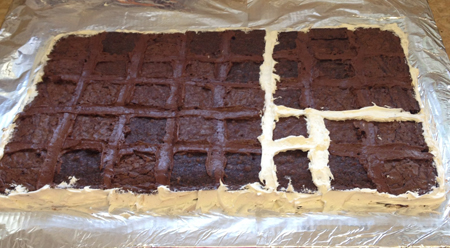
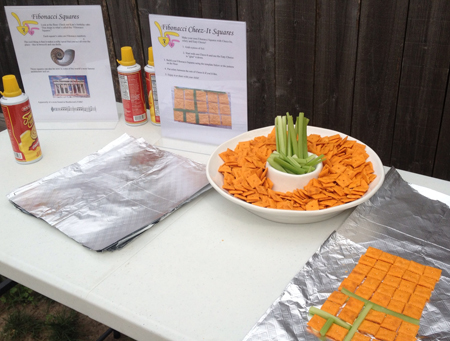
    Here is the birthday “cake” I made. It’s a Fibonacci Squares brownie cake!

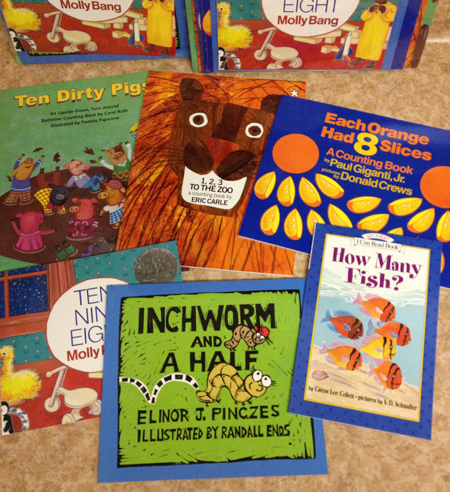
    I ordered these math picture books from Kaplan for the party favors. I put a sweet “thank you for coming to my party” sticker on the inside from K8:

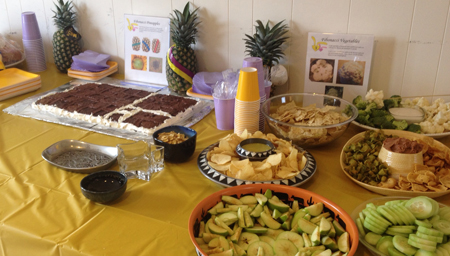
    The set up was intricate.

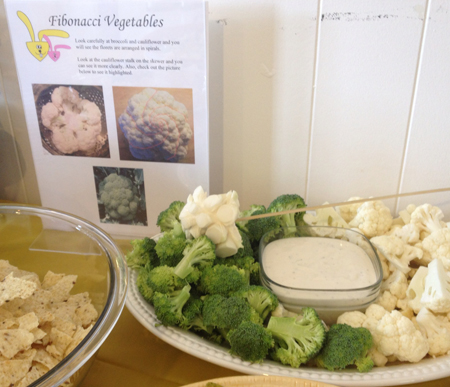
    The spread included descriptions of how each thing was related to Fibonacci.

    Someone said, “I’ve never been to a grownup’s three year old birthday party before.” Indeed, there were lots of informational pieces.

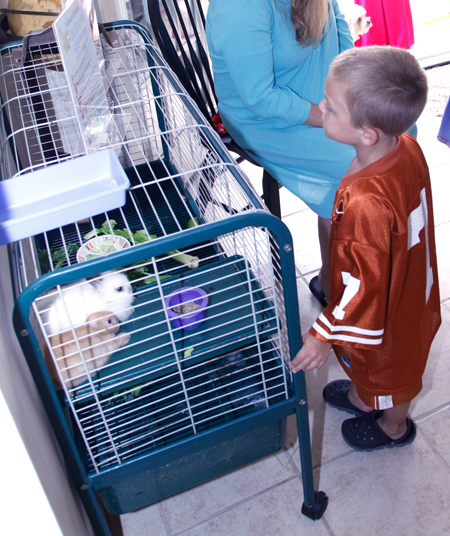
    We even had the Furry Fibonacci Bunnies out!

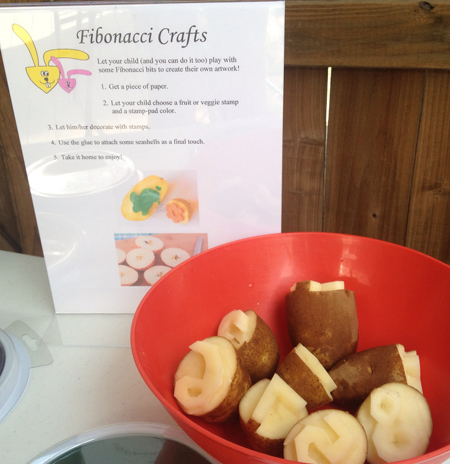
    And there were activities too!

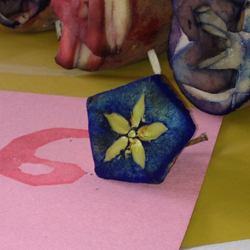
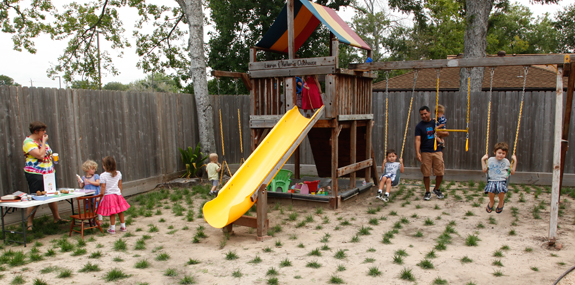
    My mom carved potato stamps with all the digits and I had apples cut open so the kids could stamp with them. There were also sea shells to glue on!

    We had glue and squares out for kids (and parents) to make their own Fibonacci Squares and Fibonacci Spiral.

    Even the grownups had a “craft” to do!

    Grownups AND kids had a great time!

    I refrained from pointing out the pseudo Cartesian Coordinate plane created by my new grass.

    Here’s Wil explaining the Fibonacci Squares to my three moms.

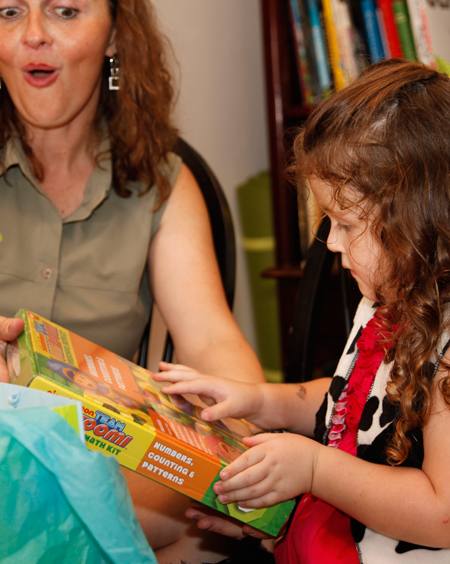
    Math presents!

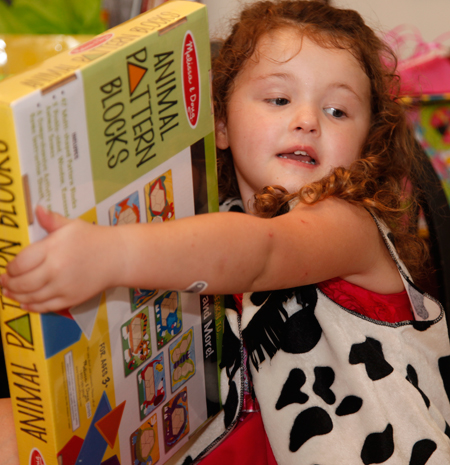
    How fun that K8 got some really neat math presents — like this animal pattern blocks from Melissa & Doug.

    And we were both excited about the UmiZoomi Preschool Math Kit!

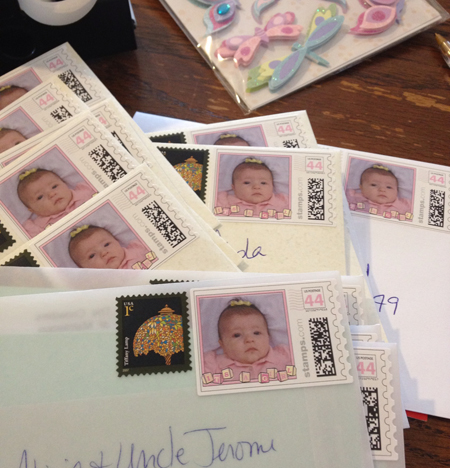
    Even the “Thank You” notes use math!

    I pulled out the stamps we ordered for K8’s announcements three years ago. Of course postage has gone up since then so we needed to add one!

    Do the activities with your kids!

    Here are some free downloadable printouts. Use them to play and learn more about Fibonacci.

    Share your thoughts in the comments or on twitter/x.

    Non-disclaimer: We paid for everything at this party. Kaplan gave me a nice discount for the books, though. Thanks, y’all!
    Bad-girl confession: Many of the images on the document stands were stolen from various online sources. Since I was using them for personal use, I neglected to give anyone credit. The downloadable documents shared above have legal images, though.

    You might also like:
  • Is Math in the 3 Categories of Learning?

    Is Math in the 3 Categories of Learning?

    Our world is struggling with education of all sorts. We know that STEM fields are in trouble. Not enough people are excited about taking the science and math classes needed to jump into them.

    But there’s another piece of the education puzzle that’s missing — writing.

    I talked to a primary school teacher at a social function today. She was telling me how students these days were often taught the algorithms of writing. One of which is the classic intro-supporting paragraphs-conclusion that I remember.

    I said, “Oh, so they don’t get taught to write in their own voice, and stuff like that?”

    “That’s just it,” she said. “They naturally write in their voice. But with the systematic methods we push on them it destroys it!”

    That sounds familiar!

    It pulled on my heartstrings — there was another basic subject that was competing with the almighty and all-powerful queen of subjects — reading.

    Seems writing has the same challenges as math — people think there’s a formula to it when really it’s about voice, personal preference, beauty and art.

    And writing, like math, is something people always do when they have to but rarely do just for fun.

    What do we learn — really?

    It made me really think about learning and teaching. All learning can be boiled down into one of three categories:

    1. Learning information (historical facts, spelling, times tables)
    2. Learning how to get information (reading, researching, googling)
    3. Learning how to give information (writing, speaking)

    Reading clearly has its place in #2, as does writing in #3.

    But where is math?

    When you teach math, are you only teaching facts (like in #1)? Or are you teaching children how to get or discover information (#2)? Or are you teaching them how to give or share information (#3)?

    I’ll leave my answers for next time. Until then — what do you teach?

    Share your thoughts in the comments or on twitter/x.

    You might also like:
  • Dumb Questions? Aren't They All?

    Dumb Questions? Aren't They All?

    I was labeled an “airhead” in high school. Until today, I’ve avoided telling people that. The moniker had a real negative effect on me.

    I was known as the kid who asks dumb questions. If my peers wanted to waste the last five minutes of class and not have to start another topic, they’d whisper at me, “Ask one of your dumb questions.”
    “There are no dumb questions.”

    If you’ve never said these words, email me now and I’ll send you $10.

    You’ve said them, haven’t you?

    Yup — we all have.

    The fact is that every question is a dumb question. Because someone else knows the answer.

    And the more people who know the answer, the dumber the question is. And the more valuable it is to ask it.

    Just because everyone knows the answer to a question, doesn’t mean it’s the right answer. It’s just the safe answer.

    I asked a question with an obvious answer.

    The story of how I earned my “airhead” nickname is a rather curious one. It happened like this:

    We had a guest speaker, a grownup, in our debate class. He was explaining details of the debate topic, which involved transporting water across some distance.

    He drew a series of pumps and downward sloping pipes on the chalk board. He explained that water had to be pumped up every so many feet so it could continue traveling the decline.

    I watched and listened. I wondered why they didn’t just pump the water straight through a horizontal pipe.

    I asked, “So why do the pipes have to be tilted?”

    The grownup responded with a snicker, “Because water runs downhill.”

    In retrospect, it is clear to me that I was dealing with an idiot. He lacked the novel thought, as well as nurturing behavior, to wonder what a 14 year old might be thinking when she asked the question.

    My classmates joined in on the grownup’s joke. “Wow, you don’t know that water runs downhill,” they jeered, “What an airhead!”

    Who knows what would have happened…

    Suppose that grownup would have encouraged my line of questioning.

    “The pipes have to be tilted because we let gravity do most of the work.”

    “But why can’t we just pump it straight through horizontal pipes?”

    “It’s not efficient to do it that way.”

    “What does it mean to be efficient? Do we have numbers on that?”

    “I’m not sure. Maybe that bears some investigation.”

    Perhaps I would have proposed that we create a pumping system so powerful, and efficient, that we didn’t need thousands of pumping stations? That might have led to other innovations.

    There’s no telling.

    And yet his snide remark, which gave the other students encouragement to be mean, shut down all routes of novel thinking for me.

    At least in that class.
    The airhead learns best.

    Novel thought — creative thought — is the foundation of innovation. It’s the foundation of learning.

    In math, thinking outside the proverbial box is an efficient way for a student to learn. Asking crazy, airheaded, dumb questions gets a student thinking about all sorts of things.

    The effort put into this novel thinking to solve a math problem will seem high. But the depth and breadth of a student’s understanding when they do this is incredible.

    And that understanding will carry to other things — decreasing the effort to learn even more!

    So why not be an airhead?

    Kids start out being airheads — thinking novelly and creatively. And grownups (like the guest speaker in the debate class) have an uncanny knack for destroying it.

    When your kids ask a dumb question, refrain from being a grownup. Ignore the fact that everyone knows the answer to that. See what happens.

    Encourage your kids to ask dumb questions. Give prizes for the most dumb question of the day — the one that sparks the most novel and innovative thinking.

    Epi-blog

    By the way, my peers continued this nonsense for years. It might be easy for me to say that I stopped wasting my dumb questions on those idiots. But in fact, they were just as squashed as I was.

    They were covertly given permission to do it by our teachers (except for Mr. Berkebile), therefore they continued.

    Share your thoughts in the comments or on twitter/x.

    You might also like:
  • 3 Statements to Reset Educational Assumptions

    3 Statements to Reset Educational Assumptions

    Forget it. If they don’t want to pay attention and learn, so be it.

    Perhaps you’ve heard others say this, or felt it yourself. It can be extremely frustrating trying to teach a child something who just doesn’t get it, doesn’t pay attention, doesn’t seem to care or who doesn’t seem to want to learn.

    There is an alternative.

    However, if we consider the bigger picture, we see another possibility. Much of a student’s behavior can be a protective front to keep them from feeling like a failure – after all, who likes that?

    Perhaps they act this way because the material is unfamiliar and therefore they don’t know if they can understand it. The uncertainty is a bit scary.

    “Well they don’t have to be scared,” we say.

    But they are. So… if they pretend they don’t care, and if they don’t try or if they hold back on really applying themselves, they can’t fail. Problem solved.

    What does this have to do with me?

    Those students who experience these negative feelings can exhibit behavior that can make it seem as if they don’t care. And then we take it personally. “They’re just really ungrateful of everything I do.”

    It’s our job to meet them where they are — in their distraction, interest, frustration, intimidated state, excitement, fear, wonderment, avoidance, etc. But if we are burned-out, frustrated, or feel unappreciated, it’s hard to do that.

    So how do I get there?

    Adjusting just a few assumptions can put us in a more relaxed, sustainable place to offer reassurance and hope to kids who feel this uncertainty. Doing this is just as much for our self-care as it is for their education.

    Use these statements to reset your assumptions.

    These guidelines are designed to help us “reset” our assumptions in the service of positively impacting our approach to students.

    1. It’s about them, not us.

    When kids avoid or check-out, most of the time they aren’t doing it to “get back” at us. They do it to avoid the concern they feel about whether they’ll be able to meet a challenge. Or because they’re worried about looking incompetent in front of their peers.

    They may even act out to divert attention away from their academic ability. This is another protective feature — again, not about us.

    Adjusting this assumption can free up the compulsion to defend ourselves. It can also allow for more time and energy for them.

    2. Kids have different levels of abilities. Period.

    If we assume this, all of a sudden we aren’t expecting Joe to perform as well as Roger, or vice versa. This allows us to determine, without judgment, where Joe and Roger are with their abilities and to ask independent, non-comparative questions.

    “What does Joe need to further his learning and education.”

    And completely separately…

    “What does Roger need to further his learning and education.”

    3. They ARE trying.

    There’s an assumption that all students CAN understand “if they just try” hard enough.

    When we take this into the classroom, it’s easy to become frustrated (All they have to do is…), become resentful (I am so tired of busting my tail and they’re not caring) or even retaliate (If they don’t want to work in class, I’m just gonna load them up with a ton of homework. That’ll teach ’em!).

    Assume that they ARE trying and ARE understanding as much as they possibly can. Doing this rids us of the temptation of doing things such as shaming and scolding — which has been shown to be counterproductive to learning.

    It also puts us in a “glass half full” position of recognizing what they DO learn, rather than focusing on what they don’t. (Half cup of motivational praise, anyone?)

    Keep these statements handy.

    Write the above sentences down and keep them nearby. Read them at the beginning of every day, or every lesson or class even. It helps to have brief, yet constant reminders.

    After a couple of weeks, see if you can tell a difference in how you feel, your stress level, and the reaction of your students.

    Try them out and share know how it goes in the comments or on twitter/x. Did you come up with some of your own assumption adjustments?

    You might also like:
  • Insight into the Development of That’s Math!

    Insight into the Development of That’s Math!

    Update: The That’s Math! membership site is no longer available. However, this post still has useful and entertaining information.

    While developing the That’s Math! membership site, that launches today, we’ve had some interesting discussions about wording. Because of our different backgrounds, we’ve had to have some lengthy clarifications. Bon, with her technical math info, and myself, with ethical/credible research wording.

    Below is a rough “transcript” sample compiled from a couple of discussions.

    Bon: Math anxiety makes it so that kids lock up – they’re paralyzed with fear and then can’t do math.

    Wil: Well, actually, the anxiety they experience doesn’t prevent them from doing math. It just makes it much more difficult.

    Bon: And That’s Math! will fix that.

    Wil: No. We aren’t trying to “fix” anything. Just help parents with positive math exposure.

    Bon: And the research proves that the parents talking about math in front of kids will take care of that. Got it.

    Wil: You have to be careful with that word “prove”. We have to say the research suggests that kids who have a supportive environment are more likely to engage in math exercises and homework. Part of that support is talking about math in a positive way.

    Bon: Great! So we support the parents by helping them discover math that happens in their environment.

    Wil: Right. And the exercises we’ve designed help parents to practice saying that math in front of their kids. When the kids hear Mom and Dad talk about math, the kids learn to be not so scared of it.

    Bon: We act just like we see our role models act. Mom says “hey, there’s math” instead of “I was never good at math, it’s so hard!”

    Wil: Right. It’s called social modeling. We pick up on what other people do, whatever it is. There’s all kinds of research to support that social modeling is how we learn how to act.

    Bon: So “social modeling” is doing stuff where kids see it. And if parents use that for math specifically…

    Wil: Exactly and…

    Bon: …and BAM! Their kids will love math and be geniuses!!!

    Wil: It doesn’t mean they’ll love math or be geniuses!

    Bon: But it will get them closer to being geniuses.

    Wil: Well, there’s research that supports that they are likely to engage more, so I guess you could say they’re getting closer to being geniuses.

    Bon: Virtually proving that using positive math talk like we teach in That’s Math! will improve your kids’ grades.

    Wil: Dude. You’re killin’ me. But I like the enthusiasm.

    Are you ready to positively influence your kids in math? Learn more about the That’s Math! membership website now!

    Share your thoughts in the comments.

  • Practice, Practice, Practice – Really?

    Practice, Practice, Practice – Really?

    Math is not a spectator sport.

    Who said it first? Maybe Jerry Mortensen. Maybe George Phillips.

    But hundreds, maybe thousands, of math teachers have said it and put it on their syllabus.

    Because it’s true.

    But does this mean that students have to “practice, practice, practice”?

    And what exactly does that mean?

    Say to me “practice, practice, practice,” and I’ll growl at you.

    You’d might as well say to me, “I don’t know squat about your learning style and aren’t interested in finding out. But I know that you’d better do all 50 problems or you’ll lose points on your homework grade.”

    So I prefer to think of this triad mantra in three phases: Practice Phase 1, Practice Phase 2 and Practice Phase 3

    Practice Phase 1 is isolated practice.

    When a student learns a new math concept, he or she should apply it a few times, by itself. This is what’s offered in the problem sets of textbooks: isolated practice of the new math skill.

    This practice is also an assessment phase. At many points here, the student can ask, “Can I do this? Do I understand this?”

    Regardless of the answer, the student can proceed to Practice 2.

    Why “regardless of the answer”?

    Practice phase 1 is what’s commonly referred to when grownups say “practice, practice, practice.” But over practicing can be detrimental.

    Some kids need to nail the isolated practice before moving on.

    Some kids.

    And some kids will become annoyed with it and need to move on to see the value of the skill.

    Refrain from giving 50 problems just because “practice makes perfect.” It doesn’t. Practice sometimes makes frustration.

    Let your child move on to practice phase 2. You can even let them skip assigned problems. She or he may return to the isolated practice in phase 1 later or mentally isolate the skill within the “bigger picture” in phase 2 or 3.

    Practice Phase 2 is “big picture” practice.

    This practice phase helps solidify the math skill. It should teach the integration of the skill into the full toolbox of math skills.

    The math skills ancillary to the main skill being practiced, are themselves being practiced (hopefully in phase 2 or 3). How fluent a student is in these ancillary skills has an impact on his or her perception of achievement of the main skill.

    Textbooks offer a problem set for this phase, but it’s often disguised. It just looks like harder problems.

    It’s helpful to point out the ancillary skills being practiced. This helps affirm how much a child is learning and aids in building confidence.

    Practice Phase 3 is ongoing.

    Real skill is realized when it’s integrated without thought. For me this was always at least six months after first learning a skill. Sometimes it happened years later.

    And there are some things I didn’t “get” until decades later.

    Which means that practicing a skill must be continuous – even if a student doesn’t fully understand the logic underlying the process.

    Of course this phase is subtle if not completely invisible. But instructors can point out when the “old skills” come into play long after they are learned.

    Example: Factoring

    Skill: Use the distributive property to remove a common factor from an expression.

    Practice Phase 1 – Isolated

    \(3x + 3y = 3(x + y)\)

    Or with letters:

    \(xy + xz = x(y + z)\)

    Practice Phase 2 – Big Picture

    Here the skill is integrated with factoring numbers:

    \(3x + 6y = 3x + (3 \cdot 2y) = 3(x + 2y)\)

    Here it’s integrated with rules of exponents:

    \(3x^2 + 5x = x(3x^{2-1} + 5) = x(3x + 5)\)

    This one’s integrated with combining like terms:

    \(3x^2 + 4x^2 + 5x = 7x^2 + 5x = x(7x^{2-1} + 5) = x(7x + 5)\)

    Here there are fractional exponents:

    \(3x^2 + 5x^{\frac{3}{2}} = x(3x^{2-1} + 5x^{\frac{3}{2}-1}) = x(3x + 5x^{\frac{1}{2}})\)

    Practice Phase 3 – Ongoing

    At some point a student might notice that combining like terms is equivalent to factoring the common term then combining the numbers, like this:

    \(3x + 5x = (3 + 5)x = (8)x = 8x\)

    So, really – how much practice and when?

    A student should practice in phase 1 until he or she is comfortable. Remember, over practice can be annoying and seem punitive.

    And punitive math is never effective.

    A student should practice in phase 2 based on his or her comfort level. This is a great time for parents/instructors to notice weaknesses in other skills, too.

    Practice phase 3 is, well, ongoing.

    It’s really helpful to note, out loud, where old math skills come into play. Instructors should always be on the lookout for ways to do this.

    Even things like long division show up in the more advanced skill of polynomial division.

    Pay attention to your student.

    Some kids may respond to the “practice, practice, practice” mantra. Some may get annoyed at it (like me). If your child needs and wants more top-down learning, allow it.

    Don’t force phase 1 practice – offer it.

    And if you see a deficiency in an ancillary skill in phase 2, bring them back to phase 1 on that one.

    Math really isn’t a spectator sport. But that doesn’t mean you have to drill like crazy on it. Adjust the teaching and practicing according to the child.

    Thanks to my math cousin, Vijay, for inspiring this article with his commnent on another post.

    Share your thoughts in the comments or on twitter/x.

    You might also like:
  • Math Skills in a Math Toolbox

    Math Skills in a Math Toolbox

    We don’t teach each new math skill just to have something to do during the next math lesson. And yet textbooks make it look like we do.

    Math skills are presented in bubbles called sections. The section doesn’t show how the math rule being taught connects to past or future lessons. Nor does it point out what previously learned skills or rules are currently being employed.

    Okay, it might note that this section is similar to the others in the chapter. But how often do you see a section point out how you’re going to use the skills you learned in a previous course?

    Kids rarely understand that each level of math is taught so that the tool that’s being practiced can be used later – in another math lesson or math situation.

    They don’t see the long term growth of math skills and math maturity – their math toolbox.

    Math skills are tools.

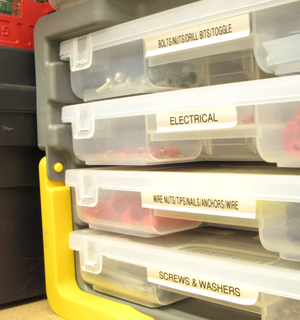
    Take a look in any man’s garage and you’ll see a plethora of tools.

    Point one out and ask the owner these things:

    1. What is this?
    2. Under which situations will it function (and under which won’t it)?
    3. In what situations would it be helpful to use?
    4. Do you have the confidence and ability to use it when you need to?
    5. Have you ever used it when there was something else that would’ve worked better?

    Chance are, he’ll have thorough answers for 1, 2 and 3. And for number 4 – he’ll look at you like you’re nuts and say, “Well, yeah!”

    For number 5, he’ll say, “Well, of course. Sometimes I’m not sure what will work best, so I just pick a tool that I know can work. If it turns out to not be the best tool for the job, it’s no big deal. It might have taken a little longer, but it still got the job done.”

    Tools accumulate – and add to each other.

    Mr. Garage Owner didn’t collect a whole bunch of tools that he’s clueless about. He likely wanted to build one thing and realized a tool could help. So he bought it.

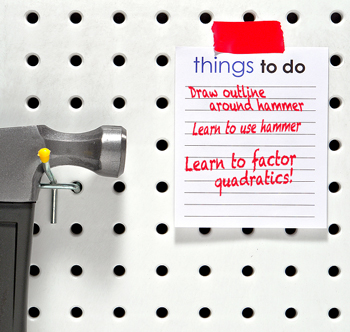
    He learned how to use it, then hung it on the wall. Probably on a pegboard with the shape of the tool outlined.

    Then he wanted to fix something else. He could have used his tool, but if he had another tool as well, it would make it even easier.

    So he bought another tool.

    Together with the first tool, he fixed his gadget then hung the new tool on the wall.

    He continued this way until his pegboard was full and he was building more tool storage space in the back yard.

    Now he knows each tool, when and how to use them, and confidently pulls them out each time it’s necessary.

    And if he chooses the wrong tool for the job, he gets over it quickly.

    Teach math like the kids are accumulating tools.

    When you start a new section in your math lesson, review the math rules that they previously learned. Show how the newest problems may (or may not) be solved with the old math skills alone.

    Present the new skill or math rule thoroughly. Be clear on what it is, how it can be used and under what circumstances. Also point out where it can’t ever be used. Like “adding to both sides” can’t work when there’s no equal sign.

    Point out some areas where the new math rule might be helpful. Point out some areas where the new rule might not be the best for the job, but it would still work.

    Show how to use the new math rule along with the old rules (pointing them out everywhere) to achieve results.

    Have them make a list of all the math skills they’ve learned – a pegboard outline – so they can be kept handy.

    Let them play.

    Math is typically thought of as the subject where “there’s only one way to do it.”

    BAH!

    Just like Mr. Garage Owner, using the non-optimal tool for the job still gets the job done. As long as it works (can’t run an electric drill in the rain, after all).

    So let them play. Turn your math lesson into a time where they can use any math rule they want. Let them discover their own confidence in choosing tools.

    And let them try out tools that might not be the best for the job.

    As they grow their math toolbox, they’ll grow in math maturity and confidence!

    Share your thoughts in the comments or on twitter/x.

    You might also like:
  • Why You Should Give Your Phone Number to Students

    Why You Should Give Your Phone Number to Students

    This is the 3rd in the draft purge series where I’m throwing stuff out. I’m down to 56 drafts – down from 70! (not factorial)

    I’ve taught in the classroom for over 17 years. I never hesitated to give my phone number out. In all those years, with all those kiddos, I got one drunk call. And that was an accident – he meant to call Ben and not Bon.

    It was a good idea. And I’ve had good results.

    So why should you do it?

    To show you’re human.

    If you teach math, you just might be viewed as supernatural. Or inhuman, depending on the student. Famous, important or supernatural people don’t just give out their phone numbers willy-nilly.

    If you give yours, you’re showing your human side. You have to keep the authority, but you can give a little. Let them in.

    To offer a ray of hope.

    They will probably be nervous about calling, but they’ll text. And they’ll understand if it takes you a while to get back to them. If they have this lifeline, they won’t lose the confidence

    they have gained in your presence.

    I’ve heard hundreds of students say, “I was doing okay in class, but when I got home, I just couldn’t understand what I’d been doing.”

    There’s a magic of the teacher standing there. It’s a safety net. And it gives many students the confidence they need to keep going.

    It’s a fake net, but it works.

    If they know they can text you, they maintain this safety net at home.

    To show trust.

    For some reason, classrooms have gotten into the “us vs. them” mentality. Teachers are the bad guys to the students. Teachers may label kids unfairly, too.

    Show your students you’re not a label maker. Let them know that you have trust and faith in them. Give them your number!

    Will you do it?

    How do you show you’re human? How do you give hope and show trust? Will you try the phone number sharing?

    Let me know in the comments and don’t forget to share this on twitter!

    You might also like: