For a while, a long while, I let this math blog just sit. I didn’t want to delete it. I spent too much time on it and I knew it was full of great stuff that was still being used. But I wasn’t in love with writing on it.
In my lethargy, the hackers and jerks managed to infiltrate and completely take it down. That was on October 23, 2025.
Today is December 30, 2025. I rescued all the posts and will gradually get all the good ones reposted. But I have to start over, creating the whole website from scratch.
Luckily the wayback machine (internet archive) has a nice snapshot of the images and layout. It’ll take me a while, but I’ll get it all back up. Maybe even with some improvements!
If you are looking for a specific post – something you remember from long ago or something you want to know about – leave it in the comments. I’ll hunt it down and get it posted.
I’m looking forward to having all those great math stories, thoughts and tips live again – I hope you are too.
This post originally appeared on The HSBA Post on December 17, 2012.
This year, money’s tight. But we’ve had tight Christmases before. And what I know from tight budget Christmases is that they’re a drag.
I know – giving isn’t the reason for Christmas. But it’s really fun to choose things for the ones you love that make their faces light up.
Nothing makes you feel like you’re celebrating Jesus’s birthday like having a family member say, “Oh, wow! This is the coolest thing ever!”
So when I first thought about how we were going to manage Christmas giving this year, I had a small idea: give things I already have.
I had no idea that small idea would grow to be huge.
“If you don’t use it, pitch it.”
I’m married to a professional organizer. So I constantly hear stories of his clients and the things he coaches them. The big one is, “Yes you could use it, but do you use it?”
I own a lot of things that I don’t use. But they are beautiful or special — so much so that I ignore the advice. I just can’t pitch them — or even donate them — because… well, because I just can’t.
But if I shared it, now that’s a different story.
Excitement welled!
As I looked around at the things in my home that are fabulous and unused, I got excited. I went from shelf to shelf, drawer to drawer, discovering all the cool things that I could give.
Then I thought about all the things in my mother’s attic. I gave her a call.
“How about a special Christmas gift for you, Ma?” I asked. “Can I come over and get all my boxes out of your attic?”
Now she got excited.
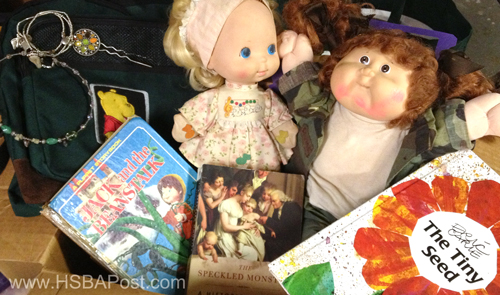
So last week I went “shopping” in Ma’s attic. All my old toys, books, crafts, clothes, and jewelry are going to find their way into hands that will love them like I do. And use them!
I’m recycling, reusing, cleaning out my home and Ma’s attic – all on a $0 budget.
And I’m celebrating the way Jesus would – by sharing!
How about you – are you on a shoestring budget or a $0 budget, too? Tell us about it in the comments!
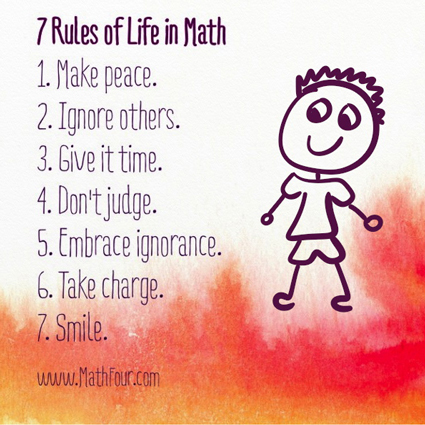
I’m not big on sappy sayings or lists. But when I saw a list of “7 Rules of Life” on Facebook, I couldn’t help but see the 7 Rules of Life in Math in it.
1. Make peace.
Did you have a math teacher laugh at you? Write him a letter and tell him he was a meanie.
Did you have a math teacher say you weren’t good at math? Find her number, give her a call and let her know that she was wrong.
Find a way to make peace with that past event.
You’re not bad at math. You never have been. You just had some teachers that made you feel yucky.
2. Ignore others.
Forget about what others think. Your learning in math is your business.
Don’t worry yourself wondering if you’re learning as fast as someone else. If you’re happy with your learning, that’s good enough.
3. Give it time.
Time helps — a lot.
Learning isn’t something you sit and do today and then have in your brain forever. Often we put things in today and they don’t really make sense until 6 months from now.
And practice over time helps it to gel. So be patient.
4. Don’t judge.
Just as your learning is yours, other people’s learning is theirs. If they don’t get it, avoid launching into the damaging “all you have to do is…” routine. Those words say, “Anyone can do this. It’s easy. And if you can’t, well… you’re an idiot.”
Knock it off.
Everyone learns differently — just because you get it quickly, doesn’t mean you get to be pushy about teaching it to others.
5. Embrace ignorance.
It’s okay to not know the answers. Math is about exploring. Discovering.
If you don’t get the answer today, come back later. Don’t beat yourself up about it.
In spite of what all the textbooks and teachers say, math is not linear. If you don’t get something today, keep rolling. It’s okay to skip it.
When you least expect it, you’ll understand that “missing” concept so much better than if you tried for force yourself into it too soon.
6. Take charge.
No one’s in charge of your learning except you. Really.
If you have to play the grades game, fine. But remember to learn along the way.
Don’t jump through hoops for the sake of jumping.
7. Smile.
The next time you’re smiling, look around. There was math in what you did that made you happy.
Maybe you saved 75% off a great dress. Or gotten to an event on time. Or had more people show up at your party than you expected.
All of those are math. And you’re smiling about it!
So keep smiling and share your thoughts in the comments or on twitter/x.
This is a math story, but the names have been changed to protect the innocent.
UPDATE June 2026: When going back through content on MathFour.com, I read through this and it took me a while to figure out what the heck I was writing. If you start reading this and feel like you’re confused, try using this word unscrambler tool for the proper names in this story.
There once was a strange little world called Lears. It was quite small, relatively speaking, and had only one continent. The residents called the continent Tailorsan and they named the single ocean (with all its very strange fish) Ralitanisor.
In Tailorsan, there was a single city called Egrestin. Anyone living outside of the city was called a “mice lad.” (People weren’t very nice to those country folk!)
All the Egrestins lived happily in Egrestin, it seemed. At least until one day…
Crime set in!
There was a group of Egrestins who didn’t seem to like anyone. They would meet regularly and fight. Everything they did was hateful and mean.
So the more optimistic and positive of the Egrestins began to migrate to one side of the city. Soon they decided to form an official, and gated, neighborhood.
They held a contest for the name of their new community and Mr. Reoz, a very liberal man, won. He had chosen “The Lehow Urbsmen.” (A rather fancy name, but they were the snobs of the city.)
“That outta keep out the rubbish,” Mrs. Neetiff said to some of her neighbors as they finished the gate around their shiny new community.
Mr. Reoz overheard her and was horrified.
“Mrs. Neetiff. I understand that we don’t want crime in our neighborhood,” said Mr. Reoz, “and we don’t like all the negativity. But the people outside of The Lehow Urbsmen aren’t ‘rubbish’ — they’re people too!”
She responded, “Well, how about this, then… why don’t you move outside our nice little community!?”
Mr. Reoz looked at her and thought about it. He never liked her much — and she was so odd.
He said, “Since I picked the name for the community, I don’t really think that’s right. But I’m not sure I want to live inside the gate with the likes of you!”
So they rebuilt the gate to exclude Mr. Reoz’s house. He remained a part of the The Lehow Urbsmen, but just not inside the gate.
He named the gate “The Alasturn” — a word that means “The Optimists” in the Learsian language. He hoped that giving them that name would have a positive effect on them.
He became the middle man.
Mr. Reoz eventually became friends with everyone in Egrestin. In his networking, he was able to introduce people from inside the Alasturn to other Egrestins.
It seemed that through him, each member of the gated community perfectly matched someone outside of the community.
And they lived happily ever after!
Can you draw the map of Lears? What does this have to do with math? Did I miss anything?
I’m substitute teaching 5th grade Language Arts today. I just found a handout with a set of questions titled “Peck’s Questions.” I quickly figured out (with my amazing powers of deduction) that they were questions you could ask about a novel.
After reading them, though, I thought, “Why don’t they have something like that for math?!”
So I did some research.
Before creating the super math list, I thought I would find out a little more about the original list.
Apparently this Richard Peck guy is pretty famous in young adult literature. The list is officially titled, “Ten Questions To Ask About a Novel” and was published in the The ALAN Review in the Spring, 1978 edition. Here it is:
What would this story be like if the main character were of the opposite sex?
Why is this story set where it is (not what is the setting)?
If you were to film this story, what characters would you eliminate if you couldn’t use them all?
Would you film this story in black and white or in color?
How is the main character different from you?
Why would or wouldn’t this story make a good TV series?
What’s one thing in this story that’s happened to you?
Reread the first paragraph of Chapter 1. What’s in it that makes you read on?
If you had to design a new cover for this book, what would it look like?
What does the title tell you about the book? Does it tell the truth?
The list allows students to dig in a little deeper to the novel. It helps them get creative and think about the story in ways they wouldn’t normally.
And it trains them to do this with novels throughout their lives.
Why a list of questions about math problems?
Before creating them, I decided the questions should do the following:
Allow the student to dig in deeper to the math problem, and the math behind the problem.
Help the student to think about the problem in ways they wouldn’t normally.
Let the student get creative in thinking about the problem.
And of course doing these things regularly will train them to continue to do this with all math problems through their lives.
Ten Questions to Ask About a Math Problem
Who do you think created this math problem? Was it a man or woman? How old were they?
Who do you think first figured out how to do a problem like this? How long ago?
Imagine this is a real problem asked by a real person. What is that person’s job? Why are they asking this question?
Why does this problem use the scenario that it does?
If you could rewrite the problem using the same numbers and getting the same numeric answer, what scenario would you use?
What numbers would you use in the problem to make it easier? What numbers would you use to make it funny?
Is there a story that can be created before or after this math problem that makes sense?
Has the situation in the problem ever happened to you or someone you know?
What about this math problem appeals to you? If nothing, why did you continue to work on it?
If you had to illustrate this math problem, what would it look like?
(UPDATE Nov 5 from suggestion in comments) Can you develop some sort of theory as a result of solving this problem?
(UPDATE Nov 5 from suggestion in comments) How does this problem relate to problems you have encountered before?
Will it work?
Try using it yourself first. Get a feel for what each question means and how it might be answered.
Then try it on your children. Which questions work? What questions should be changed — and to what?
Share what you find in the comments or on twitter/x so we can have a super solid list of Ten Questions to Ask About a Math Problem!
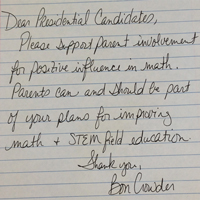
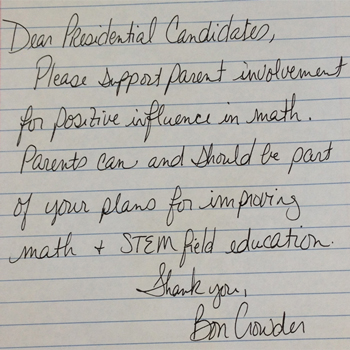
This is an open letter, please feel free to share onTwitter, via a printed copy or on your favorite social media site.
Dear Mr. President and Mr. Romney,
Thank you for supporting education and for being dedicated to improving the math learning in the United States. Americans all know that we may be in trouble when it comes to competing with the world in STEM fields — now and in the foreseeable future.
I am not writing to give my method of how to fix the schools. We have plenty of those — both in theory and in action.
Instead, I am writing to ask that you direct some of your considerable support towards a mission that is in great need of it: parent involvement for positive influence in math.
WHAT’S MISSING
Consider the influence that math-anxious grownups, such as parents, grandparents, aunts and uncles, have on young children. Research has shown that social modeling — parents saying, “I was bad at math too, honey” — has a significant impact on the attitudes and level of engagement kids have when going into a math classroom.
All the money invested in and all the programs that we currently use are ineffective if our children see their role models openly announcing that they don’t like or do math.
What if we could get parents to notice the math that they do effortlessly all day, every day, and announce THAT to their children? Children would then see that math is something done daily — not just in a classroom with pencil and paper. Children would enter their math lessons excited to engage in the next math-related discussion. And research bears out that this engagement is what facilitates true learning.
WILL IT WORK?
We have seen this work in the literacy movement of the past decades. Reading is Fundamental, and its competitive and companion programs, have created a society where parents not only read to their children on a daily basis, but also read to their children in utero!
How ridiculous to consider that reading to a child at such a young age will help them learn to read! But what it does do — and why the practice is effective and encouraged — is turn parents into positive reading role models. We have turned a society that was once comfortable with illiteracy into a society of readers. All from positive social modeling!
And what is lacking in our STEM education, nationwide, is this positive influence from adults towards children regarding math. But it CAN be done!
WE NEED YOUR HELP
Please integrate a parent involvement element in your education programs to help parents learn to to be a positive influence in math. We’re working at a grass roots level but we can enact this change much more quickly if we have your help. We can stop leaving the children behind if we get the parents to start exerting educational influence early.
With kindest regards, Bon Crowder, Writer & Publisher, Math Mom & Education Advocate
This is an open letter, please feel free to share onTwitter/X, via a printed copy or on your favorite social media site.
This quote, by Theodore Roosevelt, is from his speech “Citizenship In A Republic,” delivered at the Sorbonne, in Paris, France on 23 April, 1910:
It is not the critic who counts; not the man who points out how the strong man stumbles, or where the doer of deeds could have done them better. The credit belongs to the man who is actually in the arena, whose face is marred by dust and sweat and blood; who strives valiantly; who errs, who comes short again and again, because there is no effort without error and shortcoming; but who does actually strive to do the deeds; who knows great enthusiasms, the great devotions; who spends himself in a worthy cause; who at the best knows in the end the triumph of high achievement, and who at the worst, if he fails, at least fails while daring greatly, so that his place shall never be with those cold and timid souls who neither know victory nor defeat.
If you’re in tears and your heart is on fire, you’re probably a soldier in the Math Revolution.