
Author: Bon Crowder

  • A Teacher Remembers 9/11

    A Teacher Remembers 9/11

    U.S. Navy photo by Photographer’s Mate 3rd Class Ramon Preciado (Public Domain)

    Written on September 11, 2011

    Ten years ago today I learned about kids. Not that I didn’t know anything about them before. But I learned a great deal in one day because of the horror that took the U.S.

    I was teaching at a high school – something I did for about 6 months – and doing a fine poor job of it. I had taught almost ten years of college math and was struggling with the concept of discipline and lecture – simultaneously.

    The downright creativity of those guys was amazing – they could come up with the most ingenious ways of conning me into stuff. They were brilliant!

    We were in Algebra when I read the news.

    The email from the principal came through with an exclamation mark denoting high priority. I didn’t pay much attention to those flags because I didn’t have a whole lot of respect for her – she treated children and teachers alike, as if we were 2nd class citizens to be disciplined for rules that seemed to have no basis.

    So my class went clueless for the hour. It wasn’t until the next class arrived that I learned something was up.

    I headed back to the email – perhaps this time there was a wolf.

    Sure enough, the super creepy email was there. Hard to wrap my brain around. Especially since I had never been to New York and hadn’t a clue what the World Trade Center Twin Towers were.

    I went to the library during my off period and watched the subsequent disasters unfold.

    And I watched the students’ reactions.

    When I first started teaching there, I was very cautious in listening to other teachers who labeled certain kids as “bad.” In fact, I started to favor the students that had earned that moniker. How can you be “bad” at 14? Maybe on your way to bad, but certainly not there yet!

    And sure enough, one of my favorite students (with a “very bad” label) was the most devastated by the tragedy. “Why?” he asked with tears in his eyes. “Why would anyone do that? I just don’t understand.”

    No doubt the “good” kids who blew it off and make terribly inappropriate jokes did so out of personal protection.

    It was strange to see the various reactions of all the different kids. And many of them were not what I would’ve expected.

    There are many things I’ll never forget.

    Indeed this was a moment, a day, and ten years that I’ll never forget. And most importantly, I’ll also not forget how children take things.

    Kids are people too. And they aren’t bad. None of them.

    If you’re a teacher, know this. If you’re a parent, remember this.

  • Counting with Big Numbers

    Counting with Big Numbers

    Last night I had the privilege to meet and teach Eddie*, an ESL student from Mexico, at Literacy Advance of Houston. He was there to learn in the “Math and Your Life” class, as part of the “Math and…” class series.

    I didn’t realize I was there to learn too.

    I walked in prepared to discuss just about anything math related. And I’m glad that was the preparation I did.

    Eddie was interested in something that I’ve long struggled with. And I’m guessing many children struggle with it, too.

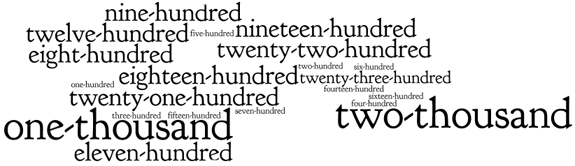
    In English, the number 1600 is pronounced both as sixteen hundred and as one thousand six hundred. I still get these mixed up. Not when I stop and think about them, but when I casually and quickly throw them out.

    Husband is often stunned when I tell him I saw a new suburban at the low low price of thirty-five hundred dollars. Of course I mean thirty-five thousand dollars!

    It’s not just me, I guess.

    I wonder how many other grown-ups still struggle with this. And how often we neglect to teach this to children.

    We are quite accustomed, and comfortable, with teaching our youngsters to count from 1 to 10. Were amazingly proud when we can get them to count from 1 to 20.

    Is that enough? Based on my conversation with Eddie last night, no.

    Teach them skip counting with hundreds!

    Why not use the 1-20 model with hundreds? Like this:

    one hundred
    two hundred
    three hundred
    .
    .
    .
    eight hundred
    nine hundred
    one thousand
    eleven hundred
    twelve hundred
    thirteen hundred
    fourteen hundred
    .
    .
    .
    nineteen hundred
    two thousand
    twenty one hundred
    .
    .
    .

    Teach them all sorts of counting!

    I suggested in this article to count with your children by fractions. It never occurred to me to count by giant numbers.

    What other ways should we teach children to count? Share your ideas in the comments.

    *”Eddie” is used as a variable – i.e. his name has been changed because I didn’t ask his permission to talk about him.

    Related articles
  • Back to School Math Clothes

    Back to School Math Clothes

    For many across the  world, today is the first  day of school. For after schooling families, or blended homeschoolers going to a co-op,  you’ve probably been shopping for new clothes for a few weeks. For those in areas that offer tax-free back-to-school weekends, you no doubt have taken advantage of that. Even if you unschool on a sailboat hopping around the coast!*

    And why should the children have all the fun? Why not do a little back-to-school shopping of your own?

    And of course, don’t just buy any clothes, buy math clothes!

    Math accessories dress up a business or formal look.

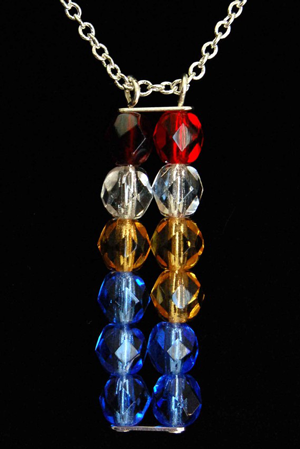
    At a fancy business meeting, or a full tilt gala, show your  affinity for math with your jewelry. This Fibonacci sequence necklace is a beautiful addition to the little black dress or business suit:

    Notice the Fibonacci sequence: 1, 1, 2, 3, 5

    This artist is working with me to create some really neat Fibonacci earrings and matching bracelet. We’re also working on other patterns and concepts for jewelry that says, “Math is cool, and it’s pretty too!”

    Business casual means t-shirt with a blazer.

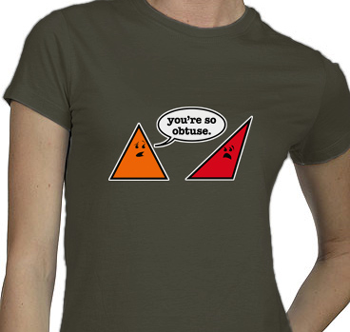
    My favorite outfit is a math T-shirt with a blazer over the top. I wear some slacks and modest heels and I’m ready to take on the world. Here’s a T-shirt that I found that’s on its way to me now:

    This “obtuse” shirt is created by Matt at ExBoyfriend Collection (now BoredWalk), who is generous enough to give one to me! I’ll post a photo in full dress when it arrives.

    It reminds me of what my Ma used to tell us: “Quit being so obtuse!”

    Matt creates other math t-shirts too! We’re looking at collaborating on some – so keep your eyes peeled.

    Take it to the limit with casual wear.

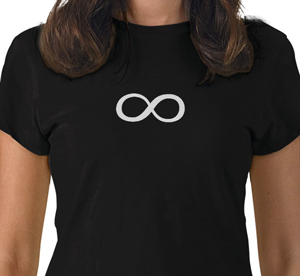
    You can also wear a t-shirt as just a t-shirt, with shorts or capri pants.

    This infinity shirt is from Mike who publishes MathFail, Spiked Math Comics and Math Shirts.

    What’s your favorite math outfit? Are you hitting the stores for yourself this back-to-school season? Share with us in the comments!

    * BTW, that’s my homeschooling dream – on a sailboat, unschooling around the coast!


    Related articles
  • The Flipped Classroom – Getting Back to Traditional Education

    The Flipped Classroom – Getting Back to Traditional Education

    Years and years ago there was a math education model. It went like this:

    Children would read a section or chapter of a textbook the night before class. They would come to school the next day ready to ask questions and do hands on practice with a teacher close by to help.

    This was a “normal” classroom situation.

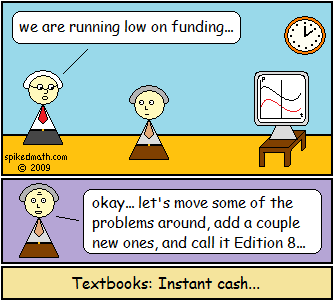
    Over the course of many years, textbook publishers have squeezed more and more topics into textbooks. Thus, they have squeezed more and more detail out. Which has gotten rid of much of their value.

    As math texts had their details extracted to fit more topics, children began having difficulty comprehending them. Even if they attempted to read the section the night before, the teacher would have to fully explain it during class the next day.

    Thus the first flip happened!

    Kids gave up altogether on trying to read math textbooks. They soon realized that the teacher’s instructions to “read the section” as homework was just an empty request. The teacher would explain all of it the next day anyway.

    This model, the first flipped classroom, has sustained for quite some time.

    Enter web-based video.

    Fun to watch and easy to rewind, online videos allow kids to flip back the model. Because videos aren’t regulated, nor monetarily driven, anyone can make them – including people who are really good at it.

    Yes, a pair of teachers at Woodland Park officially did the first flip. But check out what kids have done without teachers. They found Cousin Sal’s videos before it was ever <cue music> Khan Academy.

    They inherently knew that there could be more and that there was a better way to learn. They started watching videos at night after they didn’t get everything they needed during the day. And they started going to school the next day asking questions of their live teachers: “I saw this video on YouTube and he did it this way… can I do it like that?”

    We didn’t flip anything.

    Yes, we think we’re really clever and have this great “flipped classroom” model. Guess what? We adults haven’t done squat – we’re just writing about it and making cute infographics.

    Let’s give credit where credit’s due, shall we? Textbook companies drove the first flip. And kids are driving this one.

    Not us.

    Related articles
  • [50 Word Friday] The Original Flipped Classroom

    [50 Word Friday] The Original Flipped Classroom

    Years ago, kids learned from a textbook at home and came to class the next day prepared to do hands-on practice.

    Since then, textbooks have minimized details to maximize topics, rendering them useless.

    Students required the model to flip to school learning and home practice.

    Luckily, it’s getting flipped back.

    Learn more about 50 Word Friday here.

    Other 50 Word Friday Articles
  • Cheesy Math – No, Really. Math & Cheese!

    Cheesy Math – No, Really. Math & Cheese!

    Last night was taco night and my job was to grate the cheese.

    I didn’t get too far in before I noticed some math.

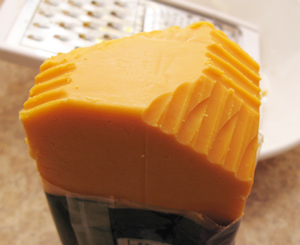
    For some reason I always start grating on a corner. Then I rotate the block so I’m grating on another corner. After doing this a few times I noticed the angles I was creating:

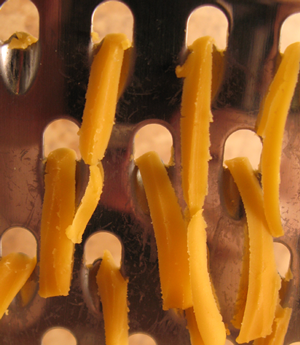
    And what exactly are the shapes, anyway? What is the shape of the grating holes of the grater? And what is the resulting shape of the cheese sliver?

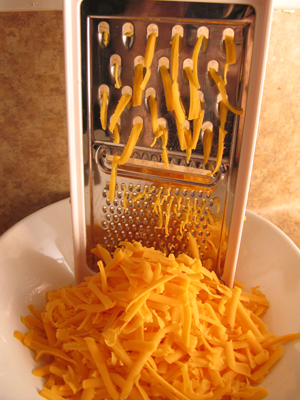
    How much cheese is in the pile after you “fluff” it by grating it? What’s the volume of fluffed cheese compared with stuck-together-in-a-block cheese?

    More importantly, is there enough for two grownups and a toddler? (When one of the grownups loves cheese!)

    What are your math curiosities in the kitchen?

    Related articles
  • Playing with Algebra Concepts

    Playing with Algebra Concepts

    I’ve been itching to get into some basic abstract algebra goodies. With the help of the Cuisenaire Rods, Simply Fun Sumology number tiles and the Discovery Toys Busy Bugs, I’m able to do that.

    Start with wrap around addition.

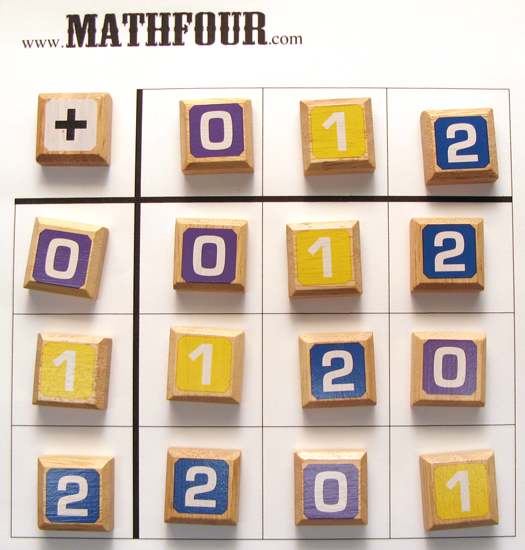
    This type of math is officially called “modular arithmetic.”  We are only going to use the numbers 0, 1 and 2.

    It begins as regular addition. And since we are only using those three numbers, all our answers have to be either 0, 1 or 2. So when we add 1+2, we wrap around.

    If we were to count in our system, we’d say: “0, 1, 2, 0, 1, 2, 0, 1, 2, 0, 1, …”

    The addition table looks like this:

    (Notice you could do this with numbers from 1- 12 and it would be clock addition!)

    Now things get buggy.

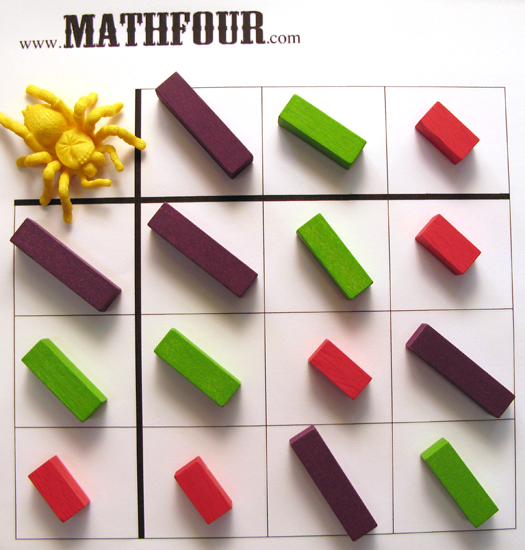
    Switch out all the number tiles with some pretty color Cuisenaire Rods. They don’t have to be the “right” rods. We’re only looking at the colors. Here’s the progression I did:

    The end result is a very abstract chart!

    You can “bug” two things together.

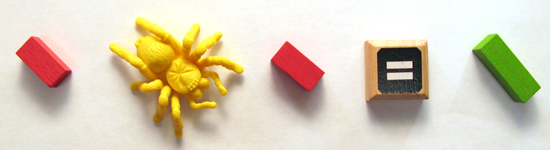
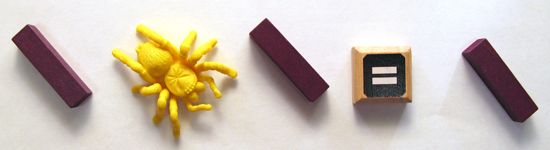
    Like this:

    (I know – a spider isn’t a bug. But run with me on this, okay?)

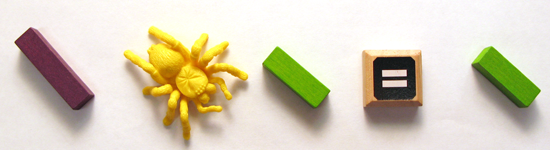
    Notice that each of these are directly from the “spider table” above.

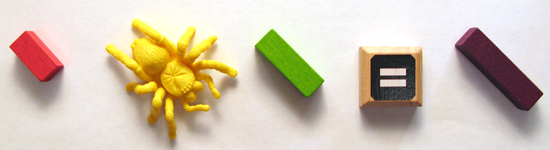
    You can read this as, “Purple spider green equals green,” just like you would say, “Zero plus one equals one.”

    And then turn your child loose!

    First make a chart, or download this one.

    You can, but don’t have to, start out with numbers. The rules are this:

    • You can only use three colors.
    • All three colors must go across the top.
    • All three colors must go down the left.
    • Fill in the 9 spaces however you want, as long as it’s only those three colors.

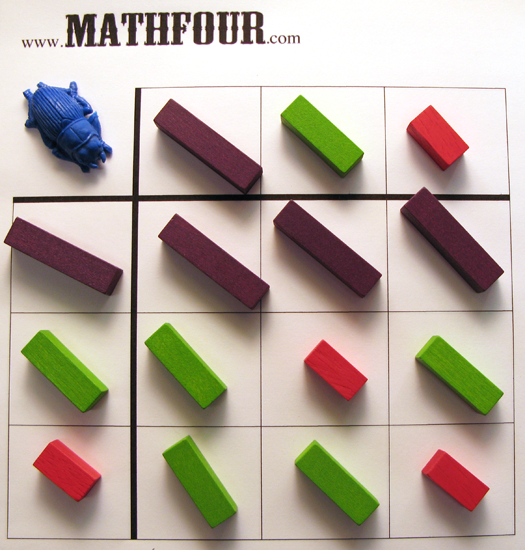
    I did this one with the blue beetle as the “addition” piece:

    So what can you do with a goofy “blue beetle table”?

    Let your child play, for one. And experiment.

    You can also talk about commutativity and associativity, identities, inverses… but I’ll leave that for another article!

    What do you think? Does your child want to play like this? What else can you do? Share your thoughts in the comments.

    Related articles
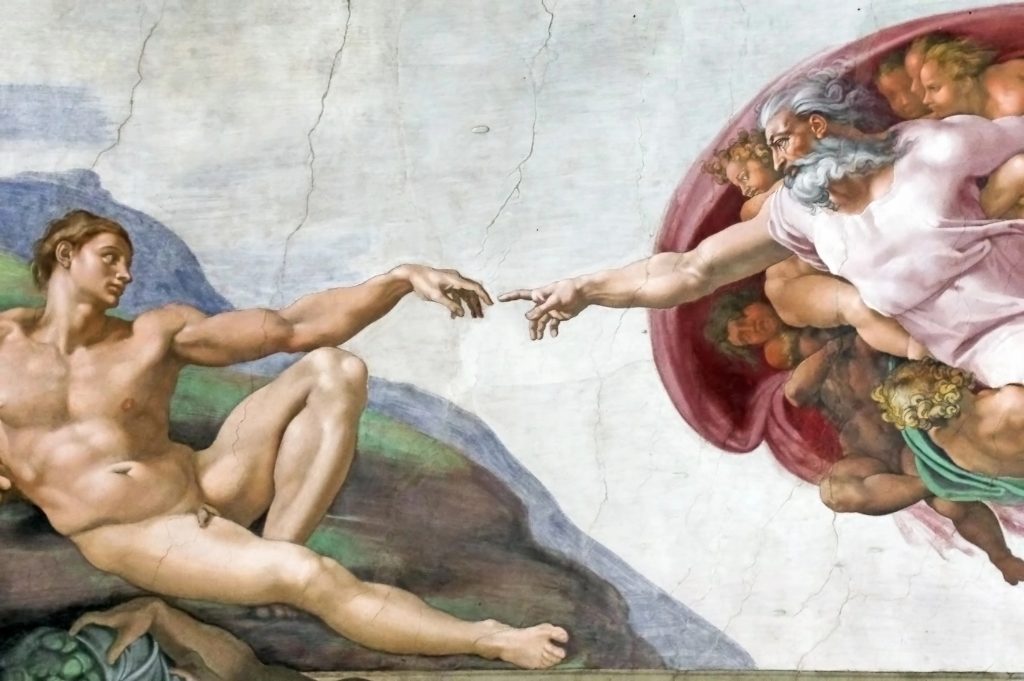
  • A Mathematical Proof of Creationism

    A Mathematical Proof of Creationism

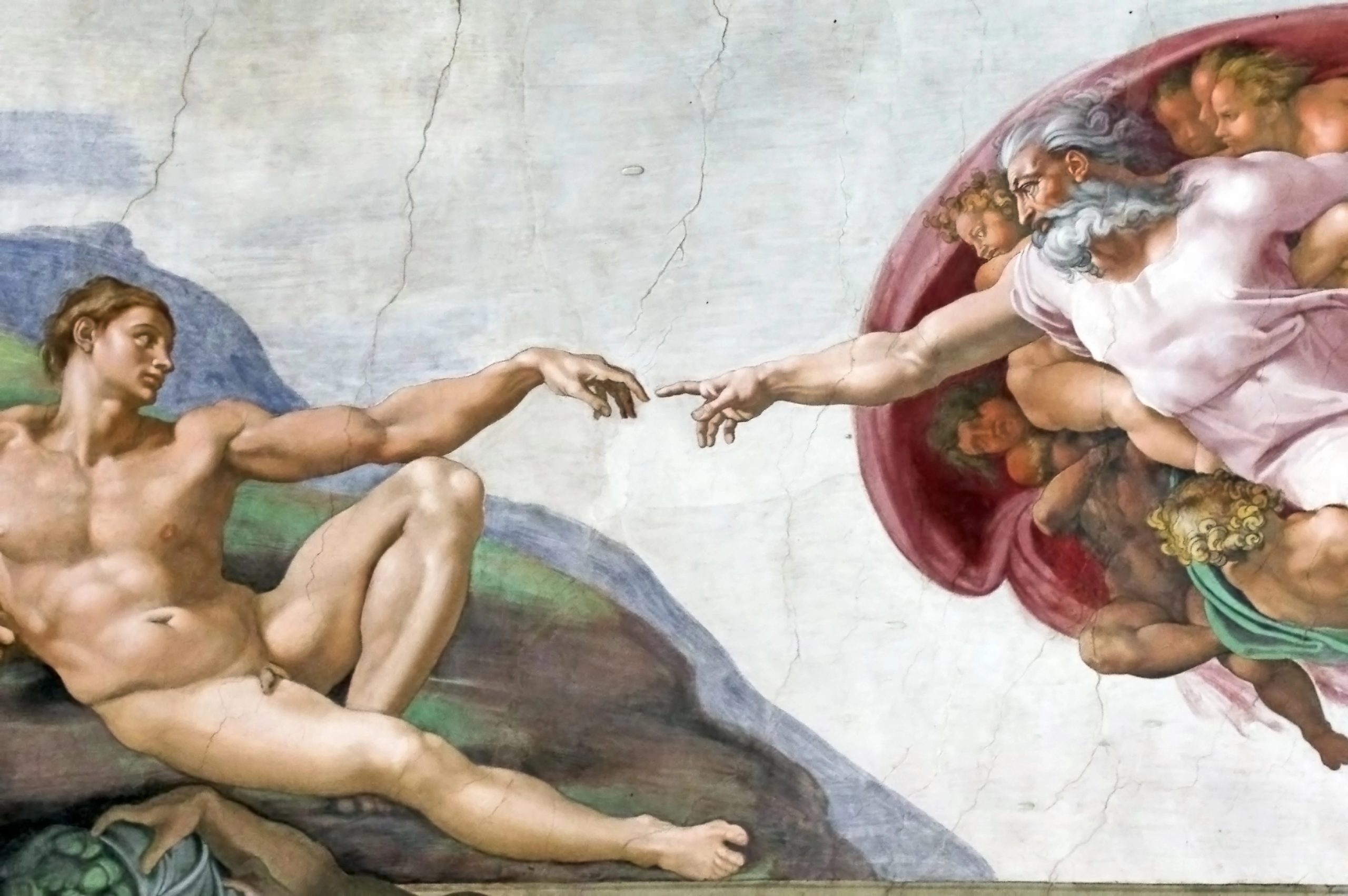
    Over the past ten years or so I’ve been hearing this word “creationism.” It seems that it’s the opposite of “evolutionism.”

    No problem – until I read about people trying to “prove” creationism. And articles trying to refute it.

    I’m not sure what the big hubbub is about. 20 years ago I heard a guy make a simple statement about it all. He proved creationism in 30 seconds.

    And it was a mathematical argument.

    Before I give you that 30 second super-statement, let’s chat a little about what a real mathematical proof looks like.

    Math starts with definitions.

    We say, “Okay, here’s the deal. Let’s define a nebino as a number that’s greater than all prime numbers,” or something of that nature. (And yes, you get to make up your own words if you want.)

    No math – none – ever starts out with confusing terms. If it does, someone jumps in and says, “You’ve got stuff that isn’t defined clearly.”

    Everything shuts down until that gets resolved.

    Math assumes… well… assumptions.

    Once you have your definitions clear, you get to set up what you assume. This actually might come before the defining part. And often it isn’t said out loud at all.

    Which is one reason that scientists sometimes think that they can do math. They’re always assuming the world (i.e. reality). Mathematicians don’t cotton to such vast and willy-nilly assumptions.

    Then you get your hands dirty.

    You’ve got definitions and you know what you’re assuming. You’re foundation is down. Now you build.

    In other words, you create some math.

    But things don’t always work out like you planned. So…

    If it doesn’t work, you change the definitions or assumptions.

    Yep – sometimes we really want something to work, so we just go back and tweak some of the starter points. Which means we change a definition or add (or delete) an assumption.

    (Which means if you’re using someone’s math, you have to make sure you’re working with the same definitions and set of assumptions.)

    And that’s the best argument for Creationism.

    The statement I heard from this Creationist was, in essence, this:

    We don’t have to use any evidence of science to prove God created the world in 7 days, 6,000 years ago. God planted the fossils and created all sorts of nifty things like DNA that would contradict the Bible. It was all meant to test our faith.

    Voila! Creationism proven.

    Brilliant! Change the assumptions, and you’re there.

    Beliefs are just that: beliefs.

    Which means there’s just no proving them. Kinda like my thoughts on the real line. I don’t believe in it – to the chagrin of my Twitter friend Colin.

    So if you want to prove something, change the rules. Or ignore them. Mathematicians do it all the time.

    *If you’re really really interested in my beliefs, I’ve shared them here.

    Related articles
  • 9 Ways Teaching Math is Like Giving Birth

    9 Ways Teaching Math is Like Giving Birth

    Now that school’s officially in session, I’m really thinking about all the homeschooling moms who are taking on teaching math. I can’t help but see the similarities to something they’ve already done – given birth.

    For each, I noticed that…

    It’s darn scary.

    Giving birth is pretty freaky. Especially if you’ve never seen or done it before. If you have the privilege of seeing another arrive in this world, it makes it easier. (I watched both my sisters and my best friend give birth!)

    Teaching math might be a whole new world – and pretty strange if you’ve never done it. Dig back to some good math experiences you had as a child and draw on those.

    It’s gonna happen no matter what.

    Kids get born. They must. And they do. So you might as well make the best of it and enjoy the process the best you can – with a happy and positive pregnancy!

    Kids learn math. They must. And they do. So you might as well make the best of it and encourage them in the best way – with a happy and positive math environment!

    You get to choose how you do it!

    You can give birth at home, in a hospital, with a doctor, with nobody, with drugs, without drugs… pretty much any way you want.

    We’ve got more freedom now that we ever had. In Texas, where Betsy and I live, a homeschool is an independent private school. We get to teach in an unschooling way with lovely things like Math on the Level.

    It may not go the way you want,

    You’ve got a great plan. You know what to do and how to do it. You’ve taken the classes and my goodness! You’re in hard labor for 32 hours and you’re still at labor station -4.

    You might think you have the best curriculum in the world. You’re all prepared. You start teaching an holy cow! Your sweet student couldn’t be less interested in everything you’re presenting.

    …so be flexible.

    Yes you’re frustrated. Remember the goal – a healthy child. Put away the frustrations and go for the C. Make it up by being a breastfeeding champion.

    Likewise, you’re wanting a happy, healthy child. Choose a different curriculum. Let your child choose a different one. Experiment. Make it up by taking the crew to a great museum.

    There are professionals for this.

    Get a good ob/gyn, doula or midwife. You don’t have to go-it alone.

    Get a tutor, enroll in a program like Kumon, join a homeschool co-op. You don’t have to go-it alone.

    There is lots of information online.

    With books like Betsy Dewey’s Birthright and sites like this one, there’s no reason to go into either blind.

    It’s hard,

    Giving birth is no piece of cake. However you choose to do it, you’re gonna have pain – in some way. Not to mention the nine months of puberty-like hormone swings!

    Teaching math is a challenge. It’s not about conveying information, it’s about following a child’s natural curiosity and pointing out the math that happens along the way. Which means having to recognize math and the learning/curiosity style of another human. Not an easy task.

    …and it’s worth it.

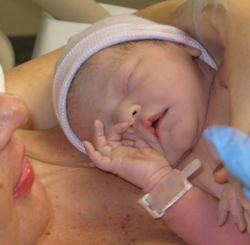
    AH, the prize! When you are presented with a slimy little mini-human, you can’t help but think how cool it is!

    And when a munchkin comes to you and says, “Did you know…” your heart fills with the glee of knowing that she extrapolated to get that – not just memorized it.

    Are there more?

    Any other similarities that I missed? Share them in the comments!

    Betsy Dewey, my cousin, was a huge help and resource when I was pregnant with Daughter. She was pregnant with her second at the same time – that made it even cooler!

    Betsy is an advocate of natural home birth and homeschooling. This article is written in honor of her and everyone else that listens to the beat of their family’s drum – and marches to it!

    Related articles