
Tag: cognition

  • GeoGebra – Who's It Really For?

    GeoGebra – Who's It Really For?

    Yesterday I shared my first experience on GeoGebra – and hinted that I had some concerns.

    GeoGebra bills itself as “Free mathematics software for learning and teaching.” Indeed the intent is learning – but the market for the software is teachers.

    Which means grownups are using it and then making kids use it. And we are using it as if we know what a student needs to learn math.

    Yes, we occasionally do. But we have much less discovery learning these days and much more spoonfeeding.

    And I worry that a powerful tool like this can easily turn into another way we can tell students:

    Here, do this. It will help you learn math because it’s hands on. Make sure you follow the instructions so you can discover what you’re supposed to.

    But we don’t have to let it!

    The objectives are the current focus.

    In the classic backwards way we teach, the “lesson plan” might go something like this:

    We need to learn that the center of the circumcircle around a right triangle is the midpoint of the hypotenuse. So I’ll give them the steps to draw a circumcircle. Then I’ll teach them how to move the vertices.

    I’ll construct specific questions to lead them to discover that the center of the circle will be the midpoint of the hypotenuse. They’ll certainly get it then.

    And what if they don’t “discover” it on their own? It becomes another performance based failure. And then the teacher discovers it for them.

    We can refocus on discovery!

    I discovered math when I used GeoGebra. Math I never knew.

    I loved watching the circles and triangles dance. From that I saw that when my point “Marsha” is on each of the sides, it appears she’s on the midpoint.
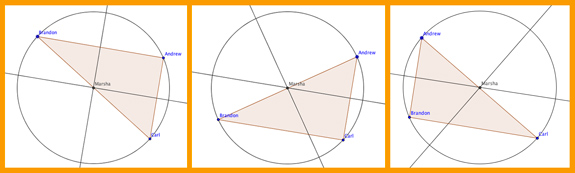
    But I wasn’t answering any questions about it. I followed the instructions to draw the triangle and the circle. And then I played.

    There were no leading questions. Nothing I had to “get right.” I just had fun.

    Try it in class.

    Suppose you gave your kids exactly what I had – instructions to draw the circumcircle and how to use the Move Tool.

    And left it at that.

    Would some students discover the hypotenuse/center thing?

    Sure!

    Would other students not?

    Yepper!

    And that’s okay.

    I’d never heard of a circumcircle. I know “circumscribed” – but not circumcircle or circumcenter. And I’m doing pretty well mathematically.

    If a child discovers something, that’s a win. If they don’t – well that’s NOT a loss! Let it go.

    It’s not your job to discover it for them. No matter what the Common Core Standards or TEKS say.

    See what happens…

    Restructure your lesson plans. See if you can give lots of different “how-to” sheets on drawing stuff on GeoGebra. And see where their curiosity takes all of you. You just might be surprised!

    Share your thoughts in the comments or on Twitter/X.

    You might also like:
  • The Gruel We Feed Our Children

    The Gruel We Feed Our Children

    We used to discover math.

    Now it’s processed and canned in textbook factories.

    We spoon feed it to our kids.

    And sprinkle it with carcinogenic sweeteners.

    We make the spoons bigger and force feed this gruel to them.

    So much in our world is going organic.

    Maybe math should too.

    This article is a part of the 50 Word Friday series. Learn more about this strange, limited writing style here…

    Related articles
  • Time and Technology – Are we missing some math practice?

    Time and Technology – Are we missing some math practice?

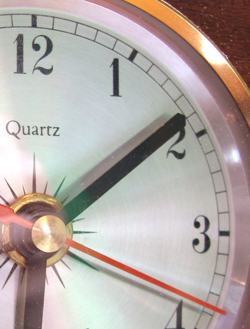
    I’ve written before that teaching time isn’t only about telling time. And this morning I started thinking about it again.

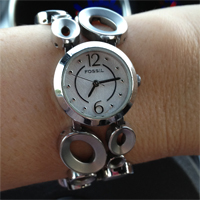
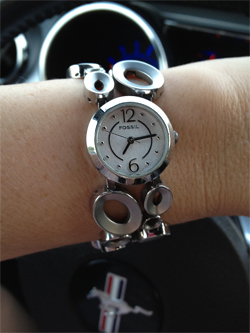
    I found my super fun circle watch from Fossil and put it on. I haven’t worn a watch in quite a while. So it’s fun wear it again.

    We don’t need to wear watches anymore.

    Well, except for fashion. Our mobile phones (even the “dumb” ones) keep time rather well.

    If you need the time, you dig out your phone. And if it’s too deep in your purse, you ask someone.

    And they tell you with words like, “It’s 8:23.”

    You never have to wonder.

    Do you recall this type of conversation:

    Kate: What time do you have?

    Wil: I show 10:15, but I’m usually about 5 minutes fast. So it’s really about ten after.

    Kate: Thanks!

    That phrase, do you have, is now obsolete. Everyone has the same time. It’s from Verizon, AT&T or TMobile. And they get it from the same place – the place that has the exact time.

    This means a lot for math.

    Nobody runs fast or slow. Also, we don’t have to add or subtract to get the real time.

    The time just is.

    20 years ago when your watch was six minutes fast, you had to do this to get the real time:

    1. Look at your watch.
    2. Figure out the time (the big hand’s on the …”).
    3. Subtract 6.

    You got to practice addition and subtraction – often!

    Which means our kids don’t get this benefit.

    Is it hurting them?

    What do you think? Share in the comments and don’t forget to tweet it out!

    Related articles
  • Happy Meal Coupon Reveals Lack of Thinking at McDonald's

    Happy Meal Coupon Reveals Lack of Thinking at McDonald's

    It was Monday. My “day off” from my diet. So Daughter and I decided to use the McDonald’s coupon we got in the mail yesterday.

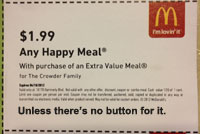
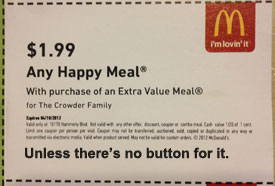
    $1.99 for a Happy Meal for her if I buy a grownup value meal.

    Easy enough, right?

    I informed the speaker: “I have a coupon for a $1.99 Happy Meal with value meal. I’d like a #2 and a Cheeseburger Happy Meal.”

    The voice said great and gave me my total: $9.97.

    Something didn’t add up.

    As I drove around, I couldn’t help thinking my $5.50 value meal, plus her $2 happy meal, plus tax shouldn’t get me all the way to $10.

    So I asked about it when I got to the first window.

    “Well,” she started, “We don’t have a button for that.”

    “I’m sorry…?”

    “Those coupons got sent out and they never put a button on our register for it. So I can’t give you the $1.99 Happy Meal. Sorry.”

    I was stunned.

    “So you’re telling me you sent me this coupon and I can’t use it because there’s no button for it?”

    She smiled and shrugged cheerily, “Right. When they sent out the coupons, they didn’t put a button on here for it. If you want to use the coupon later, they might give us a button for it in the next couple of days.”

    “Can I talk to a manager?”

    The manager was equally unhelpful.

    The conversation was similar. With a lot of “there’s no button for it.”

    She told me they would be happy to take down my name. Later I could come back for “a small fry or something.” And she tried to keep my coupon.

    I was totally confused.

    The obvious solution was, well… not obvious.

    “There’s no button for it.”

    But they have a $.99 menu. And two $.99 menu items is pretty close to $1.99. So why didn’t they merely charge me for two of those?

    I have been frustrated many times at the inability of clerks to do simple arithmetic (and to be fair, I’ve also been pleased).

    But this was more than arithmetic.

    This was thinking.

    They were both paralyzed by the fact that there was no button for it. They couldn’t see past that.

    Their lack of thinking created a terrible lack of customer service.

    I took my coupon back and said that I would be happy to patronize the McDonald’s down the road from now on.

    “Oh,” she said, “So you don’t want anything?”

    Really, lady?

    Can anything be done?

    Can we fix the lack of thinking ability in normal people?

    I don’t know the answer to that. And I don’t know the cause.

    Sometimes I think that early calculator use caused this. But there are lots of parents who allow calculator use early on and raise brilliant, thinking kids.

    Sometimes I think it’s the education system.

    And sometimes I think it’s society.

    What I do know is that my Grams had a 6th grade education and more thinking power than many high school graduates.

    Don’t raise blind button pushers.

    However you can. Whatever method you find.

    We need our kids to learn: If there’s no button for it, you can make it work another way.

    Raise them to be thinkers.

    Comments?

    Related articles
  • Teaching Time Isn’t Only About Telling Time

    Teaching Time Isn’t Only About Telling Time

    There are tons of great products out there to help with teaching time. White board clocks, clocks with movable hands, games, etc.

    But teaching time isn’t only about telling time.

    When we teach children how to tell time, we are merely giving them another “reading” skill. We’re teaching them how to interpret the hands on a clock.

    We also teach them how to understand what time things happen during the day. With this we’re getting closer to giving them an appreciation of what time is. But we’re still not there.

    We “spend” time like we spend money.

    My friend, Paul Cunningham once told me he was, “time poor.” We all have the same amount of time in each day. So why would one person be “poor” with respect to time, while others are not?

    Time is relative to the “must do” work.

    Parkinson’s law is: “Work expands so as to fill the time available for its completion.”

    Which also means that if you have something that must be accomplished, and extremely limited amount of time, then you figure out a way to get it done. Which sometimes means to do it at a less than perfect quality.

    Grownups experience this all the time – with work and personal tasks.

    Must do it.
    Must do it fast.

    So do it as best as you can and be done.

    Kids are required to sleep. That’s about it. Daughter sleeps 10 hours each night and about 2 hours during nap. She’s got a whopping 12 hours every day to do just about anything else!

    Of course she’s corralled in various places against her (very strong) will. But nevertheless, her only “work” is to learn.

    Parkinson’s law allows her all the time she can to “perfectly” learn everything she can.

    Time is relative to our age.

    I remember as a child understanding that Christmas was two weeks away. As an adult I can calculate that two weeks to a five-year-old is equivalent to four months as a 40-year-old!

    See… I’m 14,600 days old. My nephew is 730 days old. For me, Christmas is about \(\frac{14}{14,600}\) of my life away. For my nephew, Christmas is \(\frac{14}{730}\) of his life away!

    There are two things going on when we anticipate something in the future. As shown above, there is the amount of time we have to wait as a fraction of the amount of time we’ve been alive.

    And there is also the “habit” of waiting that gets established over time. I can wait two weeks (or even four months) because I’ve done it many many times before. A five year old rarely waits two weeks for anything!

    Can we teach the full appreciation of time?

    These subtleties and intricacies make time a very slippery subject. Teaching all these strange bits might not be doable. But it’s important as grownups that we know that they exist for us – and they don’t exist for them.

    Some of us, like Paul Cunningham, have “less time” than others.

    So when you teach time – either telling time or knowing what time things happen – don’t forget that there’s so much more. And when your child is able to grasp it – share it!

    Oh, and share your thoughts on this in the comments. 🙂

    Related articles
  • Motivation or Inspiration – How do you teach?

    Motivation or Inspiration – How do you teach?

    In order to see what the difference is between motivation and inspiration when teaching math, I’m going to start with a quick story…

    You have a dog named Herman. Herman is cute, fuzzy, has a pink nose and loves you unconditionally. You think he’s great. So you want to share him.

    You put a bow around his neck, and hand him to your children, Abby and Dirk.

    “Here is Herman. He’s cute, lovable, and a perfect pet. Isn’t he fabulous?” you tell them.

    Abby looks at Herman and is so excited. She thinks he’s fabulous, wonderful and sees in him everything that you do. Inspiration hits her – she loves him like you do!

    Dirk, on the other hand, wants a cat. He’s not sure how to voice this. But since you’re so excited about Herman the dog, he rolls with it.

    He wants to please you, so he feigns interest in Herman.

    Herman’s not a dog.

    Herman is your curiosity. Herman is what you find interesting and inspirational.

    And just because Herman is wonderful for you, doesn’t mean Herman is perfect for everyone else.

    Abby loves Herman. And Dirk loves Herman, but only because loving Herman pleases you.

    We offer Herman, and they take him. Because they want to please us.

    Lots of educators these days are talking about helping children connect with math through real life experiences. They want to give children curiosity about math in the real world.

    But the real world means different things to different people. And it means different things to different kids.

    • Some children like to build things. Give them a stack of Legos and they’ll work for hours.
    • There are kids who are outdoor people, always running around and wanting to see what next thing they can find in nature.
    • Some kids want to be in the kitchen, helping their parents cook dinner.
    • Some kids are quite happy connecting math just to math.
    • Some children are gamers, enjoying puzzles, riddles and games just for the fun of it.
    • And the list goes on…

    Grownups take their connection to the real world, their own curiosity, and pass it on to children. We take everything that we find fascinating, our own personal Herman, and hand it to the child.

    And they take it. Some because they are excited about it, and some because they want to please us.

    Motivation is not inspiration.

    The growing thought among educators is that children need to be curious in order to learn math. So we’re creating ways to get children curious.

    But are we doing it right?

    The child will happily take Herman, your form of curiosity. This could mean they are truly inspired by what you give. And it could mean that they are merely motivated.

    Motivation isn’t a bad thing, for sure! But if we mistake motivation for inspiration we are doing the children a disservice.

    If they’re motivated, they’ll only do what’s next to get praise. It’s about you, the grown-up, and how much they can please you.

    If they’re inspired, they’ll want to take their learning to the next level – even when you’re not around. They’ll want to see and do things to enhance their understanding without needing your praise and attention. It’s about them.

    And when things are about them, they own it. They succeed because they can, not just because we want them to.

    What’s your Herman?

    And have you passed him along? Was he inspirational or motivational? Share your thoughts in the comments!

    Related articles
  • Toddlers Begin Counting at the Number 2 (not 1)

    Toddlers Begin Counting at the Number 2 (not 1)

    I had this grand idea when we got married and were hoping for kids – I would teach our children to count starting at 0.

    When Daughter was 15 months old, I decided we should start teaching to count with negatives.

    But I was wrong on both.

    And so is everyone else.

    Why do we teach toddlers to count?

    We practice counting 1-10 with our kids. We know (somehow) that before they’re official school age, they should know how to count to 10. And how proud we are as parents if they can count to 20!

    But these are just words.

    I can teach Daughter to memorize the Fibonacci sequence, but she’d no more know what that means than what counting to 10 means.

    In fact, I know this first hand because I used to count to 10 in Spanish. And I’d leave out ocho everytime!

    I saw a guy made fun of in Germany because he told a waitress he had fünf people in his party and held up four fingers. (She did it behind his back to another waitress – she wasn’t so rude to say it to his face. (Thank goodness; I would’ve had to go Texan on her.))

    We teach toddlers to count for the same reason that we teach them to say please, thank you, yes ma’am and no ma’am – because someday they’ll understand what it means. And in the meantime they can establish good habits.

    So where do they start understanding?

    Regardless if we teach a toddler to start counting with -5, 0 or 1, they start with 2.

    -5 to a toddler makes no sense. Teaching -5 to a toddler can only be dreamed up by a math teacher with no kids (i.e. me three years ago).

    0 is useless. Why would you even mention that you have zero? Maybe saying that there are zero cookies after she ate them all might work. But generally zero things can’t be seen and by the time you’re down to 0 cookies, there’s probably a meltdown in the works. And we all know there’s no learning during a meltdown.

    1 is just as useless. Why count things that are only one? They started with one mom, one dad, one dog, one couch, one bed, one bear,… Almost everything in their world is a single. The number “one” is just as useless to them as the words “the” or “a.”

    But 2 is interesting!

    Daughter was so amazed at the discovery that she had two SnackTraps. Not just the ordinary situation of a bowl of snacks but “TWO BOWLS!”

    As soon as multiple copies of things are in her world, she takes note. If you’re an identical twin, the first time your child sees you with your twin might be traumatic. My best friend is the daughter of a twin and she tells horrors stories of this discovery.

    This is an extreme, but consider all the pairs of things that kids can notice – two shoes (vs. only one that you can find when you’re freaking out and you’re late), two forks (when you’re begging for yours back from her because you’ve not eaten since breakfast), two cars (when you need to get in one and she insists on going in the other).

    And, toddlers really don’t start counting at 2. They don’t start their mathematical careers with counting at all! They start by recognizing multiples. And 2 is the first and fastest multiple.

    So what can you do?

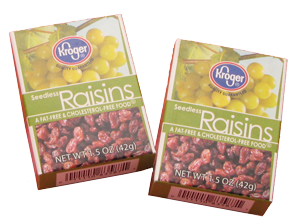
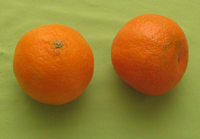
    Keep teaching your kids to count – they still need this skill, just like they need to memorize math facts. But also teach them to subitize (recognize amounts without counting them out). Hold up two of the same items and exclaim “TWO ORANGES!” Then go to another two items and exclaim, “TWO RAISINS!” Stick with one number at a time.

    Daughter is on “two,” so we’ll stick with that for a few months. We’ve got plenty of time.

    Related articles
  • Is Math a Four Letter Word?

    Is Math a Four Letter Word?

    It’s been mentioned more than a few times that ‘math’ is indeed a four letter word. Quickly after that’s said comes a look of, “So why are you claiming otherwise in your website title?!”

    I just got an email from someone asking the same question.

    Math isn’t a four letter word.

    When we type “math” we use four keystrokes. But we actually mean “mathematics” which has 11 letters. In some parts of not-Texas, outside the U.S., they abbreviate mathematics as maths. So really, math and maths are both 11-letter words!

    Math isn’t a four-letter word, either.

    The real statement of this site is that math isn’t a four-letter word. It isn’t a bad word. It isn’t something that should be feared, loathed or avoided. In fact, since everyone does it, it doesn’t make sense to fear, loathe or attempt to avoid it.

    It’s like saying, “I’m afraid to eat,” “I hate eating,” or “I avoid eating at all costs!”

    It’s something you do. You were born with it.

    Math is a four letter word.

    But indeed, yes. Math, the English language construct, has four characters:

    1. M
    2. A
    3. T
    4. H

    So I can’t really argue.

    Or I can argue all day.

    And THAT’s the real fun of being a mathematician!

    Related articles
  • Practicing Math Skills Early in Life Is a Brain Changing Event

    Practicing Math Skills Early in Life Is a Brain Changing Event

    Thanks to Will Summer who inspired this post with a retweet to me.

    Seems researchers have previously studied the differences in math skills among children vs. adolescents and grownups. Dr. Vinod Menon with has done new research on early math training that focused on kiddos who where merely one year apart.

    Turns out that in one year of math, the brain changes quite significantly!

    You can integrate early math learning into just about anything.

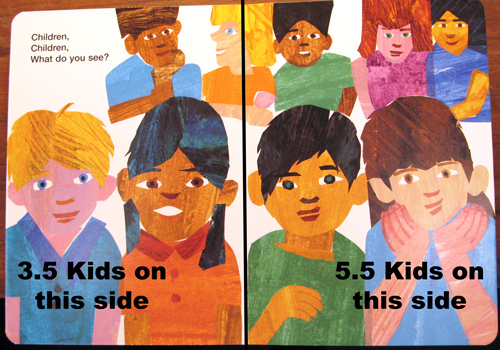
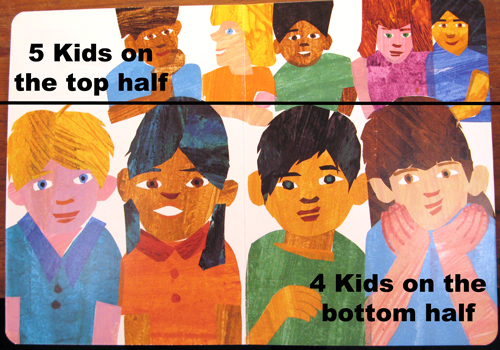
    Daughter is heavy into Brown Bear, Brown Bear by Bill Martin, Jr. and Eric Carle. This is not a math book. Nor does it pretend to be. But I’ve found a way to use it to develop math skills.

    When we arrive at the page with the children, we practice counting the kids. First in one direction, then in the other – as direction matters to kids. It isn’t inherent that if you count one way you’ll get the same number as if you count the other way.

    Sometimes we’ll count the top row of children and add it to the number of the bottom row. We can practice the commutative property by adding 5 + 4 = 9 and the adding 4 + 5 = 9.

    As an alternative twist, we’ll count and add the kids on the left page to the kids on the right page. This one gets fun, because that little blond girl is half and half!

    So we can now add fractions and practice the commutative property at the same time!

    What else?

    With Dr. Menon’s research, we now know how important it is to get started early with math learning. What other things can you do to start teaching math skills early?

    Related articles
  • How to Tell if Your Child Is a Top-Down Learner

    How to Tell if Your Child Is a Top-Down Learner

    Does your child struggle when you put him down in front of his math book? Are you frustrated in your attempts to get him to do math classwork or homework?

    Maybe he’s a top-down learner. If so, you might not know based on his current “regular” work. It will help in his education if you know he needs the big picture before the details – or the big theories before the steps.

    I remember learning to do derivatives when watching the foster kids that lived with us. I was eight. I’m a top-down learner. Here’s how to find out if your child is one too:

    How the “green beans” con works.

    My mom used to leave green beans open in a can on the table. We would walk by and eat them. If she put them on our plate, we would refuse them. So she got us to eat vegetables without asking us to, by just making them available.

    You can use the “green beans” con as a test.

    For math, put out the harder stuff. Find some books at Half Price Books or someplace cheap in your area. Open up the book. Sit and do some of the math yourself while mumbling aloud. Then walk away.

    If he sees his folks (or older sibs) working through those problems, he might be interested. Watch to see if he goes up to the book to check it out (steal a green bean). Be available to answer questions if he asks.

    If he can grasp some of  that “higher level” stuff, he’s probably be a top-down learner. He won’t want the building blocks until he sees the plans for the whole house. This could be the cause of some of the struggle and frustration – he’s been given the building blocks instead.

    Let him have the big stuff – start “allowing” him to do more of the advanced books. He’ll back up on his own to learn the “lesser” stuff so he can understand the big stuff better. You won’t have to force the work on him anymore.

    Share your experience with your top-down or bottom-up learning in the comments!

    Related articles