Tag: cognition

  • Ellipse vs. Ellipsis — And Other Similar Math & English Words

    Ellipse vs. Ellipsis — And Other Similar Math & English Words

    I have long wondered about the similarity between some math words and some English grammar words. In particular ellipse vs. ellipsis and hyperbola vs. hyperbole.

    I finally decided to look up their etymologies, and amazingly there is good rhyme to the reason!

    Ellipse and Ellipsis

    Both of these words come from a Latin root meaning, “a falling short or deficit.”

    The grammar term, ellipsis, means the three dots used to designate missing words, or a deficit of words. Like … well…, you get the picture!

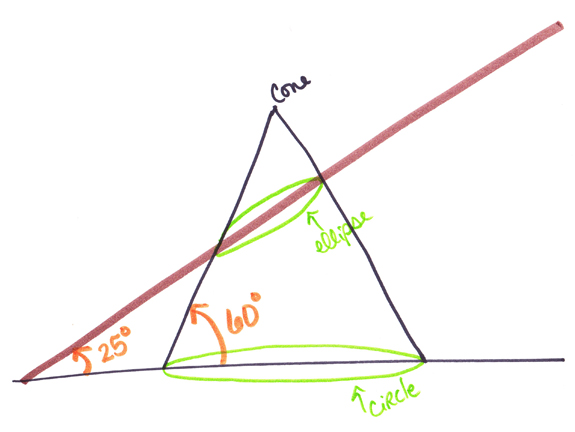
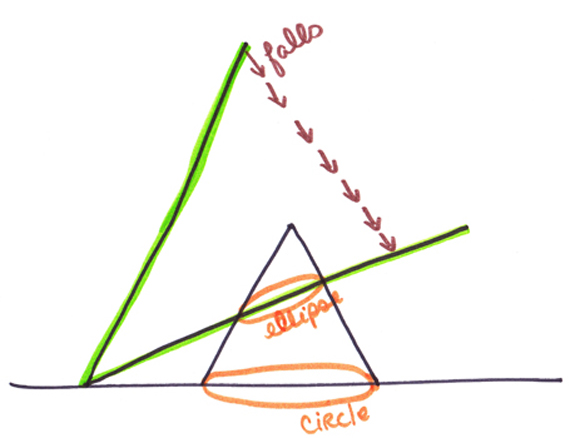
    For the mathematical shape, or graph, an ellipse is created when a cone is cut by a line whose angle is less than (or falls short of) the angle of the side of the cone to the bottom of it. (#ARG, I know. Check out the pix.)

    The brown line that creates the ellipse has a 25° angle which is much smaller than the 60° angle between the bottom and side of the cone:
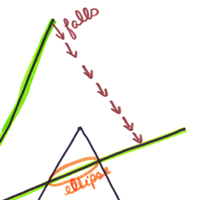
    You can see it “in action” here with the line falling:
    Hyperbola and Hyperbole

    A hyperbole is the fancy English grammar term for exaggeration. Everyone use hyperbole all the time! (See what I did there…?)

    And a hyperbola in math is the graph/shape that looks like the light beams from a two-sided flashlight.

    Both of these words come from a Latin word that means extravagance or “throwing beyond.” You can see how an exaggeration (a hyperbole) is throwing beyond. But what’s up with the math word, hyperbola?

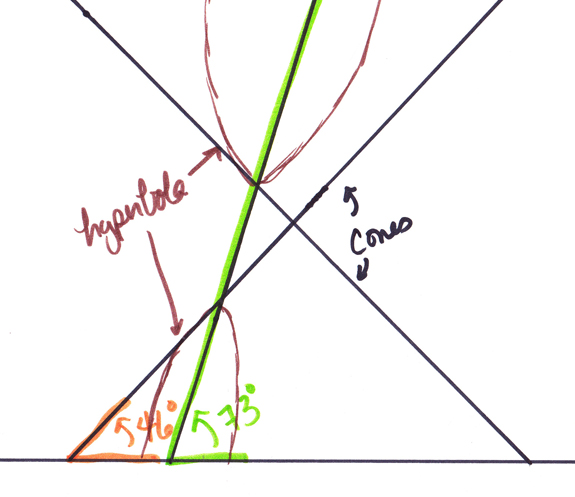
    We look to the angle of the cutting line again. A hyperbola is cut from a cone (actually stacked cones — see the picture) with a line who’s angle is “beyond” or more than the angle of the side of the cone to the bottom. It’s just the opposite of the ellipse!

    Check it out: (This one is somewhat drawn to scale so you can really see what’s going on.)
    Are there more?

    These are the only two that have bugged me through the years. But now I’m wondering if there are other math words that have cousins over in the English department.

    Any ideas? Let me know in the comments or via twitter/x, would you?

    You might also like:
  • Math Basics — The Real Ones!

    Math Basics — The Real Ones!

    I hear often that the “basics of math” are important. What people mean is that kids should memorize their math facts.

    The basics of mathematics that are required for a student to learn and do mathematics aren’t math facts. They are these: Logic, Joy of Failure and Familiarity with Math.

    1. Logic

    Children start learning what an if/then statement is at an early age:

    If you clean your room then you can go to the park and play.

    The more parents have normal conversations with their children, the more children will understand the other subtleties of logic — like negation, contradiction and contrapositive. We all understand these, even if we don’t know the proper math words for them:

    • Negation: “I am not going to listen to you whine!”
    • Contradiction: “That dog is green.” (and K8 says, “Nu-uh! That dog is brown!”)
    • Contrapositive: “Oh, I see you’re not at the park. I guess you didn’t get your room cleaned!”

    Once the basics of logic are understood, a child is able to pick up a calculus book and work through it. At any age!

    2. Joy of Failure

    Teachers often well rehearse their lectures before they present them to the students. The struggle and failure that he or she goes through figuring out how to smoothly demonstrate the problem is kept from the children. Teachers know the job of failure, but they keep it hidden.

    Thus children believe that failure is not an element of mathematical thinking. And nothing could be farther from the truth.

    Parents can support their children in finding the joy of failure by allowing them every opportunity to attempt, reattempt, and fail at everything.

    Promoting failure is tough, but important.

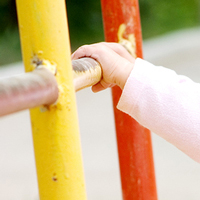
    If your toddler is trying to climb a ladder, resist the urge to jump in and help. The more the child fails a climbing the ladder, the more insight he or she will gain into what else might work. (Like different hand positions, different footing, etc.)

    You helping them climb the ladder might get them to the top faster, but resisting helping them (until they ask at least) will help them get used to learning from failure.

    Mastery may seem a pleasant goal, but it merely means there is no more learning to be done and it’s time to move onto something else. Don’t give them a false sense of mastery — let them learn the joy of failure.

    3. Familiarity with Math

    Children are quite confident and very engaged in learning the craziest things. It may be how to skateboard, how to make funny noises or how to repair their bike. One of the reasons they are competent and engaged in these activities is because they are familiar with them. Everyone is doing it!

    It’s difficult to be fearful of something that you see as a normal everyday part of life.

    Parents can help children gain a familiarity with math by pointing out where they themselves use math every day.

    This can be challenging to some parents, because they truly believe they don’t use math. But finding where the math is — and saying it out loud — will help your children a great deal.

    How are you doing?

    Do you talk to your children and let them read users’ manuals? (This promotes logic.)

    Do you let your kids mess up? (Helping them find a joy of failure.)

    Do you talk math to your kids? (Showing them how math is everywhere.)

    Will you start?

    Share your thoughts in the comments or on twitter/x.

    You might also like:
  • The Prime Directive in Education

    The Prime Directive in Education

    The Prime Directive in Star Trek is to not interfere with other cultures.

    The Prime Directive in medicine is do no harm.

    The Prime Directive in parenting is to keep the child alive.

    There’s a Prime Directive in Education too!

    Through all my suggestions, recommendations and ideas about math education, the one thing that trumps everything else is the Prime Directive in education:

    If it works for your child, do it.

    If a method, book, course or person helps your child do better in math, then stick with it!

    Everyone has an idea of what great teaching looks like.

    Proponents of Khan Academy like that lectures can be available to everyone, everywhere for free. Opponents say that Khan Academy is still just lectures.

    Proponents of education methods popularized by Dan Meyer say that children need to connect with the math. They need to see it in action.

    Opponents (and there aren’t many) say that sometimes kids just want to do the steps.

    It’s not about great teaching, though — it’s about great learning.

    Only your child knows what great learning looks like.

    Children know how they learn best. They can’t always articulate it, thought, so they need us to watch them and figure it out for them.

    If your child needs more of a top-down understanding of what’s going on in math, then the teacher (you or the classroom teacher) should work to give him that.

    If he needs a to thoroughly practice the basics in math before moving on to something more — then that’s what he should have.

    Even alternative learning methods can be used.

    A friend of mine told me her child needs to practice his cursive writing. Because he thinks cussing and swearing is fun, she’s entertaining the idea of having him write sentences using a swear word. She worried that it might make her a bad parent.

    Enter the Prime Directive in Education. If he improves with his cursive writing, and she explains that swearing is still not appropriate out loud, why shouldn’t he write the bad words?

    If it works for your child, do it!

    Some kids need rote memorization before understanding. Some need understanding first. And some need bizarre means to connect with the task at hand.

    So if you find something that works — by golly, do it!

    What does your child need? How can you make sure he or she gets it?

    Share your thoughts in the comments or on Twitter/X.

    You might also like:
  • Why You Should Ignore the Prerequisites in Math Classes

    Why You Should Ignore the Prerequisites in Math Classes

    You’ve seen the prerequisites part of a syllabus or course listing that begins:

    To take this course you should have completed…

    But what does that really mean anyway?

    A prerequisite is a way to keep out the rubbish.

    Have you ever sat in a class with someone asking tons of questions about things they should have known before signing up? To prevent this, instructors and institutions insert the “stay out if you’re going to get on everyone’s nerves” clause.

    It’s called the prerequisites.

    Prerequisites are a way out of a class that you didn’t want to take anyway.

    Prerequites are designed in such a way to allow you to escape. If you have any apprehensions about taking the class at all, you can just refrain from ever signing up — because of the prerequisites.

    Regardless of if you have the prereq’s, you can play this card. The course description reads: To take this course you should have completed College Algebra.

    You can convince yourself using one of these:

    1. “I passed College Algebra, but only with a C-. They probably mean that I should have made a B or at least a high C.”
    2. “I passed College Algebra with a B. But I was really uncomfortable about it. They probably mean that I should feel really good about all the content in College Algebra.”
    3. “I passed College Algebra with an A. But there were quite a few things I didn’t understand really really well. They probably mean that I should be really good with all of the stuff in College Algebra.”

    See how you can talk yourself out of anything?

    But there are no real prerequisites.

    All topics of math can be learned independently. Every topic can be learned before or after any other topic. And every topic can be used to support as well as be supported by any other topic.

    There is no order to this stuff. There is merely the order in which we learned it — one of a hundred bazillion ways that you could order it.

    My little sister was interested in math in college. I suggested she take Linear Algebra, a sophomore level class, in her first semester. The course catalog listed three semesters of calculus as the prerequisites. I told her that Linear Algebra had nothing at all to do with Calculus and she should ignore the prereq’s.

    She did.

    She finished her degree in her way — following her interests. (By the way, she’s currently the Business Administrator in that same math department!)

    Prerequisites are bogus.

    Education and learning should be focused on what you’re excited about. It’s about following what the learner wants — and what he or she (or you) will engage with.

    If you, or your kids, don’t want to do it, then don’t.

    But if you do — then don’t let some nutty arbitrary prerequisite statement stop you! Or even slow you down.

    Try it on this class…

    The sweet and talented Keith Devlin is teaching an online course in Math Thinking soon that has a “Recommended background of High School Mathematics.”

    Unfortunately those words sound like, “The prerequisite for this is high school math.”

    The class is online and it’s free. If your teens are interested, encourage them to join. If you have a precocious pre-teen, see if he or she is curious. And if you have a GED or no high school math at all, jump in — if you want.

    And the next time you’re faced with anything that looks like prerequisites, ignore them!

    Share your thoughts in the comments or on twitter/x.

    You might also like:
  • Problem Solving  — Is it Teachable?

    Problem Solving — Is it Teachable?

    This is the second in the online book study series of What’s Your Math Problem?

    In Chapter 1 of What’s Your Math Problem?, Linda Gojak gives some initial thoughts on learning and teaching problem solving.

    She introduces the concepts of routine problems and non-routine problems.

    Routine problems are what you typically see at the end of a problem set in a traditional textbook. “In solving routine problems, the learner reproduces and applies a new procedure,” Gojak writes.

    Non-routine problems, or rich problems, are the way of the world. They are the things grown-ups solve everyday effortlessly, and often don’t think of them as math problems.

    Is solving non-routine problems teachable?

    There is a divergence between the way traditional word problems are taught to kids and how grown-ups handle the rich problems in their lives. What’s Your Math Problem? attempts to distill and label each strategy of what grown-ups naturally do, so that we can teach these strategies to our children.

    To make this work, knowledge of the various strategies is important. So Gojak labels, defines and gives examples of each strategy throughout the book.

    This method of teaching problem solving to children will work if an instructor is careful not to force the use of a particular strategy.

    Offer a strategy, but don’t force it.

    The idea is to label and clarify each problem solving strategy so it can be one of the options in the toolbox of problem-solving for each child.

    As students learn a strategy, teachers shouldn’t require it be used “so they can practice it.” Instead it should be offered and encouraged, but allowed to be tossed aside if the student prefers another method.

    And caution should be used to ensure problem solving using these various strategies NOT turn into another algorithm.

    Read more about it…

    Don’t forget to check out Math Coach’s Corner for some other thoughts on Chapter 1 of What’s Your Math Problem? Make sure to scroll to the bottom, because others are linking up their thoughts and opinions!

    Share your thoughts in the comments or on twitter/x.

    You might also like:
  • Is Math in the 3 Categories of Learning?

    Is Math in the 3 Categories of Learning?

    Our world is struggling with education of all sorts. We know that STEM fields are in trouble. Not enough people are excited about taking the science and math classes needed to jump into them.

    But there’s another piece of the education puzzle that’s missing — writing.

    I talked to a primary school teacher at a social function today. She was telling me how students these days were often taught the algorithms of writing. One of which is the classic intro-supporting paragraphs-conclusion that I remember.

    I said, “Oh, so they don’t get taught to write in their own voice, and stuff like that?”

    “That’s just it,” she said. “They naturally write in their voice. But with the systematic methods we push on them it destroys it!”

    That sounds familiar!

    It pulled on my heartstrings — there was another basic subject that was competing with the almighty and all-powerful queen of subjects — reading.

    Seems writing has the same challenges as math — people think there’s a formula to it when really it’s about voice, personal preference, beauty and art.

    And writing, like math, is something people always do when they have to but rarely do just for fun.

    What do we learn — really?

    It made me really think about learning and teaching. All learning can be boiled down into one of three categories:

    1. Learning information (historical facts, spelling, times tables)
    2. Learning how to get information (reading, researching, googling)
    3. Learning how to give information (writing, speaking)

    Reading clearly has its place in #2, as does writing in #3.

    But where is math?

    When you teach math, are you only teaching facts (like in #1)? Or are you teaching children how to get or discover information (#2)? Or are you teaching them how to give or share information (#3)?

    I’ll leave my answers for next time. Until then — what do you teach?

    Share your thoughts in the comments or on twitter/x.

    You might also like:
  • Time Zone Math: Using the Fret & Grind Method

    Time Zone Math: Using the Fret & Grind Method

    It took me a long time to learn how to figure out what time it was in Los Angeles when it was at 7 AM in Houston.

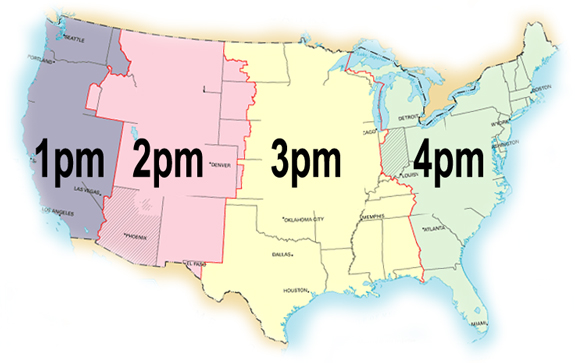
    Notice on this time zone map that the numbers count in a very intuitive way across the US:

    This works just fine if you’re managing locally.

    Global time zones are more of a challenge.

    I used to send out a weekly newsletter. Generally it was set to arrive in people’s inboxes between 3 PM and 6 PM Thursdays — in their local time zone.

    Which means any changes that I had to do would have to happen before they got the e-mail at 3pm on Thursday.

    But not everybody lives in Texas. So my deadline was not 3 PM on Thursday, really. It was the first time anyone in the world encountered 3 PM Thursday.

    In order for me to make the deadline for a global audience, it was essential to figure out what time in Houston that is.

    Greenwich Mean Time -6

    According to the website Greenwich Mean Time:

    Greenwich Mean Time (GMT) was established in 1884 at the International Meridian Conference, when it was decided to place the Prime Meridian at Greenwich, England.

    All time zones range from GMT -12 hours GMT +12 hours. Houston is Greenwich Mean Time -6 hours. Which means it should be a rather easy exercise.

    All I have to do is add my six hours on the left side of the Meridian to the 12 hours on the right side to see that I’m 18 hours difference.

    I subtract 18 hours from 3 PM Thursday to arrive at 9 PM Wednesday as my true deadline.

    But we all know what happens when you say, “all you have to do is.”

    I used maps, charts and a lot of time.

    As I mentioned in the discussion of the book What Your Math Problem?, I often use very crude methods to solve problems.

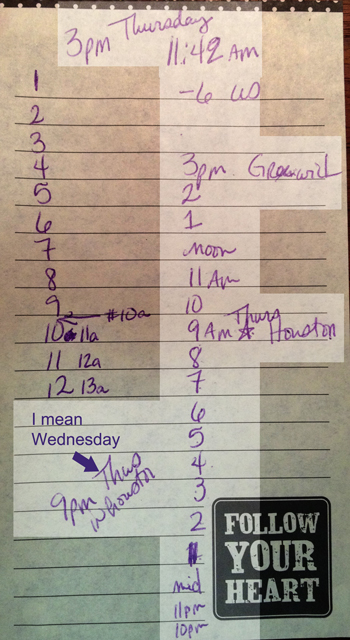
    I opened up a world time zone map, started counting and making charts:

    I didn’t solve the problem traditionally.

    Often when grownups present math problems to kids, they’ve prepared. They demonstrate working a problem like I worked it above:

    Add my six hours on the negative side of Greenwich Mean Time to the 12 hours on the positive side. I’m 18 hours difference. Subtract 18 hours from 3 PM Thursday to arrive at 9 PM Wednesday as my true deadline.

    But that’s not the real way we do math. We often use the Fret & Grind method. Fret about what’s going on, grind out some rough sketches. Then fret some more…

    So why do we show kids the nice way?

    If they see the “all you have to do is” way, then they won’t gain the confidence to use the Fret & Grind method.

    And the Fret & Grind method is the best way — sometime the only way.

    How do you teach time zone math? Do you encourage Fret & Grind?

    Share your thoughts in the comments or on twitter/x.

    You might also like:
  • What's Your Math Problem? Book Study

    What's Your Math Problem? Book Study

    Donna Boucher over at Math Coach’s Corner has started an online book study with the book What’s Your Math Problem? Getting to the Heart of Teaching Problem-Solving by Linda Gojak. I’ve jumped in late, but I’m in with a bang!

    The book is a how-to guide on teaching children math problem solving tactics. This helps them develop their own problem solving styles.

    It’s written for the classroom teacher but I’ll be giving tips on how to use the tips in your homeschooling or afterschooling journey.

    Here’s the outline of the book:

    • Chapter 1, The 5 Ws and an H of Problem Solving
    • Chapter 2, Planning for Problem Solving in the Classroom
    • Chapter 3, Getting Started Strategies
    • Chapter 4, Getting Organized Strategies
    • Chapter 5, Visualizing Strategies
    • Chapter 6, Advanced Thinking Strategies
    • Chapter 7, Assessing Problem Solving
    • Chapter 8, Questions from the Field

    Here’s what it looks like in the order that I’ll be publishing it:

    • Intro & Chapter 3 (this one — remember I’m starting late)
    • Chapter 1 (catching up)
    • Chapter 4 (I don’t want to fall behind again)
    • Chapter 2 (almost there…)
    • Chapter 5 (sweet — now I’m on schedule)
    • Chapter 6
    • Chapter 7
    • Chapter 8

    Grab your copy of What’s Your Math Problem? and jump in. Here goes Chapter 3…

    Getting started on a problem can be challenging.

    I love how Linda Gojak calls juicy, meaty problems “rich problems.” A good, fun thinkable is indeed a math word problem rich with problem solving challenges.

    But getting started on a rich problem can leave you feeling rather poor. So Chapter 3 gives, and is called, “Getting Started Strategies.”

    What’s that problem about anyway?

    The first question you (or your child) should ask when given a problem is, “What’s it all about, anyway?” This is the strategy of “Restate the Problem in Your Own Words.”

    Ask

    1. What’s happening — what does it look like?
    2. What bits of this problem are useless to me?
    3. If a normal person were to ask the question, how would it be written?
    4. Now what the heck does it really say?

    Restating the question in your own words means understanding what’s being asked and what’s happening.

    Is this a trick question?

    Sometimes textbooks (and even life) give you problems without giving you all the required information. This is grownup-talk for what kids call a trick question.

    If there’s missing information, call that bluff! What info do you need to calculate the final answer?

    • Is that information contained in the problem?
    • Can you find that information online or in a library?
    • Can you figure out that information using other stuff in the problem?
    • Is it just a flat-out trick question — there can’t be an answer because there’s no way to get the information needed?

    Calculate the information, if you can.

    Now it’s time to do a little pre-work. Gojak calls it “identifying a subgoal.”

    If you’re missing some numbers in the problem but you can get these from others, then start calculating.

    I walked 30 feet and then walked another 24 inches. How many feet did I walk?

    The subgoal here — figure out how many feet I walked the second time.

    Figure out how to show your work — or not?

    One of the strategies in chapter 3 is “Select Appropriate Notation” — which means determine how you’ll show your work.

    But first ask the question, “Do you want to show your work?”

    Here’s the big place where classroom schoolers and homeschoolers will diverge. It isn’t really necessary to show your work. Ever. And in homeschool, children don’t have to.

    If you want to show your work that’s great. If you want to share your work, you have to show your work. If you want to be a famous mathematician or even a run-of-the-mill engineer, you have to show your work.

    It doesn’t hurt to learn to show your work. But it’s not required to be a great problem solver.

    In fact, if your child struggles with notation, and you push this too hard, their developing problem-solving strategies could be stunted.

    But should you show your work for other reasons?

    Gojak writes:

    “…you use notation to help you reach a solution.”

    This is not necessarily true. Some people do. I don’t. The problem-solving strategy that works for me is doodling pictures and trial and error, strategies covered later in the book.

    I rarely solve a problem using x and y — or even crude representations of x and y like question marks or blanks.

    If you feel the need to verify that your child is thinking properly, ask them to explain it out loud. Or give them another rich problem. Don’t force them to show their work because you want to see it.

    Read more about it…

    Don’t forget to check out Math Coach’s Corner for some other thoughts on Chapter 3 of What’s Your Math Problem? Make sure to scroll to the bottom, because others are linking up their thoughts and opinions!

    Share your thoughts in the comments or on twitter/x.

    You might also like:
  • Understanding Math — Let Kids Fake It

    Understanding Math — Let Kids Fake It

    There’s a lot of talk about making sure kids understand what they are learning — instead of just practicing some arbitrary set of steps. I’m a proponent of this myself.

    I copied and laminated this back in 1998!

    But how well a child grasps a concept is based on how well he or she connects with it.

    The learning style and interests a child has has an impact on if (or how well) he or she will understand a concept. And, as far as I know, there’s no rule on figuring that out.

    You keep explaining it in different ways until you see the “aha moment.”

    Except there are some times when understanding is too far out of reach. Or the child’s way of learning requires a deeper understanding than what’s available or possible at that point.

    So what do you do in those cases?

    Do you delay teaching that piece for understanding? Do you go on to something else and skip it altogether? Can you go on to something else?

    Before making that decision, consider three points.

    1. Nobody understands everything.

    The way all the pieces of math work together is amazing. Nobody knows how they all fit — even the most famous of mathematicians. Everyone has something missing. Some of us have much missing.

    So if your child is lacking in understanding for a few things — or even many things — that’s okay.

    2. There’s more than one way to “understand” something.

    Take any math concept and you’ll find that the applications of it are vast. It’s likely that you can use it in business, in fashion, in your yard and kitchen and in the toy box. So you can explain the concept — and inspire understanding — with any of the applications.

    You can also explain a concept with metaphors to other math concepts and even metaphors to non-math concepts.

    3. But they’ll get it, eventually.

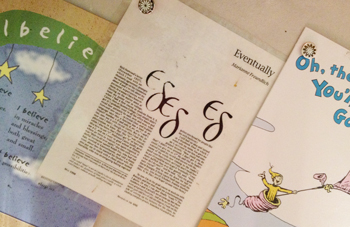
    Back in 1998 I photocopied an article from an AMS Notices journal called “Eventually” by Marianne Freundlich. I laminated it and hung it on my office wall.

    It’s moved offices a dozen times at least, but has remained an important reminder: “When learning something new, you may not get it now, but eventually you will. Just stick with it.”

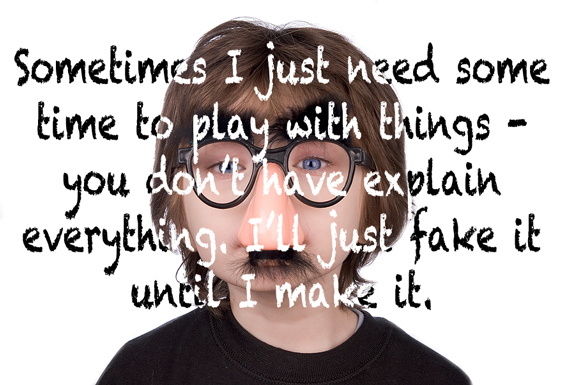
    The “fake it ’til you make it” principle works in math too. It’s okay for them to practice something that they don’t understand.

    But kids need you to know they’re faking it.

    Often kids fake their learning. But they’re also trying to fake out the instructor. It turns into a big dirty secret that they keep inside. Like this:

    “Mr. Smith, I don’t understand this. I think I can do the problems, though.”

    “Well, Joan, let me explain it this way…”

    Mr. Smith explains another way. Joan feels uncomfortable because he’s spent so much time on her and she still doesn’t get it.

    “Okay, I think I understand now.”

    “I’m glad. It’s important for you to understand before we move on.”

    Joan thinks she’ll just keep practicing and hope that something clicks before the test. She doesn’t want to ask for more explanation.

    Fake it like Fermat!

    (That’s supposed to be a play on “Bend It Like Beckham” — I’m not sure it works.)

    A well known phrase in math graduate school is, “Okay, I don’t understand that, but I’ll go with it for now.”

    Mathematicians fake it all the time. They come back later to see if they can work out the details (and don’t publish or approve of something until they do). But they announce out loud that they’re faking it.

    And kids should be allowed this too.

    “Mr. Smith, I don’t understand this. I think I can do the problems, though.”

    “Okay, Joan, that’s fine. Perhaps after you do it a while, you’ll get it. “

    “It’s possible.”

    “No problem, if you don’t get it now, you’ll get it eventually. As we move forward, when you come to something like this, just keep doing the steps. That might help you understand, too.”

    “That works for me. Thanks, Mr. Smith.”

    “Feel free to ask me any questions about it and we’ll continue the conversation until you do get it.”

    Not understanding is totally okay — but the child must know it. And, more importantly, they must know that you know it!

    So let them fake it!

    When understanding is too far out of reach, encourage some rote practicing of the steps. And let them admit, out loud, that understanding isn’t there — even be happy for it.

    Anticipate the understanding and be excited that someday it will come.

    And if your child wants to move on, do it. They’ll get that other stuff eventually.

    Share your thoughts in the comments or on twitter/x.

    You might also like:
  • Midpoint Formula and Counting – Logarithmic Style

    Midpoint Formula and Counting – Logarithmic Style

    Download a printable version of this post here.

    I’ve never been a believer in the real number line. It just always felt wrong that between any two numbers, there’s another number. Sure, you can go between two things – but is there a number there?

    And then I think, “Well, add up the numbers you’re standing between and divide it by 2 – that’s the number between them.”

    But it still doesn’t feel right.

    I could be onto something, though.

    I listened to Episode #110 of Stuff To Blow Your Mind called “Is math a human invention or a human discovery?” They pointed out that tiny babies can perceive quantities.

    “Curious,” I thought.

    Then I peeked at their math series, in particular the article on What are Numbers? Which led me to Stanislas Dehaene and his appearance on RadioLab’s episode on Innate Numbers.

    Here’s the discussion.

    I was particularly interested when they noted (around minute 11) that we don’t naturally switch from logarithmic thinking to this 1-2-3-4-counting we do now!

    Around minute 12 in the audio, they consider the idea of midpoint. Dehaene notes that in logarithmic thinking, the midpoint between 1 and 9 isn’t 5, but 3.

    The midpoint between 1 and 9 is… 3?

    Here’s how we think of the middle: “What do I add to 1 twice to get 9?”

    We can add 4 to 1, twice, to get 9. So then we add it only once to get halfway there – and halfway there is 5.

    Graphically it can look like this:

    We could also use the fancy midpoint formula:

    \((x+y) \cdot \frac{1}{2} = (1+9) \cdot \frac{1}{2} = 10 \cdot \frac{1}{2} = 5\)

    Instead of adding, how about…

    Dehaene notes that logarithmic thinkers multiply to find the midpoint! Like this:

    These people think, “What do I multiply by 1 twice to get to 9?”

    So the new fancy formula can be seen as this:

    \((x \cdot y)^ {\frac{1}{2}} = (1 \cdot 9)^{\frac{1}{2}} = 9^{\frac{1}{2}} = 3 \)

    Whoa!

    Midpoint Formula Gone Wild!

    Look how the formula got adjusted:

    (Of course this leads to a whole ‘nother discussion about how the square root is really just “half” with respect to multiplication. But that’s going a bit to far for this article)

    How about another “midpoint” example?

    What’s between 4 and 762?

    For “normal” folks, it’s:

    \((4+762) \cdot \frac{1}{2} = 766 \cdot \frac{1}{2} = 383 \)

    And for the more “natural,” logarithmic thinkers, it’s:

    \((4 \cdot 762)^ {\frac{1}{2}} = (3048)^{\frac{1}{2}} = 55 \)

    Like this:

    And the bigger the numbers, the more “ish” things become. And apparently, that’s okay!

    So maybe we do have it wrong.

    I’ve told thousands of students over the years that mathematicians just make this crap up. There’s no truth to that “mathematics is the universal language” hoo-ha that they feed you in the movies.

    Leopold Kronecker noted:

    God made the integers; all else is the work of man.

    And just maybe man has messed it up.

    So is there really a number between any two numbers? Or is there just something “sort of” between any two numbers?

    What does this mean to math learners?

    Okay – now the bottom line. What does this mean to grownups teaching math – and the kids learning math?

    These little super heros have amazing powers – right when they’re born!

    Well – one thing is that we grownups can lay off. Let the kids learn their own ways. Let them inquire, discover and develop their own methods for doing things.

    If they’re logarithmic thinkers (which they are from the start), let them ride that wave a while.

    Also, remember that we, the grownups, have been conditioned out of logarithmic thinking. Which means that their way (the natural way) seems wrong.

    But we are the ones who are wrong.

    So if your kids don’t believe what you’re feeding them. Let them doubt. They’ll learn enough eventually to pay their rent, balance their checkbook and meet their friends halfway.

    With or without our interruption.

    Buy Dehaene’s The Number Sense on Amazon.

    Share your thoughts in the comments or on twitter/x.

    You might also like: