As a mom of a girl child, I’m supposed know all about braiding hair. But I don’t. <cue dramatic bad mom music>
I know how to braid three basic strands of hair… mostly. But when I try the French braiding thing, K8’s hair looks like a feral goose nested in it overnight.
“There must be some way of knowing how much extra hair to pull in — and when!” I thought.
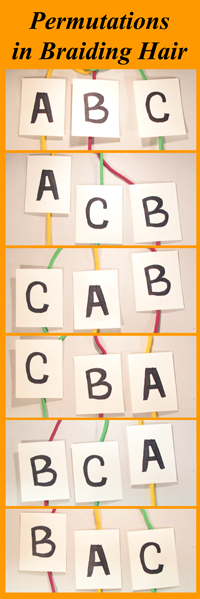
When trying to figure it out (mathematically, of course), I noticed that the strands of the braid weave to give all possible permutations of three things!
Check it out:
So we have all of these:
Are there more?
This makes me wonder what happens with four strands. Of course that kind of thinking will send any incompetent braiding mom into fits!
What do you think? Share your thoughts in the comments or on twitter/x.
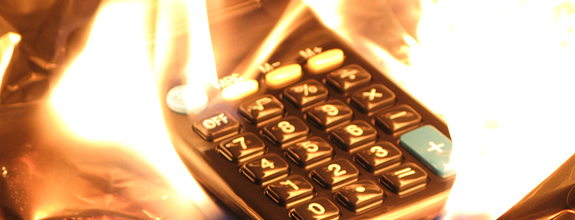
It’s no secret that I’m an opponent of calculators. In fact, I recently suggested to readers of 12Most.com that they burn their calculators!
But there is one calculator that isn’t burn-worthy.
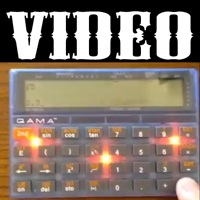
The QAMA Calculator requires the user to input a reasonable approximation before it churns out an exact answer.
So if you asked your QAMA Calculator to find the square root of 5, it would ask you first what \(\sqrt{5}\) is really close to. Like this:
That’s annoying!
Okay, maybe. If you need the calculator to do some quick work (the real reason to use a calculator), then you don’t need the darn thing quizzing you about an approximation.
But the QAMA Calculator people thought of everything. You can turn off that feature!
But then the kids will cheat!
Ah! You would think so. But check out what it does when you turn the feature off:
So what do you think? Will you get a QAMA Calculator? (It’s only about $25 after shipping & handling.) Will you let your kids use it?
P.S. I paid full price for it — it’s not expensive and it’s a crazy brilliant idea, so I went for it.
I have been working with eHow.com to get some common math questions answered. One of the questions was, “How are the areas of a rectangle and triangle with the same base and height related?”
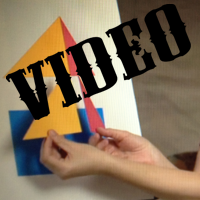
Curiously, all rectangles can be cut into triangles. And all triangles can be doubled to make a rectangle. Watch this video – and then get out the construction paper, scissors and glue.
Grab a kid and have some fun watching them discover!
You can’t get a more dense set of math words crammed into a small space than “scalar factors of scalar ratios” – shoot me.
@Milehimama, a friend of mine on Twitter and fearless leader of the Houston Blogging Chicks asked me yesterday what was up with this strange math thing. And why her son was being asked to do a table with them instead of doing it the way it seemed most natural to him.
I could go on and on – not just about the boring-ness of the table, but also the coolness of scalar factors. I’ll spare you (and her) the insane rant/passionate pep rally. I’ve limited my answer to 6 minutes in the video below.
A number system is a highly advanced concept. And yet we throw it at first grade math students expecting them to immediately grasp it.
Our number system is based on place value, like any number system (like clocks, years, etc.). Which means everything wraps around. Once you get to the “top” of the list of numerals, you have to start over, in a sense. This is crazy weird – it’s no wonder kids struggle at this point!
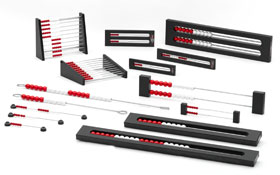
I promised to help a teacher this weekend who was struggling teaching place value to her first grade math class. I dug out a MathRack, a brand of rekenrek, which was part of a set MathRack.com shared with me months ago. I peeked at their book Mastering the MathRack to Build Mathematical Minds to get an idea of how to teach place value using this amazing tool.
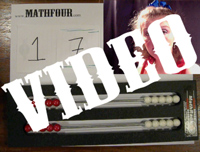
The video above uses the MathRack 20 and some place value cards. I followed the Hidden Numbers activity on page 61 of the book. (As of writing this, I’m unable to find the book online. The site where it is supposed to be doesn’t seem to be functioning anymore.)
Glenda, the first grade math teacher, specifically wanted help teaching the comparing numbers and ordering numbers. So here goes…
Comparing numbers is easier when visualized.
Children can see the value of two digit numbers better when they see the quantity of beads. Let them practice comparing numbers for a while using both the rekenrek and the place value cards. The more they practice, the better feel they’ll get for the place values in our number system.
I’m not sure what the structure of a first grade math class is, but the more days they can “play” with their MathRack like this, the better they will get at comparing numbers. If you have limited time, do a few minutes each day for more days, rather than more time on fewer days.
Ordering numbers is also easier when children see it.
Once the children have played a while with the rekenrek, they will have some comparison skills. Ordering numbers is the next step. Teach them that the act of ordering numbers is just comparing numbers many times.
Computers order numbers by comparing them one at a time to each of the other numbers. Let students try ordering numbers this way, as well as other ways. The one-at-a-time method might be slower, but it could be what the child needs.
Keep trying and share what you learn.
How about it – can you use this for your first grade number system lessons? Do you have a MathRack or can you make one? Share your successes in the comments!
Have you run into this? You get the “wrong answer” when you use a calculator and the Law of Sines to find an obtuse angle.
The problem isn’t that the Law of Sines doesn’t work (thanks @GMichaelGuy), but that you have to be cautious when dealing with the arcsine with an obtuse angle. Here’re the details:
I’ve concocted a triangle that’s pretty simple but has an obtuse angle. That’s the key here. The law of sines always “works” when you have all acute angles. It’s only when the angle in question is an obtuse angle that we have a problem. (and, as @GMichaelGuy pointed out, it always works, it just makes us do a little more work.)
Notice I used the arcsine. Turns out, the arcsine isn’t a function. Which means when you “undo” all the bits in the law of sines, technically you’ll get an infinite number of answers.
So it all boils down to the calculator not being able to determine if you want the obtuse angle when you solve for x using the law of sines!
What do you think? Any other questions on trig? Ask them in the comments.
Yup – only three. Said by you, the parent and grownup. Say them loud, say them often. And contact me when you wonder where math is in your world – or leave a comment here!