
No formulas here, only how to figure out which formula you might need to use if you’re working with present value annuities or future value annuities. (These are part of finance and often found in a Finite Math class.)
Tag: video
-
Everybody’s Good at Math
This past Monday we had a great #mathchat via Twitter. The topic was: “If you could clear one misconception about mathematics and/or teaching it, what would it be?”
I was getting a bit frustrated that a couple of people kept bringing up the misconception that girls aren’t good at math. Even to the point of creating their own hashtag #girlsaregoodatmath2.
In my life, I’ve never heard anyone say this – in any other form than somebody complaining that people say it.
So here’s my response to everyone who keeps saying to me, “I wish people would stop saying, ‘Girls aren’t good at math.’”
What do you think? What will you say from here on out?

Related articles
-
Playing with Algebra Concepts
I’ve been itching to get into some basic abstract algebra goodies. With the help of the Cuisenaire Rods, Simply Fun Sumology number tiles and the Discovery Toys Busy Bugs, I’m able to do that.
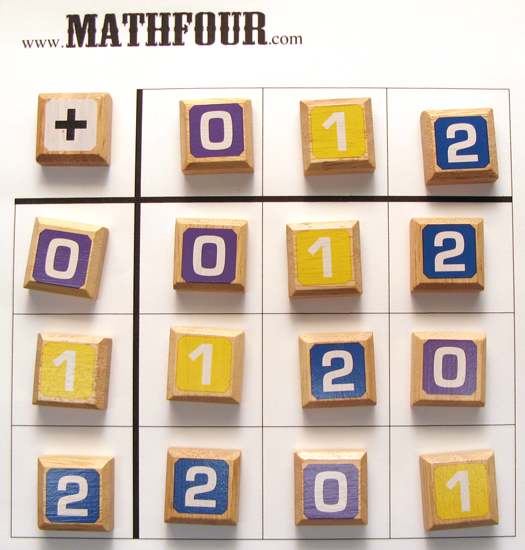
Start with wrap around addition.
This type of math is officially called “modular arithmetic.” We are only going to use the numbers 0, 1 and 2.
It begins as regular addition. And since we are only using those three numbers, all our answers have to be either 0, 1 or 2. So when we add 1+2, we wrap around.
If we were to count in our system, we’d say: “0, 1, 2, 0, 1, 2, 0, 1, 2, 0, 1, …”
The addition table looks like this:
(Notice you could do this with numbers from 1- 12 and it would be clock addition!)
Now things get buggy.
Switch out all the number tiles with some pretty color Cuisenaire Rods. They don’t have to be the “right” rods. We’re only looking at the colors. Here’s the progression I did:
The end result is a very abstract chart!
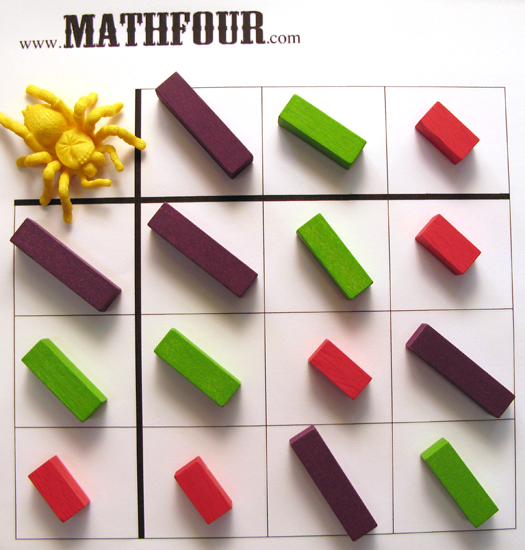
You can “bug” two things together.
Like this:
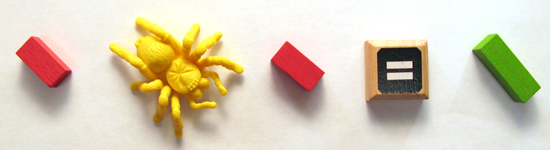
(I know – a spider isn’t a bug. But run with me on this, okay?)
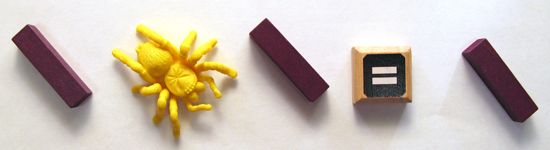
Notice that each of these are directly from the “spider table” above.
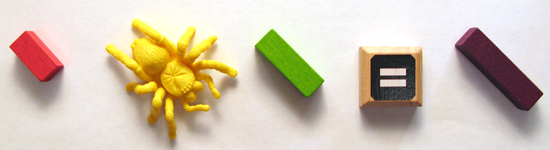
You can read this as, “Purple spider green equals green,” just like you would say, “Zero plus one equals one.”
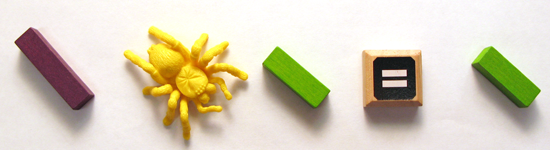
And then turn your child loose!
First make a chart, or download this one.
You can, but don’t have to, start out with numbers. The rules are this:
- You can only use three colors.
- All three colors must go across the top.
- All three colors must go down the left.
- Fill in the 9 spaces however you want, as long as it’s only those three colors.
I did this one with the blue beetle as the “addition” piece:
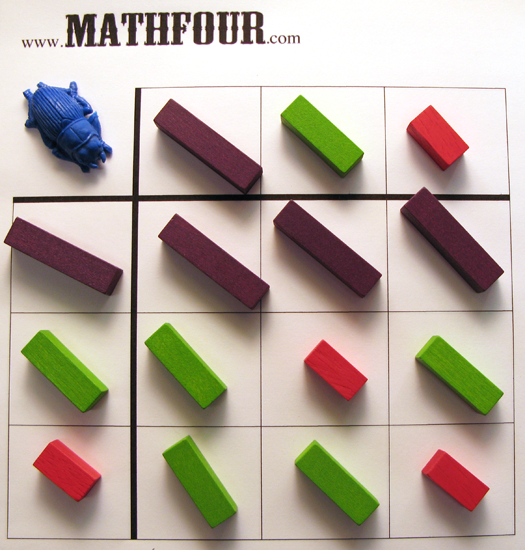
So what can you do with a goofy “blue beetle table”?
Let your child play, for one. And experiment.
You can also talk about commutativity and associativity, identities, inverses… but I’ll leave that for another article!
What do you think? Does your child want to play like this? What else can you do? Share your thoughts in the comments.
Related articles
-
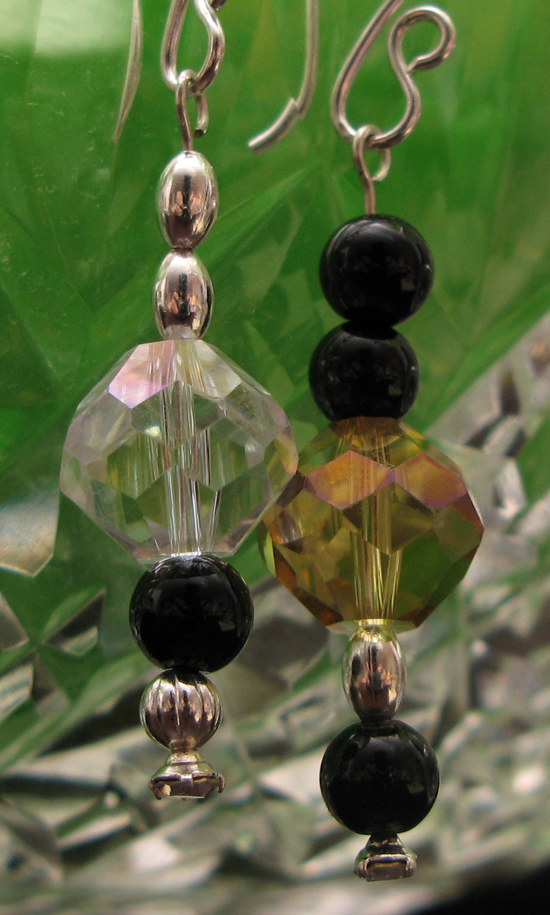
Math Crafts: Probability Earrings
Kathy at Nova Beads helped me “tie them off” and choose the hangers. The end result is beautiful!
Have questions about probability or making jewelry with it? Ask in the comments!
Related articles
-
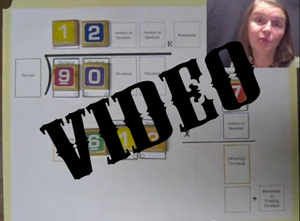
Long Division with Sumology Number Tiles
A few articles back, I published a video called Long Division with Playing Cards. I did it super-fast in response to a comment at Living Math Forum.
I’ve pondered this a bunch since then and decided I like the idea, but the playing cards are too cumbersome. I ran across a game called Sumology (from Simply Fun) at the Texas Home School Coalition Convention. The heavens parted and angels sang.
Or at least my heart started beating and my head started spinning.
So here’s the same teaching method, but with a little more pizzazz and a couple of free downloads:
What do you think? Will your child like it? Please share your thoughts in the comments.
Related articles
-
The 1-2-3 Song
Part of the Count 10 Read 10 series to help parents connect with kids through math a little each day.
Did you know that the alphabet song, Twinkle Twinkle Little Star and Baa Baa Black Sheep are all the same tune!?
Well, now there’s another!
Thanks to all the great folks who have public domain images out there that I could use for this.
Specifically
- www.PublicDomainPictures.net (I LOVE this guy and his crew!)
- www.WPClipArt.com
- www.OpenClipArt.org
- www.Clker.com
Related articles
-
Long Division with Playing Cards
I have since shot another video showing this with number tiles instead of playing cards.
In response to a post on the Living Math Forum, here’s a way to teach long division with playing cards.
Whatcha think? Will it work? Let me know if it does!
Related articles
-

Embracing the Not-Knowing at a Homeschool Convention and in Math
I’m heading to the Texas Home School Coalition’s Convention this weekend in The Woodlands, close to Houston, Texas. The excitement I have for it makes me think of the excitement due to math…
(and I have on Husband’s Roger Creager shirt that is faded brown – I’m NOT naked.)
Related articles
-
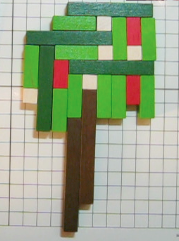
Cuisenaire Rods
Cuisenaire Rods are brightly colored wooden sticks. Technically, they’re “proportionally sized rectangular parallelepipeds.” (But only say that if you want to hear your 3 year old repeat something really cute!)
The “proportional” thing is important. The white ones are 1cm square, the red ones are twice as long and each color is 1cm more than the next color.
I’m anticipating many articles and videos on how to teach with these (since the possibilities with these things are virtually unlimited), so I thought I would start a running series. Here are the ideas and the links to the articles/videos that are ready:
- Cuisenaire Rods – (this one) graphing and practicing coordinate pairs (see video below)
- Cuisenaire Rod Art Inspires Thought and Decision – more graphing and thinking like a mathematician
- Cuisenaire Rods Go Pythagorean! – figuring out the coordinates on “tilted” rods on a graph
- Playing with Algebra Concepts
- Adding Fractions with Cuisenaire Rods
- Relations – Greater Than and Less Than
- Algebra – Solving Equations with Beautiful Colors
- Set Theory
Creating Coordinate Pairs with Pictures
Share your own ideas on how to use Cuisenaire Rods in the comments!
P.S. I spent my hard earned money on these at Teacher Heaven. This small set was $15 in the store, but I see you can get it for less than $13 online.
This is also shared on Works for Me Wednesday.
Related articles
-
Teaching Subtraction Using a Balance
I love finding nifty ways to use tools for teaching math. Especially tools that aren’t supposed to teach math. Or at least the math I’m trying to get it to teach.
I have this very cool balance that I got from Discovery Toys that would normally be a science toy. But, alas, I’m a mathematician, Jim, not a doctor. So I’ve taken the fancy science toy and turned it into a way to teach subtraction.
You can, of course, use it to teach addition and later I’ll do a post on using it to teach multiplication and division.
If you have children who struggle with math concepts, teaching them with hands on bits (manipulatives) sometimes helps. Here’s how to teach subtraction using a balance:
This nifty trick can be done with any balance as long as you have weights appropriately sized. Sometimes that’s not so easy to find. Order a colorful balance that’s similar to the Discovery Toys one in video here.
Did it work? How did your children receive this method of learning arithmetic? Please share your experience with it in the comments!