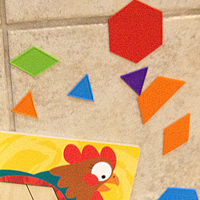
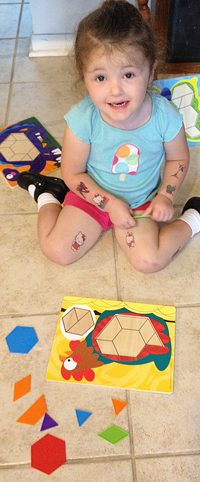
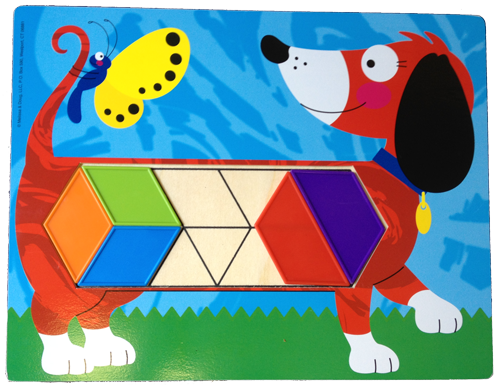
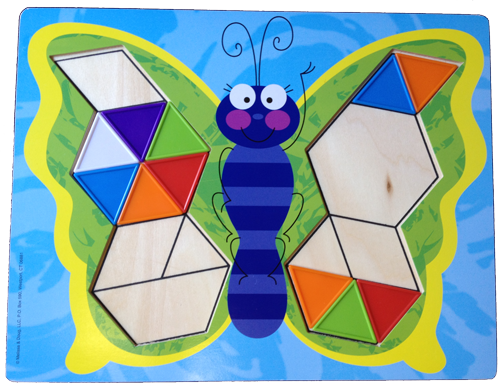
It has ten different animals (on five two-sided boards) and over 50 plastic shapes in tons of colors to complete the pictures.
Use it to teach more than just shapes.
Of course you can talk to your toddler about hexagons, triangles, parallelograms (which are also rhombuses in this math toy) and trapezoids. But you can do even more!
All the shapes can make the bigger ones. So it’s not just a bunch of shapes that may or may not work – this toy is designed with some serious thought.
Here are some questions you can ask while playing:
How many of each shape can squeeze into a hexagon?
Pick a shape and cram them into the hexagons!
How many triangles fit in each shape?
This is huge in math. Since all shapes can be made of triangles, answering this questions preps your little one for some big geometry stuff.
And after you play with those a while, you might notice how the number of sides of a shape compare to the number of smaller shapes that can fit in it.
Last minute shopping? Me too! How about some of these math gifts for your favorite folks…
For Kids
Numb ‘n’ Number by Peter Weatherall – A collection of fun math songs.
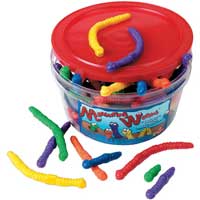
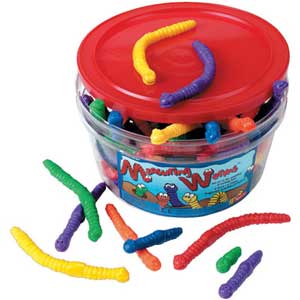
Worms! What kid doesn’t like worms? And these are measuring worms!
For Grownups
Math T-Shirts by ExBoyfriend Collection – Sad? Funny? These are cute for even the “non-math” people.
Want something a little more fancy? How about math jewelry like this Fibonacci necklace!
For Families
Math games are great for full family fun – and games like Uno… well, that’s math too!
For Math Geeks
Old math books! Husband found a College Algebra book from 1947 for me – gave it to me as a “just because” gift. Here’s a Trig book by the same guy. You probably can get an old math book for your favorite geek at any second hand book store!
Math Music! The Klein Four Group’s instant download Musical Fruitcake CD (I just downloaded it, myself!) To give you a sample of how cool these guys were (they are now professors all over the world), here’s a fun Christmas song from them:
How about it – what are you up to for last minute shopping? Are you done?
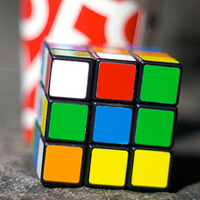
I stumbled upon the Paul Smith Gallery in Las Vegas a couple of weeks ago and was completely drawn by the Rubikcubism art by Invader on the wall.
It was a pixelated image that looked interesting from afar, but when you got close, there was a whole new surprise. It was made from 225 Rubik’s Cubes!
I spent a good 30 minutes in the shop talking to David, the Paul Smith associate. So many questions came up, including:
How can you make an image with only six colors? (Rubik’s cube has six sides, thus only six colors.)
The price tag on the artwork was $22,000, how much money was spent in actual Rubik’s cubes?
Could I do something like this?
If I were to replicate it, could you tell the difference between the original and the fake?
What kind of math is involved in creating something like this?
Can your kids do it?
It might be fun. It could get expensive, though: at $10 a pop, and after sales tax, 225 Rubik’s Cubes come to about $2500.
I don’t have this kind of money to drop on cubes, and I’m guessing that most homeschoolers don’t either. But for only $10 and the technology you already have around the house, you can let your child be a Rubikcubist!
They sure can!
If your children are inclined to give this a shot, buy them each a Rubik’s cube. Let them explore the number of sides, and the number of “pixels” on each side. If they don’t already know about how colors work together, they can either research or learn through experimentation.
They can choose to use graph paper & colored pencils, Microsoft Excel, or a paintbrush program to map out what they want their image to look like.
As they twist the Rubik’s Cube into each pattern, take a photo of it, or a color scan. Print it at full size and let them use the prints to create the final artwork.
Making Rubikcubist artwork is math!
Throughout the projects, explore the concepts of area and patterns. Also encourage them to think about color theory (of which I know squat, but your kids will be learning as they experiment).
Questions to ask:
How many total “pixels” did you use?
How many total Rubik’s Cubes did you use?
If you were to make this “for real,” how much would it cost us in Rubik’s Cubes?
What else did you notice about the project regarding colors, patterns and area?
Solving a Rubik’s Cube is math, too.
By the way, the solution to a Rubik’s cube is mathematical. It’s actually part of mathematics called group theory. My office mate in grad school was able to solve a Rubik’s cube in about 20 minutes.
I was never able to figure it out.
Share your art!
Put your child’s final artwork on Flickr.com or other photo service and post a link to it in the comments.
Feature image is by Robin Iversen Rönnlund on Flickr.com, CC BY.
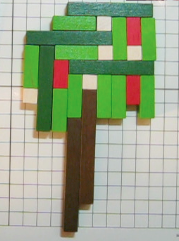
Cuisenaire Rods are brightly colored wooden sticks. Technically, they’re “proportionally sized rectangular parallelepipeds.” (But only say that if you want to hear your 3 year old repeat something really cute!)
The “proportional” thing is important. The white ones are 1cm square, the red ones are twice as long and each color is 1cm more than the next color.
I’m anticipating many articles and videos on how to teach with these (since the possibilities with these things are virtually unlimited), so I thought I would start a running series. Here are the ideas and the links to the articles/videos that are ready:
Cuisenaire Rods – (this one) graphing and practicing coordinate pairs (see video below)
I love finding nifty ways to use tools for teaching math. Especially tools that aren’t supposed to teach math. Or at least the math I’m trying to get it to teach.
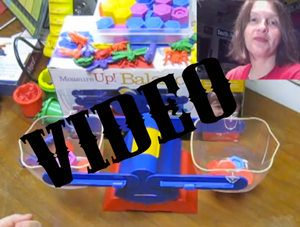
I have this very cool balance that I got from Discovery Toys that would normally be a science toy. But, alas, I’m a mathematician, Jim, not a doctor. So I’ve taken the fancy science toy and turned it into a way to teach subtraction.
You can, of course, use it to teach addition and later I’ll do a post on using it to teach multiplication and division.
If you have children who struggle with math concepts, teaching them with hands on bits (manipulatives) sometimes helps. Here’s how to teach subtraction using a balance:
This nifty trick can be done with any balance as long as you have weights appropriately sized. Sometimes that’s not so easy to find. Order a colorful balance that’s similar to the Discovery Toys one in video here.
Did it work? How did your children receive this method of learning arithmetic? Please share your experience with it in the comments!
Remember the ol’ “if A equals B and B equals C, then A equals C” deal? At parties it’s a great line to drop. In math, it’s officially called … cue music…
The Transitive Property
Saying it is fun, teaching it is curious, learning it can be weird.
Grownups think it’s intuitive. But to a kid, it isn’t. It takes experience and experimentation to learn all the bits that we think are “common sense.”
The transitive property is really thinking things through. Starting from one place and moving along through another and then arriving at a third place.
There are many ways to help kids with this learning. Word problems simulate thinking stepping stones. But they can be rather stressful. If you do it through play, you reduce the stress that they face and give them skills they need to tackle advanced thinking, forever.
This video shows a nifty “toy” from Discovery Toys that can get kiddos using those brain stepping stones.
Notice the flow is
Choose the number tile with the question number.
Read and answer the question.
Correspond the answer to the letter in the answer box.
Put the number tile with the question number in the corresponding letter box.
Thinking through from question number to answer letter while avoiding the pitfalls is the challenge.
Have you played with these? How do you train your kids’ brains for the transitive property?
I learned my math facts by “singing” them while looking at flashcards.
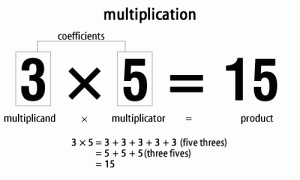
Having these facts ingrained with chanting or singing isn’t a bad idea. It might not “feel right” because we’re so into experiential learning these days. But if a kid can’t immediately access and use things like 8 x 7 = 56, he’s going to be slower than if he can.
And if he’s slower, he might get frustrated and start to think that he’s not good at math.
Also, knowing these cheap and dirty math facts helps with confidence. Even if a kid’s struggling with other things in math, knowing that he has this one thing (the “facts”) will help out.
I fight this battle often. Some people feel that math facts shouldn’t be memorized. But there’s so much value in it.
How about you? Which side of the fence are you on?
Want to give your kiddos a jump start on multiplication and division? What to help the ones struggling with division to grasp it better?
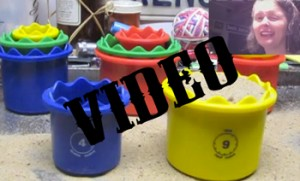
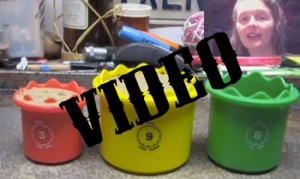
The Discovery Toys Measure Up Cups can do just that. They are built as a curriculum tool, in the proper ratios, so that the #6 cup holds exactly twice as much as the #3 cup. This allows for engaging and beneficial play that gives kids a grasp on how numbers relate to reality.
For example, in this video, kids can compare the numbers 3, 6 and 9 to see how they relate:
You don’t have to say out loud, “three plus 6 is 9” or, “9 divided by 6 is one with three left over.” But these concepts are ingrained into the child’s brain as they see this work.