The math education revolution has been growing. Last year Salman Khan and the Gates Foundation brought Khan Academy to everyone in the world with a computer.
Dan Meyer jumped into the ring with his math class makeover. With his Any Questions? and Three Acts, he’s fighting the good fight to get kids to learn math.
Social learning math games like Sokikom, iPhone apps like Motion Math and face to face programs like Mathnasium have joined the math education revolution, too. Thousands of tutors are taking part.
Experts all over are helping kids understand that math is important, necessary and valuable to learn.
Kids still resist math homework and avoid participating in math class. Why?
Because everyone knows that math is boring, hard and has nothing to do with real life. Nobody really likes it – unless they’re an engineer or accountant.
Math teachers are mean and professors write math books just to mess people up.
Everyone knows this.
Who is this “Everyone”?
Grownups.
Yup – you and me.
When you hear people talk about math or math education, what do they say? Anything positive?
The best I’ve ever heard was, “Actually, I kinda like math.”
Which means, “I know it’s not cool, and I’m sorry for saying it, but I like math.”
Would you do something nobody liked?
No! Of course you wouldn’t. At least not on a regular basis.
If everyone you knew and respected avoided something – you would too. If all your friends jumped off a cliff – so would you.
We’re human. That’s what we do. We stick together.
So we’re losing the math education revolution.
By the very design of our society, Khan Academy, Sokikom, teachers, tutors and everything designed to help kids learn math are failures. The math eduction revolution is bust.
We want kids to learn math because it’s important. Math is necessary and valuable to learn.
But since nobody really likes math, or even does math, kids aren’t buying it.
And I can’t blame them.
Is it fixable?
At this point it’s easy to throw in the towel. Give up. Quit. Decide that the world is going to end up like that movie Idiocracy.
But we’re so close to the solution.
The solution involves something that’s very cheap – and research based!
Ready for it?
The missing piece of the math education revolution is that we need to teach parents positive influence skills to encourage math.
What? Will that work?
We have seen this happen with reading – remember the Reading is Fundamental campaign of the 80s? It’s still going strong along with other programs like the “Read 3” program from HEB. Parents are encouraged, even pushed, by teachers to read to their children every day.
These efforts have changed the culture in our world so that reading is viewed as something “everybody does.” Parents now have positive influence skills in encouraging reading.
And those skills have extended across our entire culture!
That’s the missing piece!
Parents can develop the same skills for encouraging math. And when we do, everything will change.
Just like it did with reading.
When parents start talking about math in a positive way, all of society will.
The math education revolution will succeed!
It’s your turn…
If you’re a parent, learn how to use some positive math talk. Join a program like That’s Math, read articles on Math for Grownups or any other math blog that strikes your fancy.
If you’re a math teacher, blogger, tutor or developer of math products – make something teaching parents how to talk positively about math. We’re developing That’s Math, but there needs to be more of these.
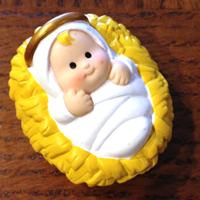
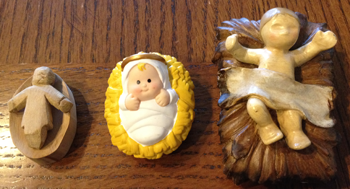
I’ve been stumbling over baby Jesuses for a few weeks now. I realized that with three working nativity sets in the house it was time to do a little math with Jesus.
All of them.
You can count the bits and pieces.
Animals, people, buildings – count them for each nativity set and count them up total.
How many total Jesuses do you have?
How many angels?
How many “visitors” does Jesus have?
How many sheep? Cows? Donkeys? Camels?
How many total animals?
You can compare the numbers.
My three nativity sets have varying numbers of characters and structures. It’s curious how some sets include more animals that visitors – and some sets don’t have any animals.
Which of your nativity sets have more animals? Which has more people?
Which has more buildings (or non-people/non-animal things)?
Are there more visitors than animals or more animals than visitors?
Arrange the sets in order of least to greatest – people, animals, etc. Are they always in the same order?
Is one set bigger or heavier than the others?
Do some arithmetic.
Take the opportunity to show how counting and arithmetic are kinda the same thing.
If you add up the number of sheep you have with the number of donkeys, how many is that? Is it the same if you group them together and just count them?
What if all the shepherds left? Talk about how you can count them, or you subtract the number of shepherds from the total number of visitors.
How many nativity sets do you have? Talk about how 3 times that number is the number of wise men you have.
Do fractions – but only if you must.
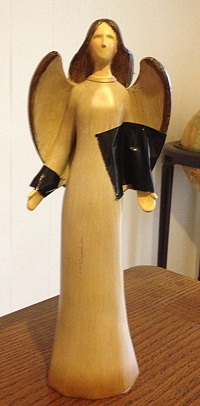
I know many people avoid fractions. I wish I could have avoided it with Math with Jesus. Daughter gave us the opportunity to talk about fractions by breaking the angel (or the “butterfly” as she calls it). Good thing we have Gorilla Tape.
Count 10 Read 10 is a family numeracy and literacy initiative. Read more about it on the Count 10 Read 10 page and watch this video explaining all about it:
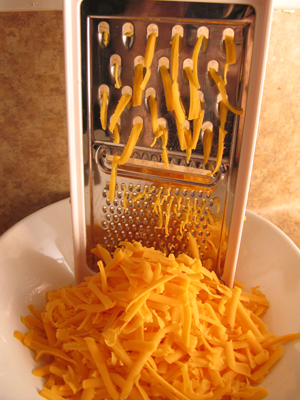
Last night was taco night and my job was to grate the cheese.
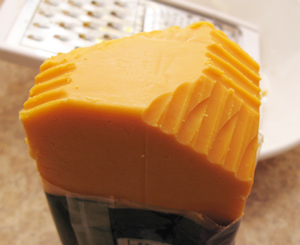
I didn’t get too far in before I noticed some math.
For some reason I always start grating on a corner. Then I rotate the block so I’m grating on another corner. After doing this a few times I noticed the angles I was creating:
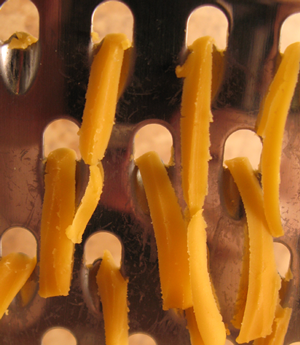
And what exactly are the shapes, anyway? What is the shape of the grating holes of the grater? And what is the resulting shape of the cheese sliver?
How much cheese is in the pile after you “fluff” it by grating it? What’s the volume of fluffed cheese compared with stuck-together-in-a-block cheese?
More importantly, is there enough for two grownups and a toddler? (When one of the grownups loves cheese!)
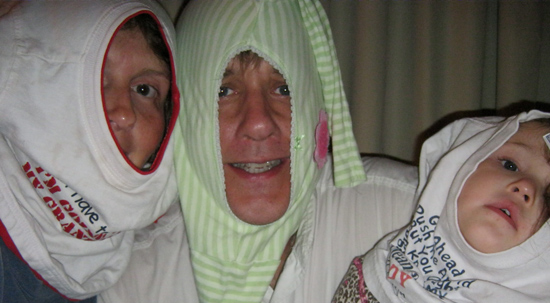
In an attempt to join the Wordless Wednesday crowd, I’m sharing this photo. But as you can see, for MathFour.com, this is only a Somewhat Wordless Wednesday.
Before this photo we were discussing size of shirts – a numeracy concept that is visually displayed through the inability for grownups to fit 4T nightshirts on their bodies. Count 10 Read 10 is part of our family’s afterschooling routine.
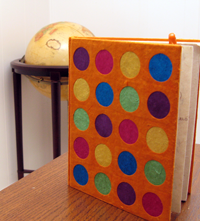
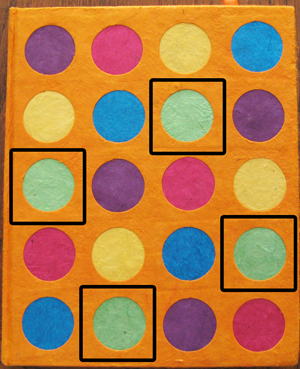
For my 40th birthday, I bought myself this beautiful Lokta paper book from a fabulous little store in the Houston Heights called Write Now!
It has circles on it – one of my “things.” I love circles. But then I saw how the colors were laid out.
“Holy cow! This is a teaching opportunity!” I thought.
And it got even better at the Texas Home School Coalition’s convention this last week. I shared it with former math teacher and now-homeschooler Sharon Brantley and she saw even more goodies in it!
You can use it to teach math!
Anything that has more than one aspect/characteristic/color (pretty much everything) can be checked for patterns. Patterns are an essential, perhaps even the most important, building block for mathematical thinking and development.
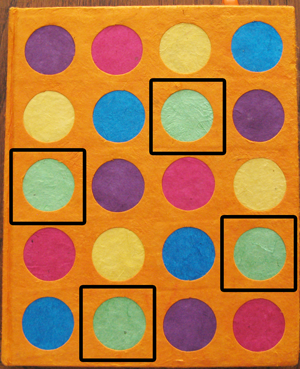
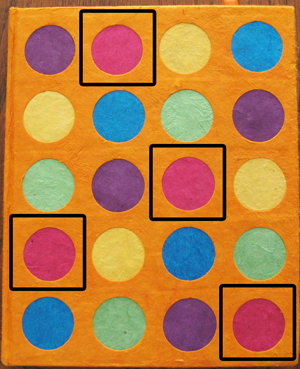
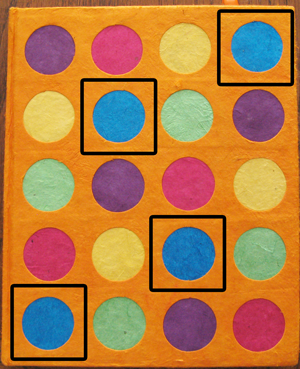
Here’s what you can see in this book cover:
Connect the green dots and you get a square. (Also the yellow dots.)The pink dots form a line and then the one dot off to the side can make a perpendicular line to the other line. (Purple dots, too.)
These blue dots make a funny little shape.
But wait! There’s more!
What Sharon pointed out to me was that you can draw an L from any dot to another dot of the same color!
Optional: This “L” thing links directly to the slope, by the way. Between any two points of the same color, the slope is either 1/2 or -2. Cool, huh?
Where do you see patterns in your world? Share it (and a link to the picture) in the comments!
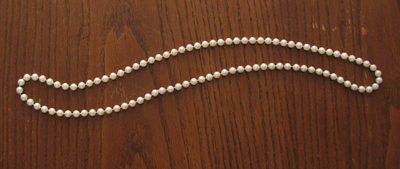
I noticed Daughter attempting to bejewel Husband with a strand of my faux pearls the other day. I watched, enthralled with the math learning taking place.
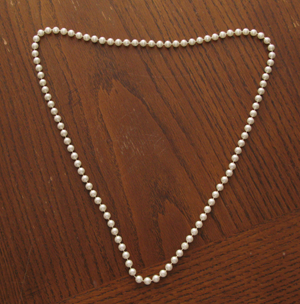
She held the necklace in her hands – one on each side. Just about equal. So the space available for Husband’s head was almost non-existent. Like this:
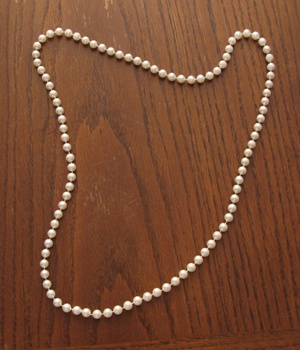
If she were to hold the necklace at two points that were closer together, she would create a “dip” in the necklace where his head could fit. Like this:
There’s an extended learning opportunity here!
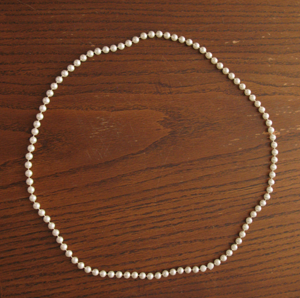
This made me think of all the nifty things you can show about the relationship of perimeter to area and how you can have the same perimeter but change the area to all sorts of sizes.
If you aren’t wearing a necklace, find some mardi-gras beads. Daughter has many strands, so I’m guessing your house might be littered with them as well. If not, join the club. Go buy some.
Play with them in the bathtub or right before bed. (Make sure they give them up before going to sleep, though – it’s a strangulation hazard!)
Move the necklace around on a flat surface (or on the bed) and let your child experiment with the ways the area changes. Ask questions like:
How much “stuff” can you fit inside the shape? (If there are blocks or other toys to act as “stuff,” use them.)
How much “stuff” can you fit inside the shape after you move it around?
Is that more or less “stuff” than you could fit inside it before?
Did the distance around the necklace change? (You can introduce the words perimeter and circumference.)
Can you make it into a square? A triangle?
Be careful how much you do.
Don’t forget, activities like this should be fun. For your child as well as you. So don’t get too in depth talking the math talk if it feels weird. Go with the flow.
And let me know how that flow goes, would you? Share your thoughts in the comments.
Learning math isn’t just about being taught math. It’s about fun, discovery and experimentation. In the Count 10, Read 10! program, parents get to spend 10 minutes a night playing math with their children.
Like many games you’ll find here, this is a version of Calvinball (from Bill Watterson’s Calving & Hobbes cartoon). You and your children make up the rules as you go along or as you see fit.
The next player says “plus” and another number. Then adds them and says the result.
The next player says “plus” and another number. She adds that to the previous result and says the new result.
Play continues until a winner is determined.
Example
Leader: Five!
Player 2: Plus three is eight!
Leader: Plus one is nine!
Player 2: Plus two is eleven!
Leader: WINNER!
End game, and how to choose a winner.
The round ends when the youngest child reaches their limit of counting or adding. The winner is determined by a rule or random choosing. The older the children, the more “real rules” you’ll need to follow.
Possible winning rules:
The first person to add up to 10 – or a number designated by the leader at the beginning of the game.
The person who noticies that another player is wrong in their calculations (this is perfect for the parent to “test” the kid).
At the whim of child or parent.
Variations
The point is to have fun with counting and math. As your children grow, you’ll have to adjust the rules to give them more challenge and to fit the “real game” model. Here are some options for variations:
Each player can only add a multiple of their age (grownups use one of the digits from their age).
Each player can only add a multiple of a roll of a die (get foam dice for bedtime).
Subtraction – instead of adding up, start with a higher number and add down.
Multiplication – instead of adding, multiply each new number. This one could get “fun” really quick!
Will it work?
All games created at MathFour.com are tested or will be tested on Daughter. The rub is that Daughter is almost 2 – we’ll have to wait a while to do this one. So your input is important.
Will it work? Did it work? Try it and let me know how it goes in the comments, please. Also share your own variations.