The comparison of numeracy to literacy is curious.
Learning math is the opposite of learning to read. When you read, usually simultaneous to learning a language, you sound out words and then put meaning to them. When you learn to count and do math, you know the meaning inherently and then put a language to it.
At some point we learn to recognize words without sounding them out. And at some point we learn to recognize quantities without counting them out. This is called subitizing.
The Your Baby Can Read program uses the concept of subitizing to teach reading – you show your baby the word alongside the object. So the shape of the word car is as recognizable as a car itself.
The children using Your Baby Can Read don’t learn to sound out words. They don’t understand the concept of letters any more than babies not using the program. But they instantly recognize the shapes of the words – giving them an (assumed) advantage.
Aside: We didn’t use the “Your Baby Can Read” program, not because it was gimmicky (I love anything that looks gimmicky), but because there is a huge DVD element to it. We decided not to put Daughter in front of the TV for her first 2 years. A decision we stuck with, but sometimes was a struggle!
This article contains a “your baby can count” type program. (And it’s a free download!)
How did we learn subitizing?
I don’t recall having been taught it directly. Although I could be wrong. The research on it has been happening since the early 1900s, so it might have been taught without being labeled “subitzing.”
I wonder how many of us do that. Are grownups so adept at subitizing that they forget that’s how we assess quantity? Maybe we’re taught to chant-count because that’s the way we think counting is.
But it isn’t!
How do you teach subitizing?
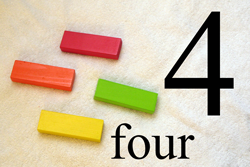
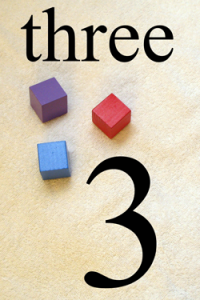
Images are accompanied by the written numeral as well as the number spoken aloud. The images would be printed on cards, done via video or “live” with 3D objects.
I’m still working on the numbers 5-10 and up, but for the numbers 1-4, the following 8 styles of image sets would be done twice. Once using the same objects for each image set, and once using different objects for each image set.
Organized in a row vertically.
Organized in a row horizontally.
Organized in a row diagonally.
Organized in a row other way diagonally.
Organized in a regular shape (triangle, square).
Organized in a differently oriented regular shape.
Organized in an irregular shape.
Organized in a different irregular shape. (There will be more of these for 4 than 3, etc.)
The objects could be blocks, cars, little dolls, just about anything. I created the set below from blocks I found left in Daughter’s block set.
Each zip file contains a few .jpg files with 4″ x 6″ pictures. You can print them at home or ship them to Walmart, Target, CVS, etc. for printing. I left off the MathFour.com logo so the kiddos wouldn’t get distracted. Please share them along with links back here.
I had this grand idea when we got married and were hoping for kids – I would teach our children to count starting at 0.
When Daughter was 15 months old, I decided we should start teaching to count with negatives.
But I was wrong on both.
And so is everyone else.
Why do we teach toddlers to count?
We practice counting 1-10 with our kids. We know (somehow) that before they’re official school age, they should know how to count to 10. And how proud we are as parents if they can count to 20!
But these are just words.
I can teach Daughter to memorize the Fibonacci sequence, but she’d no more know what that means than what counting to 10 means.
In fact, I know this first hand because I used to count to 10 in Spanish. And I’d leave out ocho everytime!
I saw a guy made fun of in Germany because he told a waitress he had fünf people in his party and held up four fingers. (She did it behind his back to another waitress – she wasn’t so rude to say it to his face. (Thank goodness; I would’ve had to go Texan on her.))
We teach toddlers to count for the same reason that we teach them to say please, thank you, yes ma’am and no ma’am – because someday they’ll understand what it means. And in the meantime they can establish good habits.
So where do they start understanding?
Regardless if we teach a toddler to start counting with -5, 0 or 1, they start with 2.
-5 to a toddler makes no sense. Teaching -5 to a toddler can only be dreamed up by a math teacher with no kids (i.e. me three years ago).
0 is useless. Why would you even mention that you have zero? Maybe saying that there are zero cookies after she ate them all might work. But generally zero things can’t be seen and by the time you’re down to 0 cookies, there’s probably a meltdown in the works. And we all know there’s no learning during a meltdown.
1 is just as useless. Why count things that are only one? They started with one mom, one dad, one dog, one couch, one bed, one bear,… Almost everything in their world is a single. The number “one” is just as useless to them as the words “the” or “a.”
But 2 is interesting!
Daughter was so amazed at the discovery that she had two SnackTraps. Not just the ordinary situation of a bowl of snacks but “TWO BOWLS!”
As soon as multiple copies of things are in her world, she takes note. If you’re an identical twin, the first time your child sees you with your twin might be traumatic. My best friend is the daughter of a twin and she tells horrors stories of this discovery.
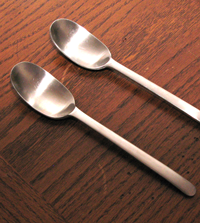
This is an extreme, but consider all the pairs of things that kids can notice – two shoes (vs. only one that you can find when you’re freaking out and you’re late), two forks (when you’re begging for yours back from her because you’ve not eaten since breakfast), two cars (when you need to get in one and she insists on going in the other).
And, toddlers really don’t start counting at 2. They don’t start their mathematical careers with counting at all! They start by recognizing multiples. And 2 is the first and fastest multiple.
So what can you do?
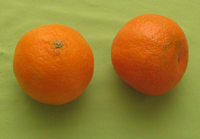
Keep teaching your kids to count – they still need this skill, just like they need to memorize math facts. But also teach them to subitize (recognize amounts without counting them out). Hold up two of the same items and exclaim “TWO ORANGES!” Then go to another two items and exclaim, “TWO RAISINS!” Stick with one number at a time.
Daughter is on “two,” so we’ll stick with that for a few months. We’ve got plenty of time.
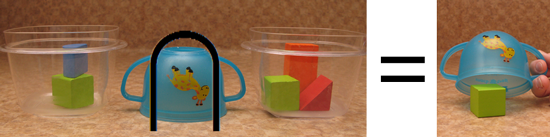
The union is on the left and the intersection is on the right.
I discussed empty sets in a previous article. I hadn’t yet listened to the recent podcast of The Math Dude, Jason Marshall, in which he introduced sets and subsets. Such a curious coincidence; I thought I would continue down our united path.
This week, the sweet Math Dude talked about union and intersection of sets. So I’m heading there too – and incorporating the empty set.
Union and intersection have symbols.
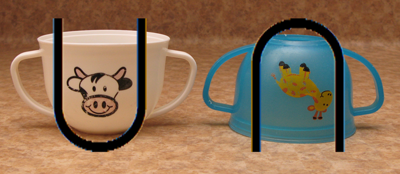
These symbols represent “operations” (like addition or multiplication) that you do to a pair of sets. They are called the cup and cap and look like, well, a cup and a cap. Or a U and an upside down U. The Union is the U and the intersection is the other one – that’s how I remember it and teach it.
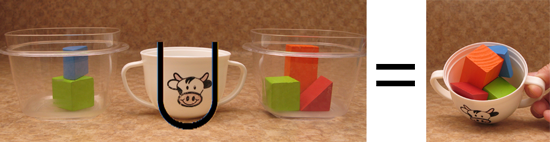
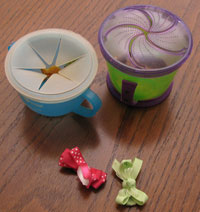
For the sake of illustration, I’ll use Daughter’s handy SnackTraps like in the picture above.
The union is everything.
The sets I’m using are
L ={green cube, blue half circle thingie}
R = {green cube, red triangular prism, orange rectangular prism}
I’m using the letters L and R for left and right in the picture.
The union of the two sets results in all the pieces from each set, all crammed together. (And if there is a repeated item, you only take it once.)
The union of the two sets is everything combined (without duplicates).
Let’s take the set of all states that border Texas and the set of all states that border Oklahoma, like this:
T = {Louisiana, Arkansas, Oklahoma, New Mexico}
O = {Arkansas, Colorado, Kansas, Missouri, New Mexico, Texas}
Then the union of the two would be “The set of all states that border both Texas or Oklahoma or both” and would be T U O = {Louisiana, Arkansas, Oklahoma, New Mexico, Colorado, Kansas, Missouri, Texas}
Notice we don’t keep duplicates.
The intersection is only the common stuff.
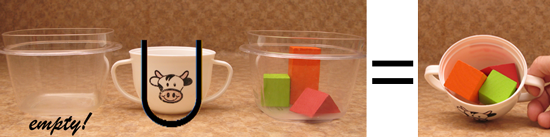
Using the same L and R sets from above, I can take the intersection.
The intersection is only the stuff they have in common (we get rid of the duplicates here, too).
Let’s go back to our set of all states that border Texas and Oklahoma:
T = {Louisiana, Arkansas, Oklahoma, New Mexico}
O = {Arkansas, Colorado, Kansas, Missouri, New Mexico, Texas}
Then the intersection of the two would be “The set of all states that border both Texas and Oklahoma, at the same time” and would be T ∩ O = {Arkansas, New Mexico}.
What happens with the empty set?
When you start throwing the empty set into the mix, you follow the same rules.
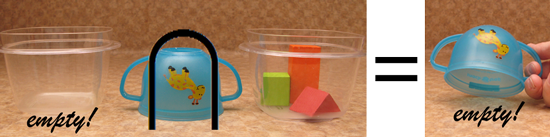
For the union, you throw everything in both sets into one bag. Well, since there’s nothing in the empty set, “everything” is the original other set!
The union of the empty set with anything… is that same set back!
For the intersection, you take only the stuff that’s in common between the two. Since the empty set has nothing – there’s nothing in common.
The intersection of the empty set with any other set it just the empty set – there’s nothing in common at all!
Think about it…
Does this remind you of anything? What similarities do you see between this and addition or multiplication (or subtraction or division)? Ask your children these questions too.
Get out some snack traps and blocks (or a map) and go for it! Let me know how it goes in the comments.
Are you teaching sets? Some of the stuff that you talk about in set theory is pretty clear – you have a basket { } and you put stuff in it {♥, ✂, ☎, ✿}. No problem.
But what’s the deal with the basket with no stuff in it?
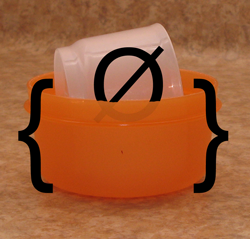
That’s the empty set. It’s written like Ø or simply as the “basket” like this: { }.
But kids might be tempted to write {Ø} – and then they get it wrong. BUT WHY?
The empty set is an object!
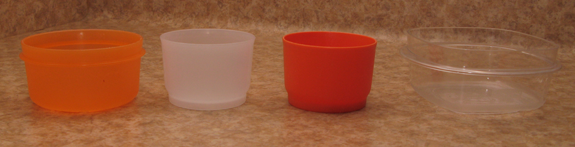
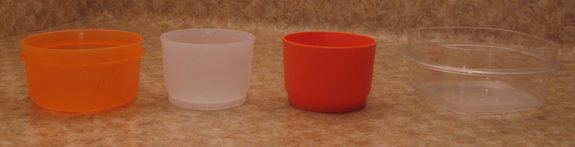
Suppose you have four empty sets. Do you have nothing? Nope – you have four containers. Just check your cabinets – I’m guessing you have a handful of empty sets in there with the Rubbermaid® or Tupperware® logo on them.
And {Ø} is an object inside a set.
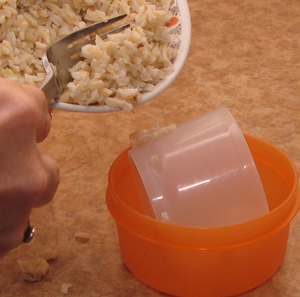
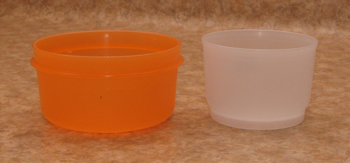
Supposed you put one inside the other, like this:
This is the same as {Ø}. Would you be willing to put leftovers inside the bigger one while the smaller one is there? It would be something like this:
Instead, wouldn’t you be more likely to remove one empty set from the other and have just Ø and Ø (no curly brackets) like this:
What do you think? Does this help you understand the empty set? Will it help you teach it?
Previously, I gave a definition and some resources for subitizing – assessing quantity without counting. The questions I posed in the previous article were
Having thought a great deal about it, I wondered if it was even relevant to teach it. And Husband asked the question, “Don’t they need to count and know their numbers before learning to subitize?”
You don’t have to learn to count to know “how many.”
Although evidence indicates that subitizing and counting happen in the same part of the brain, you don’t have to know how to count to subitize.
Subitizing up to 4 or 5 using recognition bypasses the “counting” of numbers.
Daughter is currently subitizing 2 – without counting. I haven’t taught her how to count objects at home and they don’t do it at school yet. So she has no concept of one. But “two bows” (one for my hair and one for hers) is very important to her. Likewise “two bowls” (one with goldfish and one with Rice Chex) is an amazing thing.
This article by Ernst von Glasersfeld explains how number words can be associated with the quantity without ever counting. Children give the appearance of counting because they’ve memorized the number words and they use the cadence to tap their finger on objects. But they’re usually doing this to be rewarded with praises and cheers. They don’t really understand the concept of counting. This is what I saw the little girl doing at the playground.
It IS important for kids to subitize.
What’s the point, anyhow? If I can quickly see 8 things – does it matter? And is it important to tell the difference between 8 things and 9 things? If there are 8 hungry tigers heading for me and I subitize that there are 9, will it make a difference in how fast I run from them?
I researched more and found out that subitizing does matter to the understanding of numerical concepts.
Subitizing 2 items and putting it with a subitzed 3 items can yeild the perceived 5 without ever knowing what addition is. And having the group of 4 items and seeing within it a group of 3 or 2, leads quickly to subtraction and division.
Thus subitizing “teaches” various mathematical concepts without ever getting into the language or construct that grownups have put on it.
So how did we learn it?
My initial guess was that we’ve learned to do it the same way we’ve learned to read without sounding out the words. Over the years we’ve seen and counted many hundreds of bundles of 3 things that when we see another bundle of 3 things, we know there’s 3 of them.
Upon further research I’m now of the opinion that I learned it from Ma saying to me “there’s three of them” while I looked at a collection of three objects. I bypassed the counting and went straight to learning the cardinality – with the help of grownups.
The cliffhanger…
So I’ve yet to answer the question, “How do we teach subitizing?” Alas, it’s coming. (UPDATE: it’s here, complete with downloadables!)
In the meantime, where do you observe subitizing and does it seem important?
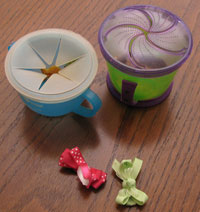
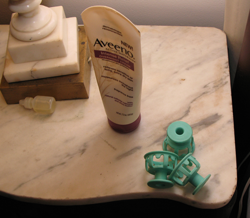
I used perceptual subitizing to “know” that there were three green hair curlers here.
Alas, I had never heard this term. So I did some research and thought I’d share what I’d learned.
Subitizing is a way of instantly counting. In fancy math terms it would be getting to the cardinal number of a set (how many) without without going through the ordinals (counting each one’s position).
There are two types, perceptual and conceptual. Perceptual is perceiving the number of objects immediately. Conceptual is putting a little effort into it.
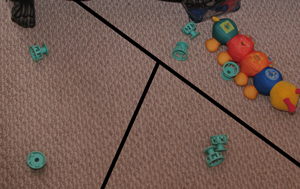
For instance, I glanced at the hot rollers Daughter had scattered on my side of the bed. I perceived there were three on the nightstand. But I had to do a little conceptual subitizing to arrive at the number of curlers on the floor (see the pictures).
I had to mentally “chunk” these hair curlers into smaller perceivable bundles to conceptually subitize the number here.
We spent our vacation a couple of weeks ago in central Texas. We had lots of fun – including lots of counting.
One to one association of fingers to Discovery Toys’s Giant Pegboard pegs
I noticed that some of the basic counting principles grownups know, aren’t inherently known to kids.
I was observing Daughter as I was counting. She continued to look in deep concentration as I counted from one direction and then recounted from the other. Then I would rearrange the items and count them again. She was still enthralled.
We teach our young children to count to 10, but never realize they don’t know what that means.
Counting is a way to associate how much with a group of objects.
If there are three things in a bundle, we associate the word “three” and the symbol 3 with that bundle. This number is called the cardinality of the set/bundle and means the number of things in it.
My lone Calculus classmate in high school decided to create her own number system when we were freshmen. Everyone else laughed at her, but I got it. She was noticing that there was no rhyme or reason that we called a set of two objects “two.”
We’ve decided to say out loud “two” and label it two and 2 and that means this many things: X X
Counting is a way to order things.
A bunch of things can be lined up and counted – even if they aren’t technically in a line. Each subsequent number is associated with another object. These numbers are the ordinal numbers. The final number that you count ends up being the cardinality of the set (from above). In this way you use ordinals to determine the cardinality.
Counting is a way to compare one group of objects with another.
Take two groups of objects. Pair one object from one group to an object from the other group – set them up in a one-to-one fashion. This shows that the two groups have the same number of objects. It doesn’t determine how many there are, but very young children don’t have to know the numbers to grasp the concept of “the same.”
This eventually leads to the concepts of equality as well as less than and greater than.
Counting isn’t dependent on which object you start with.
This was the craziest concept for me. I noticed this when reading Brown Bear, Brown Bear one night.
To mix it up (to keep my sanity) I would count the children in the book in differnet directions. After 3,000 nights of reading the same book over and over, something occurred to me. There is no reason for a 2 year old to know that counting in one direction will yeild the same number as counting in another direction.
This is taught – not directly, but through experience. After counting a bazillion times, we eventually figure out that no matter which way you count things, you’ll get the same number.
Well, unless Little Brother starts eating those things.
Counting can be stopped and picked up where you left off.
This is another concept that grownups “just know.” If you can mark your place (and Little Brother isn’t involved), stopping and coming back won’t change the result. This is the forerunner to addition, too.
If you can get your kiddo to count, the rest is cake. And not just saying, “1, 2, 3, 4, 5, 6, 7, 8, 9, 10,” but really getting him or her to understand the totality of the concepts.
How much is there?
Is there an order?
Does one group have more, less or the same as another group?
Did the number of objects change when you counted differently?
Grownups get it, but we aren’t born with it. Imagine that you don’t know these things inherently. How does that change the way you observe the world?
Counting is a big deal in our household these days. Daughter’s 21 months old so teaching advanced multivariable calculus takes way too long for her attention span.
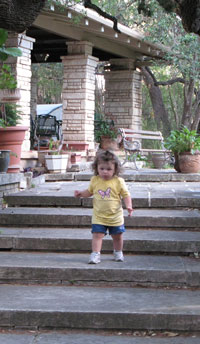
Walking Steps and Counting Them
But we count everything. Things in books, steps, bobby pins, people… you name it.
We count in negatives, too.
If you’re following my tweets, you might know that I count to Daughter in the bathtub – from negative 30 to positive 30.
My neighbor suggested that early introduction to negatives might have helped her friend’s 14 year old son. He now has all sorts of difficulties with math. Not the least of which is arithmetic among positives and negatives.
This makes me even more excited about counting in negatives to Daughter.
Counting in negatives shows order.
You may not need 61 seconds of anything. But you can count from negative 5 to positive 5. The point in the counting of negatives is to introduce the order of the numbers – since negatives seem to go “backwards” when you list them in order.
And you can introduce distances with counting. You can show how distance is different than the number of points. Counting from -5 to +5 is actually 11 numbers. In this video you can see how I “rediscovered” this and then explained it:
Parents often focus on the alphabet and reading in the very early years. There’s some neglect of math things outside of counting to 10 (starting at 1). You can do so much with counting – counting negatives, counting distances, skip counting (2, 4, 6, 8, etc.), finger counting, counting backwards.
Counting is the foundation of all of math. And there’s tons of fun ways to use it in the early years.
Share your ideas about counting in the comments below!
In the last post I discussed cardinal and ordinal numbers. I gave definitions but not much in the way of examples.
Here’s an example of using ordinal numbers to count up to arrive at the final cardinal number. Oh – and I’m using the fun little critters from Discovery Toys!
Whatcha think? Does it make you want to count some bugs?