Category: Cognition

  • Understanding Math — Let Kids Fake It

    Understanding Math — Let Kids Fake It

    There’s a lot of talk about making sure kids understand what they are learning — instead of just practicing some arbitrary set of steps. I’m a proponent of this myself.

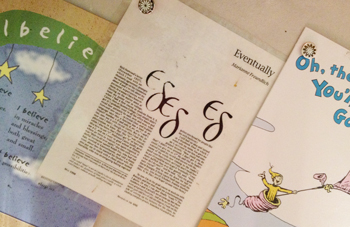
    I copied and laminated this back in 1998!

    But how well a child grasps a concept is based on how well he or she connects with it.

    The learning style and interests a child has has an impact on if (or how well) he or she will understand a concept. And, as far as I know, there’s no rule on figuring that out.

    You keep explaining it in different ways until you see the “aha moment.”

    Except there are some times when understanding is too far out of reach. Or the child’s way of learning requires a deeper understanding than what’s available or possible at that point.

    So what do you do in those cases?

    Do you delay teaching that piece for understanding? Do you go on to something else and skip it altogether? Can you go on to something else?

    Before making that decision, consider three points.

    1. Nobody understands everything.

    The way all the pieces of math work together is amazing. Nobody knows how they all fit — even the most famous of mathematicians. Everyone has something missing. Some of us have much missing.

    So if your child is lacking in understanding for a few things — or even many things — that’s okay.

    2. There’s more than one way to “understand” something.

    Take any math concept and you’ll find that the applications of it are vast. It’s likely that you can use it in business, in fashion, in your yard and kitchen and in the toy box. So you can explain the concept — and inspire understanding — with any of the applications.

    You can also explain a concept with metaphors to other math concepts and even metaphors to non-math concepts.

    3. But they’ll get it, eventually.

    Back in 1998 I photocopied an article from an AMS Notices journal called “Eventually” by Marianne Freundlich. I laminated it and hung it on my office wall.

    It’s moved offices a dozen times at least, but has remained an important reminder: “When learning something new, you may not get it now, but eventually you will. Just stick with it.”

    The “fake it ’til you make it” principle works in math too. It’s okay for them to practice something that they don’t understand.

    But kids need you to know they’re faking it.

    Often kids fake their learning. But they’re also trying to fake out the instructor. It turns into a big dirty secret that they keep inside. Like this:

    “Mr. Smith, I don’t understand this. I think I can do the problems, though.”

    “Well, Joan, let me explain it this way…”

    Mr. Smith explains another way. Joan feels uncomfortable because he’s spent so much time on her and she still doesn’t get it.

    “Okay, I think I understand now.”

    “I’m glad. It’s important for you to understand before we move on.”

    Joan thinks she’ll just keep practicing and hope that something clicks before the test. She doesn’t want to ask for more explanation.

    Fake it like Fermat!

    (That’s supposed to be a play on “Bend It Like Beckham” — I’m not sure it works.)

    A well known phrase in math graduate school is, “Okay, I don’t understand that, but I’ll go with it for now.”

    Mathematicians fake it all the time. They come back later to see if they can work out the details (and don’t publish or approve of something until they do). But they announce out loud that they’re faking it.

    And kids should be allowed this too.

    “Mr. Smith, I don’t understand this. I think I can do the problems, though.”

    “Okay, Joan, that’s fine. Perhaps after you do it a while, you’ll get it. “

    “It’s possible.”

    “No problem, if you don’t get it now, you’ll get it eventually. As we move forward, when you come to something like this, just keep doing the steps. That might help you understand, too.”

    “That works for me. Thanks, Mr. Smith.”

    “Feel free to ask me any questions about it and we’ll continue the conversation until you do get it.”

    Not understanding is totally okay — but the child must know it. And, more importantly, they must know that you know it!

    So let them fake it!

    When understanding is too far out of reach, encourage some rote practicing of the steps. And let them admit, out loud, that understanding isn’t there — even be happy for it.

    Anticipate the understanding and be excited that someday it will come.

    And if your child wants to move on, do it. They’ll get that other stuff eventually.

    Share your thoughts in the comments or on twitter/x.
    You might also like:
  • The Learning Cycle

    The Learning Cycle

    Kids learn.

    People learn.

    If you aren’t a “lifelong learner,” well, bummer for you. Because you’re dead.

    But what exactly does it mean to learn?

    What does real learning look like?

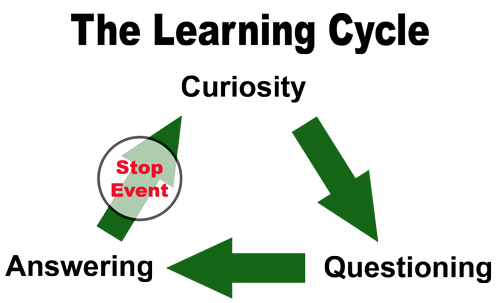
    I’ve been watching people learn for over 20 years. Everyone goes through this learning cycle:

    Curiosity

    It all starts when you get curious.

    “Hmm… I wonder…”

    Questioning

    And then you form curiosity into words.

    “What is that?”

    “How does it work?”

    “Why?”

    Answering

    After the question is out there, someone answers it.

    “What is that?”

    “It’s a flower.”

    You might answer it yourself. Or someone else chimes in to offer an answer.

    And the answer could be all sorts of things.

    • The “right” answer (something that’s true)
    • The “wrong” answer #1 (something that’s false, but sounds good)
    • The “wrong” answer #2 (something that’s false, and obviously so)
    • The “I don’t know” answer (an open ended un-answer)

    The learning cycle can continue.

    After obtaining some sort of answer, you decide if you should go on or stop. Continued curiosity causes you to go through the learning cycle again. You start searching for deeper meaning.

    “Hmm… What is that?”

    “It’s a flower.”

    “Oh. It’s funny looking for a flower. Hmm… I wonder…”

    And the learning cycle can hit a stop event.

    If you have enough information to satisfy your curiosity, you’ll likely stop the learning cycle. (Even if the answerer is ready to give more information.)

    “Hmm… What’s that?”

    “It’s a flower.”

    “Oh. It’s pretty.”

    But sometimes the stop event is damaging.

    If you obtain an answer in a way that oppresses your natural curiosity, you’ll also stop.

    And here’s where trouble starts.

    “Hmm… What is that?”

    “Really? Are you blind? It’s a flower.”

    Or

    “Hmm… What’s that?”

    “We already went over this. It’s a flower.”

    And if you encounter a damaging stop event, you’re likely to internalize it. You’re also likely to avoid that curiosity again.

    What is your experience with your learning cycle? Share it in the comments or on twitter/x.
    You might also like:
  • Midpoint Formula and Counting – Logarithmic Style

    Midpoint Formula and Counting – Logarithmic Style

    Download a printable version of this post here.

    I’ve never been a believer in the real number line. It just always felt wrong that between any two numbers, there’s another number. Sure, you can go between two things – but is there a number there?

    And then I think, “Well, add up the numbers you’re standing between and divide it by 2 – that’s the number between them.”

    But it still doesn’t feel right.

    I could be onto something, though.

    I listened to Episode #110 of Stuff To Blow Your Mind called “Is math a human invention or a human discovery?” They pointed out that tiny babies can perceive quantities.

    “Curious,” I thought.

    Then I peeked at their math series, in particular the article on What are Numbers? Which led me to Stanislas Dehaene and his appearance on RadioLab’s episode on Innate Numbers.

    Here’s the discussion.

    I was particularly interested when they noted (around minute 11) that we don’t naturally switch from logarithmic thinking to this 1-2-3-4-counting we do now!

    Around minute 12 in the audio, they consider the idea of midpoint. Dehaene notes that in logarithmic thinking, the midpoint between 1 and 9 isn’t 5, but 3.

    The midpoint between 1 and 9 is… 3?

    Here’s how we think of the middle: “What do I add to 1 twice to get 9?”

    We can add 4 to 1, twice, to get 9. So then we add it only once to get halfway there – and halfway there is 5.

    Graphically it can look like this:

    We could also use the fancy midpoint formula:

    \((x+y) \cdot \frac{1}{2} = (1+9) \cdot \frac{1}{2} = 10 \cdot \frac{1}{2} = 5\)

    Instead of adding, how about…

    Dehaene notes that logarithmic thinkers multiply to find the midpoint! Like this:

    These people think, “What do I multiply by 1 twice to get to 9?”

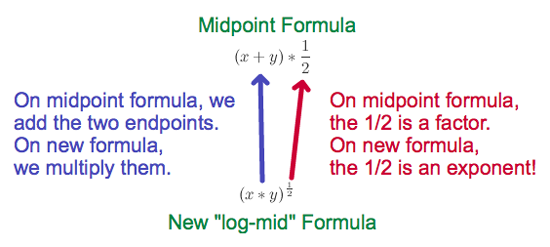
    So the new fancy formula can be seen as this:

    \((x \cdot y)^ {\frac{1}{2}} = (1 \cdot 9)^{\frac{1}{2}} = 9^{\frac{1}{2}} = 3 \)

    Whoa!

    Midpoint Formula Gone Wild!

    Look how the formula got adjusted:

    (Of course this leads to a whole ‘nother discussion about how the square root is really just “half” with respect to multiplication. But that’s going a bit to far for this article)

    How about another “midpoint” example?

    What’s between 4 and 762?

    For “normal” folks, it’s:

    \((4+762) \cdot \frac{1}{2} = 766 \cdot \frac{1}{2} = 383 \)

    And for the more “natural,” logarithmic thinkers, it’s:

    \((4 \cdot 762)^ {\frac{1}{2}} = (3048)^{\frac{1}{2}} = 55 \)

    Like this:

    And the bigger the numbers, the more “ish” things become. And apparently, that’s okay!

    So maybe we do have it wrong.

    I’ve told thousands of students over the years that mathematicians just make this crap up. There’s no truth to that “mathematics is the universal language” hoo-ha that they feed you in the movies.

    Leopold Kronecker noted:

    God made the integers; all else is the work of man.

    And just maybe man has messed it up.

    So is there really a number between any two numbers? Or is there just something “sort of” between any two numbers?

    What does this mean to math learners?

    Okay – now the bottom line. What does this mean to grownups teaching math – and the kids learning math?

    These little super heros have amazing powers – right when they’re born!

    Well – one thing is that we grownups can lay off. Let the kids learn their own ways. Let them inquire, discover and develop their own methods for doing things.

    If they’re logarithmic thinkers (which they are from the start), let them ride that wave a while.

    Also, remember that we, the grownups, have been conditioned out of logarithmic thinking. Which means that their way (the natural way) seems wrong.

    But we are the ones who are wrong.

    So if your kids don’t believe what you’re feeding them. Let them doubt. They’ll learn enough eventually to pay their rent, balance their checkbook and meet their friends halfway.

    With or without our interruption.

    Buy Dehaene’s The Number Sense on Amazon.

    Share your thoughts in the comments or on twitter/x.
    You might also like:
  • GeoGebra – Who's It Really For?

    GeoGebra – Who's It Really For?

    Yesterday I shared my first experience on GeoGebra – and hinted that I had some concerns.

    GeoGebra bills itself as “Free mathematics software for learning and teaching.” Indeed the intent is learning – but the market for the software is teachers.

    Which means grownups are using it and then making kids use it. And we are using it as if we know what a student needs to learn math.

    Yes, we occasionally do. But we have much less discovery learning these days and much more spoonfeeding.

    And I worry that a powerful tool like this can easily turn into another way we can tell students:

    Here, do this. It will help you learn math because it’s hands on. Make sure you follow the instructions so you can discover what you’re supposed to.

    But we don’t have to let it!

    The objectives are the current focus.

    In the classic backwards way we teach, the “lesson plan” might go something like this:

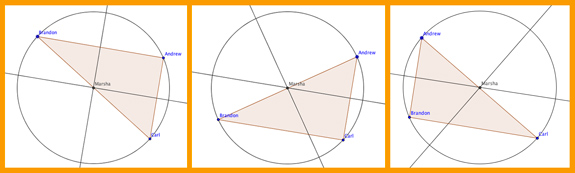
    We need to learn that the center of the circumcircle around a right triangle is the midpoint of the hypotenuse. So I’ll give them the steps to draw a circumcircle. Then I’ll teach them how to move the vertices.

    I’ll construct specific questions to lead them to discover that the center of the circle will be the midpoint of the hypotenuse. They’ll certainly get it then.

    And what if they don’t “discover” it on their own? It becomes another performance based failure. And then the teacher discovers it for them.

    We can refocus on discovery!

    I discovered math when I used GeoGebra. Math I never knew.

    I loved watching the circles and triangles dance. From that I saw that when my point “Marsha” is on each of the sides, it appears she’s on the midpoint.

    But I wasn’t answering any questions about it. I followed the instructions to draw the triangle and the circle. And then I played.

    There were no leading questions. Nothing I had to “get right.” I just had fun.

    Try it in class.

    Suppose you gave your kids exactly what I had – instructions to draw the circumcircle and how to use the Move Tool.

    And left it at that.

    Would some students discover the hypotenuse/center thing?

    Sure!

    Would other students not?

    Yepper!

    And that’s okay.

    I’d never heard of a circumcircle. I know “circumscribed” – but not circumcircle or circumcenter. And I’m doing pretty well mathematically.

    If a child discovers something, that’s a win. If they don’t – well that’s NOT a loss! Let it go.

    It’s not your job to discover it for them. No matter what the Common Core Standards or TEKS say.

    See what happens…

    Restructure your lesson plans. See if you can give lots of different “how-to” sheets on drawing stuff on GeoGebra. And see where their curiosity takes all of you. You just might be surprised!

    Share your thoughts in the comments or on Twitter/X.

    You might also like:
  • Literacy Improvement – Can It Be Modified for Numeracy?

    Literacy Improvement – Can It Be Modified for Numeracy?

    Can we apply the tactics of literacy improvement campaigns to numeracy improvement?

    It sure would be nice!

    Last week at the Western Social Science Association conference, I presented this question along with some possible answers.

    This is the first in a series explaining how that may work. Here is the proposed series:

    • Introduction and Definitions (this one)
    • How Numeracy & Literacy are Similar
    • How Numeracy & Literacy are Different
    • Tactics of Literacy Improvement Models
    • Modification Ideas & Needs for Numeracy Improvement

    The first step to formulating a plan to apply literacy improvement models to numeracy improvement is to define them.

    The Definition of Literacy

    James Paul Gee spent some considerable time, in a paper titled What is Literacy?, discussing and formulating a definition of literacy.

    Many definitions include reading and writing. Some definitions include thinking critically.

    Various definitions extend the definition to include cultural norms, technology and interpreting various multimedia forms of communication.

    Under these extremely expanded definitions of literacy there is a much greater number of “illiterate” people that those normally labeled (either self-labeled or otherwise) as illiterate.

    Because of this, I will keep my definition of literacy tightly defined as:

    Literacy is the ability to decode written text and verbal statements, comprehend the literal meaning of them and speculate on the writer’s or speaker’s meaning.

    Speculating on the writer’s or speaker’s meaning includes the comprehension of various forms of metaphorical devices. I have included this in my definition since metaphorical devices are ubiquitous.

    Note that literacy, in this definition, much be of a certain language.

    The Definition of Numeracy

    Numeracy is a much less familiar word, but has no less variation in definition. Definitions can encompass: number sense, arithmetic, mathematical manipulation techniques, data analysis, measurement, geometry, probability, statistics, the ability to solve spacial and quantitative problems and the ability to interpret and understand graphs, diagrams, charts and tables.

    Because of this seemingly exhaustive list, I will keep my definition to this:

    Numeracy is the ability to collect, organize and interpret information and arrive at numerical or numerically supported conclusions.

    This definition, because of the numerical requirement of conclusions, assumes the information being collected, organized and interpreted is of a numerical nature.

    Thus the definition includes the requirement of a person to be able to “read math.”

    A slight clarification of the definitions.

    Both of my definitions include the assumption that the abilities don’t have to be demonstrated “out loud.” A person can have a “gut feeling” of the content of a written metaphor without the ability to articulate it.

    Likewise, a person can, within moments, collect, organize and interpret the information of a pack of hungry lions rushing toward him and come to the conclusion of “RUN!” – a decision numerically supported by the number of attackers and the probability that he’s not going to win that fight.

    Next…

    Share your thoughts and your definitions in the comments. And shout it out on twitter.

    Oh – and stay tuned for the next in the series, How Numeracy & Literacy are Similar.

    Disclaimer – this was originally drafted as a Paper (capital P) so that’s why some parts might look a whole lot less like my normal writing. Please excuse this.

    Related articles
  • Numeracy Compared to Literacy

    Numeracy Compared to Literacy

    I’m doing research for a paper that I’ll be presenting in two days at the Western Social Science Association

    conference. Here’s the outline:

    1. What is literacy?
    2. What is numeracy?
    3. The Similarities between Numeracy and Literacy
    4. The Differences between Numeracy and Literacy
    5. Some Models for Literacy Improvement
    6. How These Literacy Improvement Models Might be Modified for Numeracy Improvement

    In attacking the first two questions, I’ve come across a paper titled What is Literacy? by James Paul Gee. Amazingly, the definitions he gives to primary discourse (or use of language), secondary discourse and meta-discourse are all applicable to math literacy/numeracy.

    Primary use of language is “casual” discourse.

    Primary use of language is the acquired communication tools we use among our “intimates.” This means it’s the way we talk, write or otherwise communicate with family members, close friends or others who are part of our personally identified social group.

    Secondary use of language is more formal and used with anyone.

    Secondary discourse is the acquired communication tools we use with anyone. This includes our close friends or family – sometimes.

    But mostly this is the way we talk in (or write for) “polite company,” as my mother would say.

    Meta-discourse is the study of the discourses.

    Freaky, I know. But meta-anything is freaky once you think about it.

    In particular, meta-discourse is the study of grammar and syntax as well as literary analysis and other English-class-goodies like that.

    Where you put the commas and if you use “I” or “me,” are both bits that you’d find in meta-discourse.

    How does this compare to numeracy?

    Consider what primary, secondary and meta uses of mathematics might look like.

    Primary use of math is the stuff you do everyday. The subtraction that you do without thought in order to know what time to set your alarm clock.

    A secondary, or more formal used of math might be borrowing money from a bank. It could also look like the calculation of gas mileage.

    Secondary use of math involves a more conscious effort to do “math things” – like annual percentage rate for a loan or division of miles driven by gallons used.

    And meta-math is the formal stuff.

    So then math that is taught (like in school) is the equivalent of meta-discourse. It is the study of the formalizations of arithmetic and logic that we use.

    Often people term primary and secondary uses of math as “mathematics” while labeling meta-discourse in math as “Mathematics” – with the capital M.

    You say tomato and I say, well… you know.

    Literacy is acquired, not taught.

    Yup – here’s the quote (and I love this):

    Literacy is mastered through acquisition, not learning… it requires exposure to models in natural meaningful, and functional settings…

    So we “teach” reading, but it’s really a matter of hurrying along the process of acquisition.

    It’s likely that children are already well on their way to acquisition of language (or literacy) by the time they’re in school. Many parents read to their children very early – and continue to do so well into school aged years.

    This is a display of discourse or use of the language. And it supports the child’s acquisition of the language.

    Isn’t numeracy also acquired?

    I certainly didn’t teach K8 perpendicular distance at 2 years old, and yet she knows enough about it to apply it at an Easter egg hunt!

    Through experience, she’s acquired that primary use of math.

    And just watch when a toddler does “division” using a box of three dolls when she sees four kids. You don’t want to be in that room!

    This is also a “skill” acquired through experience and observation.

    So why isn’t the acquisition of numeracy encouraged?

    Math learning – at least in the primary and secondary uses – is happening automatically. But why don’t we notice and celebrate it?

    Sure, we teach our kids to count and make sure they know their shapes. But then we stop.

    We wait to start math-talk until children are sitting in their chairs, hair combed, hands washed, ready for class. We send the message that math isn’t done unless you’re in math class or at the kitchen table with pencil, paper and book.

    We shove meta-math at them after making them think that they’ve never experienced the primary or secondary use of math.

    We should be ashamed of ourselves!

    Thoughts? Share them in the comments.

    Wanna share? Tell your friends on twitter.

    Related articles
  • Practicing Math Skills Early in Life Is a Brain Changing Event

    Practicing Math Skills Early in Life Is a Brain Changing Event

    Thanks to Will Summer who inspired this post with a retweet to me.

    Seems researchers have previously studied the differences in math skills among children vs. adolescents and grownups. Dr. Vinod Menon with has done new research on early math training that focused on kiddos who where merely one year apart.

    Turns out that in one year of math, the brain changes quite significantly!

    You can integrate early math learning into just about anything.

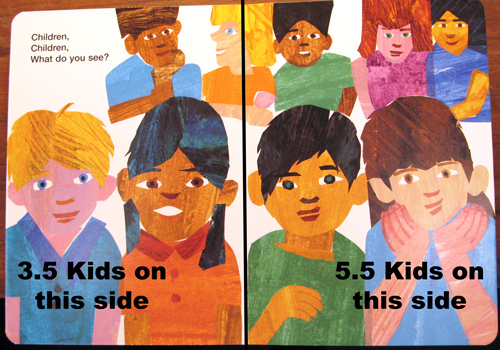
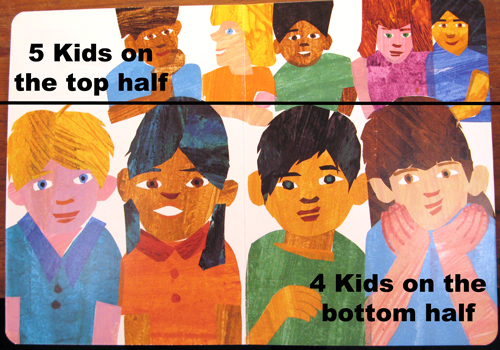
    Daughter is heavy into Brown Bear, Brown Bear by Bill Martin, Jr. and Eric Carle. This is not a math book. Nor does it pretend to be. But I’ve found a way to use it to develop math skills.

    When we arrive at the page with the children, we practice counting the kids. First in one direction, then in the other – as direction matters to kids. It isn’t inherent that if you count one way you’ll get the same number as if you count the other way.

    Sometimes we’ll count the top row of children and add it to the number of the bottom row. We can practice the commutative property by adding 5 + 4 = 9 and the adding 4 + 5 = 9.

    As an alternative twist, we’ll count and add the kids on the left page to the kids on the right page. This one gets fun, because that little blond girl is half and half!

    So we can now add fractions and practice the commutative property at the same time!

    What else?

    With Dr. Menon’s research, we now know how important it is to get started early with math learning. What other things can you do to start teaching math skills early?

    Related articles
  • What’s the Difference Between Gifted and Disabled?

    What’s the Difference Between Gifted and Disabled?

    There are many definitions of giftedness. And there are many reason to test for giftedness. But the bottom line is how that giftedness is treated.

    I was so moved by this letter I received from a homeschooling mom in Australia. She has generously allowed me to reproduce it.

    Of course ALL children ARE gifted! ALL people ARE gifted!

    What people seem to refer to by the use of the word ‘gifted’, is actually referencing ‘intellect’ or ‘intelligence’ or just plain good ‘ole ‘smarts’! or is it speed? ie, the child can do the work faster than other children and have more time to spare. Or is it their ability to concentrate better in such a busy environment as a classroom? aren’t easily side-tracked? extremely focused?

    My children are extremely gifted, and I have never thought of them in any other way except that. Yet they have been diagnosed with several ‘disabilities’ (I refer to them as ‘diffabilities’ – different abilities) and if the doctor’s had their way, they’d be diagnosed with more!

    So, why are they considered ‘disabled’? because they meet a set of criteria which isn’t the norm. Why is someone considered ‘gifted’? because they meet a set of criteria which isn’t the norm. Why is one considered to be on one end of the ‘intelligent/ability’ spectrum and the other on the opposite end? semantics? perception? social conditioning?

    What is normal anyway?

    If I compared my children’s IQ test with most children, my children would win – only saying that from the numbers on a piece of paper, not pride.

    Yet, because of many other challenges they have, they can’t even survive in a classroom environment, and would be considered for remediation classes, not the advanced classes. They would be considered intellectually disabled and shunted to a special needs learning unit (separate ‘schooling’ on same campus as ‘normal’ school and the aim is to integrate them into the ‘normal’ school classroom).

    Yet, my gifted, brilliant munchkins are struggling with learning higher math concepts, because, although we have spent more than 7 years trying to learn and retain the basic math facts, it just seems out of their ability to grasp. Yet we do university level science and computer studies, etc.

    Gifted? Disabled?

    All I know is that it’s a daily challenge for our munchkins and many others like them, who may or may not benefit from labelling in our society. I sincerely have no idea whether labelling is a wise course to take or not. Unfortunately we don’t have parallel lives so that we can compare the two with the same people and situations – wouldn’t that be fabulous?

    One thing I didn’t understand for many years was this particular comment from parents, therapists and professionals alike “it’s so obvious you love your children” – what the??? doesn’t everybody love their children??? But sadly, I started seeing that although parents LOVED their ‘gifted/disabled’ children deeply and painfully, they just couldn’t tolerate their behaviour, so their interaction with their child looked like intolerance, disgust, despair…

    …and a lot of shame and guilt in the mix.

    It’s so sad that we don’t feel we have the freedom to show how much we love our children in our society, especially when our children just don’t ‘fit’ anywhere. They are too different.

    But isn’t that what we should be celebrating? their difference?

    We do.

    But I won’t say it’s always easy to do so 😉

    Thanks for letting me share this!

  • Should You Test Children to See if They’re “Gifted”?

    Should You Test Children to See if They’re “Gifted”?

    In a previous article, I wrote What it Means to Be Gifted in Math. Now the question is, should you test for this?

    I heard this story once about testing and learning:

    A group of people were given a test and then separated into two rooms. One room of people was told that the test showed they had an aptitude for learning welding. And so they were being taught welding. The other set was told that their tests reflected a lack of natural ability to weld. But they were being taught welding, anyway. The group that was told they were gifted at welding, excelled. The group that was told they had no aptitude, did poorly.

    Curiously, the tests were never graded and the people were separated arbitrarily!

    Perception changes things.

    As soon as the people in the “bad at welding” class perceived they couldn’t do the job, they didn’t try as hard. It became part of their internal belief system that they wouldn’t be good at it.

    And once the gifted people realized that welding was their “thing,” they believed they would be great, so they tried harder.

    If it is part of your and your children’s internal belief system that they’re mathematicians at heart, then they will be. They will excel regardless of the method of teaching you choose. They might still decide to be political scientists or English professors, but they will do well in math.

    Do you test your child for Gifted & Talented?

    There’s a saying among corporate trainers: “Don’t ask for feedback about something unless you can, and intend to, change it.”

    Only test your child if you will act on the results of the test.

    Children who are part of a classroom school system will be tested before being allowed into an honors or GT class. If you are a homeschool system, you can teach “GT style” without ever testing.

    But you may be interested in “testing just out of curiosity.” Keep the story of the welding students in mind as you make that decision. As soon as you “know” something about your child, you will treat them differently. We’re human; we can’t prevent this.

    If you’re curious, and the result of a GT test is, “Nope, your child’s just plain normal,” there’ll be disappointment.

    Indeed there are anomalies – prodigies, math intuitives, etc. But unless you’re sure that your child falls into one of these categories, and you intend to act on that knowledge, don’t have them tested.

    Treat your child as gifted.

    In lieu of testing, just treat them as gifted from the get-go. It’s not about if your child is gifted, it’s about if you believe they are gifted.

    Thanks to the great parents at the LivingMathForum for the discussion that inspired this post.

    Related articles
  • How to Tell if Your Child Is a Top-Down Learner

    How to Tell if Your Child Is a Top-Down Learner

    Does your child struggle when you put him down in front of his math book? Are you frustrated in your attempts to get him to do math classwork or homework?

    Maybe he’s a top-down learner. If so, you might not know based on his current “regular” work. It will help in his education if you know he needs the big picture before the details – or the big theories before the steps.

    I remember learning to do derivatives when watching the foster kids that lived with us. I was eight. I’m a top-down learner. Here’s how to find out if your child is one too:

    How the “green beans” con works.

    My mom used to leave green beans open in a can on the table. We would walk by and eat them. If she put them on our plate, we would refuse them. So she got us to eat vegetables without asking us to, by just making them available.

    You can use the “green beans” con as a test.

    For math, put out the harder stuff. Find some books at Half Price Books or someplace cheap in your area. Open up the book. Sit and do some of the math yourself while mumbling aloud. Then walk away.

    If he sees his folks (or older sibs) working through those problems, he might be interested. Watch to see if he goes up to the book to check it out (steal a green bean). Be available to answer questions if he asks.

    If he can grasp some of  that “higher level” stuff, he’s probably be a top-down learner. He won’t want the building blocks until he sees the plans for the whole house. This could be the cause of some of the struggle and frustration – he’s been given the building blocks instead.

    Let him have the big stuff – start “allowing” him to do more of the advanced books. He’ll back up on his own to learn the “lesser” stuff so he can understand the big stuff better. You won’t have to force the work on him anymore.

    Share your experience with your top-down or bottom-up learning in the comments!

    Related articles