I’m fascinated by how the simple is really the most complex. Just proving that the two assumptions
3 + 0 = 3
and
3 + x = 3
will force x to also be 0 is a serious and important proof. And harder to do than you think.
When we get even more basic and talk about equality and comparison, things get impossibly complex.
And that’s the fun in the challenge inspired by 2nd grade math teacher, Suzanne Weider. She wrote:
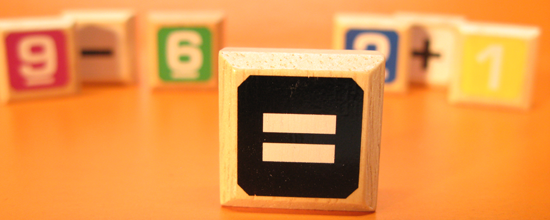
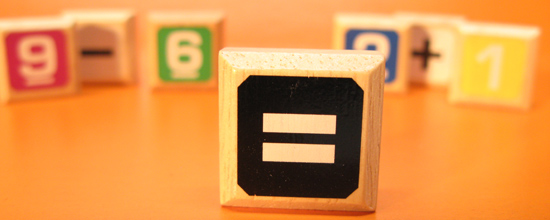
Another idea I have been looking into has to do with the equal sign: teaching it as a symbol that means “the same as” as opposed to the sign that comes before the answer.
Equality and comparison are everywhere.
Some people are obsessed with fairness. Almost all people have some sense of fairness. This means that things need to be roughly equal, if not the same, for all situations in life.
We go into every situation assessing what’s the same and what’s different. Which means a judgment call on equality.
The beauty of this is that you can tap into how our natural comparison connects with the comparison tools of mathematics. These are tools like the greater than, less than and equals signs. This can set your children up for some hard-core success in algebra, geometry, calculus, and Radon-Schure-Greenlee Mathematics. (I made that last one up, but I mean crazy everything math.)
Equality and comparison are so complex that a single article won’t hold all there is to write about it. So this is the first in a series.
Children need a strong foundation in beginning math skills, like counting and basic addition and subtraction, in order to succeed with higher level math operations.
You probably already know this, but it’s easy to feel pressure to move your child on to the next level in math even when these basic foundational skills are stabilized. It’s easy to assume she’ll just “get it” with enough exposure.
Except that isn’t true.
Children that don’t pick up basic math skills with a decent amount of exposure and practice likely need a different kind of math stimulation.
Take basic addition and subtraction. Learning facts like 3+4=7 requires both a strong understanding of the concept of addition as well as a strong picture for the fact itself. In many ways, math facts are like sight words. Even when we understand the meaning of 3+4=7, we still need automatic fluency with recognizing and remembering it.
If you treat basic facts like sight words, it’s possible to help your child develop a strong mental picture for the fact – just like you can close your eyes and picture the letters in the word ‘teach.” (There are five symbols – letters or numbers/signs – in each!)
You can develop imagery for basic facts using sensory processing by using a “see, say, feel” multi-sensory approach.
After looking at a fact flash card, have your child write the fact horizontally in the air with her dominant pointer finger. Encourage her to really watch her finger and focus on picturing the equation as she writes it
As she writes the numbers and signs, have her say what she is writing out loud. “Three plus four equals seven.” This should happen simultaneously as she writes.
After she writes the equation, ask imagery questions like: “What number do you see in the middle?” or “What sign do you picture after the three?”
This simple process stimulates your child’s sensory processing in three fundamental ways all at the same time.
It stimulates her visual processing as she focuses on creating a mental image for the fact.
It stimulates her auditory processing as she says and hears the equation out loud.
It stimulates her kinesthetic processing as she literally feels her finger drawing the equation and develops muscle memory for writing it.
Using a multi-sensory approach to teaching basic math facts benefits all math students.
For children who really need to strengthen their visual, auditory, or kinesthetic processing for learning, this technique fills a need that additional worksheets, timed tests, and more flash cards games just can’t. For kids who don’t necessarily need the multi-sensory stimulation, it serves to accelerate learning. They are more engaged in each problem.
Now if only they made scratch-and-sniff flash cards – that would probably really get their attention!
How did it work for you? Please share your experiences in the comments.
Beth McKeon, of Bright Brain Studio, is a brain-based educator on a mission to demonstrate that every child has the capacity to learn. She has spent the past ten years customizing instruction for individual students and teaching teachers and parents how to engage the whole brain in the learning process. Her workshops and coaching provide practical techniques parents can use to reduce the frustration and resistance around homework assignments.
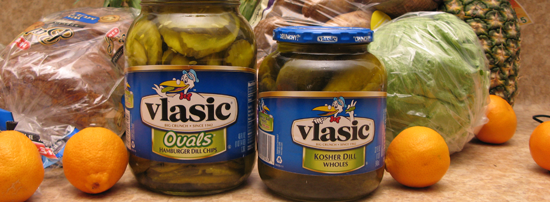
Daughter is into pickles. Like way into pickles. If I were to start a blog just for her, it would be called www.PicklesAndPretzels.com. (She’s also into pretzels.)
So when Husband grabbed two instead of one jar yesterday, it seemed natural.
Unloading the groceries, I saw the two jars a little more closely.
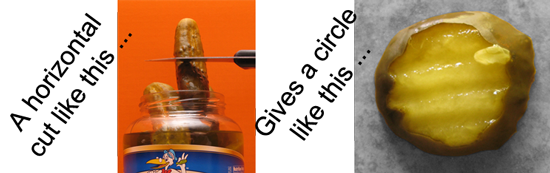
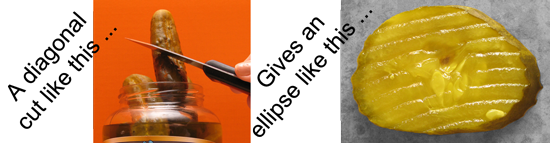
“Holy cow,” thought I. They’ve made ellipses (pickle ovals) out of segmenting cylinders (the whole pickles)! And they’re marketing them!
I had the pleasure of assisting Sarah Shah in her appearance on Great Day Houston yesterday.
While preparing for the show, I observed Sarah and the host, Deborah Duncan, in the makeup room having a conversation about math.
When I said to Sarah later, “that was an interesting math conversation,” she looked at me with anticipation, encouraging me to share what I heard. She had no idea I was referring to her conversation!
The math conversation was fully on-topic.
It was national thrift store day, and Sarah was going to share with GDH viewers some tips on shopping at resale shops. The topic of the show inspired their kibitzing behind-the-scenes about buying gold jewelry.
Deborah was talking about how there’s a difference (sometimes big) between the cost of the gold in a piece of jewelry, and the sale price.
The cost of craftsmanship should be close to its value.
Deborah was making the point that there’s value on the design of an object based on the workmanship that went into it. And this goes only so far.
Right now gold prices are around $1700 per ounce. Since an ounce is around 28 grams, gold is valued at about $60 per gram.
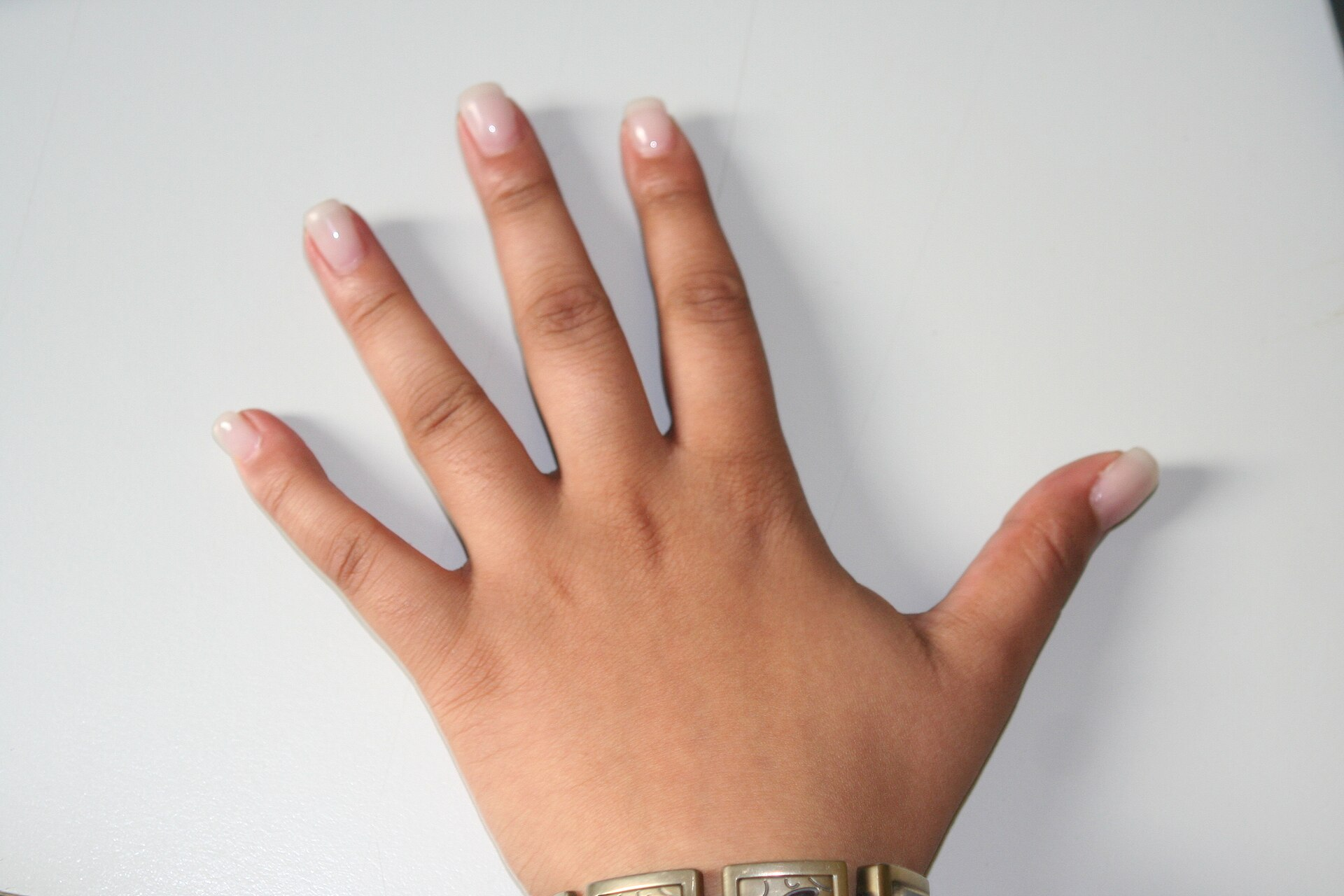
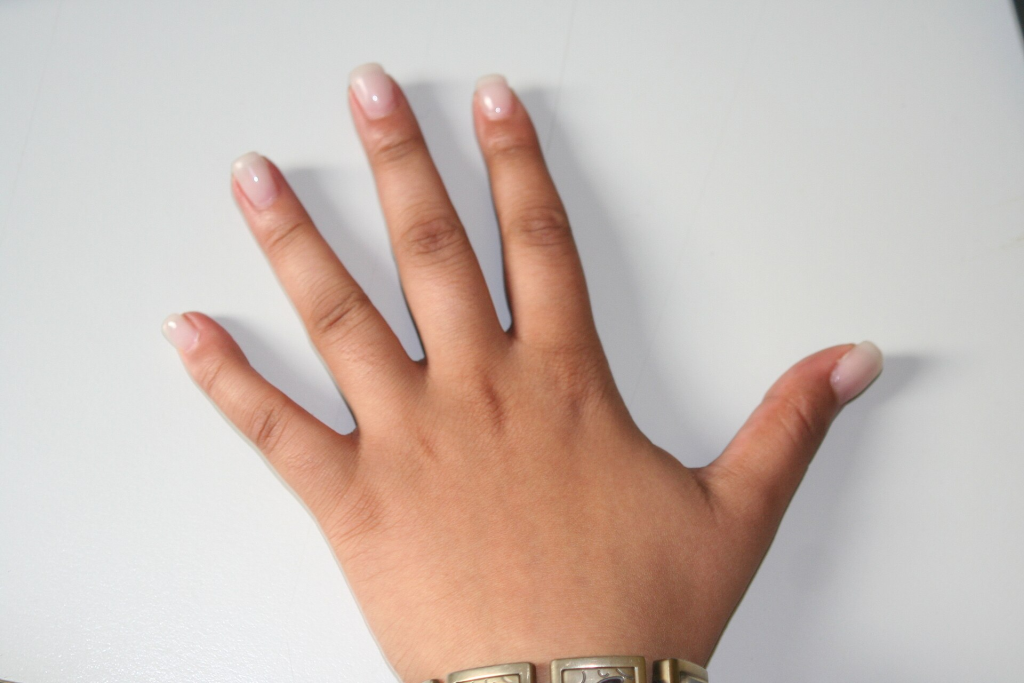
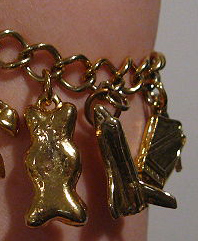
The QVC bracelet in the picture is 9 grams. It’s selling for $530 – pretty much exactly the value of the gold contained within.
If the value of gold for a 9 gram bracelet is around $530, charging $3000 for it means you’re paying about $2500 for the craftsmanship!
Unconscious math is all around.
Aqua And Gold Fractal by Sharon Apted
It was a wonderful experience to see two intelligent, educated women having a lively and entertaining conversation about math. It was quite disheartening, though, that Sarah didn’t even recognize it. In a previous life she was a physicist.
How many other conversations about math are ignored? How many people who claim they aren’t good at math have these conversations every day?
Look around at your conversations this week. How many of them are about math? Share your conversations in the comments. And with your kids!
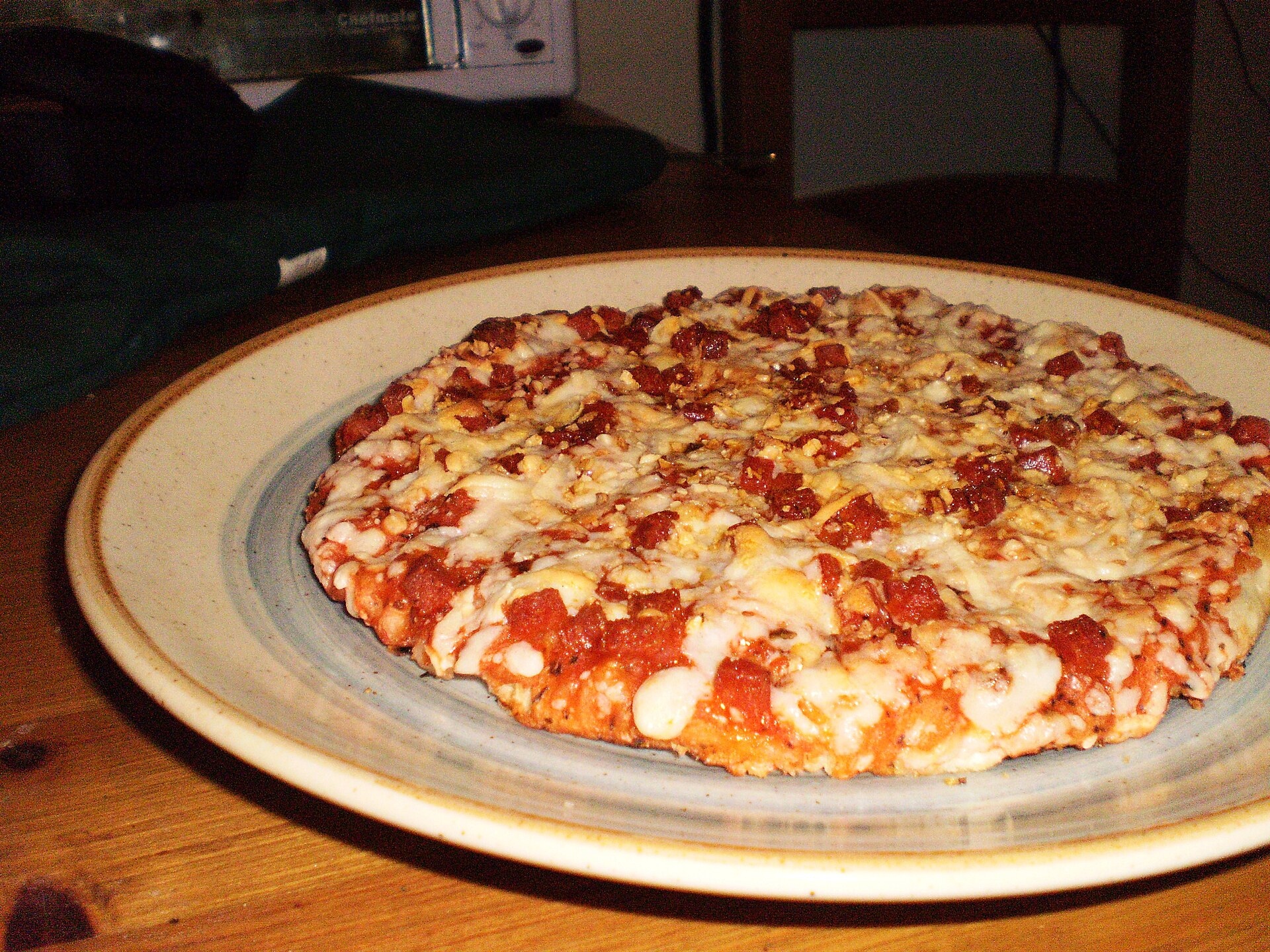
Our discussion on fractions and pizza on #mathchat yesterday reminded me of a story.
Image via Wikipedia
My best friend lost on this deal back in 1978. But she gained a valuable lesson.
My friend, let’s call her Linda…
She was a terribly terribly slow eater. Like annoyingly so.
We would sit down to a Totino’s pizza on a summer afternoon. I would finish my half while she was still working on her first piece!
One day I suggested a different method.
“Let’s NOT divide the pizza in half – equally,” said I in my sweetest voice. “We’re best friends, and dividing food up is so primal. Let’s just eat like normal people.” (Okay, I’m sure I didn’t say, “primal,” but you get the point.)
She agreed. Even though she could manipulate the heck out of me, I certainly had my share of the talent.
She got two pieces.
A whopping 1/4 of the pizza.
She still tells this story.
And guess what? She totally knows the difference between her 1/4, our 1/2 and my 3/4.
What about you? Do you have any lessons you learned from friends in math? Share them in the comments.
Please note that my bottom still reflects this bad pizza eating habit. Perhaps writing it down for the world to see will help me knock of the over-pizza-eating habit. That and the LoseIt! iPhone app.
Most parents aren’t professional mathematicians. But there are a few. This is the sixth in a series of interviews with mathematician parents with the goal of helping parents integrate math teaching into parenting.
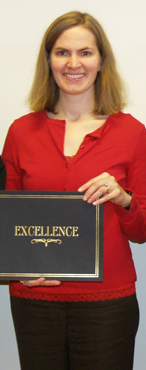
Jennifer here shown receiving recognition for being a Mississippi finalist for the Presidential Awards for Excellence in Mathematics and Science Teaching!
This week we visit with a high school math teacher in Mississippi. Jennifer Wilson, NBCT, teaches at Northwest Rankin High School, and is a Teachers Teaching with Technology (T3) instructor with Texas Instruments.
MathFour: Thanks so much, Jennifer for giving us your time. First, can you share a little about your degree and career?
Jennifer: I have a B.S. and an M.S. in mathematics. I have been teaching high school mathematics for 18 years.
MathFour: Tell me about your family – how many kids do you have and how old are they? Are any of them more or less interested in math than the others in the family?
Jennifer: I have two daughters who are 6 and 9. They are okay with math – but the 9 year old will tell everyone very quickly that her first love is reading.
MathFour: Do you have any worries about your girls academically? In particular, do you think they will do better in math than in other subjects because of your influence?
Jennifer: I feel very lucky to not be worried about my children academically. They love to learn. My husband and I both encourage their curiosity and try not to stifle their desire to ask why or come up with a different idea of how to do something, especially when the only good reason we can think of is “because I told you so”.
I think they will do well in math – but not necessarily better than other subjects. My husband and I both love to learn, and so the girls definitely recognize that desire and enjoy learning as well.
MathFour: That’s great! How do you play with your daughters? Do you view your playtime as different in any way than other “non-mathematician” parents?
Jennifer: We play games. I probably view play differently than a lot of parents – but probably similar to many teachers, no matter their subject of expertise. I am all about learning, and it is hard to turn that off, even at home.
MathFour: Do you think you speak with your daughters or behave differently than other parents because you have a math background?
Jennifer: Yes. Anytime some kind of math problem arises, I always ask the girls about their thinking, because I am very interested in how they arrive at answers.
At dinner, one daughter noticed that her tortilla chip was in the shape of a trapezoid, so we had a great conversation that night about trapezoids. We have a “pi” pie plate, so both girls already know a little bit about pi. They definitely call an “oval” an ellipse and a “diamond” a rhombus. They have called their blocks by the appropriate solid names, such as cylinders, prisms, and pyramids, since a very early age.
When the 9 year old missed a question on her state practice test about perspective drawing, instead of just telling her the correct answer, I got out the stash of Unifix cubes at our house to make her build the drawing with the cubes. She completely understood after doing so – and asked me to make up some more questions for her because she enjoyed working through the problems with the manipulatives. Both daughters play with my TI-Nspire™ CX handheld. They love making shapes, measuring their parts, and making them different colors.
MathFour: I had to google that one – fancy device!
Have you ever had either of your girls express negative thoughts about math? If not, how do you think you will handle it if that happens?
Jennifer: Not yet…I’m not sure I will handle it well. But I am hopeful that since my goal is not just calculating math but understanding math, they can at least appreciate my passion for it, and I will honor their passion for another subject, if the need arises.
MathFour: How do you think you’ll handle it if you find your self in disagreement with one of your children’s math teachers?
Jennifer: I’m not sure I will handle it well if it does happen, but so far, so good. I am lucky to teach in a great school district with great support for teachers at all levels, so I will keep my fingers crossed!
MathFour: Now to change direction a little to a more worldview of math. What do you see as the biggest challenge in math education today?
Jennifer: Having teachers who are experts in mathematics at all grade levels.
MathFour: What do you see great happening in the world of math education?
Jennifer: I see teachers who are willing to use technology to engage students in the learning and understanding of mathematics, teachers who are learning alongside students (often because of and through technology), and teachers who are willing to give up some of their control over the classroom to create a classroom that is truly interactive.
MathFour: What advice can you give to non-mathematician parents that might help them raise their kids to like and appreciate math.
Jennifer: I have been amazed at some of the mathematics that my students are learning in the computer games that they play. So while I realize that some students go overboard with the time that they spend in front of their electronic devices, find a way to encourage them to explore mathematics through tools that do interest them.
MathFour: Wonderful, Jennifer, thank you so much!
How ’bout You? It’s back to school time – do you have any questions for a super technology oriented math mom? Ask them in the comments!
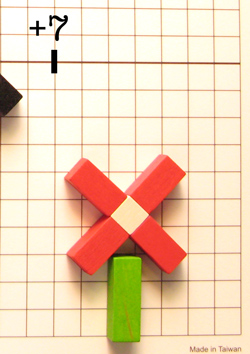
I’ve been playing with the lovely Cuisenaire Rods for a few weeks now. I made the (fortunate) mistake of creating this flower in a past article about coordinate pairs.
The mistake was that I would eventually have to come up with the coordinates for this thing. Fortunate because it gives the MathFourTicians out there something else to teach with the rods!
The center of the flower is the place to start.
Since all the “petals” are attached to the center, that’s probably the best place to begin.
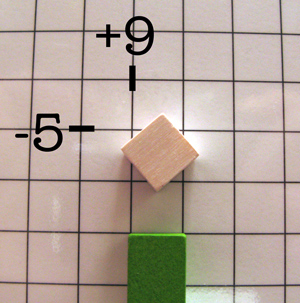
I converted to something I could see.
Since everything is tiny (1 cm), I went to a bigger setup. And some of the coordinates were easy to pick out. So I put those in the big grid, too:
And then I started to do some work…
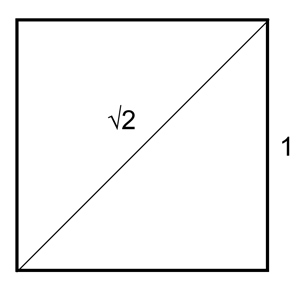
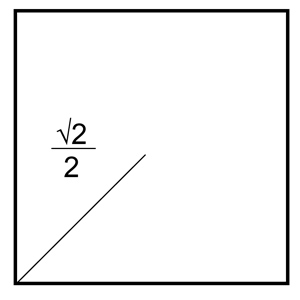
Next I considered what I was really dealing with: a square. And each side was 1 cm.
According to those crazy Pythagoreans, the diagonal measures :
So half the diagonal is :
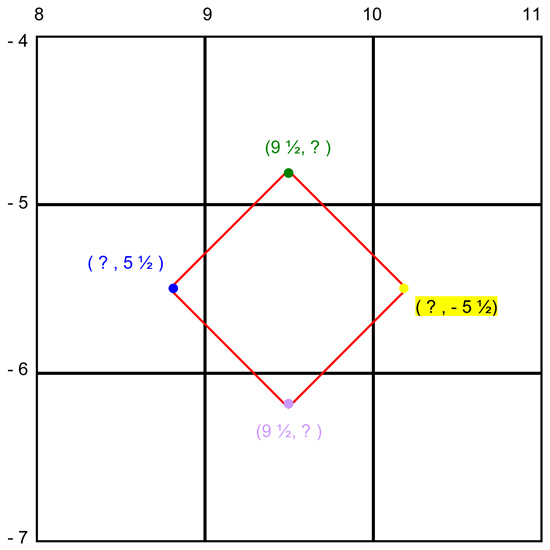
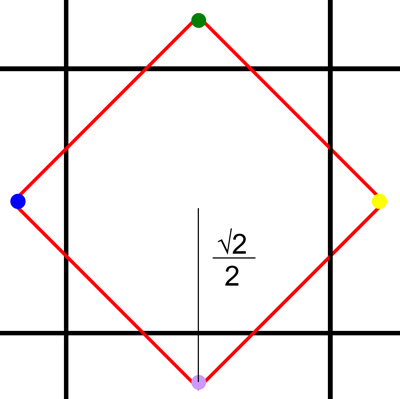
I went back to the big grid.
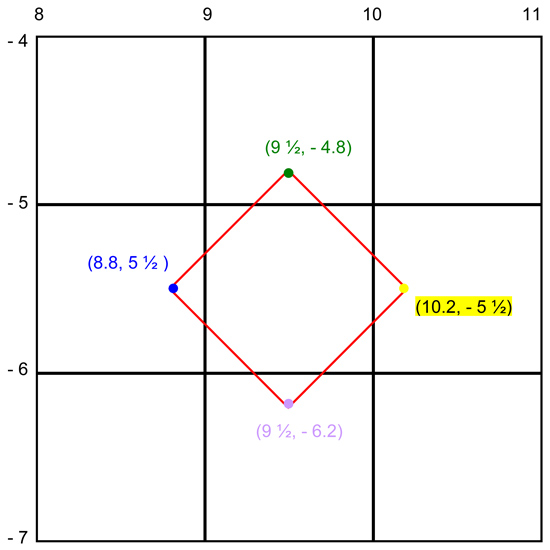
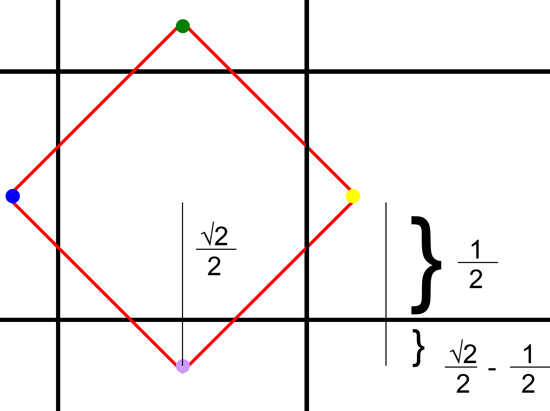
When I put this information on the big grid, it looks like this:
Knowing that each corner pokes out roughly 0.2, I can calculate the coordinates:
From this I can create the ordered quadruples as described here for the petals of the flower. But at this point I’m pretty much needing a break. So I’ll leave that for next time.
Whatcha think? Fun? Share your thoughts in the comments and on Twitter:
I’ve pondered this a bunch since then and decided I like the idea, but the playing cards are too cumbersome. I ran across a game called Sumology (from Simply Fun) at the Texas Home School Coalition Convention. The heavens parted and angels sang.
Or at least my heart started beating and my head started spinning.
So here’s the same teaching method, but with a little more pizzazz and a couple of free downloads:
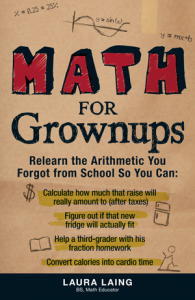
Today’s article is from Laura Laing, author of the book Math For Grownups and publisher of the website of the same name.
So you think you don’t use math on a daily basis? Think again.
You may not be solving for x, and the distance formula may not roll off the tip of your frontal lobe—mainly because you haven’t used it in years and years. But if you can put “parent” among your titles, you do math. I promise.
Just look at a typical day:
6:35 a.m.
Your darling daughter went to bed late last night. Seems that she couldn’t pull herself away from the most recent novel she’s devouring, and she had to finish, “just one chapter.” Problem is, she’s a bear to wake up when sleep deprived, and she’s got an 8:00 checkup at the pediatrician. She can usually get ready in about 45 minutes, and it takes 15 minutes to get to the doc’s office. How much longer can you let her sleep in?
9:03 a.m.
Check-up is done, and you’re waiting to pay the bill. You’ve got $33.65 in your wallet and a $25 co-pay. But after a morning of running errands, you’ve promised dear daughter lunch at the local fast food place. Should you use your cash for the co-pay or pay with plastic?
11:21 a.m.
At the grocery store, you’re deciding between three brands of ketchup. One is on sale for $2.27. For another, you have a 50¢ off coupon. And the third is a smaller container for only $1.49. Which one should you buy?
12:08 p.m.
At Burgers ‘R’ Us, your daughter has requested the chicken nuggets and a drink – no fries! You’d like to eat the fries that come with her kids’ meal, but you’re not sure you can afford the calories. Luckily, the restaurant has a handy sign displaying the caloric values for each menu item. What can you order to go with her fries that won’t force you to eat only carrot sticks for dinner?
1:31 p.m.
You need to fill up, and you have your choice of gas stations. One offers regular unleaded for $3.27 per gallon, plus a free car wash (a $10 value). Another offers $3.15 per gallon—no car wash. Which station offers the best deal?
2:47 p.m.
It’s time for your daughter to practice piano—a task that she hates. You thought the practicing contest that her teacher started would give her the motivation to practice every day. Nope. So today, she’s going to try to catch up on the days that she slacked off. She’s expected to practice a total of 15 minutes a day, but she’s only practiced a total of 25 minutes for the week. Her lesson is tomorrow. How many more minutes does she need to practice to please her teacher?
5:32 p.m.
Time for dinner, and you’re exhausted. Instead of making a meal from scratch, you decide to order from the local pizza joint. Your daughter wants plain cheese, your husband wants pepperoni and sausage and you want a veggie pizza. What’s the most cost-effective way to order dinner?
8:35 p.m.
Thankfully, your daughter has crashed early, meaning she can catch up on the sleep she lost last night. If you wake her up at 7:00 a.m., how much sleep will she have gotten?
Typical day? Perhaps. Typical math? Definitely.
So the next time you think, “I can’t do math,” keep in mind the number-based tasks that come across your path on a normal day. You might be surprised at what you accomplish without even thinking about it.
Where is the math in your day? Tell us in the comments!
Laura Laing is the author of Math for Grownups, a funny and accessible look at how the over-18 set uses math in everyday situations. While this post is not based exactly on a day out of her life, it could be. She is a freelance writer and the parent of a pre-teen in Baltimore.