This past Monday we had a great #mathchat via Twitter. The topic was: “If you could clear one misconception about mathematics and/or teaching it, what would it be?”
I was getting a bit frustrated that a couple of people kept bringing up the misconception that girls aren’t good at math. Even to the point of creating their own hashtag #girlsaregoodatmath2.
In my life, I’ve never heard anyone say this – in any other form than somebody complaining that people say it.
So here’s my response to everyone who keeps saying to me, “I wish people would stop saying, ‘Girls aren’t good at math.’”
What do you think? What will you say from here on out?
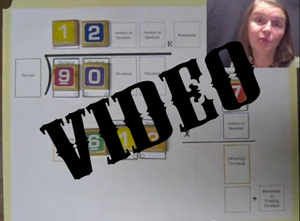
I’ve been itching to get into some basic abstract algebra goodies. With the help of the Cuisenaire Rods, Simply Fun Sumology number tiles and the Discovery Toys Busy Bugs, I’m able to do that.
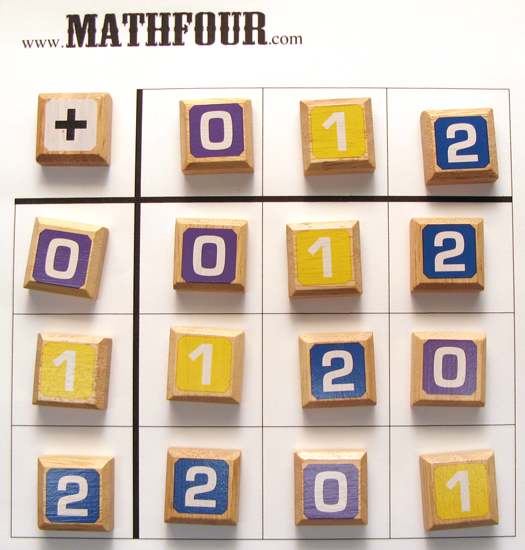
Start with wrap around addition.
This type of math is officially called “modular arithmetic.” We are only going to use the numbers 0, 1 and 2.
It begins as regular addition. And since we are only using those three numbers, all our answers have to be either 0, 1 or 2. So when we add 1+2, we wrap around.
If we were to count in our system, we’d say: “0, 1, 2, 0, 1, 2, 0, 1, 2, 0, 1, …”
The addition table looks like this:
(Notice you could do this with numbers from 1- 12 and it would be clock addition!)
Now things get buggy.
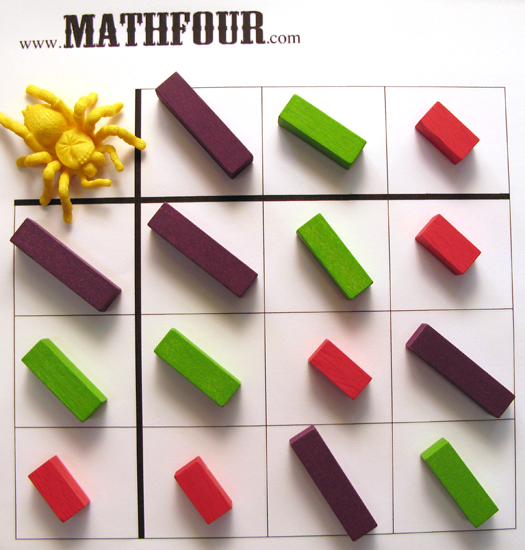
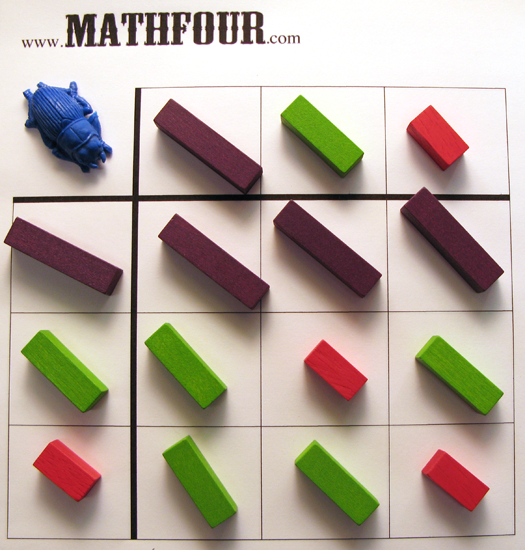
Switch out all the number tiles with some pretty color Cuisenaire Rods. They don’t have to be the “right” rods. We’re only looking at the colors. Here’s the progression I did:
The end result is a very abstract chart!
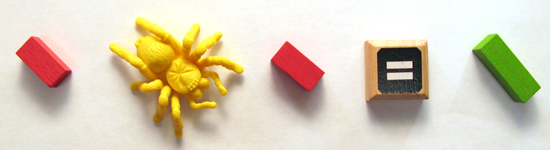
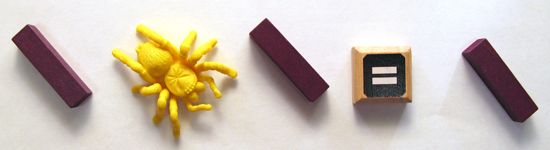
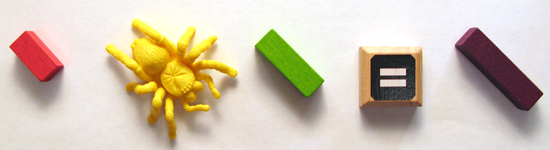
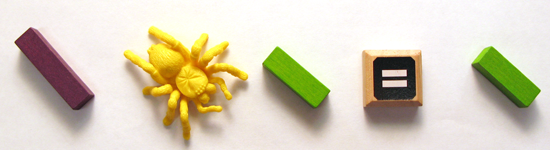
You can “bug” two things together.
Like this:
(I know – a spider isn’t a bug. But run with me on this, okay?)
Notice that each of these are directly from the “spider table” above.
You can read this as, “Purple spider green equals green,” just like you would say, “Zero plus one equals one.”
I’ve pondered this a bunch since then and decided I like the idea, but the playing cards are too cumbersome. I ran across a game called Sumology (from Simply Fun) at the Texas Home School Coalition Convention. The heavens parted and angels sang.
Or at least my heart started beating and my head started spinning.
So here’s the same teaching method, but with a little more pizzazz and a couple of free downloads:
I’m heading to the Texas Home School Coalition’s Convention this weekend in The Woodlands, close to Houston, Texas. The excitement I have for it makes me think of the excitement due to math…
(and I have on Husband’s Roger Creager shirt that is faded brown – I’m NOT naked.)
Cuisenaire Rods are brightly colored wooden sticks. Technically, they’re “proportionally sized rectangular parallelepipeds.” (But only say that if you want to hear your 3 year old repeat something really cute!)
The “proportional” thing is important. The white ones are 1cm square, the red ones are twice as long and each color is 1cm more than the next color.
I’m anticipating many articles and videos on how to teach with these (since the possibilities with these things are virtually unlimited), so I thought I would start a running series. Here are the ideas and the links to the articles/videos that are ready:
Cuisenaire Rods – (this one) graphing and practicing coordinate pairs (see video below)
I love finding nifty ways to use tools for teaching math. Especially tools that aren’t supposed to teach math. Or at least the math I’m trying to get it to teach.
I have this very cool balance that I got from Discovery Toys that would normally be a science toy. But, alas, I’m a mathematician, Jim, not a doctor. So I’ve taken the fancy science toy and turned it into a way to teach subtraction.
You can, of course, use it to teach addition and later I’ll do a post on using it to teach multiplication and division.
If you have children who struggle with math concepts, teaching them with hands on bits (manipulatives) sometimes helps. Here’s how to teach subtraction using a balance:
This nifty trick can be done with any balance as long as you have weights appropriately sized. Sometimes that’s not so easy to find. Order a colorful balance that’s similar to the Discovery Toys one in video here.
Did it work? How did your children receive this method of learning arithmetic? Please share your experience with it in the comments!
I mean: “What is three times a number (that number is four), plus two?”
The domain is all the possible questions:
What is three times a number (that number is five,) plus two?
What is three times a number (that number is six,) plus two?
What is three times a number (that number is seven,) plus two?
What is three times a number (that number is eight,) plus two?
<how long will I have to do this – Egad!>
Not only do the questions go on forever, but they also have all the fractions and decimals in between. And all the negative versions of those numbers (and zero).
So, what’s the point, you might ask. Looks like the questions go on forever and you can just pick any number.
The domain might not include all the numbers.
The two sticky points for the definition of “function” are bolded:
A function is a question with only one answer to a valid question.
The “valid question” part is where the domain comes in.
The numbers that make “valid” – meaning we actually can get some answer – are the numbers that aren’t negative.
Many functions have “all real numbers” as a domain. There are no limits on the things you can put in, other than numbers that aren’t imaginary or alligators.
For the most part, there are only two places where you have to be careful of limited domains. Those are
Numbers that cause a zero to turn up in the denominator
Numbers that cause negatives to turn up in square roots.
Here are two videos tackling each:
What do you think? Is this easier to teach when you consider “analyzing” the function rather than “solving” it? Share your thoughts and tips in the comments!