I’m working on a $0 budget for Christmas this year. And now that I’m in the wrapping phase, I’m noticing some missing checkboxes on my list.
So my big question this morning was, “How do I stay at $0 — but still give something they’ll love?”
Make something cool!
My abilities redefine crafty. Well, they defy crafty anyway.
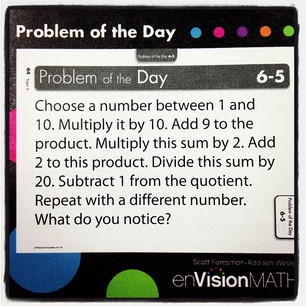
I remembered seeing this number puzzle in a textbook a few weeks ago:
I dissected it and came up with a formula for recreating the number puzzle using any numbers I wanted.
And I figured out how to make it so the end result would be anything — not just the number you picked at the beginning.
Personalized number puzzles as gifts!
So I’m taking each person’s “special number” and creating a number puzzle out of it. For some, that’s their birth year. For others it will be their favorite number or last four digits of their phone number.
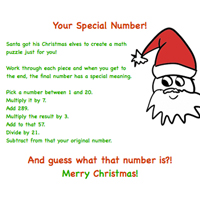
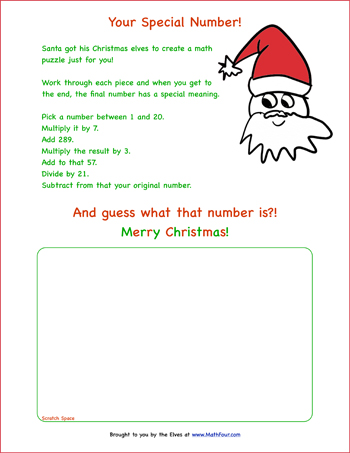
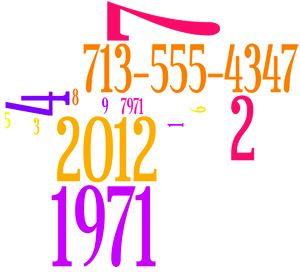
And I’m making them into a pretty little gift sheet:
You can do it too.
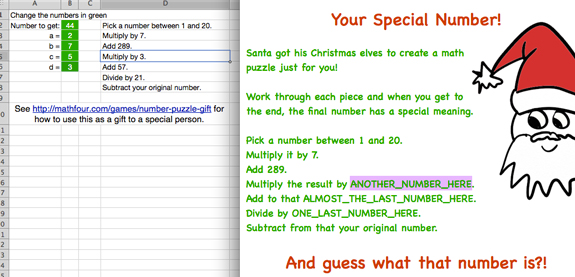
I’ve put all this neatly in a spreadsheet so you can put in your own numbers — and make a number puzzle gift for your cherished math people!
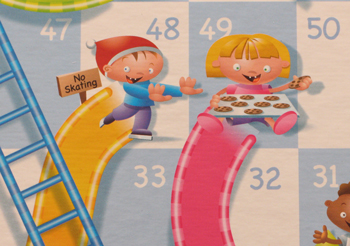
I was playing Chutes and Ladders with K8 the other day when I noticed something. It might seem a little obvious, but I just saw it.
Chutes and Ladders is played on a Hundreds Chart!
It is! And as you look at it, and play it, you can see it’s totally a math game.
You can practice numeracy with your children by counting up from a number. In Chutes and Ladders, if you’re on space #46 and you spin a three, you count up three: 47, 48, 49.
The whole game is numeracy practice like this.
It’s even good for the bigger kids.
Sometimes big kids don’t want to play the little kid games. In Chutes and Ladders, the big kids have the opportunity to calculate how big the loss is on a chute. And how big the gain is on a ladder.
Get freaky with your rules!
You can also team a big kid with a little one and create some house rules. After spinning the wheel, the team gets 5 seconds to calculate the number square to which they’ll advance. If they get it right, they get a bonus of a free spin or to skip over any chutes.
And if you really want to get advanced, choose a new function at the beginning of each game. Like SPIN + 2 or 3 x SPIN + 1. After spinning the wheel, the team gets 5 seconds to calculate the number square to which they’ll advance using that formula! If they can’t do it, they only get to advance the number of spaces on the original spin.
You can make your own!
And don’t forget you can make your own game using an $.88 Hundreds Chart that you can find at your local teachers’ supply store. Break out the construction paper, scissors and glue and start creating some Chutes and Ladders on it.
This post originally appeared on The HSBA Post on September 14, 2012.
How does a kid go from from having the attention span of a distracted gnat to an active game player? Baby steps!
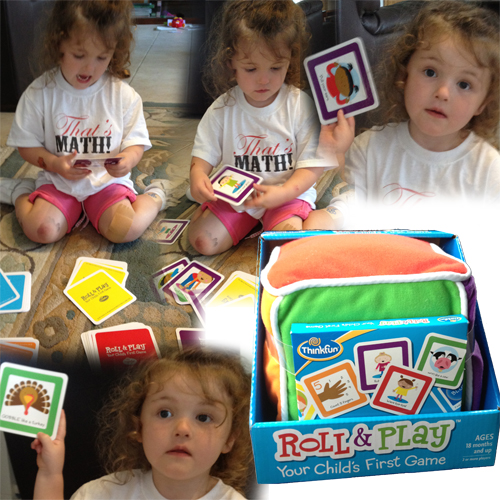
ThinkFun has created Roll & Play, a “my first game” to start your little one out to becoming a regular part of family game night.
Roll the die!
The die in the Roll & Play game is a large plush cube. Each side is a different color. Players roll the die and then draw a card of the same color.
This seems lame to older kids and grownups. But consider what you have to know in order for the die rolling to work.
When the die stops, there are five sides showing and one hidden. You have to know that you’re focus is on the side that is face up. Rolling the big die teaches little ones that the top of the die is the indicator – not one of the sides facing him or her.
Read the card!
Each card has an activity on it. The pictures are sufficient for little ones to know what to do.
When they “read” the card, they get to do the activity. To keep them engaged, you can have them read the cards to the other players.
And then they get to pass the turn to the next person – another important game playing skill.
Play, do, and change the rules at will!
When you play Roll & Play, you’ll be hopping around, dancing, making animal noises, and having a great time. And if you want, you can adjust the rules to fit your little one.
We started out by skipping some of the cards. They just weren’t as engaging as the others. We’ll work around to getting to all of them.
Your turn!
How have you integrated your little ones into game play? Would your toddler do well with ThinkFun’s Roll & Play?
P.S. I got the Roll & Play game for free on accident. ThinkFun meant to send me another game and accidentally shipped this one. I refused to return it, promising instead to enjoy it and write about it.
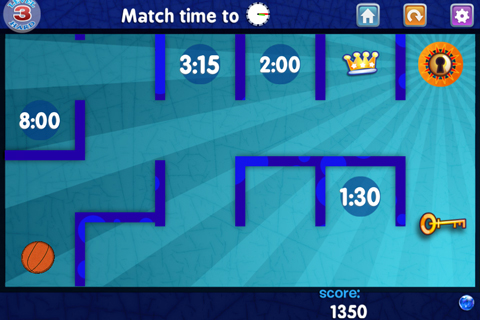
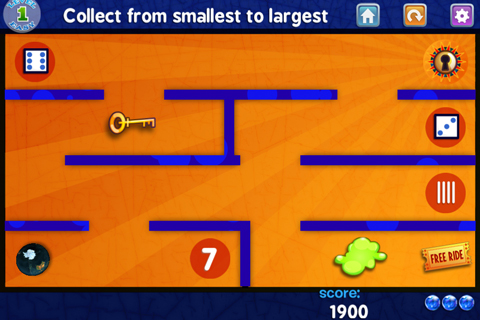
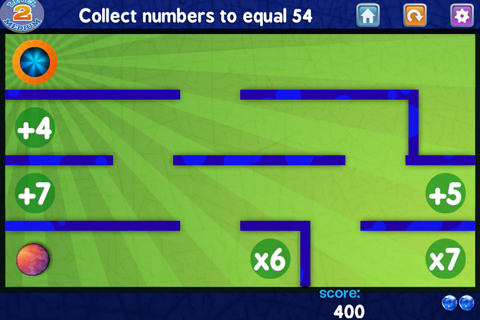
In the games, you roll or drag a marble around a maze collecting right answers (or the pieces of a right answer) to a math question.
Husband likes to roll the marble. He says that’s more fun because dragging the marble isn’t a challenge.
But I like to drag it.
Marble Math is fun and educational!
Both of the Marble Math games have the same features: it’s a maze with obstacles, vortexes, bonus items and point decreasers.
The difference between the two apps is the level of math. So before you see the cool screenshots, check out some of the things covered in each version of the iPhone app:
Ordering things (including a mixture of dice, tallies, arabic numerals, etc.)
Finding items that are the same as a given number
Identifying shapes
Adding up to a number
Telling time
Finding numbers less than a number
Multiples of 2 and multiples of 10
Basic multiplication (by 10)
Some basic fractions
Basic algebra with addition (10+?=17)
The pictures are worth 103 words!
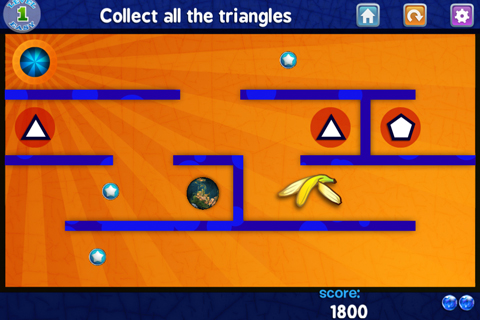
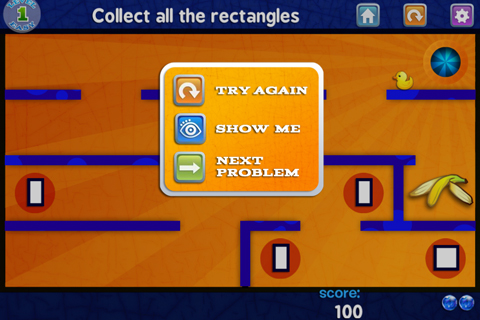
The “pick the shapes” puzzles are fun. The banana will make your marble slip, but collect all the stars and you’ll get an extra life.
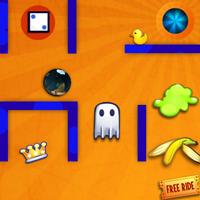
The ghosts look like badguys — but they’re actually your friends. They let you go through the walls. (Come to think of it, it might be bad if you’re rolling the marble and not dragging it!)
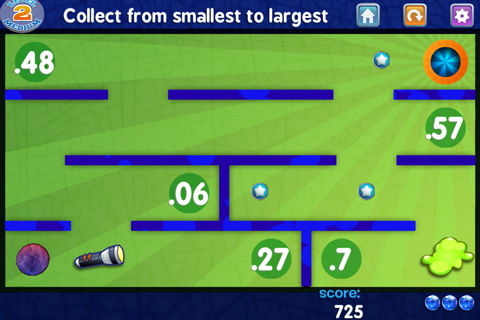
Collect all three tiny stars and you earn another “life.” Roll over the flashlight and… well, I’ll let you see what happens then!
I like that they use time, but that tiny little clock is hard to see. (But my eyes are a good 30 years older than the target audience!)
The key opens the “I’m done” portal.The green slick sends you spinning. The Free Ride ticket give you extra points:
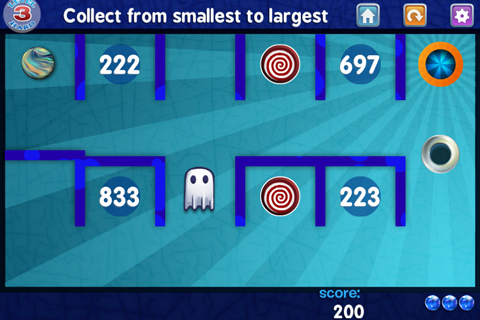
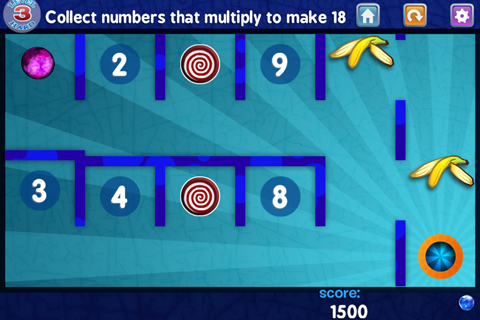
Here’s a sample of a multiply one. The bananas here will make your marble slip and the swirlies will transport you between them!
Having problems? Skip it, get the solution or give it another shot:
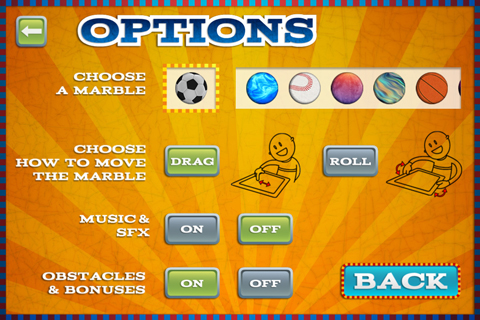
But at some point the math will be hard enough to turn off the obstacles and bonuses. You can also choose your marble — but you have to earn them first!
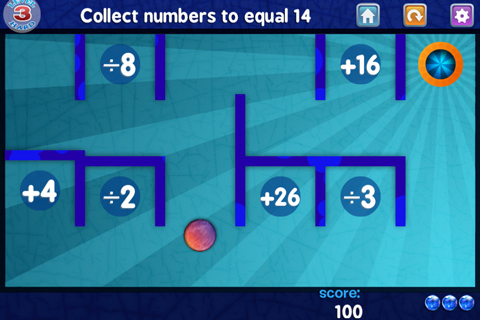
Here’s a nice order of operations one:
This one almost killed me. I kept plugging at it, though. It’s from Level 3 of Marble Math.
This is the 6th in the draft purge series. It was first drafted in May 2011. If you have examples of this type of math puzzle, please include them in the comments.
Since the first time I used email back in 1991, people have sent me various versions of the puzzle “I can guess your birth year.” The results end up as something like:
This year (and this won’t work for any other year)
Your phone number
Your birth date
Your favorite number and the year you were born
Your blood type
Okay, that’s exaggerating a little. But it seems like these puzzles get wilder and wilder.
When I receive these emails, it’s usually from a family member with the preface: “Can you tell me how this works?”
So I’ve dissected tons of these over the years. And I’ve always thought, “You know – I could totally make my own math puzzle like this!”
You can invent your own math puzzle!
The trick to this math puzzle is to add zero and multiply by one in clever ways.
First you pick the result you want. Like the last four digits from my childhood phone number: 4347.
Factor it into primes, if you can. Let your kids do this by hand if you want them to have practice on factoring. If they struggle, you or they can calculate the prime factors using an online service like this one.
Mine is: (3)(3)(3)(7)(23)
If you can’t factor into primes, subtract a single digit number and try it.
Like 4349 – it’s prime, so subtract 2 and then use that to do the rest of this.
At the end of the whole math game you’ll just need to put one more step that includes subtracting this number.
Start constructing the math game.
The starter line for your game will be “Choose a single digit number from 1 to 9.”
We’re going to construct our game using this, with x as the chosen digit.
I’ll keep going until I have a nice set of instructions. Then I can do this on my Ma, Paps, my siblings and all my childhood friends that remember that phone number.
And it’s a great learning tool!
Kids will learn and practice order of operations and algebra. At the same time, they create something they can email or perpetrate on another person – preferably a grown up – and impress them!
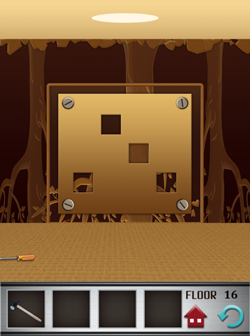
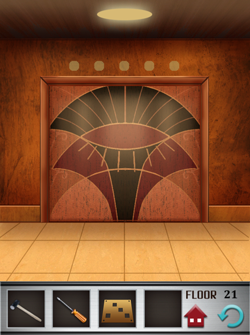
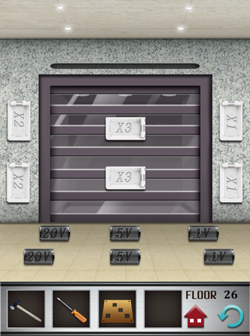
I’ve become slightly addicted to this free iPhone game called 100 Floors. It has strange and interesting parallels to leraning math.
It has no instructions and no hints. And upon first entry to the app, you feel lost, confused and annoyed. (Already starting to sound like a math problem, right?)
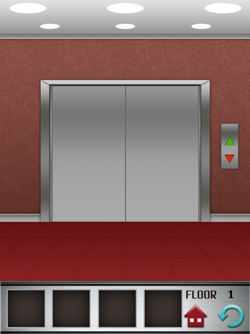
Based on the name of the game and the view of “Floor 1,” it’s clear that the idea is to open each set of elevator doors.
But with just a bit of patience and curiosity, you find yourself challenged just enough on each subsequent floor to keep going.
And you have no idea what to do next.
With each floor you’re not sure what to do.
So you start doing seemingly random things. You notice yourself bumping the phone. Tilting the phone. Shaking it. Blowing on it (I know, that isn’t a feature yet, but I tried anyway).
You tap and drag everything on the screen – including the ads.
(I even yelled into it – just in case that was the key to getting the doors open.)
And sometimes you just stare at it. Curious.
Remember – there’s no punishment for failure.
This one is my favorite!
If you can’t get the doors open immediately, no big deal. If you look, shake, yell, bump, tap and tilt with no results… okay.
So what? Who gives a fuzzy red rat’s tail?
You might turn off the phone and go mow the yard.
But those closed elevator doors stay in your mind. So you’ll come back at some point. You’ll open the app and check it out.
Just one more time.
Just to see…
And when the doors open – yippee!
There’s no prize. There’s no grade. There’s no money.
But the excitement you have from getting those crazy doors open and seeing the green arrow is unimaginable!
“Cheating” is allowed.
Sharing a tip is something you do only if you want. Giving or getting a solution isn’t prohibited, but it’s fun to try to get the solution yourself.
So you choose what to share and what to ask for. Based on your own desires and curiosity.
And it’s the same as learning math.
This one almost killed me. Had to go do something else for a while and come back later.
So far I haven’t found an official math problem in the game. But the tactics, patience and curiosity that you use are exactly what learning math is all about.
In each new math problem, students may wonder, “What the heck do I do with this one?” Just like you do with those elevator doors.
And if there’s no punishment for trying nutty things, their curiosity will take them places.
Tapping, dragging, shaking and yelling into the phone might have made me look goofy. But Husband was nestled in his chair doing equally insane things to get his elevators to open.
But there IS punishment in learning math.
That’s where things diverge.
Performance based teaching is the basis of the typical math lesson. Math problems are given to the student. And the student is expected to give back the right answer.
If the right answer isn’t given, there are repercussions. Points are deducted or the failure is publicly noted. Or both.
And if you don’t have the right answer, you’re just not learning math.
Period.
(BTW – that’s a horrible myth!)
And “cheating” is all or none.
This one sort of turns out to be a math problem.
Either the teacher coaches step-by-step, or there is no tutor or teacher at all.
Think about the last time you did a math problem from a textbook with a teacher watching.
If you took the wrong path, you were quickly guided back on track. This was either with words, “Are you sure that’s what you need to do?” or with facial expressions.
Math students aren’t allowed to take or leave tips at will. And they sure aren’t allowed to give them when they want.
That’s cheating.
But isn’t that what grownups do when they “guide” students?
How do we change this?
How can we make learning math more like playing 100 Floors? How can we get students into the adventurous mode – tapping, shaking and doing anything they can to a math problem?
How do we get them to cheat on their own terms? And how do we get grownups to stop over cheating?
Share your thoughts in the comments. And share this article on twitter!
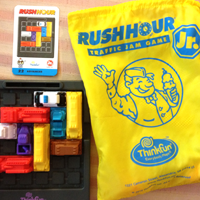
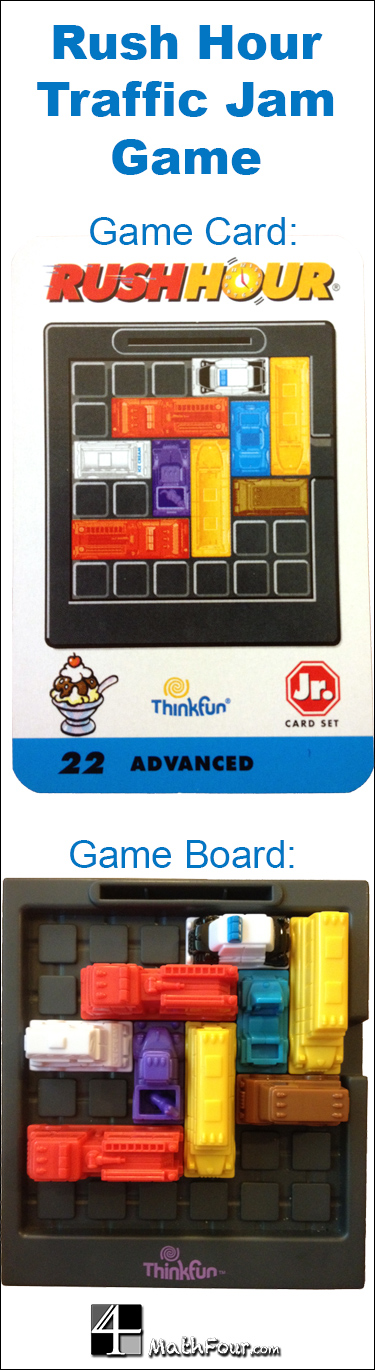
My sister-in-law showed me the Rush Hour Traffic Jam Game by Think Fun this weekend. She “assigned” one of the harder cards in the deck to me (sometimes it sucks to be known as the math mom) and assured me that I could do it.
The Set-up
You set up the 6×6 game board with the plastic vehicles just like the game card shows. Here’s where the math starts.
The skills children develop doing this support graphing on the Cartesian coordinate plane later on.
Even if your child isn’t ready for the actual game play, this step supports them in math!
The Goal
Allow the ice cream truck to “escape” the maze.
In order to do this, you are allowed to slide any of the cars forward or back. They can’t crash into other cars to push them out of the way. And you can’t lift any of them off the game board.
A more challenging goal is to also do this in the minimum amount of moves possible.
The Strategy
Everyone has their own plan. My nephew likes to scooch the cars around until he stumbles upon an answer. I decided to pick up the cars and move them to the most unique solution to see what the end result should look like.
The Math
You’ve the coordinate plane. You have logic. And you have strategy. But you have someone much more amazing here.
The beauty of the game is the way it simulates mathematical research and discovery.
Everyone has their own style.
Everyone has their own solution.
If you follow the rules and “win” then you’ve done it right, regardless of how someone else did it.
There are many levels of success – and the player determines which level he or she is shooting for.
Given the board and the colorful cars, you can create your own game.
Wanna play?
The next time you’re tutoring or teaching math, consider treating it like the Rush Hour game. Give it to your child then back off. Refrain from telling or showing. Let him or her play.
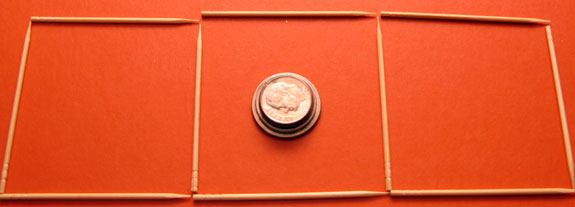
One of my favorite math games as a kid was The Tower of Hanoi. I had no idea what it was called until college, though. To me it was another cheap wooden puzzle. Or a game you could play with four coins and 10 toothpicks.
The object of the game:
Move the stack from where it is, to another square or post.
The rules of the game:
You can only move one disk (or coin) at a time.
You can only put a disk (or coin) on top of one that’s bigger – physically. (I.e. you can’t put a big one on top of a smaller one.)
You can play it online for free or buy a physical version in classic or kid-friendly versions.
How can you use The Tower of Hanoi with your kids?
In the Tower of Hanoi puzzle, the math is vast – especially for such a simple little puzzle. But the math can be discovered gradually.
Present these challenges to your kids, one at a time:
Move the stack according to the rules (just get it to another place.)
Move the stack according to the rules in as few moves as possible. How many moves is that?
Make the stack smaller or larger. Then move the stack according to the rules in as few moves as possible. How many moves is that?
Repeat challenge #3 with many different numbers of coins/disks. Use cut out pieces of paper if necessary.
Determine how many moves it would take to move a stack of 100 disks. Or 1000 disks.
Then figure out a way to say this without numbers. In other words, create some sort of formula that will tell you how many moves you need to move any number of disks.
These challenges might range over many many years. I first learned of The Tower of Hanoi when I was about ten. And I’m still learning about it 30 years later.
Oh, and try to resist giving them any answers – ever. Instead let them work on it in their spare time.
Your turn!
Have you played The Tower of Hanoi math game, or a version of it? Do you remember the first time you came across it? Did you learn or teach math with it?
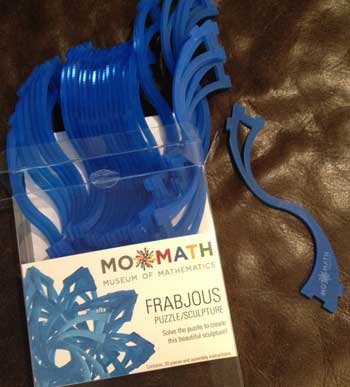
I had to wait for Daughter to be in bed before digging in – the box states, “Recommended for ages 16+.”
I was pretty sure that a precocious 10 year old could handle it but I was unwilling to risk a 2 year old eating my cool puzzle.
My “solution” to the puzzle…
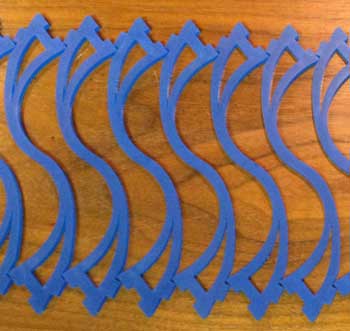
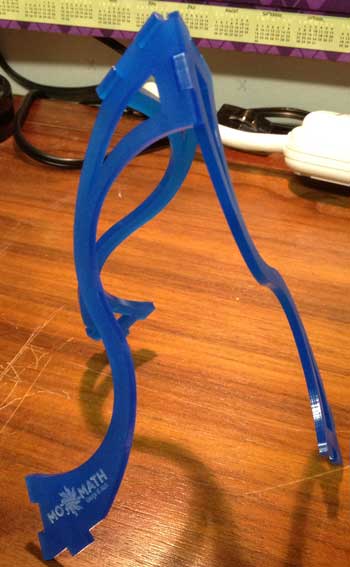
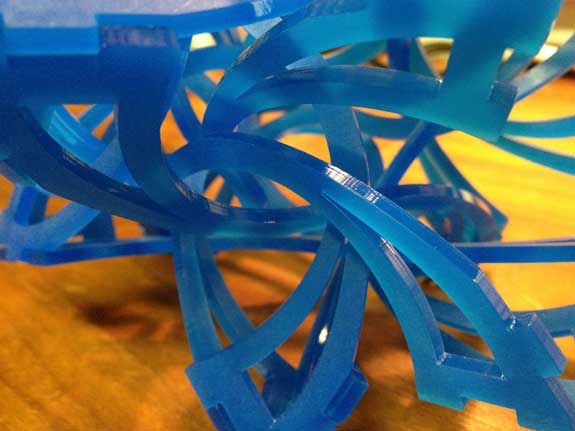
Oh, my… all the pieces are exactly the same!
No biggie, though – I’m pretty smart. “I can do this!” I thought.
I thought.
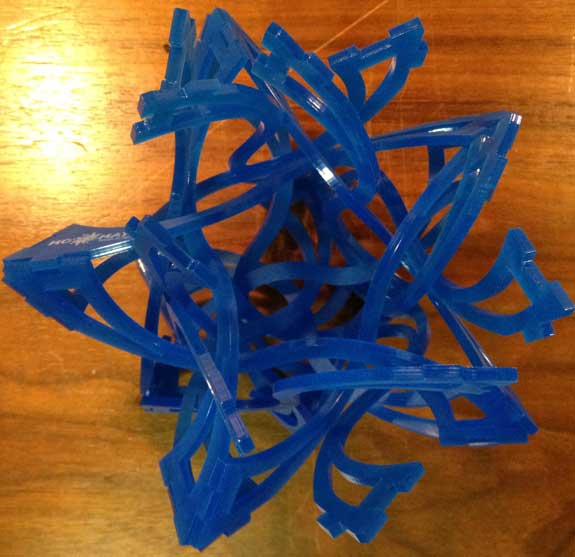
After a while, I felt like maybe I was doing it right, and maybe not. Here’s the view from the top when I had 12 of the 30 pieces left to go:
Guess what – the instructions clearly state “check that no parts are touching in the interior.”
Everything in mine is touching!
I’m (maybe) throwing in the towel!
I keep looking at the mostly-built thing. It’s pretty, even in its unfinished state. I’m not one to quit, but I will pause temporarily.
So for now, I have the wad of blue looking at me everyday. Staring. Saying, “Are you smart enough to finish me?”
Sometimes I tell it to hush.
Sometimes I google it.
Windell Oskay, an Evil Mad Scientist, has some great images on his writeup of making your own Frabjous. I’ll likely use these when I get the courage tackle this thing again.
I could just watch the video.
I’m against looking in back-of-the-book answer pages. So I’m certainly not about to let a video tell me how to work a puzzle.
But my cantankerous attitude doesn’t mean that you get deprived. Here’s the video:
You can buy the Frabjous online for $29 plus about $7 shipping within the U.S. Technically, you can save the $36 bucks and build your own. But that might be a real pain. Plus, if you buy it from the Museum of Mathematics, you support them!
What do you think? Do you want one? Have you built one? Share your thoughts and links to pictures in the comments.
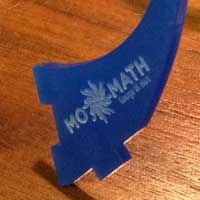
The Museum of Mathematics (MOMath) will open in New York City in 2012.
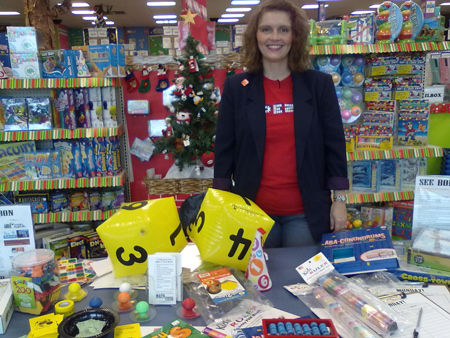
Do you have any Pre-K and/or K12 kids in your family? I spent the day at Teacher Heaven on the Southwest Freeway in Houston, Texas yesterday and found some great math games!
I was there for the day to demonstrate math games and manipulatives and generally help parents and teachers of K12 kiddos with math goodies.
Meagan, Shantrelle and the crew had chosen a couple of math games to start me off. I also went and browsed the rest of the math section for others. By the end of the day, my table was jam-packed with math games!
I fell for the loss leader!
The big push at Teacher Heaven was the “fill-the-tub” sale – and I fell for it before I left. Hook, line and sinker!
I resisted too many goodies for myself, but made sure to do a little Christmas shopping. Here’re a few of my excellent finds. Luckily my family members a) don’t read this site much and b) don’t know that these things were originally shrink wrapped!
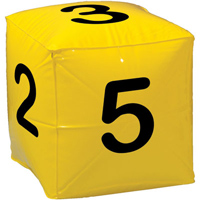
The Pre-K find of the day was inflatable number cubes!
I nabbed these number cubes early in the day to have something to get the little ones engaged as they walked in the door. They were so cool I couldn’t resist taking them home to Daughter.
They’ll be great for helping her identify the numeral and saying the word. Plus, I’ll be able to create a bunch of math games with it – like doing arithmetic with the numbers when she gets older, etc.
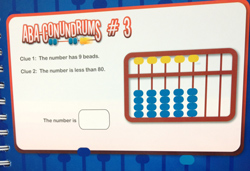
One K12 treasure was the Aba-Conundrums by Fat Brain Toys.
Aba-Conundrums comes with an abacus and a fun puzzle book. Using logic, you practice creating numbers and working with the tool.
I can’t decide if I’ll give it to one family member, keep it for myself or give it to Ma as a “house” game.
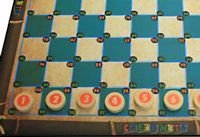
My other K12 find was the Check Math Game.
Also by Fat Brain Toys, Check Math is totally for my niece. I’ll likely open it and play it with Husband first, though!
You set the number pieces up and you capture your opponents pieces like checkers. The movement of pieces is a little different, though: a number piece can move to any square that’s a multiple of it. For example, the 2 can move to a 6 or 14. The 3 can move also to the 6 but not to the 14.
Time for Christmas shopping!
Pick up one of these math games at your local teacher supply store. And if you’re in Houston, head over to Teacher Heaven!