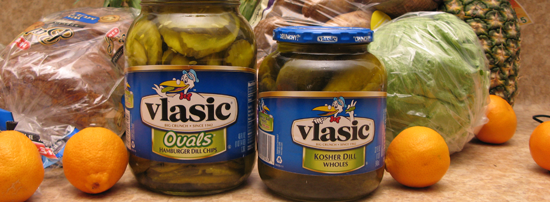

Daughter is into pickles. Like way into pickles. If I were to start a blog just for her, it would be called www.PicklesAndPretzels.com. (She’s also into pretzels.)
So when Husband grabbed two instead of one jar yesterday, it seemed natural.
Unloading the groceries, I saw the two jars a little more closely.
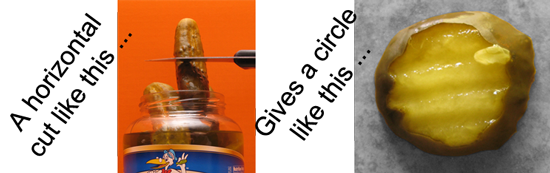
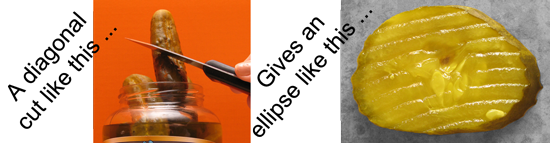
“Holy cow,” thought I. They’ve made ellipses (pickle ovals) out of segmenting cylinders (the whole pickles)! And they’re marketing them!
I had the pleasure of assisting Sarah Shah in her appearance on Great Day Houston yesterday.
While preparing for the show, I observed Sarah and the host, Deborah Duncan, in the makeup room having a conversation about math.
When I said to Sarah later, “that was an interesting math conversation,” she looked at me with anticipation, encouraging me to share what I heard. She had no idea I was referring to her conversation!
The math conversation was fully on-topic.
It was national thrift store day, and Sarah was going to share with GDH viewers some tips on shopping at resale shops. The topic of the show inspired their kibitzing behind-the-scenes about buying gold jewelry.
Deborah was talking about how there’s a difference (sometimes big) between the cost of the gold in a piece of jewelry, and the sale price.
The cost of craftsmanship should be close to its value.
Deborah was making the point that there’s value on the design of an object based on the workmanship that went into it. And this goes only so far.
Right now gold prices are around $1700 per ounce. Since an ounce is around 28 grams, gold is valued at about $60 per gram.
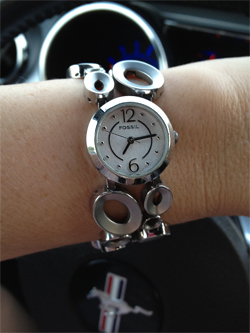
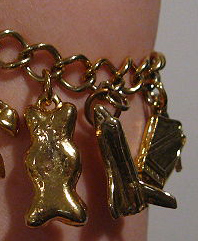
The QVC bracelet in the picture is 9 grams. It’s selling for $530 – pretty much exactly the value of the gold contained within.
If the value of gold for a 9 gram bracelet is around $530, charging $3000 for it means you’re paying about $2500 for the craftsmanship!
Unconscious math is all around.
Aqua And Gold Fractal by Sharon Apted
It was a wonderful experience to see two intelligent, educated women having a lively and entertaining conversation about math. It was quite disheartening, though, that Sarah didn’t even recognize it. In a previous life she was a physicist.
How many other conversations about math are ignored? How many people who claim they aren’t good at math have these conversations every day?
Look around at your conversations this week. How many of them are about math? Share your conversations in the comments. And with your kids!
When we crossed the street, I exposed her to undo risk by crossing at an angle.
So on our way out, I explained to her that we were walking a little further to get to the car this time. And we would minimize the risk of getting hit by a car by taking the longer route.
(Of course she’s not yet two, so she really didn’t care. But it was important for me to say.)
Crossing at an angle is shorter than going straight across.
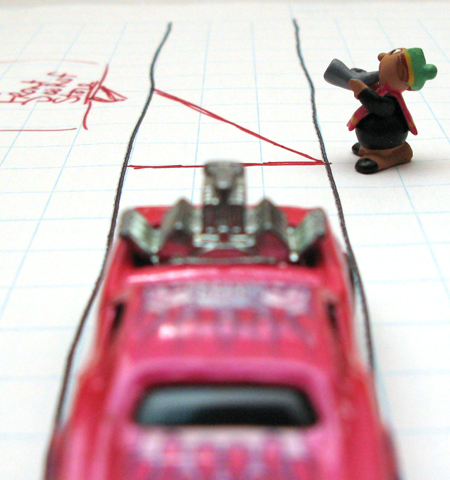
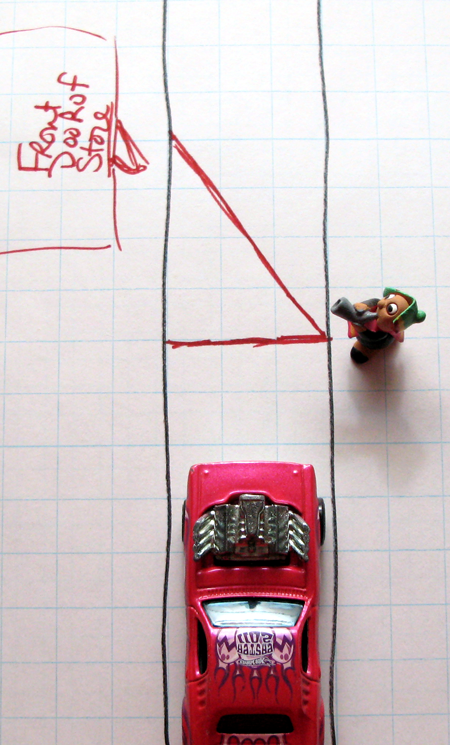
People most often cross the street at an angle. Intuitively we know it’s shorter. Look at the tiny person in this picture. He needs to get to the front door of the store.
It’s five yards to go at the angle, while if the little guy walked straight across then up, it would be seven yards.
Suppose walking one yard takes 5 seconds. It will take the little guy 15 seconds to cross the street straight across. (And with a toddler, it does take 5 seconds to walk a yard.)
Then he has to walk the four yards along the side to the door. Which means his total time is
5 yards diagonally at 5 seconds per yard = 25 seconds
Total walking time = 25 seconds!
Crossing at an angle puts you at risk for longer.
For the pedestrian in a hurry (and wearing the shirt that reads “Safety Third”) the angled route is the way to go. But for a parent with toddler in tow, minimizing risk is a better option.
If the little guy were to cross at the angle, he’d be in front of the oncoming cars for 25 seconds. If he were to take the route that is longer overall, he’d be in front of oncoming traffic for only 15 seconds.
The car doesn’t care what angle you’re walking, it can squish you pretty easily either way.
Not to mention he keeps the driver happy.
Getting out of the driving area faster means keeping the driver happy. That might not be your goal, but adding some cosmic happy juice into the world of drivers never hurts.
Plus, if someone were to “hypotenuse you” by taking the angled route when you were driving, wouldn’t you get a little annoyed?
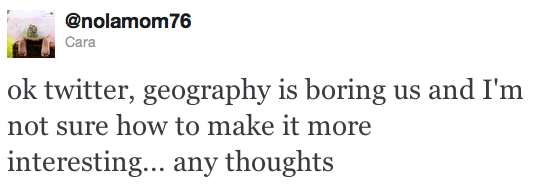
Everyone’s getting back into the schooling groove. So twitter is filled with questions like Cara’s:
And since my world revolves around math, here are my thoughts.
Use the Four Color Theorem (but don’t say it out loud).
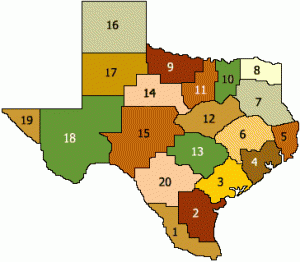
The Four Color Theorem says that if you only have four crayons, you’re good to color your map and not have any colors touching. (That’s the he kiddo version of the theorem.)
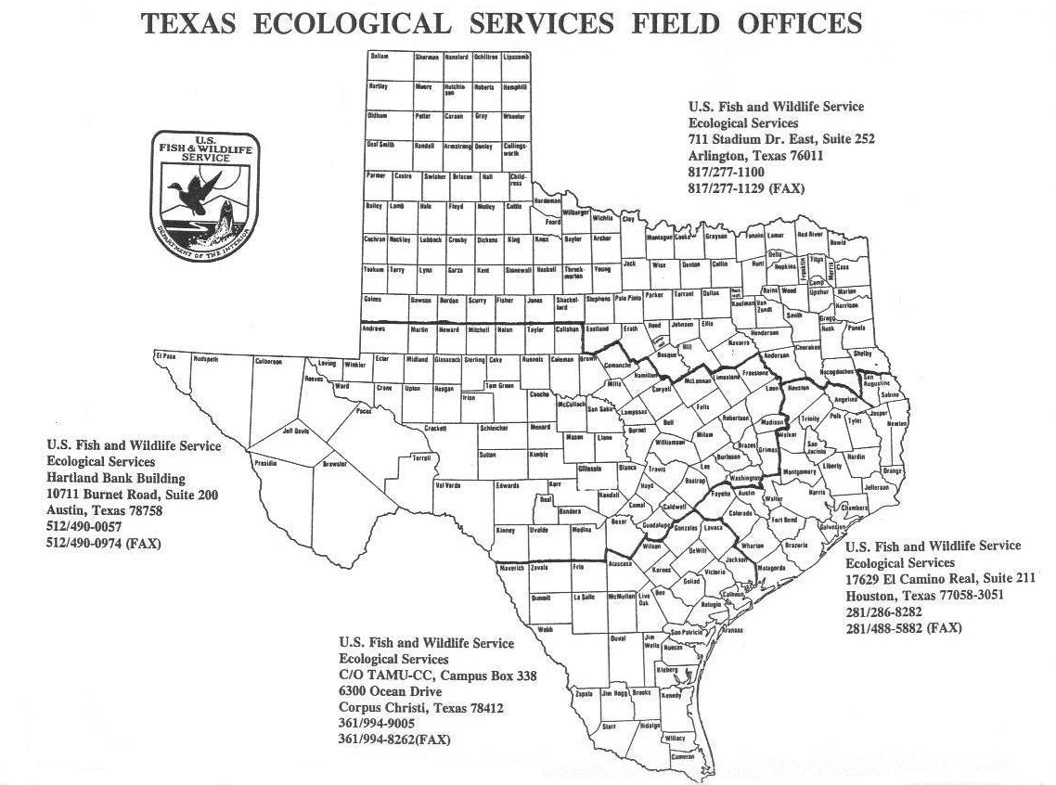
So get out your google and print out some map coloring pages. Choose ones with lots of borders. (As fun as it is to color Texas as a whole, use a map of Texas’s counties.)
Caution: don’t tell the children they’ll be using math. Let them figure it out.
Now it’s coloring time!
And here’s the challenge: color the map with as few colors as possible so that no two touching territories have the same color.
While they color, you can talk about the names of the locations and some of the details. Even have them label them.
Once they finish coloring, have them remember how few colors they used.
Next time you talk about this map, ask them to use one less color than they did before. Continue labeling and discussing the locations.
After a while they’ll figure out that they can’t do it with three, but they can do it with four.
Shower, rinse, repeat.
From the Texas Environmental Education Providers (how cool is that!)
Kids are experimental. And they don’t believe that what works once, automatically works again (that’s why they drop Cheerios on the floor over and over and over again).
So you can do this with the next map when you’re ready to go to another part of the world.
Indeed, they’ll eventually figure out that four is the magic number. Then they can google it and learn all about the theorem!
How about it? Did it work? Share your experiences in the comments.
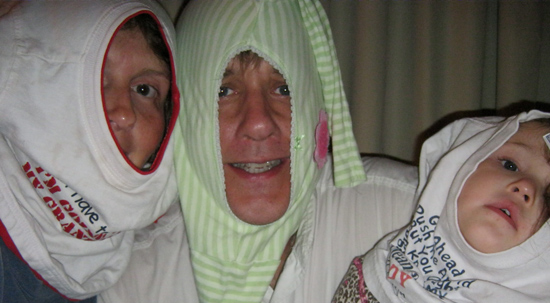
In an attempt to join the Wordless Wednesday crowd, I’m sharing this photo. But as you can see, for MathFour.com, this is only a Somewhat Wordless Wednesday.
Before this photo we were discussing size of shirts – a numeracy concept that is visually displayed through the inability for grownups to fit 4T nightshirts on their bodies. Count 10 Read 10 is part of our family’s afterschooling routine.
For my 40th birthday, I bought myself this beautiful Lokta paper book from a fabulous little store in the Houston Heights called Write Now!
It has circles on it – one of my “things.” I love circles. But then I saw how the colors were laid out.
“Holy cow! This is a teaching opportunity!” I thought.
And it got even better at the Texas Home School Coalition’s convention this last week. I shared it with former math teacher and now-homeschooler Sharon Brantley and she saw even more goodies in it!
You can use it to teach math!
Anything that has more than one aspect/characteristic/color (pretty much everything) can be checked for patterns. Patterns are an essential, perhaps even the most important, building block for mathematical thinking and development.
Here’s what you can see in this book cover:
Connect the green dots and you get a square. (Also the yellow dots.)The pink dots form a line and then the one dot off to the side can make a perpendicular line to the other line. (Purple dots, too.)
These blue dots make a funny little shape.
But wait! There’s more!
What Sharon pointed out to me was that you can draw an L from any dot to another dot of the same color!
Optional: This “L” thing links directly to the slope, by the way. Between any two points of the same color, the slope is either 1/2 or -2. Cool, huh?
Where do you see patterns in your world? Share it (and a link to the picture) in the comments!
As with all good mathematics, I just spent hours pondering how to set up my super cool Cuisenaire Rod quadtuple.
It was a great experience. Made me wonder why I was being so selfish in keeping it to myself.
This is a perfect thing for kids to do!
The Setup
Seems simple enough. Make a picture on 1cm square graph paper with Cuisenaire Rods. Then write down the coordinates of the rods. Voila! You have the coordinate representation of your picture. Furthermore, you’ve practiced coordinates!
Cool, right?
The rub is that you have to correctly identify the orientation of the rods – are they up-and-down or side-to-side? Or worse – at an angle!
So now we have four things to identify: size/color, angle of rotation, x coordinate, and y coordinate.
Since the rods have width, we can’t just say “put it at (3,2).” What part of the rod goes at (3,2)? One of the four corners? The midpoint of one of the sides?
I just picked one.
My official Cuisenaire Rod Ordered Quadtuple (CROQ) looks like this:
(size of rod, angle of rod, x-value of anchor, y-value of anchor)
The size of the rod is easy.
The angle of the rod is clear, but we have to define what is zero (up-and-down or side-to-side) and how we rotate (always clockwise, counter-clockwise, either way, etc.).
I picked up-and-down to be zero degrees. It is the way I naturally look at the rods. Like this:
See the bright green dot? That’s the anchor point. It stays there (in your mind) and is the bit that you’ll put on the (x, y) point.
Which means that as you change the orientation (or rotate your rod), it sticks around. Like this:
This rod is (5, 90, 0, 0) because it is 5cm long, rotated 90 degrees (clockwise) and the anchor is at (0, 0).
You can do interesting angles too!
Check out the 45 degree one:
This one has the 4-tuple (6, 45, 0, 0). Notice that the rotation is always clockwise.
This works, but isn’t the best way.
When we graph (typically), zero degrees is horizontal. And sticking out to the right of the origin.
Perhaps the best way to represent the rods on the plane is to use this type of set up. But it wasn’t the natural choice for me.
Which is right?
It doesn’t really matter. Unless you’re running a contest (which I think ETA Cuisenaire is putting together).
Try this at home. It simulates what researching mathematicians do everyday:
Let your child make a piece of artwork with the rods on graph paper. Go ahead and spring for another home set of rods and let him glue it. You can frame it and put it on the wall later.
Ask him to do this: “Using only numbers, letters and punctuation, write the instructions to recreate your picture.”
Take a piece of graph paper and recreate their picture yourself, based on what he’s written.
Compare yours and his. Are they the same? If not, what happened? If so, were there any challenges for you while redoing it?
Discuss it and let him think about this as long as he wants (minutes, days, weeks, years). Then ask him if he can think of a different way to describe it so it is easier to recreate.
Repeat as many times as is enjoyable. After a while – sometimes years – he’ll create something similar (probably better) than what I have above.
But, really, which is right?
This is exactly what mathematics is all about. Not which is right, but which feels best. And which one will we agree on.
When ETA Cuisenaire puts together their contest, they’ll have the rules clearly defined. “Right” will only be according to how they set it up. When you enter, they’ll recreate your art based on their rules.
I like my rules. So much so, I’m going to use them next week to give the coordinates for the image at the top of this article. Wanna compare? Do it and post your CROQs in the comments.
(Notice there’s a whole-lotta math goin’ on in that image – not just coordinates!)
I noticed Daughter attempting to bejewel Husband with a strand of my faux pearls the other day. I watched, enthralled with the math learning taking place.
She held the necklace in her hands – one on each side. Just about equal. So the space available for Husband’s head was almost non-existent. Like this:
If she were to hold the necklace at two points that were closer together, she would create a “dip” in the necklace where his head could fit. Like this:
There’s an extended learning opportunity here!
This made me think of all the nifty things you can show about the relationship of perimeter to area and how you can have the same perimeter but change the area to all sorts of sizes.
If you aren’t wearing a necklace, find some mardi-gras beads. Daughter has many strands, so I’m guessing your house might be littered with them as well. If not, join the club. Go buy some.
Play with them in the bathtub or right before bed. (Make sure they give them up before going to sleep, though – it’s a strangulation hazard!)
Move the necklace around on a flat surface (or on the bed) and let your child experiment with the ways the area changes. Ask questions like:
How much “stuff” can you fit inside the shape? (If there are blocks or other toys to act as “stuff,” use them.)
How much “stuff” can you fit inside the shape after you move it around?
Is that more or less “stuff” than you could fit inside it before?
Did the distance around the necklace change? (You can introduce the words perimeter and circumference.)
Can you make it into a square? A triangle?
Be careful how much you do.
Don’t forget, activities like this should be fun. For your child as well as you. So don’t get too in depth talking the math talk if it feels weird. Go with the flow.
And let me know how that flow goes, would you? Share your thoughts in the comments.
The comparison of numeracy to literacy is curious.
Learning math is the opposite of learning to read. When you read, usually simultaneous to learning a language, you sound out words and then put meaning to them. When you learn to count and do math, you know the meaning inherently and then put a language to it.
At some point we learn to recognize words without sounding them out. And at some point we learn to recognize quantities without counting them out. This is called subitizing.
The Your Baby Can Read program uses the concept of subitizing to teach reading – you show your baby the word alongside the object. So the shape of the word car is as recognizable as a car itself.
The children using Your Baby Can Read don’t learn to sound out words. They don’t understand the concept of letters any more than babies not using the program. But they instantly recognize the shapes of the words – giving them an (assumed) advantage.
Aside: We didn’t use the “Your Baby Can Read” program, not because it was gimmicky (I love anything that looks gimmicky), but because there is a huge DVD element to it. We decided not to put Daughter in front of the TV for her first 2 years. A decision we stuck with, but sometimes was a struggle!
This article contains a “your baby can count” type program. (And it’s a free download!)
How did we learn subitizing?
I don’t recall having been taught it directly. Although I could be wrong. The research on it has been happening since the early 1900s, so it might have been taught without being labeled “subitzing.”
I wonder how many of us do that. Are grownups so adept at subitizing that they forget that’s how we assess quantity? Maybe we’re taught to chant-count because that’s the way we think counting is.
But it isn’t!
How do you teach subitizing?
Images are accompanied by the written numeral as well as the number spoken aloud. The images would be printed on cards, done via video or “live” with 3D objects.
I’m still working on the numbers 5-10 and up, but for the numbers 1-4, the following 8 styles of image sets would be done twice. Once using the same objects for each image set, and once using different objects for each image set.
Organized in a row vertically.
Organized in a row horizontally.
Organized in a row diagonally.
Organized in a row other way diagonally.
Organized in a regular shape (triangle, square).
Organized in a differently oriented regular shape.
Organized in an irregular shape.
Organized in a different irregular shape. (There will be more of these for 4 than 3, etc.)
The objects could be blocks, cars, little dolls, just about anything. I created the set below from blocks I found left in Daughter’s block set.
Each zip file contains a few .jpg files with 4″ x 6″ pictures. You can print them at home or ship them to Walmart, Target, CVS, etc. for printing. I left off the MathFour.com logo so the kiddos wouldn’t get distracted. Please share them along with links back here.