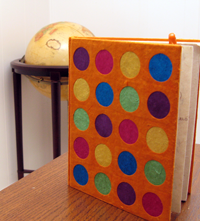
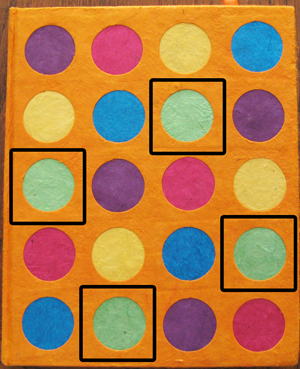
For my 40th birthday, I bought myself this beautiful Lokta paper book from a fabulous little store in the Houston Heights called Write Now!
It has circles on it – one of my “things.” I love circles. But then I saw how the colors were laid out.
“Holy cow! This is a teaching opportunity!” I thought.
And it got even better at the Texas Home School Coalition’s convention this last week. I shared it with former math teacher and now-homeschooler Sharon Brantley and she saw even more goodies in it!
You can use it to teach math!
Anything that has more than one aspect/characteristic/color (pretty much everything) can be checked for patterns. Patterns are an essential, perhaps even the most important, building block for mathematical thinking and development.
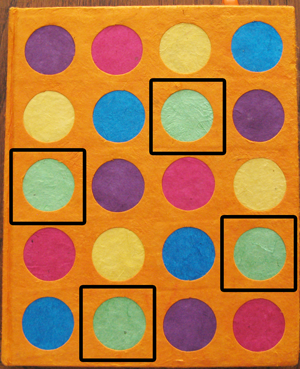
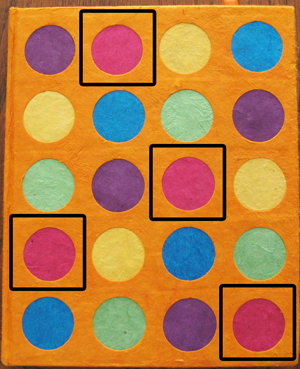
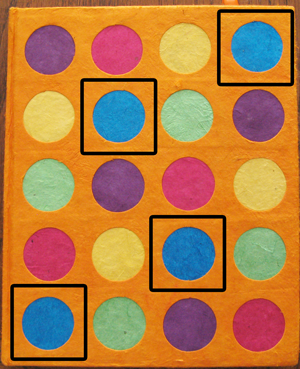
Here’s what you can see in this book cover:
Connect the green dots and you get a square. (Also the yellow dots.)The pink dots form a line and then the one dot off to the side can make a perpendicular line to the other line. (Purple dots, too.)
These blue dots make a funny little shape.
But wait! There’s more!
What Sharon pointed out to me was that you can draw an L from any dot to another dot of the same color!
Optional: This “L” thing links directly to the slope, by the way. Between any two points of the same color, the slope is either 1/2 or -2. Cool, huh?
Where do you see patterns in your world? Share it (and a link to the picture) in the comments!
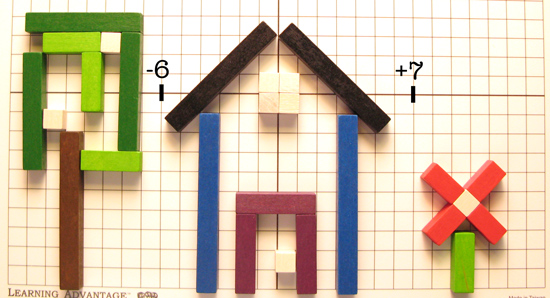
As with all good mathematics, I just spent hours pondering how to set up my super cool Cuisenaire Rod quadtuple.
It was a great experience. Made me wonder why I was being so selfish in keeping it to myself.
This is a perfect thing for kids to do!
The Setup
Seems simple enough. Make a picture on 1cm square graph paper with Cuisenaire Rods. Then write down the coordinates of the rods. Voila! You have the coordinate representation of your picture. Furthermore, you’ve practiced coordinates!
Cool, right?
The rub is that you have to correctly identify the orientation of the rods – are they up-and-down or side-to-side? Or worse – at an angle!
So now we have four things to identify: size/color, angle of rotation, x coordinate, and y coordinate.
Since the rods have width, we can’t just say “put it at (3,2).” What part of the rod goes at (3,2)? One of the four corners? The midpoint of one of the sides?
I just picked one.
My official Cuisenaire Rod Ordered Quadtuple (CROQ) looks like this:
(size of rod, angle of rod, x-value of anchor, y-value of anchor)
The size of the rod is easy.
The angle of the rod is clear, but we have to define what is zero (up-and-down or side-to-side) and how we rotate (always clockwise, counter-clockwise, either way, etc.).
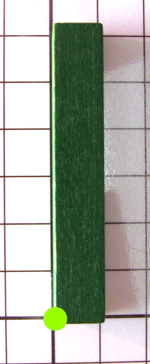
I picked up-and-down to be zero degrees. It is the way I naturally look at the rods. Like this:
See the bright green dot? That’s the anchor point. It stays there (in your mind) and is the bit that you’ll put on the (x, y) point.
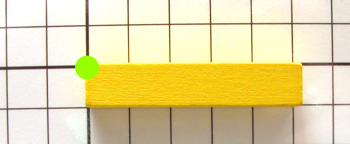
Which means that as you change the orientation (or rotate your rod), it sticks around. Like this:
This rod is (5, 90, 0, 0) because it is 5cm long, rotated 90 degrees (clockwise) and the anchor is at (0, 0).
You can do interesting angles too!
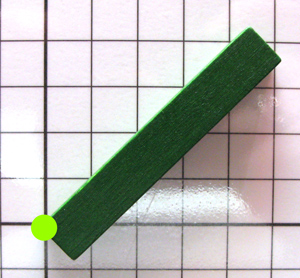
Check out the 45 degree one:
This one has the 4-tuple (6, 45, 0, 0). Notice that the rotation is always clockwise.
This works, but isn’t the best way.
When we graph (typically), zero degrees is horizontal. And sticking out to the right of the origin.
Perhaps the best way to represent the rods on the plane is to use this type of set up. But it wasn’t the natural choice for me.
Which is right?
It doesn’t really matter. Unless you’re running a contest (which I think ETA Cuisenaire is putting together).
Try this at home. It simulates what researching mathematicians do everyday:
Let your child make a piece of artwork with the rods on graph paper. Go ahead and spring for another home set of rods and let him glue it. You can frame it and put it on the wall later.
Ask him to do this: “Using only numbers, letters and punctuation, write the instructions to recreate your picture.”
Take a piece of graph paper and recreate their picture yourself, based on what he’s written.
Compare yours and his. Are they the same? If not, what happened? If so, were there any challenges for you while redoing it?
Discuss it and let him think about this as long as he wants (minutes, days, weeks, years). Then ask him if he can think of a different way to describe it so it is easier to recreate.
Repeat as many times as is enjoyable. After a while – sometimes years – he’ll create something similar (probably better) than what I have above.
But, really, which is right?
This is exactly what mathematics is all about. Not which is right, but which feels best. And which one will we agree on.
When ETA Cuisenaire puts together their contest, they’ll have the rules clearly defined. “Right” will only be according to how they set it up. When you enter, they’ll recreate your art based on their rules.
I like my rules. So much so, I’m going to use them next week to give the coordinates for the image at the top of this article. Wanna compare? Do it and post your CROQs in the comments.
(Notice there’s a whole-lotta math goin’ on in that image – not just coordinates!)
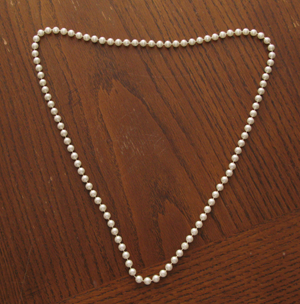
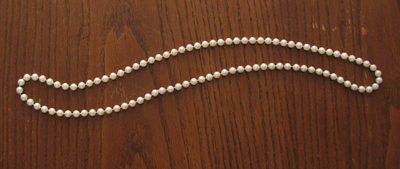
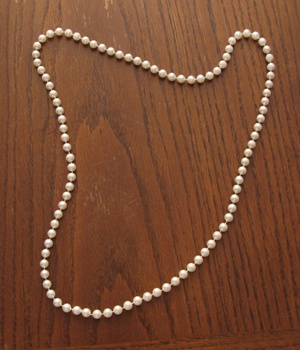
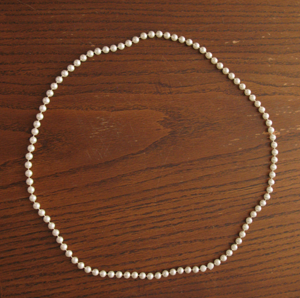
I noticed Daughter attempting to bejewel Husband with a strand of my faux pearls the other day. I watched, enthralled with the math learning taking place.
She held the necklace in her hands – one on each side. Just about equal. So the space available for Husband’s head was almost non-existent. Like this:
If she were to hold the necklace at two points that were closer together, she would create a “dip” in the necklace where his head could fit. Like this:
There’s an extended learning opportunity here!
This made me think of all the nifty things you can show about the relationship of perimeter to area and how you can have the same perimeter but change the area to all sorts of sizes.
If you aren’t wearing a necklace, find some mardi-gras beads. Daughter has many strands, so I’m guessing your house might be littered with them as well. If not, join the club. Go buy some.
Play with them in the bathtub or right before bed. (Make sure they give them up before going to sleep, though – it’s a strangulation hazard!)
Move the necklace around on a flat surface (or on the bed) and let your child experiment with the ways the area changes. Ask questions like:
How much “stuff” can you fit inside the shape? (If there are blocks or other toys to act as “stuff,” use them.)
How much “stuff” can you fit inside the shape after you move it around?
Is that more or less “stuff” than you could fit inside it before?
Did the distance around the necklace change? (You can introduce the words perimeter and circumference.)
Can you make it into a square? A triangle?
Be careful how much you do.
Don’t forget, activities like this should be fun. For your child as well as you. So don’t get too in depth talking the math talk if it feels weird. Go with the flow.
And let me know how that flow goes, would you? Share your thoughts in the comments.
The comparison of numeracy to literacy is curious.
Learning math is the opposite of learning to read. When you read, usually simultaneous to learning a language, you sound out words and then put meaning to them. When you learn to count and do math, you know the meaning inherently and then put a language to it.
At some point we learn to recognize words without sounding them out. And at some point we learn to recognize quantities without counting them out. This is called subitizing.
The Your Baby Can Read program uses the concept of subitizing to teach reading – you show your baby the word alongside the object. So the shape of the word car is as recognizable as a car itself.
The children using Your Baby Can Read don’t learn to sound out words. They don’t understand the concept of letters any more than babies not using the program. But they instantly recognize the shapes of the words – giving them an (assumed) advantage.
Aside: We didn’t use the “Your Baby Can Read” program, not because it was gimmicky (I love anything that looks gimmicky), but because there is a huge DVD element to it. We decided not to put Daughter in front of the TV for her first 2 years. A decision we stuck with, but sometimes was a struggle!
This article contains a “your baby can count” type program. (And it’s a free download!)
How did we learn subitizing?
I don’t recall having been taught it directly. Although I could be wrong. The research on it has been happening since the early 1900s, so it might have been taught without being labeled “subitzing.”
I wonder how many of us do that. Are grownups so adept at subitizing that they forget that’s how we assess quantity? Maybe we’re taught to chant-count because that’s the way we think counting is.
But it isn’t!
How do you teach subitizing?
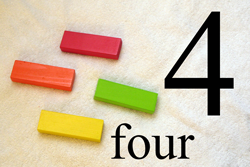
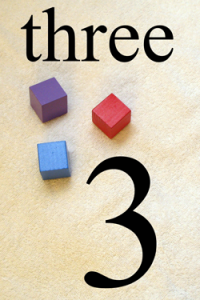
Images are accompanied by the written numeral as well as the number spoken aloud. The images would be printed on cards, done via video or “live” with 3D objects.
I’m still working on the numbers 5-10 and up, but for the numbers 1-4, the following 8 styles of image sets would be done twice. Once using the same objects for each image set, and once using different objects for each image set.
Organized in a row vertically.
Organized in a row horizontally.
Organized in a row diagonally.
Organized in a row other way diagonally.
Organized in a regular shape (triangle, square).
Organized in a differently oriented regular shape.
Organized in an irregular shape.
Organized in a different irregular shape. (There will be more of these for 4 than 3, etc.)
The objects could be blocks, cars, little dolls, just about anything. I created the set below from blocks I found left in Daughter’s block set.
Each zip file contains a few .jpg files with 4″ x 6″ pictures. You can print them at home or ship them to Walmart, Target, CVS, etc. for printing. I left off the MathFour.com logo so the kiddos wouldn’t get distracted. Please share them along with links back here.
I had this grand idea when we got married and were hoping for kids – I would teach our children to count starting at 0.
When Daughter was 15 months old, I decided we should start teaching to count with negatives.
But I was wrong on both.
And so is everyone else.
Why do we teach toddlers to count?
We practice counting 1-10 with our kids. We know (somehow) that before they’re official school age, they should know how to count to 10. And how proud we are as parents if they can count to 20!
But these are just words.
I can teach Daughter to memorize the Fibonacci sequence, but she’d no more know what that means than what counting to 10 means.
In fact, I know this first hand because I used to count to 10 in Spanish. And I’d leave out ocho everytime!
I saw a guy made fun of in Germany because he told a waitress he had fünf people in his party and held up four fingers. (She did it behind his back to another waitress – she wasn’t so rude to say it to his face. (Thank goodness; I would’ve had to go Texan on her.))
We teach toddlers to count for the same reason that we teach them to say please, thank you, yes ma’am and no ma’am – because someday they’ll understand what it means. And in the meantime they can establish good habits.
So where do they start understanding?
Regardless if we teach a toddler to start counting with -5, 0 or 1, they start with 2.
-5 to a toddler makes no sense. Teaching -5 to a toddler can only be dreamed up by a math teacher with no kids (i.e. me three years ago).
0 is useless. Why would you even mention that you have zero? Maybe saying that there are zero cookies after she ate them all might work. But generally zero things can’t be seen and by the time you’re down to 0 cookies, there’s probably a meltdown in the works. And we all know there’s no learning during a meltdown.
1 is just as useless. Why count things that are only one? They started with one mom, one dad, one dog, one couch, one bed, one bear,… Almost everything in their world is a single. The number “one” is just as useless to them as the words “the” or “a.”
But 2 is interesting!
Daughter was so amazed at the discovery that she had two SnackTraps. Not just the ordinary situation of a bowl of snacks but “TWO BOWLS!”
As soon as multiple copies of things are in her world, she takes note. If you’re an identical twin, the first time your child sees you with your twin might be traumatic. My best friend is the daughter of a twin and she tells horrors stories of this discovery.
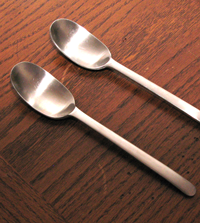
This is an extreme, but consider all the pairs of things that kids can notice – two shoes (vs. only one that you can find when you’re freaking out and you’re late), two forks (when you’re begging for yours back from her because you’ve not eaten since breakfast), two cars (when you need to get in one and she insists on going in the other).
And, toddlers really don’t start counting at 2. They don’t start their mathematical careers with counting at all! They start by recognizing multiples. And 2 is the first and fastest multiple.
So what can you do?
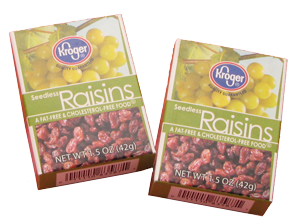
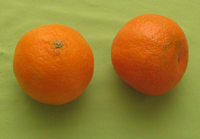
Keep teaching your kids to count – they still need this skill, just like they need to memorize math facts. But also teach them to subitize (recognize amounts without counting them out). Hold up two of the same items and exclaim “TWO ORANGES!” Then go to another two items and exclaim, “TWO RAISINS!” Stick with one number at a time.
Daughter is on “two,” so we’ll stick with that for a few months. We’ve got plenty of time.